
Ciro Csa Canadian Investment Dealers
CIRO (IIROC) IDPC Rule 4400 Free Credit Cash Caps: 8x/12x RAC Regulatory Filings
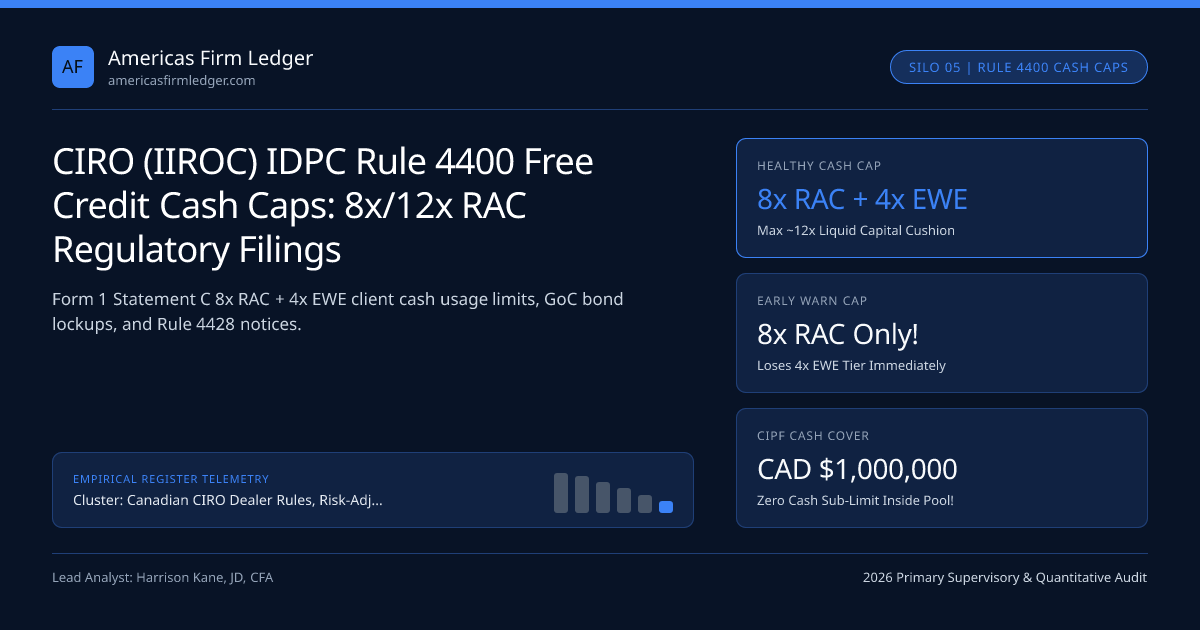
Unlike U.S. SEC Rule 15c3-3 Exhibit A weekly reserve locks, Canadian broker-dealers under CIRO (formerly IIROC) IDPC Rule 4400 may use uninvested client free credit cash in business operations ONLY up to 8x Risk-Adjusted Capital plus 4x Early Warning Excess in Form 1 regulatory filings.
Here is one of the most fascinating structural contrasts in all of North American brokerage law: in the United States, SEC Rule 15c3-3 forbids a broker-dealer from using net customer free credit cash to fund proprietary operations—locking excess credits inside a Special Reserve Bank Account. In Canada, CIRO IDPC Rule 4400 (Sections 4420–4433: Protection of Client Free Credit Balances) permits a carrying investment dealer to use client uninvested Free Credit Cash in its ordinary brokerage business—but strictly caps that usage as a mathematical multiple of the dealer's own Risk-Adjusted Capital (RAC) and Early Warning Excess (EWE)! Any dollar of client cash above that cap must be segregated in cash or Government of Canada securities at an Acceptable Institution!
See how Rule 4400 pairs with CIPF's uncapped CAD $1,000,000 cash coverage in our Canadian CIRO Dealer Rules & CIPF Filing Guide inside the Canadian CIRO & CSA Topic Hub.
How the 8x RAC + 4x Early Warning Excess Tiered Cap Works (Form 1 Statement C)#
Under IDPC Rule 4422 and Form 1 Statement C, CIRO ties a carrying dealer's right to utilize client free credit balances directly to its net liquid equity buffer:
- Healthy Dealer Outside Early Warning (8x RAC + 4x EWE, Maximum Effective ~12x): When a dealer is not in Early Warning, its Allowable Free Credit Usage equals 8 times Risk-Adjusted Capital (RAC) plus 4 times Early Warning Excess (EWE)! Because EWE equals RAC minus the Early Warning Reserve, a well-capitalized dealer with minimal reserve drain can deploy up to roughly 12x its liquid capital in client free credits (primarily to fund client margin debit loans), while every single dollar of client free credits exceeding 8x RAC + 4x EWE must be segregated!
- Dealer Inside Rule 4100 Early Warning (Capped at 8x RAC — Loses 4x EWE Tier!): The instant a dealer trips IDPC Rule 4100 Early Warning, its second-tier 4x EWE allowance evaporates to CAD $0, slashing allowable free-credit usage down to 8x RAC (or tighter supervisory freezes under Level 2) and forcing an immediate cash transfer into segregated client trust/bond accounts!
Comparing Client Cash Protection: Canadian Rule 4400 vs. U.S. SEC 15c3-3 vs. UK FCA CASS 7#
Global treasury officers comparing cash sweep and uninvested cash safety across Toronto (CIRO), New York (SEC), and London must evaluate both segregation rules and statutory cash insurance caps:
| Cash Protection Feature | Canada (CIRO Rule 4400 + CIPF) | United States (SEC 15c3-3 + SIPC) | Canadian EMD / PM (CSA NI 31-103) |
|---|---|---|---|
| Operational Cash Usage? | Permitted Up to 8x RAC + 4x EWE | Permitted Only Against Client Margin Debits | 0% — EMDs/PMs Prohibited From Holding! |
| Excess Cash Segregation | Segregated Trust Cash or GoC Bonds | Special Reserve Bank Account (Cash/USTs) | Must Stay at Independent Qualified Custodian |
| Computation Frequency | At Least Weekly (Plus Monthly Form 1) | Weekly (Switching to Daily >= $500M 2026!) | Daily Custodial Trust Separation |
| Insolvency Cash Cap! | Full CAD $1,000,000 Per CIPF Pool! | USD $250,000 Cash Sub-Limit (Inside $500k) | $0 CIPF Unless Held at CIRO Custodian! |
| Mandatory Statement Legend | Yes — Rule 4428 Payable-on-Demand Notice | Rule 15c3-2 Free Credit Notice | Quarterly Custodian Statement Direct to Client |
Worked Calculation: Auditing Form 1 Statement C Free Credit Segregation#
Suppose a fast-growing Canadian online discount brokerage holds CAD $22,000,000 in Form 1 Risk-Adjusted Capital and CAD $16,500,000 in Early Warning Excess after subtracting a CAD $5,500,000 Early Warning Reserve. Because high interest rates attracted retail cash balances, retail clients hold CAD $310,000,000 in uninvested Free Credit Cash across cash and TFSA/RRSP accounts:
- Tier 1 Capacity: 8 x Risk-Adjusted Capital (8 x CAD $22,000,000) = CAD $176,000,000
- Tier 2 Capacity: 4 x Early Warning Excess (4 x CAD $16,500,000) = CAD $66,000,000
- ------------------------------------------------------------------------------------------
- Maximum Allowable Free Credit Cash Usable in Business = CAD $242,000,000
- Total Actual Client Free Credit Cash Held = CAD $310,000,000
- Less: Maximum Allowable Operational Usage = (CAD $242,000,000)
- ===========================================================================================
- Minimum Required Free Credit Cash Segregation (Must Lock Up Immediately!) = CAD $68,000,000
Free Credit Segregation Spike Under Early Warning Stress#
Look what happens next if a trading loss trims EWE to zero and pushes the brokerage into Level 1 Early Warning with RAC at CAD $18,000,000: Tier 2 (4x EWE) drops to CAD $0, Tier 1 (8x $18M) shrinks to CAD $144,000,000, and required client cash segregation leaps from CAD $68,000,000 to CAD $166,000,000 overnight—requiring the treasurer to lock up an extra CAD $98,000,000 in segregated trust deposits or Government of Canada Treasury bills!
The Mandatory Rule 4428 Client Account Statement Legend#
Flip to the fine print on any monthly statement from a Canadian investment dealer and you will spot the exact disclosure mandated by IDPC Rule 4428: every dealer that uses client free credits within its 8x RAC + 4x EWE cap must print a clear statement informing the client that uninvested free credit funds are not segregated from general firm funds, may be used in the conduct of the dealer's business, and are payable on demand! Why don't Canadian savers panic over that sentence? Because unlike U.S. SIPC's $250,000 cash ceiling, CIPF insures 100% of uninvested brokerage cash up to the full CAD $1,000,000 limit per general and separate registered pool!
Frequently asked questions
Why does my Canadian brokerage statement say my cash "is not segregated and may be used in the conduct of the dealers business"?
Do not be alarmed—that exact wording is legally required across Canada by CIRO IDPC Rule 4428! It reflects that Canadian carrying dealers may use client cash up to 8x RAC + 4x EWE (primarily to fund margin loans), while CIPF still insures your uninvested cash up to the full CAD $1,000,000 pool limit!
What assets can a CIRO dealer hold to satisfy its excess Free Credit Cash segregation obligation?
Under IDPC Rule 4424–4426, required free credit segregation must be held either as cash in designated trust/segregated accounts at an Acceptable Institution (such as a Canadian Schedule I/II bank) or invested in segregated Government of Canada bonds/Treasury bills valued net of Series 5000 margin!
How often must a Canadian carrying dealer calculate its Free Credit Cash segregation requirement?
IDPC Rule 4425 mandates calculating free credit segregation at least weekly (and monthly on Form 1 Statement C), with any shortfall cured promptly within prescribed business-day windows—or else deducted dollar-for-dollar from Risk-Adjusted Capital!
Can an Exempt Market Dealer (EMD) like Atlas One use client free credit cash under Rule 4400?
Never! Rule 4400 applies solely to CIRO Investment Dealers backed by Form 1 RAC and CIPF. Under CSA National Instrument 31-103 Section 14.5.2, EMDs are strictly prohibited from holding client cash or securities in operational custody!
Publication record
- Published
- November 13, 2026
- Updated
- November 14, 2026
- Author
- Harrison Kane, JD, CFA
- Review
- Review not recorded
- Automated fact check
- Passed in the stored pipeline record
- Source URLs
- 3 recorded
AI assistance recorded: anthropic/claude-opus-4.6. This field does not establish human review or source verification.
Academic & Institutional Attribution
Cite This Research & Embed Live Data Card
Standard academic & institutional research paper citation format.
Harrison Kane, JD, CFA. (2026, November 14). CIRO (IIROC) IDPC Rule 4400 Free Credit Cash Caps: 8x/12x RAC Regulatory Filings. Americas Firm Ledger. https://americasfirmledger.com/filings/ciro-idpc-rule-4400-free-credit-cash-usage-rac-cushion-capsRegulatory Directory Cross-Reference
Referenced Institutions & Regulatory Registries
Top Regulated Institutions in This Coverage Slice
Related Ciro Csa Canadian Investment Dealers & Institutional Briefings
Explore Ciro Csa Canadian Investment Dealers Hub (20) →Ciro Csa Canadian Investment Dealers
Canadian CIRO (IIROC) Dealer Rules, Form 1 RAC & CIPF Regulatory Filings GuideCiro Csa Canadian Investment Dealers
CIPF CAD $1M Coverage Rules: CIRO General vs. Separate Registered FilingsCiro Csa Canadian Investment Dealers
CIPF vs. CDIC CAD $100k Deposit Insurance: Chartered Bank GIC & Cash ETF FilingsCiro Csa Canadian Investment Dealers
CSA National Instrument 31-103 Categories: CIRO Dealer & Asset Manager FilingsCiro Csa Canadian Investment Dealers
CSA NRD Filings: Form 33-109F4, MI 11-102 Passport & CIRO Broker-Dealer RegistryCiro Csa Canadian Investment Dealers
CSA Client Focused Reforms (CFR): CIRO Know-Your-Product & Conflict FilingsCiro Csa Canadian Investment Dealers
CRM2 & 2026 CRM3 Total Cost Reporting: CIRO & CSA Fee Regulatory FilingsCiro Csa Canadian Investment Dealers
CIRO (IIROC) OTC Derivatives, CFD & Retail Forex Margin Regulatory FilingsRegulatory Compliance
SEC Enforcement Penalties Fall to 18-Year Low - WSJRegulatory Compliance
US SEC enforcement activity plunges two years into Trump administration - ReutersMarket Insights
CoreWeave's Funding Challenges Are 'Manageable:' Bank of America Sees the Stock More Than Doubling From Here - BenzingaMarket Insights
Nasdaq futures rise over 500 points: 5 things to know before Wall Street opens - Invezz
Americas Firm Ledger Data, Benchmarks & Contributor Records
CC BY 4.0 Open Data
Open Institutional Datasets (CSV / JSON) →
Download desk-compiled quantitative series & schemas.
2026 Reference Matrix
2026 Institutional Benchmarks & Thresholds →
Statutory capital, clearing, margin & rate conventions.
Editorial Records
Authors & Review Records →
View named contributors where those records are available.
Complete Index
Master Research & Dossier Archive →
Browse all published briefings by topic pillar & date.