
Finra Brokercheck Form Bd Crs Filings
SEC Regulation Best Interest (Reg BI) Rule 15l-1: Care, RCAP Alternatives & Conflict Mitigation
SEC Regulation Best Interest (Rule 15l-1) replaced legacy FINRA "suitability" for retail investors with an overarching Best Interest standard—enforced through four mandatory obligations covering written cost/conflict disclosures, Reasonably Available Alternatives (RCAP), sales-contest bans.
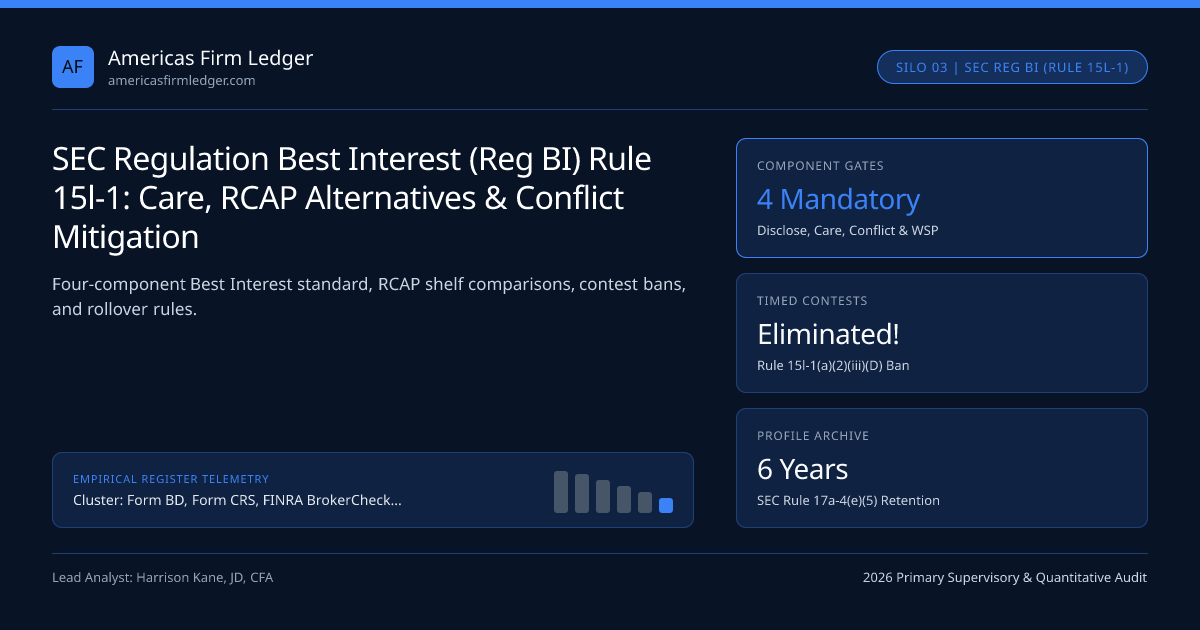
Since June 30, 2020, recommending a high-commission non-traded REIT, leveraged inverse ETF, or high-expense mutual fund share class to a retail household merely because it was "generally suitable" has been unlawful in the United States! Under SEC Regulation Best Interest (Exchange Act Rule 15l-1, 17 CFR 240.15l-1), a broker-dealer and its associated persons may never place the financial or other interest of the broker-dealer or rep ahead of the interest of the retail customer when recommending any securities transaction or investment strategy involving securities (explicitly including account-type elections and 401(k) rollovers!).
This conduct-supervision manual extends SEC Form CRS relationship summary disclosures inside our Form BD, Form CRS & BrokerCheck institutional guide, contrasting Reg BI transactional duties with ongoing Advisers Act fiduciary duties for dual-registrants.
The Four Mandatory Component Obligations of Rule 15l-1(a)(2)#
Unlike common-law principles, Reg BI is satisfied exclusively by complying with all four interlocking component obligations audited jointly by the SEC and FINRA:
- Disclosure Obligation (a)(2)(i): Prior to or at the time of the recommendation, provide full and fair written disclosure of all material facts relating to the scope and terms of the relationship (capacity as a broker-dealer, material fees and costs, type/scope of services, limitations on product shelves) AND all material facts relating to conflicts of interest associated with the recommendation! (Crucial note: Form CRS alone almost never satisfies the transaction-level Reg BI Disclosure Obligation—firms supplement Form CRS with a Reg BI Regulation Disclosure Brochure + product point-of-sale supplements!)
- Care Obligation (a)(2)(ii) — The RCAP Standard: Exercise reasonable diligence, care, and skill to:
- Understand potential risks, rewards, and costs of the product;
- Have a reasonable basis that the recommendation is in the particular retail customer's best interest—explicitly evaluating Reasonably Available Alternatives ("RCAP") on the firm's product shelf!; and
- Ensure a series of recommended transactions is not excessive (eliminating the scienter/control loophole of old churning law!).
- Conflict of Interest Obligation (a)(2)(iii) — Disclose vs Mitigate vs ELIMINATE!: Establish, maintain, and enforce written policies designed to:
- Mitigate rep-level incentives (differential payout grids, production bonuses) that encourage placing rep compensation ahead of the client;
- Prevent proprietary-shelf limitations from causing off-interest recommendations; AND
- Completely ELIMINATE all sales contests, sales quotas, bonuses, and non-cash compensation (trips, prizes) based on the sales of specific securities or specific types of securities within a limited period of time!
- Compliance Obligation (a)(2)(iv): Written Supervisory Procedures (WSPs) specifically tailored to Reg BI (merely search-and-replacing the word "Suitability" with "Best Interest" in FINRA Rule 2111 WSPs triggers automatic FINRA AWCs!).
Comparing Reg BI (Broker-Dealer) vs Advisers Act Fiduciary Duty (RIA) vs Legacy FINRA 2111#
Note that FINRA formally amended FINRA Rule 2111 so that recommendations to retail customers are governed strictly by Reg BI, leaving Rule 2111 strictly for institutional/corporate accounts:
| Conduct Dimension | Legacy FINRA Rule 2111 (Now Institutional Only) | SEC Regulation Best Interest (Retail BD) | Advisers Act Section 206 Fiduciary (RIA) |
|---|---|---|---|
| When Duty Attaches | At Time of Recommendation | At Time of Recommendation (Incl. Hold/Rollover) | Continuous / Ongoing Across Relationship |
| Explicit Cost & RCAP Comparison? | Cost Not Determinative Alone | Yes — Mandatory Cost & RCAP Shelf Review! | Yes — Share-Class & Fee Best Execution |
| Cure Conflicts Purely by Disclosure? | Broadly Permitted | No! Rep Incentives Must Be Mitigated; Timed Contests Eliminated! | Full & Fair Disclosure + Informed Consent |
| Excessive Trading ("Quantitative") | Required Broker "Control" of Account | Control Eliminated! Applies to Non-Discretionary Series! | Ongoing Fee-vs-Activity ("Reverse Churning") |
| Account-Type & 401(k) Rollovers | Guidance Only (RN 13-45) | Codified Inside Rule Text! | Codified Fiduciary Rollover Analysis |
Quantitative RCAP & Quantitative Turnover / Cost-to-Equity Ratios#
Two quantitative formulas drive automated FINRA and SEC Reg BI enforcement cases (including the landmark first federal SEC Reg BI litigation and multi-million-dollar FINRA restitution orders over excessive trading and illiquid L-share / non-traded REIT commissions):
- AnnualizedTurnoverRate = TotalAnnualAggregatePurchases / AverageMonthlyCustomerNet_Equity
- RolloverFeeDelta10Yr = PresentValue(IRAAdvisoryPlusFundFees10Yr) - PresentValue(Employer401kInstitutionalFees10Yr)
- Worked Reg BI Quantitative Care & Rollover Violations:
- 1. Series Care Breach (Active Trading in Non-Discretionary Retail Account, $150,000 Avg Equity):
- Rep recommends 48 in-and-out trades totaling $1,350,000 purchases; total commissions + margin interest = $34,500!
- Turnover Rate = $1,350,000 / $150,000 = 9.0x (> 6.0x Classic Presumption!)
- Cost-to-Equity Break-Even Hurdle = ($34,500 / $150,000) * 100 = 23.0% annual return required JUST TO BREAK EVEN!
- Reg BI Result: Violates Care Obligation EVEN THOUGH customer approved every trade verbally!
- 2. RCAP Alternative Failure:
- Rep recommends Mutual Fund Class A (5.75% front load + 0.85% ER) when identical-strategy ETF (0.09% ER, $0 commission) sits on the same firm's approved shelf with zero documented liquidity/tax justification!
Reg BI Surveillance Thresholds & Top Enforcement Areas#
The 401(k) Rollover Trap & Digital Engagement ("Gamification") Nudges#
Two modern operational fronts demand strict WSP guardrails:
- Actual Plan Data vs National Averages on 401(k) Rollovers: SEC Staff Bulletins warn that relying solely on generic industry 401(k) fee averages without attempting to review the customer's actual ERISA Rule 404a-5 participant fee disclosure (and documenting loss of ERISA creditor protection, Rule of 55 penalty-free withdrawals, or net unrealized appreciation on company stock) fails the Reg BI Care Obligation!
- Self-Directed App Push Notifications: Even "self-directed" brokerages lose their Reg BI exemption if personalized push notifications, confetti nudges, or curated "Buy Now" lists cross the line into an individually tailored call to action ("recommendation")! Next, track what happens when a Reg BI dispute turns into a formal customer complaint on FINRA Form U4 Item 14 ($15,000 settlement rules & 30-day clocks) inside the Form BD, BrokerCheck & CAT Topic Hub.
Frequently asked questions
Does Reg BI require a broker-dealer to always recommend the single cheapest ETF or mutual fund on the market?
No. Cost is a mandatory factor that can never be ignored, nor does a broker have to search outside its own firm's product shelf—however, when recommending a higher-cost security over a reasonably available lower-cost alternative on the firm's shelf, the rep must have a reasonable, documented justification (such as tax advantages, liquidity, or strategy features) why it serves the client's best interest.
Can a broker-dealer run a Q4 recognition club trip to Hawaii for top sellers of its proprietary structured notes?
Absolutely not! Rule 15l-1(a)(2)(iii)(D) requires broker-dealers to completely ELIMINATE sales contests, sales quotas, bonuses, and non-cash compensation (including trips) tied to sales of specific securities or specific types of securities within a limited period of time.
Does Reg BI apply if a wealthy individual has $75 million in net worth—exceeding FINRA's $50 million institutional threshold?
Yes! Reg BI contains NO net-worth carve-out for natural persons. Even if an individual qualifies as an "institutional account" under FINRA Rule 4512(c) ($50M+ assets), if they use the account for personal, family, or household purposes, Reg BI applies in full!
How long must a broker-dealer preserve Reg BI customer investment profiles and recommendation records?
Under SEC Rule 17a-3(a)(35) and Rule 17a-4(e)(5), every record of information collected from and provided to a retail customer pursuant to Reg BI must be preserved for at least 6 years after the earlier of the date the account was closed or the information was replaced.
Publication record
- Published
- November 13, 2026
- Updated
- November 14, 2026
- Author
- Harrison Kane, JD, CFA
- Review
- Review not recorded
- Automated fact check
- Passed in the stored pipeline record
- Source URLs
- 4 recorded
AI assistance recorded: anthropic/claude-opus-4.6. This field does not establish human review or source verification.
Academic & Institutional Attribution
Cite This Research & Embed Live Data Card
Standard academic & institutional research paper citation format.
Harrison Kane, JD, CFA. (2026, November 14). SEC Regulation Best Interest (Reg BI) Rule 15l-1: Care, RCAP Alternatives & Conflict Mitigation. Americas Firm Ledger. https://americasfirmledger.com/filings/sec-regulation-best-interest-reg-bi-care-conflict-mitigationRegulatory Directory Cross-Reference
Referenced Institutions & Regulatory Registries
Mentioned Regulated Institutions
Related Finra Brokercheck Form Bd Crs Filings & Institutional Briefings
Explore Finra Brokercheck Form Bd Crs Filings Hub (20) →Finra Brokercheck Form Bd Crs Filings
Form BD, Form CRS, FINRA BrokerCheck & CAT Supervision: Institutional Filing GuideFinra Brokercheck Form Bd Crs Filings
FINRA Form U4 Item 14 Disclosures: $5k Written Complaints, $15k Settlements & 30-Day LiensFinra Brokercheck Form Bd Crs Filings
FINRA Form U5 Termination Disclosures: 30-Day Clocks, Section 7 Reviews & Defamation ClaimsFinra Brokercheck Form Bd Crs Filings
FINRA BrokerCheck Customer Dispute Expungement: Rule 2080, Rule 12805 & Unanimous PanelsFinra Brokercheck Form Bd Crs Filings
FINRA Rule 4530 Self-Reporting Guide: 30-Day Internal Conclusions & Quarterly Complaint CodesFinra Brokercheck Form Bd Crs Filings
FINRA Letters of Acceptance, Waiver, and Consent (AWCs): Sanction Guidelines & Collateral BarsFinra Brokercheck Form Bd Crs Filings
FINRA Rule 4111 Restricted Firm Obligations: Numeric Thresholds, Escrow Cash & BrokerCheck FlagsFinra Brokercheck Form Bd Crs Filings
Consolidated Audit Trail (CAT) Compliance: 50ms/100us Clock Sync, T+1 8:00 AM & Error FinesCFTC Nfa Fcm Segregated Residual Interest
CFTC Rule 1.17 FCM Adjusted Net Capital: $1M Floor vs 8% Customer & Non-Customer Risk MarginCFTC Nfa Fcm Segregated Residual Interest
CFTC Form 1-FR-FCM & Joint FOCUS Filings: Daily Noon Segregation & 17-Day WinJammer RulesCFTC Nfa Fcm Segregated Residual Interest
CFTC Rule 1.12 Early Warning Notices: 110% Net Capital, Segregation Shortfalls & 25% DropsCFTC Nfa Fcm Segregated Residual Interest
Retail Foreign Exchange Dealers (RFEDs) Under CFTC Rule 5.7: $20M Capital, 5% Add-On & No Seg!
Americas Firm Ledger Data, Benchmarks & Contributor Records
CC BY 4.0 Open Data
Open Institutional Datasets (CSV / JSON) →
Download desk-compiled quantitative series & schemas.
2026 Reference Matrix
2026 Institutional Benchmarks & Thresholds →
Statutory capital, clearing, margin & rate conventions.
Editorial Records
Authors & Review Records →
View named contributors where those records are available.
Complete Index
Master Research & Dossier Archive →
Browse all published briefings by topic pillar & date.