
Ciro Csa Canadian Investment Dealers
CSA Client Focused Reforms (CFR): CIRO Know-Your-Product & Conflict Filings
Under CSA National Instrument 31-103 Client Focused Reforms (CFR) and harmonized CIRO (formerly IIROC) conduct rules, every Canadian broker-dealer and asset manager must resolve material conflicts in the clients best interest, document KYP alternatives.
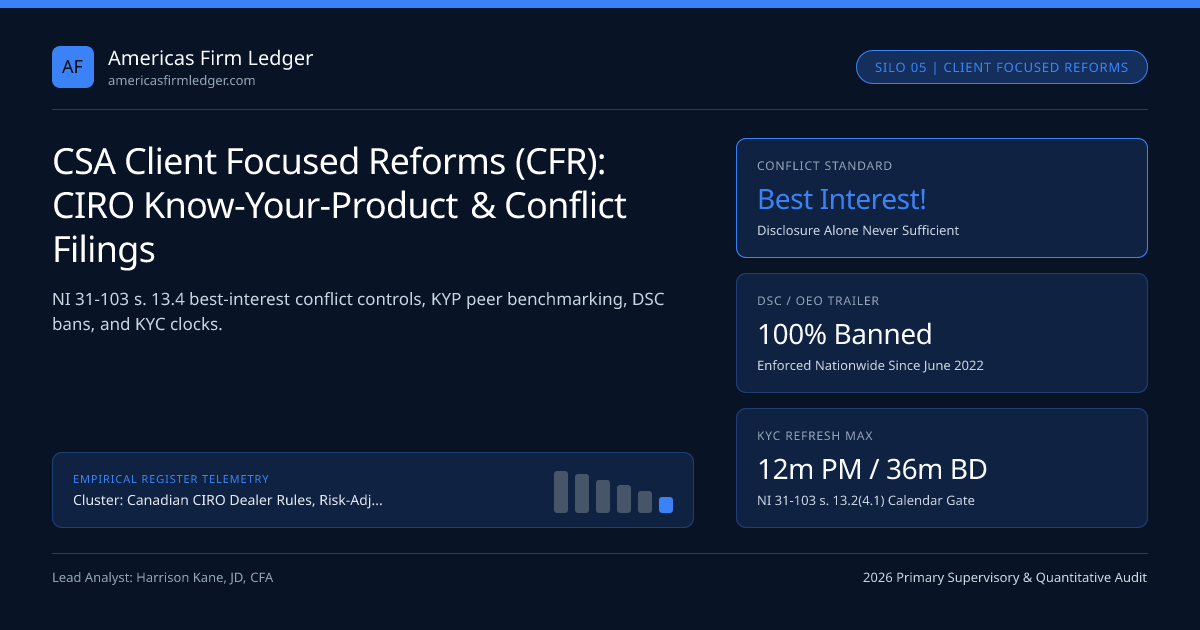
When the United States adopted SEC Regulation Best Interest (Reg BI) in June 2020, Canada's Canadian Securities Administrators and CIRO went a decisive step further: across 2021, Canada implemented the Client Focused Reforms (CFRs) across NI 31-103 Part 13 and harmonized CIRO IDPC/MFD rules—coupled with a nationwide June 1, 2022 outright ban on Mutual Fund Deferred Sales Charges (DSCs) and a ban on Order-Execution-Only (OEO / discount broker) trailing commissions!
See how CFR conduct standards fit within the complete supervisory pyramid in our Canadian CIRO Dealer Rules & CIPF Filing Guide inside the Canadian CIRO & CSA Topic Hub.
Why Disclosure Alone NO LONGER Cures a Material Conflict in Canada (s. 13.4)#
Before June 30, 2021, Canadian broker-dealers routinely neutralized proprietary-shelf conflicts, third-party referral payments, and internal sales contests simply by burying three sentences of boilerplate disclosure in a 40-page Relationship Disclosure Information (RDI) booklet. NI 31-103 Section 13.4(2) & (3) outlawed disclosure-only conflict curing! Today, every Canadian dealer and adviser must:
- Identify all material conflicts of interest (firm-vs-client and individual-rep-vs-client);
- Address every material conflict in the BEST INTEREST of the client—either through hard structural controls (leveling advisor grid compensation between proprietary bank funds and third-party ETFs, banning sales quotas) or outright avoidance if controls cannot resolve the conflict in the client's best interest; and
- Deliver plain-language conflict disclosures BEFORE or AT account opening, explicitly acknowledging that disclosure alone never satisfies the firm's best-interest duty!
Comparing CSA Client Focused Reforms vs. U.S. SEC Reg BI vs. UK FCA Consumer Duty#
Cross-border wealth compliance officers managing Canadian CIRO/PM desks alongside U.S. SEC / FINRA broker-dealers or OSC Exempt Market Dealers such as Atlas One must distinguish three sharp doctrinal differences:
| Conduct Standard Element | Canada CSA / CIRO CFR (NI 31-103) | U.S. SEC Regulation Best Interest (Reg BI) | Canadian OEO Discount Broker |
|---|---|---|---|
| Applies to Ongoing Account Monitoring? | Yes — Triggered on Periodic KYC Refresh & Material Events! | No Mandatory Ongoing Duty (Point-of-Rec Only unless agreed) | Exempt From Suitability (NI 31-103 s. 13.3) |
| Know Your Product (s. 13.2.1) | Explicit Statutory KYP Rule (Firm Shelf + Rep Mastery!) | Care Obligation Component | Shelf Approval + Zero Advice Rule! |
| Deferred Sales Charges (Back-End Loads) | 100% Banned Nationwide (Effective June 1, 2022) | Permitted (FINRA Time-Horizon Scrutiny) | Trailing Commissions 100% Banned! |
| Risk Profile Formula | Lower of Risk Willingness vs. Financial Risk Capacity! | Holistic Investor Profile | Self-Directed Investor Attestation |
| Proprietary-Only Product Shelf | Allowed ONLY With Peer Benchmarking & Client Disclosure | Permitted With Reg BI Conflict Mitigation & CRS Notice | Open Shelf Standard |
Worked Calculation: Enhanced KYC Risk-Profile Cap & KYP Cost-Alternative Audit#
Joint CSA-CIRO CFR sweep reports repeatedly flag two quantitative failures: (a) averaging a client's subjective "Risk Willingness" with objective "Risk Capacity" instead of taking the LOWER constraint, and (b) recommending a 2.15% MER proprietary mutual fund when an identical 0.20% ETF or 0.95% F-Series peer sits on the exact same firm's KYP shelf without documented justification! Let's quantify both over a 10-year horizon on a CAD $400,000 RRSP:
- 1. Enhanced KYC Risk Profile Rule (Retiree Age 69, Needs CAD $28,000/yr RRIF Draw):
- Subjective Risk Willingness Questionnaire Score = 82 / 100 ("High Growth")
- Objective Financial Risk Capacity Score = 35 / 100 ("Low-Medium Preservation")
- CFR Mandatory Profile = MIN(Willingness 82, Capacity 35) = 35 ("Low-Medium"!)
- > Averaging ((82+35)/2 = 58.5 "Medium-High") Is an Automatic CFR Audit Violation!
- 2. KYP & Suitability Reasonable-Alternative Comparison (CAD $400,000 Balanced Allocation,
- 6.5% Gross Pre-Fee Return Over 10 Years):
- Shelf Option A (0.85% Total Fee F-Class ETF Wrap): $400k x (1.0565)^10 = CAD $693,068
- Shelf Option B (2.15% Proprietary Fund, Zero Added Feature): (1.0435)^10 = CAD $612,356
- ============================================================================================
- 10-Year Compounding Wealth Erosion From Unjustified Higher-Cost Shelf Pick = CAD $80,712!
Top Joint CSA-CIRO Sweep Findings on CFR Compliance#
Under NI 31-103 Section 13.3(1)(b) ("Put the Client's Interest First"), if Option A and Option B sit on the same dealer shelf with comparable risk/strategy, the advisor CANNOT pick Option B simply because Option B pays a higher internal grid credit or counts toward a bank branch scorecard—and must document why any higher-cost selection genuinely benefits the client!
Mandatory Periodic KYC Refresh Clocks (12 Months vs 36 Months)#
Unlike U.S. Reg BI, NI 31-103 Section 13.2(4.1) locks in hard calendar clocks for keeping Know-Your-Client files current—even if no trade occurs:
- Every 12 Months for discretionary Portfolio Managers and Exempt Market Dealers transacting with clients; and
- At least every 36 Months for all other CIRO Investment Dealers and Mutual Fund Dealers (or immediately upon learning of a material change in marriage, retirement, job loss, or health)! Pair CFR compliance directly with CRM2 & 2026 CRM3 Total Cost Reporting and OBSI CAD $350,000 investor dispute redress.
Frequently asked questions
Can Canadian bank-owned brokerages still sell only proprietary in-house mutual funds under Client Focused Reforms?
Yes—proprietary-only shelves are still permitted in Canada, PROVIDED the firm conducts and documents periodic KYP benchmarking comparing its proprietary funds against external market peers on cost, risk, and performance, eliminates conflicted sales quotas, and clearly discloses the proprietary-only limitation upfront!
Why did my Canadian discount brokerage (like TD Direct, RBC Direct, or Questrade) auto-convert my Series A mutual funds into Series F or Series D?
Because effective June 1, 2022, the CSA and CIRO banned Order-Execution-Only (OEO) discount brokers from collecting embedded "trailing commissions" paid for ongoing financial advice that discount brokers are legally prohibited from providing!
What happens if a client insists on buying an aggressive crypto or micro-cap stock that violates their Low-Risk KYC profile?
At an advisory CIRO dealer under s. 13.3(2.1) client-directed trade rules, the advisor cannot simply rubber-stamp the order: they must explain why the trade does NOT put the clients interest first, recommend suitable alternatives, and capture documented informed client instruction!
How often must my advisor legally contact me to update my KYC profile in Canada?
Under NI 31-103 Section 13.2(4.1), discretionary Portfolio Managers must review and update KYC information at least every 12 months, while non-discretionary CIRO investment and mutual fund dealers must refresh KYC at least every 36 months (or sooner upon any material life change).
Publication record
- Published
- November 13, 2026
- Updated
- November 15, 2026
- Author
- Harrison Kane, JD, CFA
- Review
- Review not recorded
- Automated fact check
- Passed in the stored pipeline record
- Source URLs
- 3 recorded
AI assistance recorded: anthropic/claude-opus-4.6. This field does not establish human review or source verification.
Academic & Institutional Attribution
Cite This Research & Embed Live Data Card
Standard academic & institutional research paper citation format.
Harrison Kane, JD, CFA. (2026, November 16). CSA Client Focused Reforms (CFR): CIRO Know-Your-Product & Conflict Filings. Americas Firm Ledger. https://americasfirmledger.com/filings/csa-client-focused-reforms-cfr-know-your-product-conflict-banRelated Ciro Csa Canadian Investment Dealers & Institutional Briefings
Explore Ciro Csa Canadian Investment Dealers Hub (20) →Ciro Csa Canadian Investment Dealers
Canadian CIRO (IIROC) Dealer Rules, Form 1 RAC & CIPF Regulatory Filings GuideCiro Csa Canadian Investment Dealers
CRM2 & 2026 CRM3 Total Cost Reporting: CIRO & CSA Fee Regulatory FilingsCiro Csa Canadian Investment Dealers
CIRO (IIROC) OTC Derivatives, CFD & Retail Forex Margin Regulatory FilingsCiro Csa Canadian Investment Dealers
Quebec AMF Derivatives Act & CSA MI 91-102 Binary Ban: CIRO Regulatory FilingsCiro Csa Canadian Investment Dealers
Canadian Crypto Platforms (CSA SN 21-332): Mandatory CIRO & FINTRAC FilingsCiro Csa Canadian Investment Dealers
CSA Value-Referenced Crypto Assets (VRCA) & CIRO 80% Cold Custody FilingsCiro Csa Canadian Investment Dealers
CIRO (IIROC) UMIR Rules: PFOF Ban, Short-Sale Pre-Borrow & Regulatory FilingsCiro Csa Canadian Investment Dealers
FINTRAC PCMLTFA Rules for CIRO Dealers & MSBs: CAD $10k EFTR & STR FilingsRegulatory Compliance
The SEC Is Pushing for Stock Tokenization. Why Nasdaq Has Concerns About How It’s Being Done. - Barron'sMarket Insights
Lucid misses Wall Street’s earnings expectations, expands loan from Saudi Arabia fundRegulatory Compliance
SEC Enforcement Penalties Fall to 18-Year LowRegulatory Compliance
Kimber Digital Securities gains broker-dealer status for tokenized assets
Americas Firm Ledger Data, Benchmarks & Contributor Records
CC BY 4.0 Open Data
Open Institutional Datasets (CSV / JSON) →
Download desk-compiled quantitative series & schemas.
2026 Reference Matrix
2026 Institutional Benchmarks & Thresholds →
Statutory capital, clearing, margin & rate conventions.
Editorial Records
Authors & Review Records →
View named contributors where those records are available.
Complete Index
Master Research & Dossier Archive →
Browse all published briefings by topic pillar & date.