
Ciro Csa Canadian Investment Dealers
CIRO (IIROC) UMIR Rules: PFOF Ban, Short-Sale Pre-Borrow & Regulatory Filings
Under CIRO (formerly IIROC) Universal Market Integrity Rules (UMIR), Canadian equity marketplaces ban U.S.-style Payment for Order Flow (PFOF), enforce Order Protection (OPR), require encrypted LEI/Client ID markers, and mandate UMIR Rule 10.16 Gatekeeper regulatory filings.
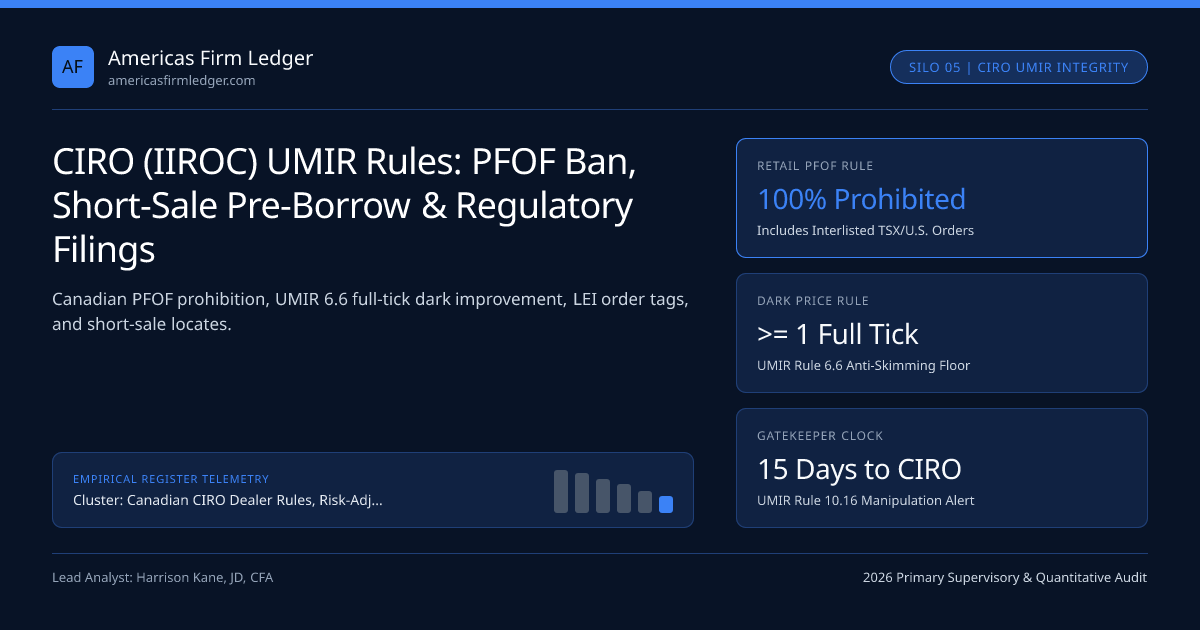
Why do "zero-commission" U.S. retail brokers earn billions routing retail equity orders to off-exchange wholesalers (Citadel Securities, Virtu) for Payment for Order Flow (PFOF), while routing Canadian TSX/TSXV retail equity orders to an off-exchange dark wholesaler for PFOF rebates is ILLEGAL in Canada? The answer lies in the Universal Market Integrity Rules (UMIR)—administered across every Canadian equity marketplace (TSX, TSXV, Cboe Canada/NEO, CSE, Nasdaq CXC, Omega, Lynx) by CIRO!
See how UMIR market surveillance complements prudential solvency rules in our Canadian CIRO Dealer Rules & CIPF Filing Guide inside the Canadian CIRO & CSA Topic Hub.
Why Canada Bans Retail PFOF Internalization: UMIR Rule 6.3 & Dark-Liquidity Price Improvement!#
Three interlocking rules under UMIR and CSA National Instrument 23-101 (Trading Rules) prevent U.S.-style 45% off-exchange retail wholesaler segmentation on Canadian stocks:
- UMIR Rule 6.3 ("Exposure of Client Orders" — <= 50 Standard Trading Units): Unless a client order exceeds 50 Standard Trading Units (typically 5,000 shares for stocks >= $1.00) or exceeds CAD $100,000 in value, a Canadian Participant MUST immediately enter the retail order on a transparent "lit" marketplace unless it executes immediately at a meaningfully better price!
- UMIR Rule 6.6 ("Provision of Price Improvement by a Dark Order" — Full Tick Minimum!): In the U.S., a wholesaler can internalize a retail buy order on a dark desk by offering $0.0001 (one hundredth of a penny!) of sub-penny price improvement. Under UMIR Rule 6.6, dark execution against a small retail order must improve the National Best Bid and Offer (NBBO) by at least ONE FULL TRADING INCREMENT (CAD $0.01 or CAD $0.005—or 50% of a single-tick spread)—destroying the economics of sub-penny PFOF skimming!
- Explicit CIRO Prohibition on PFOF: CIRO Best Execution rules (IDPC Rule 3100) forbid a Canadian dealer from routing Canadian-listed orders—including routing interlisted TSX/NYSE retail orders south to a U.S. wholesaler!—in exchange for third-party PFOF rebates that compromise best execution or bypass Canadian lit price discovery!
Comparing Canadian UMIR vs. U.S. SEC Reg NMS / Reg SHO / CAT#
Institutional DMA (Direct Electronic Access under NI 23-103) traders at firms like Velocity Trade must program FIX order gateways carefully—because order-marking errors on Short Sale versus Short-Marking Exempt (SME) are one of CIRO Market Regulation's #1 enforcement targets:
| Market Microstructure Rule | Canada (CIRO UMIR + CSA NI 23-101) | United States (SEC Reg NMS / Reg SHO / CAT) |
|---|---|---|
| Payment for Order Flow (PFOF) | BANNED (Incl. Interlisted Retail Routing!) | Permitted With SEC Rule 606 Disclosure |
| Dark Pool Retail Price Improvement | 1 Full Tick (or half of a 1-tick spread) | Sub-Penny ($0.0001) Permitted Today |
| Short-Sale Uptick Rule? | Repealed 2012; Reasonable Expectation to Settle + Pre-Borrow Triggers! | Reg SHO Rule 201 (-10% Alternative Uptick) |
| Client Audit-Trail Identifier | Encrypted LEI / Account ID Directly on FIX Order! (UMIR 6.2 / Phase 2021) | Post-Trade Overnight CAT FDID Reporting |
| Suspicious Manipulation Filing | UMIR Rule 10.16 Gatekeeper Report (To CIRO Within 15 Days!) | FINRA / FinCEN SAR-SF (30 Days) |
Worked Calculation: UMIR Rule 6.6 Dark Price Improvement vs. U.S. Sub-Penny Skim#
Suppose the National Best Bid and Offer (NBBO) on a TSX-listed bank stock is CAD $60.00 Bid x CAD $60.04 Ask (CAD $0.04 spread, CAD $0.01 minimum tick increment), and a retail investor submits a marketable buy order for 1,000 shares (10 Standard Trading Units <= 50 STUs, notional CAD $60,040 <= $100k):
- TSX Lit NBBO Quote: Bid = $60.00 | Ask = $60.04 (Spread = $0.04 > 1 Tick of $0.01)
- U.S. Wholesaler Sub-Penny Model ($0.0001 Improvement):
- Executes at $60.0399 -> Retail Saves $0.10 Total on 1,000 Shares!
- Canadian UMIR Rule 6.6 Mandatory Minimum Improvement (1 Full Tick = CAD $0.01):
- Maximum Legal Dark Fill Price = $60.04 - $0.01 = CAD $60.0300!
- Minimum Retail Savings Required to Intercept Lit Order (1,000 x $0.01) = CAD $10.00!
- (Or If Lit Spread Were Tight at 1 Tick [$60.00 x $60.01], Dark Must Fill at Midpoint $60.005 -> $5.00 Saved!)
- ============================================================================================
- Result: Canadian Dark Liquidity Must Deliver 50x-100x Larger Minimum Price Improvement Than U.S. Sub-Penny!
Top CIRO UMIR Surveillance & Enforcement Priorities#
That single piece of market-microstructure math explains why Canadian lit order books retain far healthier displayed depth—and why Canadian brokers charge modest explicit equity commissions (or monetize FX conversion/subscriptions) rather than selling Canadian order flow to wholesalers!
Tightenings in Short-Sale Settlement & UMIR Rule 10.16 Gatekeeper Reports#
Following intense scrutiny from TSXV junior mining and tech issuers over "naked shorting," CIRO and the CSA rolled out strengthened UMIR Rule 3.2 & Guidance on Reasonable Expectation to Settle Short Sales (requiring documented pre-trade positive confirmation of borrow availability before entering short sales, mandatory pre-borrow on designated hard-to-borrow/failed securities, and Extended Failed Trade reporting!). Equally critical, UMIR Rule 10.16 makes every dealer a statutory Gatekeeper: if compliance spots a client engaging in spoofing, layering, high-closing, or insider trading, the firm must file an electronic Gatekeeper Report with CIRO within 15 days (alongside any FINTRAC Suspicious Transaction Report and Series 5000 short-sale margin controls)!
Frequently asked questions
If PFOF is banned in Canada, how do zero-commission Canadian apps make money when I buy a U.S. stock like Apple or Nvidia?
Two ways: (1) many charge a 1.50% currency-conversion spread switching CAD to USD (unless you pay for a monthly USD subscription), and (2) while PFOF is banned on Canadian-listed and interlisted securities, pure U.S.-only non-interlisted orders executed via a U.S. executing broker have faced separate fee/disclosure rules—which CIRO strictly polices under Rule 3100!
What is a "Short-Marking Exempt (SME)" tag under UMIR, and why do prop desks get fined for misusing it?
The SME marker applies ONLY to specific directionally neutral, high-turnover arbitrage, market-making, or ETF-creation accounts that buy and sell the same stock continuously without holding directional net positions; tagging an ordinary directional prop/hedge-fund account as SME triggers six-figure CIRO fines!
Is "naked short selling" (shorting without locating shares to settle on T+1) legal on the TSX or TSX Venture Exchange?
No! Under CIRO UMIR rules and reinforced 2024–2025 Guidance, entering a short sale without a documented, reasonable expectation to settle sufficient securities on T+1 settlement date is an explicit violation—and Extended Failed Trades must be reported directly to CIRO!
Does my institutional hedge fund need a Legal Entity Identifier (LEI) to trade Canadian equities via Direct Electronic Access (DEA)?
Yes! Under CIROs Client Identifier Amendments (UMIR Rule 6.2 / IDPC Rule 3140), every institutional client eligible for a Global Legal Entity Identifier (LEI)—especially DEA and routing arrangements—must provide an active LEI so CIRO wraps encrypted cross-market surveillance across all Canadian venues!
Publication record
- Published
- November 12, 2026
- Updated
- November 15, 2026
- Author
- Harrison Kane, JD, CFA
- Review
- Review not recorded
- Automated fact check
- Passed in the stored pipeline record
- Source URLs
- 3 recorded
AI assistance recorded: anthropic/claude-opus-4.6. This field does not establish human review or source verification.
Academic & Institutional Attribution
Cite This Research & Embed Live Data Card
Standard academic & institutional research paper citation format.
Harrison Kane, JD, CFA. (2026, November 16). CIRO (IIROC) UMIR Rules: PFOF Ban, Short-Sale Pre-Borrow & Regulatory Filings. Americas Firm Ledger. https://americasfirmledger.com/filings/ciro-umir-universal-market-integrity-short-sale-order-markersRegulatory Directory Cross-Reference
Referenced Institutions & Regulatory Registries
Mentioned Regulated Institutions
Referenced Supervisory Authorities
Related Ciro Csa Canadian Investment Dealers & Institutional Briefings
Explore Ciro Csa Canadian Investment Dealers Hub (20) →Ciro Csa Canadian Investment Dealers
Canadian CIRO (IIROC) Dealer Rules, Form 1 RAC & CIPF Regulatory Filings GuideCiro Csa Canadian Investment Dealers
FINTRAC PCMLTFA Rules for CIRO Dealers & MSBs: CAD $10k EFTR & STR FilingsCiro Csa Canadian Investment Dealers
OBSI CAD $350k Investment Ombudsman: CIRO & CSA 90-Day Complaint FilingsCiro Csa Canadian Investment Dealers
U.S. SEC Rule 15a-6 vs. CSA NI 31-103 s. 8.18: Cross-Border CIRO & FINRA FilingsCiro Csa Canadian Investment Dealers
CIRO (IIROC) Form 1 Risk-Adjusted Capital (RAC): CAD $250k Floor & Regulatory FilingsCiro Csa Canadian Investment Dealers
CIRO (IIROC) IDPC Rule 4100 Early Warning System: Level 1 & Level 2 Regulatory FilingsCiro Csa Canadian Investment Dealers
CIRO (IIROC) IDPC Series 5000 Margin Rules: LSERM Equity & Debt Regulatory FilingsCiro Csa Canadian Investment Dealers
CIRO (IIROC) IDPC Rule 4300 Securities Segregation & Custody Regulatory FilingsRegulation and Institutional Markets
Formation Securities plans Solana stock trading venue under SEC exemptionCryptocurrency Markets
Strategy buys 1,036 Bitcoin as BTC holdings climb to 850,364Regulatory Compliance
Staff Statement on Affiliations Between National Securities Exchanges and Broker-DealersRegulatory Compliance
Statement at Open Meeting on Proposals to Expand Responsible Retailization of Private Markets
Americas Firm Ledger Data, Benchmarks & Contributor Records
CC BY 4.0 Open Data
Open Institutional Datasets (CSV / JSON) →
Download desk-compiled quantitative series & schemas.
2026 Reference Matrix
2026 Institutional Benchmarks & Thresholds →
Statutory capital, clearing, margin & rate conventions.
Editorial Records
Authors & Review Records →
View named contributors where those records are available.
Complete Index
Master Research & Dossier Archive →
Browse all published briefings by topic pillar & date.