
Ciro Csa Canadian Investment Dealers
CIRO (IIROC) IDPC Rule 4300 Securities Segregation & Custody Regulatory Filings
Under CIRO (formerly IIROC) IDPC Rule 4300, Canadian broker-dealers must calculate daily segregation requirements for fully paid and excess margin securities, hold assets at approved external locations like CDS or DTC, and report unresolved deficits in regulatory filings.
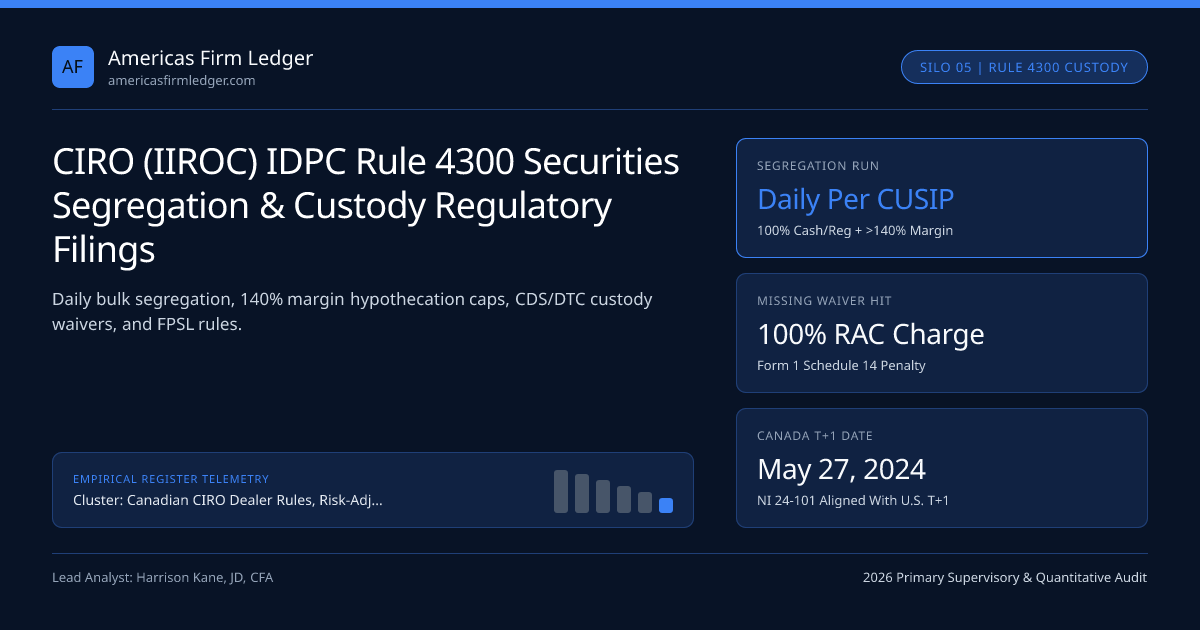
When a Canadian investor holds CAD $2,500,000 of Royal Bank and Shopify shares in a cash account or RRSP—or holds collateral exceeding 140% of their margin debit balance—what stops a carrying broker from pledging those shares for house bank loans or delivering them against proprietary short sales? The statutory firewall is CIRO IDPC Rule 4300 (Protection of Client Assets — Segregation, Custody, and Client Free Credit Balances), enforced by CIRO as the Canadian counterpart to U.S. SEC Rule 15c3-3 Possession or Control.
See how Rule 4300 interlocks with Bankruptcy and Insolvency Act Part XII customer pools in our Canadian CIRO Dealer Rules & CIPF Filing Guide within the Canadian CIRO & CSA Topic Hub.
Bulk Segregation vs. Customer-Name Registration & the 140% Margin Formula#
Under IDPC Rule 4312–4320, every carrying investment dealer must run an automated at-least-daily bulk segregation calculation across every CUSIP/ISIN on its books to determine the exact quantity of shares that cannot be hypothecated, lent without a formal Fully Paid Securities Lending (FPSL) agreement, or used to settle firm shorts:
- 100% of Fully Paid Securities: Every share held in cash accounts, TFSA, RRSP, RRIF, RESP, LIRA, and FHSA registered plans where no margin loan exists must be segregated 100%.
- Excess Margin Securities Above 140% of Client Loan Value / Margin: In margin accounts with a debit balance, the dealer may pledge securities worth up to 140% of the client's margin loan requirement to finance the client's borrowing; every single share above that threshold is "Excess Margin" and must be locked into bulk segregation!
- Priority Allocation Hierarchy (Rule 4315): When a dealer holds fewer unencumbered shares at CDS Clearing and Depository Services Inc. (CDS) or DTC than total firm-wide client claims on a given afternoon, fully paid cash/registered accounts receive first priority, followed by excess margin accounts!
Acceptable External Securities Locations & Custodial Lien Waivers (Rule 4340)#
Segregating shares on an internal ledger means nothing if the external depository or sub-custodian asserts a banker's lien over client stock when the dealer defaults! Under IDPC Rule 4342–4355, client securities count as validly held only at CIRO-defined Acceptable Securities Locations backed by a signed Written Custodial Agreement:
| External Location Type | Examples in North America | Written Lien-Waiver Required? | Form 1 Capital Penalty If Missing Agreement |
|---|---|---|---|
| Central Securities Depositories | CDS (Canada), DTC (U.S.), Euroclear | Statutory / Depository Rulebook | 0% Charge (Approved Core Depository) |
| Canadian Schedule I/II Banks & Trusts | RBC Investor Services, CIBC Mellon, Trust Cos | Yes — Mandatory Written Agreement! | 100% of Market Value Charged to RAC! |
| Carrying / Omnibus Foreign Brokers | SEC/FINRA Broker-Dealers, CIRO Carrying BDs | Yes — No Lien / Segregated Clause! | 100% Capital Penalty (Schedule 14) |
| Mutual Fund / Issuer Book-Entry | Fundata / Fundserv Nominee Registers | Yes — Issuer/Transfer Confirmation | Set-Off / Unverified Location Haircut |
| Unapproved Offshore / Crypto Hot Wallet | Unregulated Foreign Exchange / Non-Qualifying | Never Acceptable Under Rule 4300! | 100% Deduction + Rule 4100 Breach! |
Worked Calculation: Daily Bulk Segregation Deficit & Recall Action#
Suppose a Toronto carrying dealer's clients hold 250,000 shares of a TSX energy producer across RRSPs and cash accounts, plus 120,000 shares across client margin accounts carrying CAD $1,500,000 in debit balances (at CAD $25.00/share, so 140% of the CAD $1.5M debit equals CAD $2,100,000 = 84,000 shares hypothecable). At 5:00 PM ET, the dealer holds 265,000 free shares in its segregated CDS box, 40,000 shares pledged to a bank call loan, and 65,000 shares lent out on stock-loan desks:
- 1. Cash & Registered Account Requirement (100% of 250,000 sh) = 250,000 shares
- 2. Margin Account Excess Requirement:
- Total Margin Shares Held = 120,000 shares
- Less: Hypothecable Shares ($1.5M x 140% / $25) = (84,000 shares)
- Excess Margin Shares Requiring Segregation = 36,000 shares
- ---------------------------------------------------------------------------------------
- Total Required Segregated Quantity (250,000 + 36,000) = 286,000 shares
- Less: Actual Unencumbered Shares in CDS Segregated Box = 265,000 shares
- ========================================================================================
- Daily Segregation Deficiency (Must Cure Immediately Next Bus. Day!) = 21,000 shares
- Dollar Value of Deficiency (21,000 sh x CAD $25.00) = CAD $525,000
IDPC Rule 4322 Segregation Deficiency Cure Sequence#
Under IDPC Rule 4322, the moment that 21,000-share segregation deficit appears on the overnight segregation report, operations must take immediate action on the next business day—first releasing shares from the 40,000-share house bank call loan (fastest same-day cure!) or issuing a T+1 stock-loan recall on the 65,000 lent shares!
Fully Paid Securities Lending (FPSL): Why CIRO Forces Explicit CIPF Warnings!#
Over the past five years, several Canadian retail and discount brokerages launched Fully Paid Securities Lending (FPSL) revenue-sharing programs—paying retail investors 50% of borrow fees on hard-to-borrow TSX stocks. Under CIRO IDPC Rule 4600 & FPSL Guidance, a dealer cannot sweep a retail client into FPSL via buried account-opening fine print! Instead, the dealer must:
- Obtain a separate, standalone signed FPSL agreement accompanied by a plain-language risk disclosure;
- Exclude registered tax-advantaged accounts where prohibited or carefully govern eligibility;
- Post >= 100%–105% cash collateral in an independent trust account updated daily; and
- Warn the client in bold print that once their shares are loaned out to a third party, CIPF no longer covers the loaned securities themselves (leaving the client relying on the cash trust collateral rather than CIPF CAD $1,000,000 securities restoration)! Pair this with IDPC Rule 4400 free credit cash protection to audit both sides of Canadian client asset protection.
Frequently asked questions
Did Canada switch to T+1 equity settlement on the exact same weekend as the United States?
Yes—and actually 24 hours ahead due to the U.S. Memorial Day holiday! Canada (CDS / CSA National Instrument 24-101) transitioned to T+1 settlement on Monday, May 27, 2024, one day before the U.S. SEC Rule 15c6-1 switch on May 28, 2024, preventing cross-border interlisted TSX/NYSE settlement mismatches!
Can my Canadian broker lend out shares held inside my RRSP or TFSA without my permission?
Never! Under CIRO IDPC Rule 4300, 100% of securities in registered plans (RRSP, TFSA, FHSA, RESP, RRIF) and cash accounts are fully paid and must remain strictly segregated unless an eligible client signs a standalone, explicit Fully Paid Securities Lending agreement.
What happens if a foreign sub-custodian refuses to sign CIROs prescribed no-lien custody letter?
Under IDPC Rule 4350 and Form 1 Schedule 14, that depository is classified as a Non-Acceptable Securities Location—forcing the Canadian dealer to take a devastating capital charge up to 100% of the held securities value directly off its Form 1 Risk-Adjusted Capital!
How does bulk segregation under CIRO Rule 4300 differ from Customer-Name securities under BIA Part XII?
Almost all modern brokerage shares are held in street-name ("bulk segregation") at CDS so trades settle electronically on T+1; in a BIA Part XII bankruptcy, bulk-segregated assets enter the protected Customer Pool Fund backed by CIPF, whereas physical/direct-registered Customer-Name shares are returned outside the pool.
Publication record
- Published
- November 13, 2026
- Updated
- November 14, 2026
- Author
- Harrison Kane, JD, CFA
- Review
- Review not recorded
- Automated fact check
- Passed in the stored pipeline record
- Source URLs
- 3 recorded
AI assistance recorded: anthropic/claude-opus-4.6. This field does not establish human review or source verification.
Academic & Institutional Attribution
Cite This Research & Embed Live Data Card
Standard academic & institutional research paper citation format.
Harrison Kane, JD, CFA. (2026, November 14). CIRO (IIROC) IDPC Rule 4300 Securities Segregation & Custody Regulatory Filings. Americas Firm Ledger. https://americasfirmledger.com/filings/ciro-idpc-rule-4300-fully-paid-securities-segregation-custodyRegulatory Directory Cross-Reference
Referenced Institutions & Regulatory Registries
Top Regulated Institutions in This Coverage Slice
Related Ciro Csa Canadian Investment Dealers & Institutional Briefings
Explore Ciro Csa Canadian Investment Dealers Hub (20) →Ciro Csa Canadian Investment Dealers
Canadian CIRO (IIROC) Dealer Rules, Form 1 RAC & CIPF Regulatory Filings GuideCiro Csa Canadian Investment Dealers
CIRO (IIROC) IDPC Rule 4400 Free Credit Cash Caps: 8x/12x RAC Regulatory FilingsCiro Csa Canadian Investment Dealers
CIPF CAD $1M Coverage Rules: CIRO General vs. Separate Registered FilingsCiro Csa Canadian Investment Dealers
CIPF vs. CDIC CAD $100k Deposit Insurance: Chartered Bank GIC & Cash ETF FilingsCiro Csa Canadian Investment Dealers
CSA National Instrument 31-103 Categories: CIRO Dealer & Asset Manager FilingsCiro Csa Canadian Investment Dealers
CSA NRD Filings: Form 33-109F4, MI 11-102 Passport & CIRO Broker-Dealer RegistryCiro Csa Canadian Investment Dealers
CSA Client Focused Reforms (CFR): CIRO Know-Your-Product & Conflict FilingsCiro Csa Canadian Investment Dealers
CRM2 & 2026 CRM3 Total Cost Reporting: CIRO & CSA Fee Regulatory FilingsMarket Insights
Nasdaq Futures Fall as Nvidia Leadership Uncertainty and China Chip Restrictions Weigh on Markets: Dow Jones, S&P, Wall Street - Yahoo Finance UKRegulatory Compliance
SEC Enforcement Penalties Fall to 18-Year Low - WSJRegulatory Compliance
US SEC enforcement activity plunges two years into Trump administration - ReutersMarket Insights
CoreWeave's Funding Challenges Are 'Manageable:' Bank of America Sees the Stock More Than Doubling From Here - Benzinga
Americas Firm Ledger Data, Benchmarks & Contributor Records
CC BY 4.0 Open Data
Open Institutional Datasets (CSV / JSON) →
Download desk-compiled quantitative series & schemas.
2026 Reference Matrix
2026 Institutional Benchmarks & Thresholds →
Statutory capital, clearing, margin & rate conventions.
Editorial Records
Authors & Review Records →
View named contributors where those records are available.
Complete Index
Master Research & Dossier Archive →
Browse all published briefings by topic pillar & date.