
Finra Brokercheck Form Bd Crs Filings
SEC Rule 606 Order Routing & Payment for Order Flow (PFOF) Disclosures: XML & Rule 5310 Audit
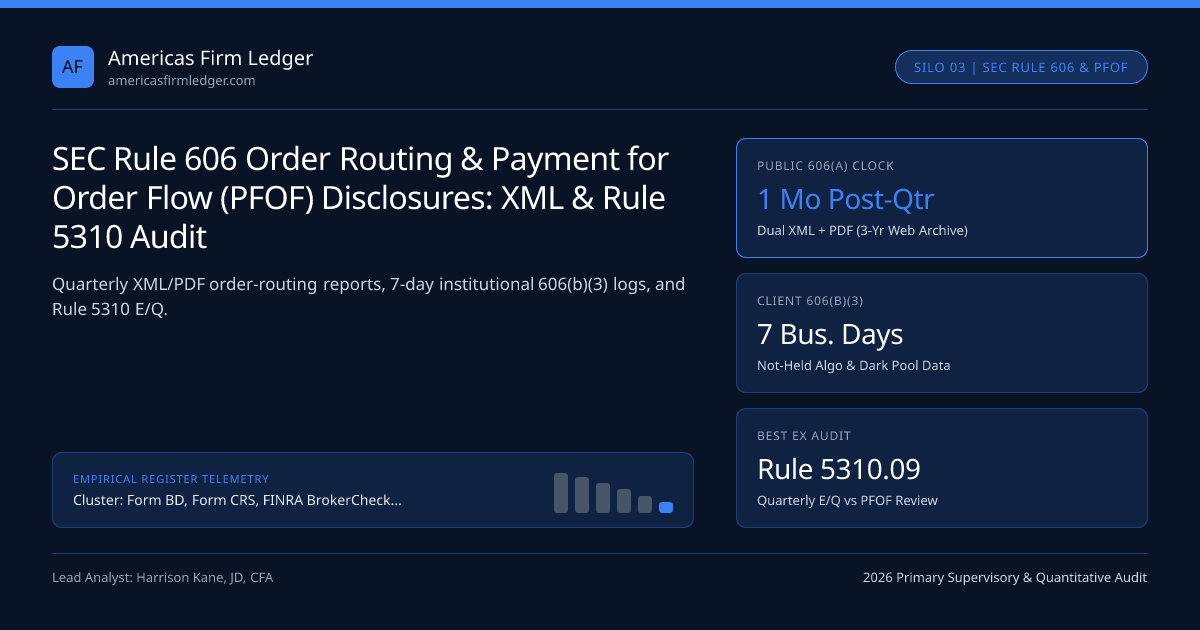
Under Regulation NMS Rule 606 (17 CFR 242.606) and FINRA Rule 5310, broker-dealers handling non-directed orders must publish machine-readable quarterly XML and PDF reports detailing top 10 execution venues, marketable vs limit order splits.
How do zero-commission U.S. retail brokerage apps generate hundreds of millions of dollars in quarterly execution revenue—and how can institutional traders prove whether a broker's smart order router leaked alpha to high-frequency dark pools? The statutory sunlight mechanism is SEC Regulation NMS Rule 606 (17 CFR 242.606, Disclosure of Order Routing Information), enforced hand-in-hand with SEC Rule 605 (execution center fill-quality statistics, expanded to large broker-dealers under the SEC's 2024 Rule 605 Amendments) and FINRA Rule 5310 (Best Execution and Interpositioning)!
This order-routing transparency guide pairs with CAT T+1 order-lifecycle surveillance inside our Form BD, Form CRS & BrokerCheck institutional guide.
Bifurcated Architecture of SEC Rule 606: Public Retail 606(a) vs Institutional 606(b)(3)#
Following the SEC's sweeping 2018/2020 Rule 606 overhaul, order-routing disclosures split cleanly by Order Dollar Size and Order Handling Type:
- Rule 606(a)(1) — Public Quarterly Retail & Non-Directed Held Reports (Posted Within 1 Month After Quarter-End!):
- Covers non-directed "held" orders (where the broker owes immediate best-execution handling rather than working an institutional VWAP slice over hours) in NMS Stocks (split into S&P 500 Stocks vs Non-S&P 500 Stocks) and Listed Options!
- Must be posted free and unrestricted on a public website (retained for 3 years) in BOTH a machine-readable SEC XML schema AND a human-readable PDF by April 30, July 31, October 31, and January 31!
- Breaks down the Top 10 Venues (plus any venue receiving >=5% of orders) across four order buckets (Market Orders, Marketable Limit Orders, Non-Marketable Limit Orders, and Other Orders), disclosing exact net dollar AND cents-per-100-shares Payment for Order Flow (PFOF) or exchange maker-taker rebates/fees for every single month!
- Rule 606(b)(3) — On-Demand Institutional "Not Held" Customer-Specific Reports (Within 7 Business Days!):
- Whenever an institutional asset manager or hedge fund requests routing data on its "not held" parent/child algorithmic orders, the broker-dealer must deliver a standardized XML/PDF report within 7 business days covering the prior 6 months—exposing mid-point dark pool fill rates, IOI leakage metrics, average order size, and fee/rebate economics across Directed vs Non-Directed child routes!
Comparing Retail PFOF Internalizers vs Maker-Taker Exchanges vs Canadian CIRO Ban!#
North American compliance officers managing cross-border order routing between Wall Street and Toronto must remember a dramatic cross-border contrast: while Payment for Order Flow (PFOF) is legal in the United States (subject to SEC Rule 606, SEC Rule 10b-10 trade-confirmation notice, and FINRA Rule 5310 Best Execution!), Canadian regulator CIRO (UMIR Rule 7.5 / IDPC Rules) strictly prohibits Canadian dealers from accepting PFOF rebates on client orders!
| Execution Venue / Routing Model | Dominant Order Type | Typical US Economic Flow (Rule 606a) | Key FINRA Rule 5310 Best-Execution Duty |
|---|---|---|---|
| Wholesale Off-Exchange Market Makers (Citadel, Virtu, Jane Street) | Retail Market & Marketable Limit | Broker Receives PFOF ($0.08–$0.22 per 100 Eq; $0.35–$0.65 per Option Ctr!) | Prove Price Improvement (E/Q < 100%) Beats Exchange NBBO Net of PFOF! |
| Maker-Taker Lit Exchanges (Nasdaq, NYSE Arca, Cboe BZX) | Resting Non-Marketable Limits | Exchange Pays Maker Rebate (~$0.20–$0.30/100 sh); Charges Taker Fee (~$0.30) | Ensure rebate-chasing never sacrifices fill probability (Rule 5310.09)! |
| Inverted (Taker-Maker) Exchanges | Aggressive Liquidity-Taking | Pays Small Taker Rebate; Charges Resting Maker | Queue-position optimization for institutional routers |
| ATS Midpoint Dark Pools | Institutional Not-Held Child Slices | Low Per-Share Execution Fee ($0.05–$0.10/100 sh) | Audit information leakage & adverse selection post-fill (Rule 606b3) |
Quantitative Price Improvement vs PFOF Conflict Audit Formula (FINRA Rule 5310)#
Why did the SEC and FINRA fine retail broker-dealers $65 million+ over PFOF? NOT because receiving PFOF is illegal per se—rather, because the broker deliberately negotiated higher per-share PFOF rates from wholesalers in exchange for accepting WORSE execution price improvement (lower E/Q) for its retail customers, violating FINRA Rule 5310 ("Regular and Rigorous Review")! Look at the exact Effective-Over-Quoted (E/Q) Spread vs PFOF trade-off every Best Execution Committee must run quarterly:
- QuotedSpreadPerShare = NationalBestOffer - NationalBest_Bid
- EOverQRatioPct = (EffectiveSpreadPerShare / QuotedSpreadPerShare) * 100 (LowerThan100Pct = Price_Improvement!)
- NetCustomerGainVsNBBO = ((QuotedSpreadPerShare - EffectiveSpreadPerShare) / 2) * Order_Shares
- Worked Best-Execution Committee Quarterly Wholesaler Audit (1,000-Share Retail Market Buy; NBBO $50.00 x $50.04, Midpoint $50.02):
- Wholesaler A offers $0.25/100 shares PFOF ($2.50 to Broker), fills client @ $50.038 (E/Q = 90% -> Only $2.00 Price Improvement to Client!)
- Wholesaler B offers $0.10/100 shares PFOF ($1.00 to Broker), fills client @ $50.026 (E/Q = 30% -> $14.00 Price Improvement to Client!)
- FINRA Rule 5310 Mandate: Routing to Wholesaler A to pocket +$1.50 extra PFOF while costing the retail customer -$12.00 in lost price improvement is an ILLEGAL Best-Execution Violation!
FINRA Rule 5310.09 Quarterly Best-Execution Audit Gates#
The Introducing-Broker Rule 606 & Rule 5310 Trap!#
What if your firm is a Fully Disclosed Introducing Broker routing 100% of retail orders to your clearing firm (e.g., Pershing or Apex)?
- Rule 606(a): You STILL must publish (or formally link/adopt with proper firm-specific header disclosures where permitted by SEC staff FAQs when 100% non-directed to clearing!) quarterly Rule 606(a) disclosures—never leave a broken 404 link on your website footer!; AND
- FINRA Rule 5310.09(c): An introducing broker routing 100% of flow to its executing/clearing broker cannot simply do nothing—its Best Execution Committee must review the executing broker's execution quality statistics at least quarterly and compare them against rival executing venues! Finally, close out Silo 3 with private-market capital raising in FINRA Rule 5123 private placement filings & SEC Form D Rule 506(d) audits inside the Form BD, BrokerCheck & CAT Topic Hub.
Frequently asked questions
Is Payment for Order Flow (PFOF) legal for SEC/FINRA broker-dealers in the United States?
Yes, provided the broker-dealer discloses PFOF arrangements at account opening, on trade confirmations (SEC Rule 10b-10), and in penny-accurate monthly detail on quarterly SEC Rule 606(a) XML/PDF reports—AND strictly ensures under FINRA Rule 5310 that PFOF rates never override superior customer execution prices!
Why did FINRA sanction broker-dealers that posted PDF Rule 606 reports on their websites?
Posting ONLY a PDF violates Rule 606(a)(1)! Every covered broker-dealer must publish BOTH a human-readable PDF AND a strictly validated XML file conforming to the SEC's published Rule 606 XSD schema (and keep all quarterly files live for 3 years).
Why are Payment for Order Flow rates per 100 shares much higher on listed options than on S&P 500 stocks?
Listed options trade across thousands of strike/expiration series with wider quoted penny/nickel bid-ask spreads than hyper-liquid 1-cent S&P 500 equities, generating larger market-making spreads from which wholesalers pay $0.35-$0.65+ per contract in PFOF.
What is an E/Q (Effective-over-Quoted) ratio in a FINRA Rule 5310 Best Execution Committee packet?
E/Q compares how far from the NBBO midpoint the customer actually filled (Effective Spread) against the posted NBBO bid-ask width (Quoted Spread): 100% means filled right at the NBBO bid/ask, 0% means filled right at the midpoint, and <50% indicates substantial price improvement!
Publication record
- Published
- November 13, 2026
- Updated
- November 15, 2026
- Author
- Harrison Kane, JD, CFA
- Review
- Review not recorded
- Automated fact check
- Passed in the stored pipeline record
- Source URLs
- 4 recorded
AI assistance recorded: anthropic/claude-opus-4.6. This field does not establish human review or source verification.
Academic & Institutional Attribution
Cite This Research & Embed Live Data Card
Standard academic & institutional research paper citation format.
Harrison Kane, JD, CFA. (2026, November 15). SEC Rule 606 Order Routing & Payment for Order Flow (PFOF) Disclosures: XML & Rule 5310 Audit. Americas Firm Ledger. https://americasfirmledger.com/filings/sec-rule-606-order-routing-payment-for-order-flow-xml-reportsRelated Finra Brokercheck Form Bd Crs Filings & Institutional Briefings
Explore Finra Brokercheck Form Bd Crs Filings Hub (20) →Finra Brokercheck Form Bd Crs Filings
Form BD, Form CRS, FINRA BrokerCheck & CAT Supervision: Institutional Filing GuideFinra Brokercheck Form Bd Crs Filings
FINRA Rule 5123 Private Placement Filings & SEC Form D: 15-Day Clocks, Rule 506(d) & RN 23-08Finra Brokercheck Form Bd Crs Filings
SEC & FINRA Form BD Ownership Disclosures: Schedules A, B & C Beneficial Control CodesFinra Brokercheck Form Bd Crs Filings
FINRA Rule 1017 Continuing Membership Application (CMA): 25% Ownership & Safe HarborsFinra Brokercheck Form Bd Crs Filings
Form BDW Broker-Dealer Withdrawal: SEC Rule 15b6-1 60-Day Wind-Down & Record CustodyFinra Brokercheck Form Bd Crs Filings
SEC Form CRS Relationship Summary Audit: 2-Page vs 4-Page Caps, Prompts & Fee ConflictsFinra Brokercheck Form Bd Crs Filings
SEC Regulation Best Interest (Reg BI) Rule 15l-1: Care, RCAP Alternatives & Conflict MitigationFinra Brokercheck Form Bd Crs Filings
FINRA Form U4 Item 14 Disclosures: $5k Written Complaints, $15k Settlements & 30-Day LiensCFTC Nfa Fcm Segregated Residual Interest
Non-Intermediated CFTC DCO Clearing vs FCM Intermediation: Digital Assets & Event ContractsCiro Csa Canadian Investment Dealers
CIRO (IIROC) Form 1 Risk-Adjusted Capital (RAC): CAD $250k Floor & Regulatory FilingsCiro Csa Canadian Investment Dealers
CIRO (IIROC) IDPC Rule 4100 Early Warning System: Level 1 & Level 2 Regulatory FilingsCiro Csa Canadian Investment Dealers
CIRO (IIROC) IDPC Series 5000 Margin Rules: LSERM Equity & Debt Regulatory Filings
Americas Firm Ledger Data, Benchmarks & Contributor Records
CC BY 4.0 Open Data
Open Institutional Datasets (CSV / JSON) →
Download desk-compiled quantitative series & schemas.
2026 Reference Matrix
2026 Institutional Benchmarks & Thresholds →
Statutory capital, clearing, margin & rate conventions.
Editorial Records
Authors & Review Records →
View named contributors where those records are available.
Complete Index
Master Research & Dossier Archive →
Browse all published briefings by topic pillar & date.