
Finra Brokercheck Form Bd Crs Filings
SEC & FINRA Form BD Ownership Disclosures: Schedules A, B & C Beneficial Control Codes
Uniform Application for Broker-Dealer Registration (Form BD) forces every U.S. broker-dealer to map direct executives and >=5% shareholders on Schedule A and trace >=25% indirect holding-company layers up to ultimate natural persons on Schedule B via Web CRD.
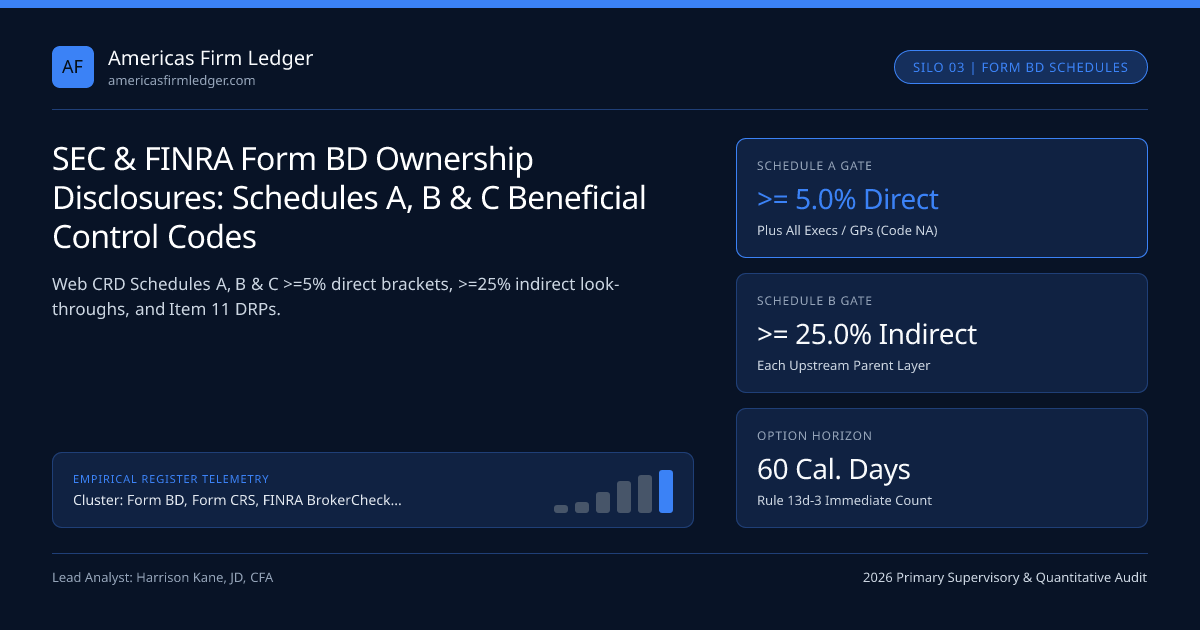
Before a U.S. broker-dealer executes its first trade—or whenever private-equity sponsors restructure a Delaware holding company organized under the Delaware General Corporation Law—compliance counsel must master the exact ownership look-through math of SEC Form BD (Uniform Application for Broker-Dealer Registration, 17 CFR 249.501)! Filed electronically through Web CRD and synced directly to public FINRA BrokerCheck "Firm Profile -> Owners & Executive Officers" screens, Form BD Schedules A, B, and C expose both direct owners and every intermediate corporate, LLC, LP, or family-trust tier possessing voting control!
This entity-disclosure blueprint anchors corporate transparency inside our Form BD, Form CRS & BrokerCheck institutional guide, pairing directly with FINRA Rule 1017 25% CMA change-of-control filings and dual-registrant Form ADV Part 1A Schedule A/B reconciliations.
How Schedule A (Direct Owners) vs Schedule B (Indirect Owners) Look-Through Works#
Why do so many fintech holding companies receive deficiency letters from FINRA Membership Application Program (MAP) examiners? Because founders confuse economic diluted equity with Form BD's class-by-class voting & capital contribution look-through rules:
- Schedule A — Direct Owners and Executive Officers: Must list:
- Every Executive Officer (CEO, CFO/FinOp, CCO, COO, Chief Legal Officer, Director, or functional equivalent) even if they own 0.00% equity (reported using Ownership Code NA!);
- For corporations: every person who directly owns, beneficially owns, or has the right to vote (including options/warrants exercisable within 60 days!) 5% or more of a class of a voting security;
- For LLCs: every member who has the right to receive upon dissolution, or has contributed, 5% or more of the LLC's capital—PLUS every Managing Member or Manager regardless of 0% capital; and
- For partnerships: all General Partners plus every Limited Partner contributing or entitled to 5% or more of capital!
- Schedule B — Indirect Owners (The 25% Look-Through Chain): Whenever any Schedule A direct owner is a non-natural entity (e.g., Parent FinTech HoldCo Inc.), Schedule B climbs up every tier of the corporate pyramid until reaching natural persons or widely held public companies (1934 Act reporting companies):
- At each upstream corporate tier: report every shareholder owning/voting 25% or more of a voting class;
- At each upstream LLC/LP tier: report every General Partner / Managing Member PLUS every LP/member contributing or entitled to 25% or more of that entity's capital; and
- Trusts: Report every Trustee and each grantor/beneficiary where revocable/control criteria apply!
- Schedule C — Amendments: Filed promptly (within 30 calendar days under SEC Rule 15b3-1 and FINRA By-Laws Article IV) whenever an officer changes title, a shareholder crosses an ownership bracket code, or an address/name changes.
The Six Form BD Ownership Bracket Codes & Control Affiliate Consequences#
Form BD never prints exact percentages (14.37%) on public BrokerCheck—instead, Web CRD maps ownership into six standardized Ownership Codes that also govern Item 11 Control Affiliate disciplinary lookbacks:
| Form BD Ownership Code | Statutory Ownership Percentage Bracket | Control Person Flag Presumption? | Triggers Rule 1017 CMA If Crossed From <25%? | Publicly Visible on BrokerCheck? |
|---|---|---|---|---|
| Code NA | Less than 5% (Executive Officer / Director / GP / Trustee) | Yes (Executive / Director Control) | Only if GP / Control Change | Yes (Owners & Officers Tab) |
| Code A | 5% but less than 10% | No (Unless Mgmt Agreement) | No | Yes |
| Code B | 10% but less than 25% | No (Watch 10% Exchange / Bank Rules) | No (Stop at 24.99% Pre-CMA!) | Yes |
| Code C | 25% but less than 50% | YES — Presumed Control Person! | YES — Rule 1017 CMA Required! | Yes |
| Code D | 50% but less than 75% | YES — Majority Control Person! | Yes (If Acquiring >=25% Stake) | Yes |
| Code E | 75% or more (Wholly Owned Subsidiary = 100%) | YES — Dominant Parent Control! | Yes (If Newly Acquired) | Yes |
Quantitative 60-Day Convertible Note & Multi-Tier Look-Through Calculation#
Notice how Form BD Instruction 4 (Beneficial Ownership) mirrors SEC Exchange Act Rule 13d-3(d)(1): if Venture Fund Alpha holds 18% common stock PLUS a convertible note or warrant exercisable within 60 days into another 9% of voting shares, Venture Fund Alpha is deemed to own 25.7% (Code C) TODAY—not when it converts! Look at the exact denominator formula (including only that holder's exercisable options in the denominator!):
- Worked Venture Financing Trap (Broker-Dealer Parent Has 1,000,000 Voting Shares Issued):
- Investor X owns 180,000 Common Shares (18.0%) + Warrant for 100,000 Voting Shares exercisable anytime!
- Naive Diluted Math (Wrong): Assumes 500,000 unvested employee pool in denominator -> Claims < 20%
- Statutory Form BD / Rule 13d-3 Math:
- Numerator = 180,000 + 100,000 = 280,000 shares
- Denominator = 1,000,000 + 100,000 = 1,100,000 shares
- DeemedVotingPct = 280,000 / 1,100,000 = 25.45% -> CODE C (>= 25.0% CONTROL PERSON!)
- Regulatory Impact: Crossed 25% without prior FINRA Rule 1017 CMA notice + Must disclose Investor X's GP on Schedule B!
SEC Form BD Ownership Bracket Thresholds (Codes NA - E)#
The Item 11 "Control Affiliate" Trap for Global Financial Conglomerates!#
Why does Form BD Schedule B matter far beyond an org chart? Because Form BD Item 11 (Disclosure Questions) requires the U.S. broker-dealer to file Disclosure Reporting Pages (DRPs) not only for its own disciplinary history, but also for every "Control Affiliate"—defined as any individual or organization (foreign or domestic!) that directly or indirectly controls, is under common control with, or is controlled by the applicant! If a European or Canadian parent bank listed on Schedule B settles a regulatory fine with the OSC or a foreign financial authority, the U.S. broker-dealer must amend Form BD Item 11 within 30 days! Next, examine what happens when a buyer acquires 25% or more of a broker-dealer in FINRA Rule 1017 Continuing Membership Applications (CMAs) inside the Form BD, BrokerCheck & CAT Topic Hub.
Frequently asked questions
Does passive non-voting preferred stock in a Delaware C-Corp have to be disclosed on Form BD Schedule A?
For a corporation, Schedule A looks strictly to >=5% of a class of a VOTING security—so pure non-voting preferred stock (with zero conversion rights within 60 days) is excluded on a C-Corp! By contrast, for an LLC or LP, >=5% passive capital contribution IS reportable on Schedule A even if non-voting!
Why do venture investors frequently cap their pre-approval investment in a broker-dealer parent at 24.9%?
Stopping at 24.9% (Code B) avoids crossing the 25.0% (Code C) statutory presumption of control—keeping the investor out of Schedule B indirect-owner look-throughs and avoiding a 180-day FINRA Rule 1017 change-of-ownership CMA freeze prior to closing!
If our Chief Compliance Officer owns 0% of the firm, do they still appear on public BrokerCheck?
Yes. Every Chief Executive Officer, Chief Financial Officer, Chief Compliance Officer, and Chief Operations Officer must be listed on Form BD Schedule A with Ownership Code "NA" (less than 5%), which publishes directly to BrokerCheck.
How quickly must a broker-dealer file a Form BD Schedule C amendment when a new CCO is appointed?
Under SEC Rule 15b3-1 and FINRA By-Laws, Form BD amendments must be filed "promptly"—enforced by FINRA as no later than 30 calendar days after the change occurs.
Publication record
- Published
- November 13, 2026
- Updated
- November 14, 2026
- Author
- Harrison Kane, JD, CFA
- Review
- Review not recorded
- Automated fact check
- Passed in the stored pipeline record
- Source URLs
- 4 recorded
AI assistance recorded: anthropic/claude-opus-4.6. This field does not establish human review or source verification.
Academic & Institutional Attribution
Cite This Research & Embed Live Data Card
Standard academic & institutional research paper citation format.
Harrison Kane, JD, CFA. (2026, November 14). SEC & FINRA Form BD Ownership Disclosures: Schedules A, B & C Beneficial Control Codes. Americas Firm Ledger. https://americasfirmledger.com/filings/sec-finra-form-bd-schedules-a-b-c-direct-indirect-ownershipRegulatory Directory Cross-Reference
Referenced Institutions & Regulatory Registries
Top Regulated Institutions in This Coverage Slice
Related Finra Brokercheck Form Bd Crs Filings & Institutional Briefings
Explore Finra Brokercheck Form Bd Crs Filings Hub (20) →Finra Brokercheck Form Bd Crs Filings
Form BD, Form CRS, FINRA BrokerCheck & CAT Supervision: Institutional Filing GuideFinra Brokercheck Form Bd Crs Filings
FINRA Rule 1017 Continuing Membership Application (CMA): 25% Ownership & Safe HarborsFinra Brokercheck Form Bd Crs Filings
Form BDW Broker-Dealer Withdrawal: SEC Rule 15b6-1 60-Day Wind-Down & Record CustodyFinra Brokercheck Form Bd Crs Filings
SEC Form CRS Relationship Summary Audit: 2-Page vs 4-Page Caps, Prompts & Fee ConflictsFinra Brokercheck Form Bd Crs Filings
SEC Regulation Best Interest (Reg BI) Rule 15l-1: Care, RCAP Alternatives & Conflict MitigationFinra Brokercheck Form Bd Crs Filings
FINRA Form U4 Item 14 Disclosures: $5k Written Complaints, $15k Settlements & 30-Day LiensFinra Brokercheck Form Bd Crs Filings
FINRA Form U5 Termination Disclosures: 30-Day Clocks, Section 7 Reviews & Defamation ClaimsFinra Brokercheck Form Bd Crs Filings
FINRA BrokerCheck Customer Dispute Expungement: Rule 2080, Rule 12805 & Unanimous PanelsCFTC Nfa Fcm Segregated Residual Interest
CFTC Regulation 30.7 Foreign Futures Secured Amount: Net Liquidating Upgrade & Foreign RiskCFTC Nfa Fcm Segregated Residual Interest
CEA Section 4d(f) & CFTC Part 22 Cleared Swaps LSOC Explained: Eliminating Fellow-Customer RiskCFTC Nfa Fcm Segregated Residual Interest
CFTC Rule 1.22 Residual Interest Target Explained: Blocking Fellow-Customer Margin UsageCFTC Nfa Fcm Segregated Residual Interest
CFTC Rule 1.25 Permitted Investments (2025 Overhaul): US Treasuries, Short-Term Treasury ETFs & Caps
Americas Firm Ledger Data, Benchmarks & Contributor Records
CC BY 4.0 Open Data
Open Institutional Datasets (CSV / JSON) →
Download desk-compiled quantitative series & schemas.
2026 Reference Matrix
2026 Institutional Benchmarks & Thresholds →
Statutory capital, clearing, margin & rate conventions.
Editorial Records
Authors & Review Records →
View named contributors where those records are available.
Complete Index
Master Research & Dossier Archive →
Browse all published briefings by topic pillar & date.