
Ciro Csa Canadian Investment Dealers
CIRO (IIROC) IDPC Rule 4100 Early Warning System: Level 1 & Level 2 Regulatory Filings
Long before a Canadian broker-dealer breaches zero Risk-Adjusted Capital, CIRO (formerly IIROC) IDPC Rule 4100 triggers Level 1 and Level 2 Early Warning regulatory filings—freezing officer bonuses, dividends, inventory expansion, and subordinated loan repayments.
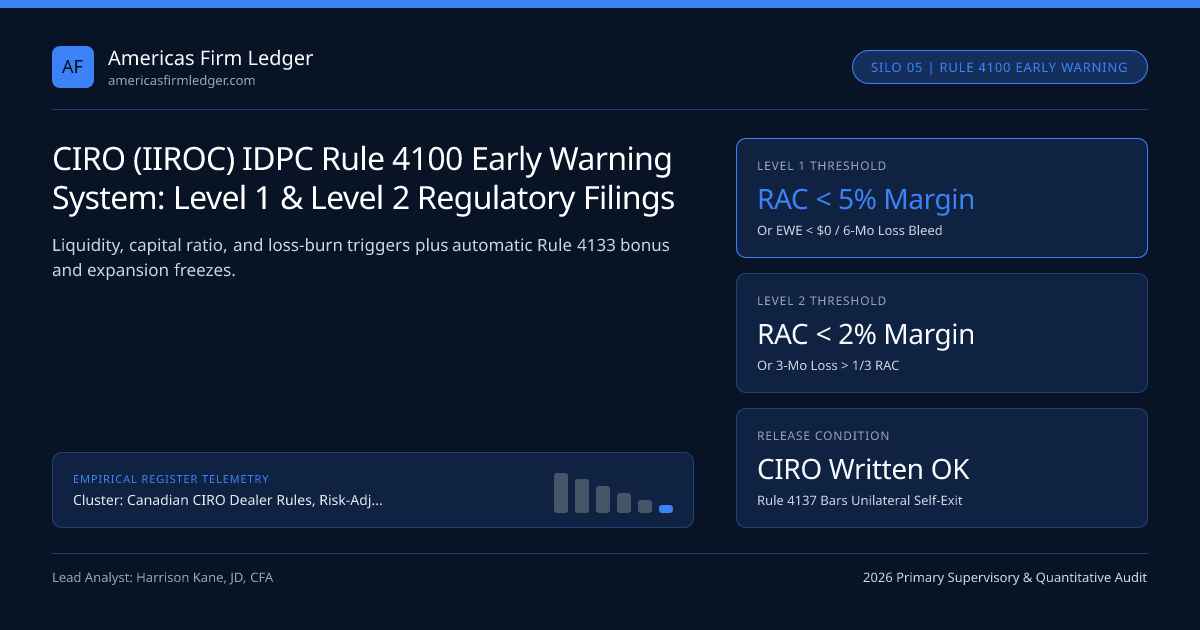
Whereas the U.S. SEC and FINRA enforce a single-dimensional capital cushion under Exchange Act Rule 17a-11 (120% of minimum Net Capital or 5% of debit items), the Canadian Investment Regulatory Organization runs a three-dimensional Early Warning System under IDPC Rule 4100 (Sections 4130–4138). Even if a Canadian dealer shows positive Risk-Adjusted Capital (RAC) on CIRO Form 1, rapid operating losses, illiquid balance-sheet bloat, or shrinking capital cushions automatically catapult the firm into Early Warning Level 1 or Early Warning Level 2!
For full integration with Canadian insolvency pools and provincial oversight, review our Canadian CIRO Dealer Rules & CIPF Filing Guide in the Canadian CIRO & CSA Topic Hub.
Three Independent Dimensions of IDPC Rule 4100: Liquidity, Capital & Profitability#
Under IDPC Rule 4100, a dealer's CFO and Ultimate Designated Person (UDP) must continuously monitor three distinct early-warning gauges—and Level 2 imposes harsher operational handcuffs than Level 1:
- Liquidity Test (Early Warning Excess < CAD $0): On Form 1 Statement C, if Early Warning Excess (EWE) turns negative—meaning liquid RAC fails to cover the Early Warning Reserve—the dealer immediately enters Early Warning (escalating to Level 2 if tighter liquidity/cushion thresholds breach!).
- Capital Cushion Test (RAC < 5% or < 2% of Total Margin Required): Even with positive EWE, if RAC falls below 5% of Total Margin Required on Statement B, Level 1 triggers; if RAC falls below 2% of Total Margin Required, Level 2 triggers immediately!
- Profitability Bleed Test (Quarterly / 3-Month & 6-Month Loss Run-Rate): If cumulative operating losses over the preceding 3 months or 6 months threaten to consume a prescribed fraction of remaining RAC (e.g., 6-month loss exceeding 1/3 of RAC for Level 1, or 3-month loss exceeding 1/3 of RAC / 1-month loss exceeding 1/6 of RAC under Level 2 profitability formulas), the dealer is swept into Early Warning before losses exhaust solvency!
Comparing Level 1 vs. Level 2 Sanctions Against U.S. SEC Rule 17a-11#
Compliance officers overseeing cross-border groups such as Velocity Trade or comparing Canadian dealers against OSC EMD working-capital notices and U.S. SEC Rule 17a-11 must understand how self-executing CIRO Rule 4100 sanctions are—they take legal effect automatically at the moment the trigger condition occurs, even before CIRO replies!
| Supervisory Dimension | CIRO Early Warning Level 1 | CIRO Early Warning Level 2 | U.S. SEC Rule 17a-11(b)/(c) |
|---|---|---|---|
| Capital Ratio Trigger | RAC < 5% of Total Margin Required | RAC < 2% of Total Margin Required | < 120% Min Cap or < 5% Debits |
| Profitability Loss Test? | Yes — 6-Month Loss vs RAC Bleed | Yes — 3-Month / 1-Month Loss Bleed! | None (FINRA Rule 4110(c) Discretionary) |
| Notice Signature Gate | Immediate CEO (UDP) + CFO Written Letter | Immediate UDP + CFO Letter + Recovery Plan | Same-Day / 24-Hr eFOCUS Notice |
| Dividend & Bonus Freeze | Automatic 100% Freeze (Rule 4133!) | Automatic 100% Freeze + Onsite Audit | FINRA Rule 4110(c) Freeze at Warn Threshold |
| Inventory & Branch Cap | Cannot Increase Margin-Consuming Positions | Mandatory Position Reduction + Weekly MFRs! | Business Expansion Freeze Under FINRA 4110 |
| Rule 4400 Cash Impact | Loses 4x EWE Tier (Capped at 8x RAC) | Tightened Free Credit Segregation! | No Free Credit Multiplier Equivalent |
Worked Calculation: Detecting a Profitability & Capital Cushion Level 2 Breach#
Suppose an independent Calgary energy/mining institutional dealer reports Total Margin Required = CAD $30,000,000 and Risk-Adjusted Capital (RAC) = CAD $1,100,000 at October month-end, after suffering three consecutive monthly underwriting/trading losses totaling CAD $480,000 (CAD $160k/month average burn):
- 1. Capital Cushion Ratio = RAC / Total Margin Required
- = CAD $1,100,000 / CAD $30,000,000 = 3.67% (< 5.00%!)
- > Capital Test Alone Triggers Early Warning LEVEL 1 (2% <= 3.67% < 5%)!
- 2. Level 2 Profitability Loss Test (3-Month Net Loss vs Remaining RAC):
- 3-Month Cumulative Loss (3 x $160,000) = CAD $480,000
- 3x Three-Month Loss Projection (Annualized / 9-Month Stress Horizon) = CAD $1,440,000
- Compare Against Current RAC: CAD $1,440,000 > CAD $1,100,000 (Loss > 1/3 of RAC = $366,667!)
- > 3-Month Loss ($480,000) Exceeds One-Third of RAC ($366,667)!
- =======================================================================================
- RESULT: Dealer Automatically Escalates Into EARLY WARNING LEVEL 2!
Automatic Rule 4133 Prohibitions Inside Early Warning#
Look how decisive that profitability screen is: even though the firm still holds CAD $1,100,000 in positive RAC above its CAD $250,000 floor, burning CAD $480,000 per quarter would wipe out the entire remaining RAC in just 6.8 months—so CIRO sweeps the dealer straight into Level 2, mandates a formal capital-restoration plan within 5 business days, freezes all executive bonuses, dividends, share buybacks, and unsecured affiliate loans, and forces the firm to file weekly or bi-weekly MFRs!
The "No Self-Exit" Rule: Why Restoring RAC Alone Does Not Lift Sanctions!#
One of the sharpest legal nuances under IDPC Rule 4137 is that a dealer CANNOT unilaterally exit Early Warning Level 1 or Level 2 merely because a parent wire arrives the next morning! Once triggered, every single Rule 4133 restriction—bonus freeze, inventory cap, free-credit tightening under Rule 4400, and accelerated reporting—remains legally binding until CIRO issues formal written confirmation that the underlying capital, liquidity, and profitability deficiencies have been sustainably resolved!
Frequently asked questions
Who must personally sign a CIRO Rule 4100 Early Warning notification letter?
Both the Ultimate Designated Person (UDP / CEO) and the Chief Financial Officer (CFO) must jointly sign the immediate written notification to CIRO, followed within 5 business days by a concrete operational plan explaining the root cause and how capital/profitability will be restored.
Does CIRO notify CIPF when a member dealer enters Early Warning Level 2?
Yes! Under the Industry Agreement between CIRO and the Canadian Investor Protection Fund (CIPF), CIRO shares Level 2 early-warning surveillance alerts directly with CIPF so insolvency risk officers can monitor client asset segregation before a default occurs.
Can a profitable investment dealer still fall into Level 1 Early Warning?
Absolutely! If a profitable trading desk surges its leveraged proprietary bond or equity inventory at month-end so Total Margin Required spikes to CAD $100M while RAC sits at CAD $4.2M (4.2% < 5%), the firm immediately enters Level 1 Early Warning despite record quarterly earnings!
What happens if a dealer triggers Level 1 Early Warning repeatedly across multiple months in a single year?
Under IDPC Rule 4100 chronic-trigger provisions, entering Level 1 multiple times within a rolling 6-to-12-month window empowers CIRO to automatically designate the dealer into Early Warning Level 2 with mandatory weekly filings and onsite examination!
Publication record
- Published
- November 13, 2026
- Updated
- November 14, 2026
- Author
- Harrison Kane, JD, CFA
- Review
- Review not recorded
- Automated fact check
- Passed in the stored pipeline record
- Source URLs
- 3 recorded
AI assistance recorded: anthropic/claude-opus-4.6. This field does not establish human review or source verification.
Academic & Institutional Attribution
Cite This Research & Embed Live Data Card
Standard academic & institutional research paper citation format.
Harrison Kane, JD, CFA. (2026, November 14). CIRO (IIROC) IDPC Rule 4100 Early Warning System: Level 1 & Level 2 Regulatory Filings. Americas Firm Ledger. https://americasfirmledger.com/filings/ciro-idpc-rule-4100-early-warning-level-1-level-2-triggersRelated Ciro Csa Canadian Investment Dealers & Institutional Briefings
Explore Ciro Csa Canadian Investment Dealers Hub (20) →Ciro Csa Canadian Investment Dealers
Canadian CIRO (IIROC) Dealer Rules, Form 1 RAC & CIPF Regulatory Filings GuideCiro Csa Canadian Investment Dealers
CIRO (IIROC) IDPC Series 5000 Margin Rules: LSERM Equity & Debt Regulatory FilingsCiro Csa Canadian Investment Dealers
CIRO (IIROC) IDPC Rule 4300 Securities Segregation & Custody Regulatory FilingsCiro Csa Canadian Investment Dealers
CIRO (IIROC) IDPC Rule 4400 Free Credit Cash Caps: 8x/12x RAC Regulatory FilingsCiro Csa Canadian Investment Dealers
CIPF CAD $1M Coverage Rules: CIRO General vs. Separate Registered FilingsCiro Csa Canadian Investment Dealers
CIPF vs. CDIC CAD $100k Deposit Insurance: Chartered Bank GIC & Cash ETF FilingsCiro Csa Canadian Investment Dealers
CSA National Instrument 31-103 Categories: CIRO Dealer & Asset Manager FilingsCiro Csa Canadian Investment Dealers
CSA NRD Filings: Form 33-109F4, MI 11-102 Passport & CIRO Broker-Dealer RegistryRegulation and Institutional Markets
Wall Street Futures Retreat as Nvidia Slides 8.5% Following Reports About CEO Jensen Huang: Dow Jones, S&P, Nasdaq - Yahoo Finance UKMarket Insights
CME Group to introduce Equilibrium Matching for U.S. Treasury Actives on BrokerTec Chicago - FX News GroupMarket Insights
Nasdaq Futures Fall as Nvidia Leadership Uncertainty and China Chip Restrictions Weigh on Markets: Dow Jones, S&P, Wall Street - Yahoo Finance UKRegulatory Compliance
SEC Enforcement Penalties Fall to 18-Year Low - WSJ
Americas Firm Ledger Data, Benchmarks & Contributor Records
CC BY 4.0 Open Data
Open Institutional Datasets (CSV / JSON) →
Download desk-compiled quantitative series & schemas.
2026 Reference Matrix
2026 Institutional Benchmarks & Thresholds →
Statutory capital, clearing, margin & rate conventions.
Editorial Records
Authors & Review Records →
View named contributors where those records are available.
Complete Index
Master Research & Dossier Archive →
Browse all published briefings by topic pillar & date.