
Ciro Csa Canadian Investment Dealers
U.S. SEC Rule 15a-6 vs. CSA NI 31-103 s. 8.18: Cross-Border CIRO & FINRA Filings
Cross-border North American broker-dealers and asset managers rely on U.S. SEC Rule 15a-6 chaperoning, SEC Rule 15a-6(a)(4) Snowbird rules, and Canadian CSA NI 31-103 Section 8.18 International Dealer and Section 8.26 International Adviser regulatory filings.
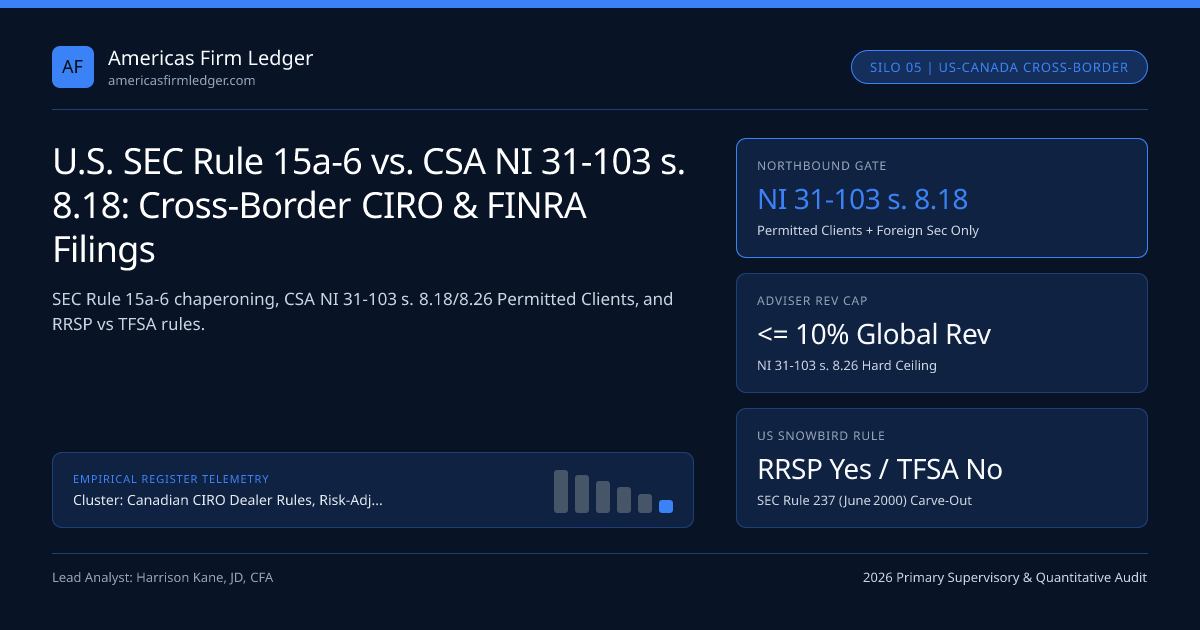
Over USD $1.5 trillion in institutional securities and derivatives flows cross the U.S.–Canada border every year between Wall Street desks in New York/Chicago and Bay Street pension funds (CPP Investments, Ontario Teachers', CDPQ) in Toronto/Montreal! How can a U.S. SEC / FINRA broker-dealer trade foreign securities with a Toronto pension fund without joining CIRO—and conversely, how can a Toronto CIRO dealer pitch a TSX mining IPO to a Boston mutual fund without registering with the SEC?
The entire North American institutional cross-border corridor runs on two mirror-image exemptions: CSA National Instrument 31-103 Section 8.18 (International Dealer) & Section 8.26 (International Adviser) northbound into Canada, and U.S. Exchange Act Rule 15a-6 (plus the SEC Rule 2010 Canadian Snowbird RRSP Exemption) southbound into the United States! Review the complete Canadian side in our Canadian CIRO Dealer Rules & CIPF Filing Guide inside the Canadian CIRO & CSA Topic Hub.
Northbound Into Canada: NI 31-103 s. 8.18 (International Dealer) & s. 8.26 (International Adviser)#
Suppose a New York FINRA broker-dealer (or London FCA firm) wants to trade securities directly with Canadian institutional investors without becoming a CIRO member. Under NI 31-103 Section 8.18, the foreign firm may rely on the International Dealer Exemption ONLY if it obeys five strict guardrails:
- "Permitted Client" Institutional Gate ONLY (NI 31-103 s. 1.1): Can deal solely with Canadian Permitted Clients—regulated banks/pensions/funds, corporations with > CAD $25,000,000 net assets, or ultra-HNW individuals with > CAD $5,000,000 in net realizable financial assets (higher than ordinary CAD $1M Accredited Investors!).
- "Foreign Security" Restriction (The TSX Trap!): An s. 8.18 International Dealer may generally trade only "Foreign Securities" (issued by non-Canadian issuers—like U.S. Treasuries, Apple, or European equities, plus narrow debt/private-placement carve-outs)! A New York FINRA broker CANNOT use s. 8.18 to execute secondary TSX shares of Royal Bank for a Toronto pension fund unless routed through a registered Canadian CIRO dealer!
- Form 31-103F2 Submission to Jurisdiction & Agent for Service: Must file Form 31-103F2 appointing a local provincial Agent for Service of Process in each province where Permitted Clients reside, plus deliver mandatory client risk notices!
- Hard December 1 Annual Renewal & OSC Participation Fee Clock!: Every year by December 1, every s. 8.18 International Dealer and s. 8.26 International Adviser (which also caps Canadian client revenue at <= 10% of consolidated global gross revenue!) must file its annual notice—and in Ontario, pay OSC Rule 13-502 Capital Markets Participation Fees!
Southbound Into the United States: SEC Rule 15a-6 Chaperoning & Snowbird RRSPs!#
Now flip directions: how does a Toronto CIRO dealer—whether a Big Six bank dealer or an institutional firm like Velocity Trade—deal with U.S. persons without violating Exchange Act Section 15(a)(1)?
| Cross-Border Scenario | Governing Exemption | Client Threshold | Local Chaperone Required? | Custody & Capital Impact |
|---|---|---|---|---|
| Unsolicited Institutional/Retail Trade | SEC Rule 15a-6(a)(1) | Any U.S. Person (Zero Solicitation!) | No (Truly Unsolicited Only!) | Remains on CIRO Form 1 / CIPF |
| Research to Major U.S. Inst. Investors | SEC Rule 15a-6(a)(2) | >= USD $100M AUM (MUII) | No if Unsolicited Trade Follows | Must Not Induce Direct Execution |
| Active U.S. Institutional Solicitation | SEC Rule 15a-6(a)(3) Chaperoning! | U.S. Institutional ($100k+) / MUII ($100M+) | YES — U.S. SEC/FINRA Broker! | U.S. Chaperone Takes 15c3-1 / 15c3-3 Charge on Fails! |
| Canadian Snowbird / Expat RRSP/RRIF! | SEC Rule 15a-6 / Rule 237 (2000) + State Blue Sky | Bona Fide Canadian RRSP/LIRA Owner in U.S. | No! (Self-Directed / Existing Rep!) | Stays in CIRO Dealer + CIPF CAD $1M Pool! |
| Canadian TFSA Owner Moves to U.S.! | NO SEC SNOWBIRD EXEMPTION! | Treated as Regular Taxable Foreign Trust/Acct | Cannot Solicit/Trade Without US BD! | Account Usually Frozen to Liquidate-Only + IRS 3520! |
Worked Calculation: Ontario OSC Rule 13-502 Participation Fee & s. 8.26 10% Revenue Test#
Every November/December, compliance teams at U.S. SEC-registered hedge-fund and institutional advisers relying on NI 31-103 s. 8.26 (International Adviser) in Ontario (OSC) and Quebec (AMF) must run two exact calculations before the December 1 deadline: (1) verify Canadian revenues (including pooled fund management fees from Canadian Permitted Clients!) stayed <= 10.00% of global consolidated gross revenue, and (2) calculate Ontario Specified Revenues for OSC Rule 13-502 participation fees:
- U.S. SEC RIA Consolidated Global Gross Revenue (Converted at BoC Avg Rate) = CAD $85,000,000
- Gross Advisory & Sub-Advisory Fees Earned From All Canadian Clients:
- Ontario Pension Plan Separate Account Mandate = CAD $4,800,000
- Quebec Institutional Endowment Mandate = CAD $2,100,000
- Alberta Corporate Treasury Mandate = CAD $950,000
- -------------------------------------------------------------------------------------------
- Total Canadian Gross Revenue ($4.80M + $2.10M + $0.95M) = CAD $7,850,000
- 1. NI 31-103 s. 8.26(4)(d) 10% Global Revenue Ceiling Check:
- Canadian Share = CAD $7,850,000 / CAD $85,000,000 = 9.24% (<= 10.00%!)
- > PASS! (Had Canadian Fees Hit >$8.50M [>10%], Full Canadian PM Registration Is Mandatory!)
- 2. Ontario OSC Form 13-502F4 Participation Fee Base (Ontario Revenue Only):
- Specified Ontario Revenues = CAD $4,800,000
- > Maps to Published OSC Rule 13-502 Tier ($2.5M to <$5M Tier Fee Paid by Dec 31!)
Cross-Border Traps: RRSP Snowbirds vs. TFSA & Chaperoning#
Missing that 10.00% ceiling is one of the sharpest tripwires in North American asset management: the moment a growing New York or Boston RIA's Canadian pension mandates cross 10% of global firm revenue, Section 8.26 vanishes and the firm must register a full CSA NI 31-103 Portfolio Manager with CFA-qualified Advising Representatives!
The "TFSA Trap" When Moving From Canada to the United States!#
Why will your Toronto CIRO broker let you continue managing your RRSP and RRIF after you relocate to Florida, California, or New York, yet immediately freeze your TFSA, FHSA, and non-registered margin account to "Liquidate Only"? Because on June 7, 2000, the U.S. SEC adopted Securities Act Rule 237 and Exchange Act Rule 15a-6 exemptions specifically for Canadian tax-qualified retirement plans (RRSP, RRIF, LIRA)—nine years before Canada invented the TFSA in 2009! Because the SEC never expanded that 2000 exemption to cover TFSAs or FHSAs (and the IRS taxes TFSAs rather than recognizing them under the Canada–U.S. Tax Treaty!), a Canadian CIRO dealer without dual FINRA + State Blue Sky licenses cannot legally accept new buy orders in a U.S. resident's TFSA, making pre-move planning across CIPF separate account pools essential!
Frequently asked questions
Why did my Canadian broker freeze my TFSA and Cash account when I moved to Texas or California, while letting me keep trading my RRSP?
Because the U.S. SECs June 2000 exemption (Rule 237 / Rule 15a-6 Canadian Retirement Account relief) and matching U.S. state "Snowbird" Blue Sky exemptions cover ONLY tax-deferred retirement plans like RRSPs, RRIFs, and LIRAs—they do NOT cover TFSAs (created in 2009), FHSAs, or taxable cash/margin accounts!
Can a New York FINRA broker relying on NI 31-103 Section 8.18 execute TSX-listed Shopify or Enbridge shares directly for an Ontario pension fund?
Generally NO! Section 8.18 restricts an International Dealer to "Foreign Securities" (securities of non-Canadian issuers, with narrow exceptions such as trades WITH a registered Canadian investment dealer). To buy domestic Canadian-issuer TSX shares, the foreign broker executes through a CIRO dealer!
What happens if a U.S. firm misses the December 1 annual renewal notice under NI 31-103 Section 8.18 or 8.26?
In provinces where the annual notice is a strict condition of continued reliance (and in Ontario under OSC Form 13-502F4 participation-fee rules), missing the December 1 / December 31 window triggers administrative late fees up to CAD $100/business day or lapses the firms exemption to deal with Permitted Clients!
How much SEC Rule 15c3-1 Net Capital must a U.S. FINRA broker hold to act as a Rule 15a-6(a)(3) "Chaperone" for a Canadian CIRO dealer?
Under the SECs Division of Trading and Markets Rule 15a-6 FAQs, a U.S. chaperoning broker-dealer must maintain at least USD $250,000 in minimum Net Capital (even if DVP/RVP settlement runs directly through the foreign dealers books) and take aged fail-to-deliver/receive charges!
Publication record
- Published
- November 12, 2026
- Updated
- November 14, 2026
- Author
- Harrison Kane, JD, CFA
- Review
- Review not recorded
- Automated fact check
- Passed in the stored pipeline record
- Source URLs
- 3 recorded
AI assistance recorded: anthropic/claude-opus-4.6. This field does not establish human review or source verification.
Academic & Institutional Attribution
Cite This Research & Embed Live Data Card
Standard academic & institutional research paper citation format.
Harrison Kane, JD, CFA. (2026, November 14). U.S. SEC Rule 15a-6 vs. CSA NI 31-103 s. 8.18: Cross-Border CIRO & FINRA Filings. Americas Firm Ledger. https://americasfirmledger.com/filings/us-sec-rule-15a-6-vs-csa-ni-31-103-8-18-international-dealerRegulatory Directory Cross-Reference
Referenced Institutions & Regulatory Registries
Mentioned Regulated Institutions
Related Ciro Csa Canadian Investment Dealers & Institutional Briefings
Explore Ciro Csa Canadian Investment Dealers Hub (20) →Ciro Csa Canadian Investment Dealers
Canadian CIRO (IIROC) Dealer Rules, Form 1 RAC & CIPF Regulatory Filings GuideCiro Csa Canadian Investment Dealers
CIRO (IIROC) Form 1 Risk-Adjusted Capital (RAC): CAD $250k Floor & Regulatory FilingsCiro Csa Canadian Investment Dealers
CIRO (IIROC) IDPC Rule 4100 Early Warning System: Level 1 & Level 2 Regulatory FilingsCiro Csa Canadian Investment Dealers
CIRO (IIROC) IDPC Series 5000 Margin Rules: LSERM Equity & Debt Regulatory FilingsCiro Csa Canadian Investment Dealers
CIRO (IIROC) IDPC Rule 4300 Securities Segregation & Custody Regulatory FilingsCiro Csa Canadian Investment Dealers
CIRO (IIROC) IDPC Rule 4400 Free Credit Cash Caps: 8x/12x RAC Regulatory FilingsCiro Csa Canadian Investment Dealers
CIPF CAD $1M Coverage Rules: CIRO General vs. Separate Registered FilingsCiro Csa Canadian Investment Dealers
CIPF vs. CDIC CAD $100k Deposit Insurance: Chartered Bank GIC & Cash ETF FilingsRegulatory Compliance
Statement at Open Meeting on Proposals to Expand Responsible Retailization of Private MarketsRegulatory Compliance
Remarks at the Small Business Capital Formation Advisory Committee MeetingRegulatory Benchmarks
North American Registered Broker-Dealers, Banks & FCMs 2026 Licensing Benchmark: 6D Prudential Scorecard Across 43 Audited EntitiesCompliance Forensics
How to Verify North American Registered Broker-Dealers, Banks & FCMs Licences & Detect Clone Firms: 2026 Supervisory Lookup Playbook
Americas Firm Ledger Data, Benchmarks & Contributor Records
CC BY 4.0 Open Data
Open Institutional Datasets (CSV / JSON) →
Download desk-compiled quantitative series & schemas.
2026 Reference Matrix
2026 Institutional Benchmarks & Thresholds →
Statutory capital, clearing, margin & rate conventions.
Editorial Records
Authors & Review Records →
View named contributors where those records are available.
Complete Index
Master Research & Dossier Archive →
Browse all published briefings by topic pillar & date.