
CFTC Nfa Fcm Segregated Residual Interest
Non-Intermediated CFTC DCO Clearing vs FCM Intermediation: Digital Assets & Event Contracts
From CFTC-regulated prediction markets and event-contract exchanges (Kalshi, ForecastEx) to 24/7 digital-commodity venues, non-intermediated Derivatives Clearing Organizations (DCOs) clear retail orders directly on 100% fully collateralized terms.
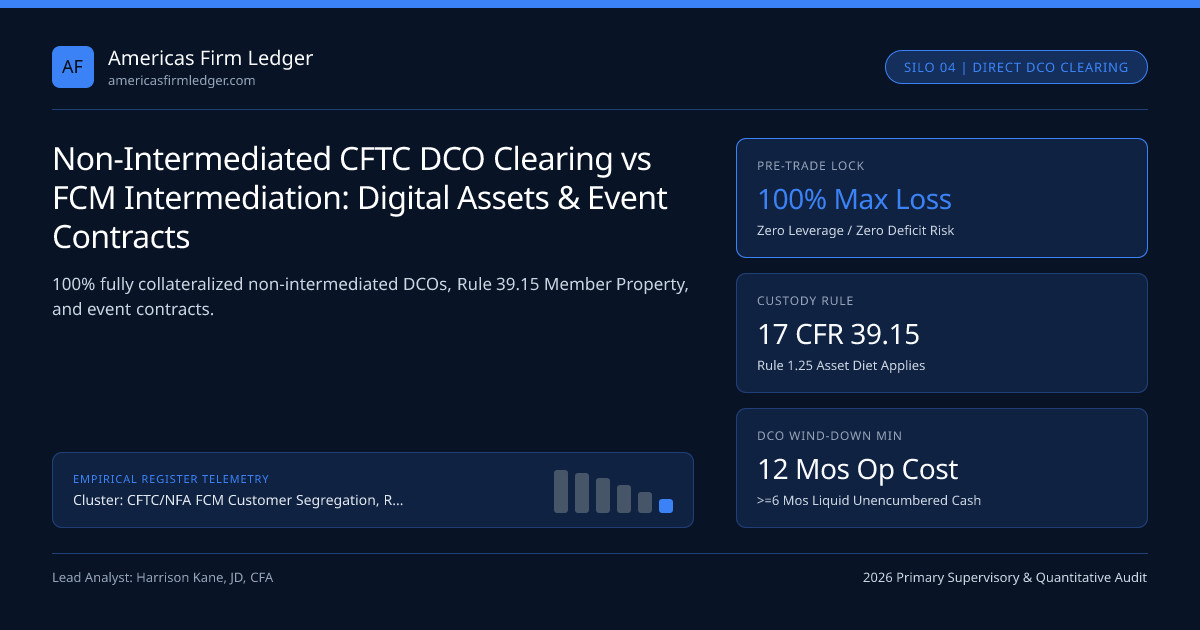
In traditional Chicago futures markets, a retail trader or hedge fund never becomes a direct clearing member of CME Clearing—instead, an FCM stands in the middle, extending intraday leverage, guaranteeing every trade to the clearinghouse, and holding Section 4d(a)(2) segregated pools. Now look at the fastest-growing CFTC-regulated venues of 2024–2026—regulated event-contract / prediction exchanges (KalshiEX / Kalshi Klear, Interactive Brokers ForecastEx, NADEX / Crypto.com North America) and direct digital-asset Derivatives Clearing Organizations (LedgerX / MIAX Derivatives, Cboe Clear Digital, Bitnomial): thousands of retail natural persons clear directly at the CFTC-registered Derivatives Clearing Organization (DCO) WITHOUT an FCM in the middle ("Non-Intermediated / Direct-to-DCO Clearing")!
This market-structure analysis concludes Silo 4 of our CFTC & NFA FCM Customer Segregation institutional guide, contrasting 17 CFR Part 39 DCO Member Property rules against traditional CEA Section 4d(a)(2) FCM customer segregation and Part 190 bankruptcy rules.
How Can a Retail Individual Legally Trade Futures/Swaps Without an FCM?!#
Under the Commodity Exchange Act, an FCM is required only when an intermediary solicits/accepts orders and accepts money/collateral to margin trades on behalf of ANOTHER person ("intermediated clearing")! When a trader becomes a direct self-clearing participant ("Direct Member") of a CFTC-registered Designated Contract Market (DCM) and Derivatives Clearing Organization (DCO):
- 100% Fully Collateralized Pre-Trade Lockup (Zero Unsecured Credit / Zero Default Mutualization!): Why doesn't a direct retail participant on Kalshi or ForecastEx need a $50 million clearing-member guaranty-fund deposit? Because every binary event contract ($0.01 to $0.99 paying $1.00) or fully collateralized futures/option contract requires 100% of maximum possible loss (Max Loss) locked in cash BEFORE the order matches! Because no participant can ever lose more than their pre-posted cash (Zero Negative Equity Risk!), Defaulting Participant A can never create a mutualized default-fund loss for Participant B!
- 2023–2025 CFTC Part 39 Amendments Protecting Direct DCO "Member Property" (17 CFR 39.15): Wait—if a direct retail participant at a non-intermediated DCO is legally a "Clearing Member" rather than an "FCM Customer," did CEA Section 4d(a)(2) apply automatically? Historically NO—which is why the CFTC finalized targeted Part 39 (Rule 39.15(b) & Rule 39.13) amendments requiring DCOs to segregate proprietary funds of direct clearing members from the DCO's own corporate operating cash, hold them in bankruptcy-remote trust/custodial accounts named clearly for participants, and obey CFTC Rule 1.25 investment restrictions!
- Hybrid Intermediated + Direct Routing (FCM Onboarding to Event Markets): Notice how platforms like Kalshi also allow traditional NFA-member FCMs (such as Interactive Brokers or Robinhood Derivatives, LLC—registered as an FCM/IB!) to route retail customers into the DCM/DCO either through traditional Section 4d FCM omnibus segregation OR direct DCO membership!
Complete Regulatory Matrix: Traditional Leveraged FCM vs FCM-Routed Event Contract vs Direct Non-Intermediated DCO!#
Institutional and fintech compliance architects building 24/7 digital-commodity or macroeconomic event-contract products (Fed Rate Cut, CPI Print, GDP, Weather) must distinguish every legal layer:
| Structural Layer | Traditional Leveraged Futures (CME via FCM) | FCM-Intermediated Event/Micro Futures (e.g., Robinhood Derivatives / IBKR) | Direct Non-Intermediated DCO (Direct Kalshi / LedgerX Member) |
|---|---|---|---|
| Margin / Collateral Model | Leveraged SPAN / Prisma (~4%–12% Initial Margin) | 100% Fully Collateralized (Or Exchange Margin) | 100% Fully Collateralized Pre-Trade (Zero Leverage!) |
| Can Account Go Negative (<$0)? | Yes! (FCM House Residual Covers; Client Liable) | Capped on Binary $0–$1 Contracts | Mathematically Impossible on Fully Funded Contracts! |
| Primary Custody Rule | CEA Sec. 4d(a)(2) & CFTC Rule 1.20 | CEA Sec. 4d(a)(2) & CFTC Rule 1.20 (Via Carrying FCM!) | CFTC Rule 39.15 (Member Property Segregation) |
| Investment of Idle Cash | CFTC Rule 1.25 | CFTC Rule 1.25 | CFTC Rule 39.15(e) -> Incorporates Rule 1.25! |
| NFA Membership Required? | Yes (FCM, IB, CTA, CPO Must Join NFA!) | Yes (Routing/Carrying FCM Is NFA Member!) | DCO Supervised Directly by CFTC (Core Principles A–R)! |
| Insolvency Statute | Part 190 Subpart B (FCM Liquidation) | Part 190 Subpart B (FCM) + Subpart C (DCO) | Part 190 Subpart C (Clearing Organization Liquidation)! |
Quantitative Binary Event-Contract Payoff & Zero-Deficit Collateral Proof!#
See why a $1.00 Binary Event Contract (CEA Section 5c(c)(5)(C) event contracts cleared at a CFTC DCO) eliminates counterparty default risk between paired Long ("Yes") and Short ("No") traders without a clearing-member default fund:
- NoBuyerPreTradeCashLocked = 1.00 - YesExecutionPriceP
- CombinedCashLockedAtDCO = YesExecutionPriceP + (1.00 - YesExecutionPriceP) = EXACTLY $1.00 PER CONTRACT!
- SettlementPayoutAtExpiration = (EventOccurs == TRUE) ? ($1.00 to Yes, $0.00 to No) : ($0.00 to Yes, $1.00 to No)
- WorstCaseUnfundedDCODeficit = $1.00PayoutOwed - $1.00PreFundedCashInRule3915Vault = $0.00!
- Worked Macroeconomic CPI Event-Contract Clearing Proof (100,000 Contracts Matched @ $0.64 "Yes"):
- "Yes" Buyers Lock: 100,000 * $0.64 = $64,000.00 cash in DCO Rule 39.15 Account BEFORE order enters matching book!
- "No" Buyers Lock: 100,000 * $0.36 = $36,000.00 cash in DCO Rule 39.15 Account BEFORE order enters matching book!
- Total Segregated DCO Settlement Pool = $64,000.00 + $36,000.00 = $100,000.00 (Invested solely in Rule 1.25 Cash/T-Bills!).
- CPI Prints Above Forecast -> DCO pays $1.00 * 100,000 = $100,000.00 to "Yes" holders with ZERO intraday margin calls and ZERO credit risk!
Why Leverage Dictates FCM vs Non-Intermediated DCO Safety#
Why Leveraged Non-Intermediated Clearing Faced Intense CFTC Pushback!#
Remember the historic 2022–2023 CFTC roundtables when offshore crypto exchanges proposed leveraged 24/7 non-intermediated retail clearing (replacing human FCM margin calls with instant automated 24/7 liquidation bots)? Traditional FCMs, pension funds, and CFTC Risk Surveillance identified a critical flaw: in a 30% weekend crypto flash crash when order books go empty, automated liquidation bots fail or trigger "Auto-Deleveraging (ADL)"—haircutting winning traders without an FCM's $100M+ House Capital & Guaranty Fund sitting in between! That is why 100% fully collateralized non-intermediated DCOs thrive safely under CFTC Rule 39.11 (which also forces every DCO to hold 12 months of rolling operating expenses including >= 6 months in unencumbered liquid cash/Treasuries for orderly wind-down!), while leveraged derivatives continue to rely on FCM capital intermediation! Return anytime to our CFTC/NFA FCM Segregation Topic Hub or explore our fifth North American cluster—Canadian CIRO & CSA regulations!
Frequently asked questions
If I trade Fed rate or election event contracts on a CFTC-regulated DCM/DCO like Kalshi, is my cash protected by SIPC?
No—just like CME futures, CFTC-regulated event contracts carry $0 in SIPC coverage! Instead, if you trade directly at the DCO, your cash is protected as segregated DCO Member Property under 17 CFR 39.15 (invested strictly in Rule 1.25 cash/Treasuries) and CFTC Part 190 Subpart C bankruptcy rules; if routed via an FCM like Robinhood Derivatives or IBKR, CEA Section 4d segregation applies!
Why don't direct non-intermediated DCOs show up in the CFTC's monthly "Selected FCM Financial Data" Excel spreadsheet?
Because a DCO (Derivatives Clearing Organization) is a clearinghouse regulated under CEA Section 5b and 17 CFR Part 39—NOT a Futures Commission Merchant (FCM)! However, if an NFA-member FCM routes orders into that DCO, those intermediated balances DO appear on the routing FCM's NFA BASIC report.
What was the landmark D.C. Circuit federal court ruling in KalshiEX LLC v. CFTC?
In late 2024, the U.S. Court of Appeals for the D.C. Circuit upheld a District Court ruling allowing CFTC-regulated DCMs to list congressional/election event contracts, holding that political elections did not fall within "gaming" under CEA Section 5c(c)(5)(C) (while state-vs-federal preemption litigation over sports event contracts continued across federal courts in 2025-2026!).
Who performs KYC, Customer Identification (CIP), and OFAC sanctions screening when there is no FCM in the middle?
The non-intermediated DCM/DCO itself! Without an introducing or clearing FCM, the direct-clearing exchange/DCO assumes 100% direct operational responsibility for onboarding identity verification, OFAC sanctions screening, surveillance, and FinCEN compliance.
Publication record
- Published
- November 13, 2026
- Updated
- November 15, 2026
- Author
- Harrison Kane, JD, CFA
- Review
- Review not recorded
- Automated fact check
- Passed in the stored pipeline record
- Source URLs
- 4 recorded
AI assistance recorded: anthropic/claude-opus-4.6. This field does not establish human review or source verification.
Academic & Institutional Attribution
Cite This Research & Embed Live Data Card
Standard academic & institutional research paper citation format.
Harrison Kane, JD, CFA. (2026, November 15). Non-Intermediated CFTC DCO Clearing vs FCM Intermediation: Digital Assets & Event Contracts. Americas Firm Ledger. https://americasfirmledger.com/filings/cftc-dco-non-intermediated-clearing-digital-event-contractsRelated CFTC Nfa Fcm Segregated Residual Interest & Institutional Briefings
Explore CFTC Nfa Fcm Segregated Residual Interest Hub (20) →CFTC Nfa Fcm Segregated Residual Interest
CFTC & NFA FCM Customer Segregation, Residual Interest & RFED Capital: Institutional GuideCFTC Nfa Fcm Segregated Residual Interest
CEA Section 4d(a)(2) & CFTC Rule 1.20 Futures Segregation: Appendix A Letters & Net Liquidating EquityCFTC Nfa Fcm Segregated Residual Interest
CFTC Regulation 30.7 Foreign Futures Secured Amount: Net Liquidating Upgrade & Foreign RiskCFTC Nfa Fcm Segregated Residual Interest
CEA Section 4d(f) & CFTC Part 22 Cleared Swaps LSOC Explained: Eliminating Fellow-Customer RiskCFTC Nfa Fcm Segregated Residual Interest
CFTC Rule 1.22 Residual Interest Target Explained: Blocking Fellow-Customer Margin UsageCFTC Nfa Fcm Segregated Residual Interest
CFTC Rule 1.25 Permitted Investments (2025 Overhaul): US Treasuries, Short-Term Treasury ETFs & CapsCFTC Nfa Fcm Segregated Residual Interest
CFTC Rule 1.17 FCM Adjusted Net Capital: $1M Floor vs 8% Customer & Non-Customer Risk MarginCFTC Nfa Fcm Segregated Residual Interest
CFTC Form 1-FR-FCM & Joint FOCUS Filings: Daily Noon Segregation & 17-Day WinJammer RulesRegulatory Compliance
NEWS: SEC enforcement actions drop to lowest level since 1991 - AML IntelligenceMarket Insights
US Stock Futures Decline as Nvidia Leadership Reports Weigh on Technology Shares: Dow Jones, S&P, Nasdaq, Wall Street - Yahoo FinanceRegulation and Institutional Markets
Wall Street Futures Retreat as Nvidia Slides 8.5% Following Reports About CEO Jensen Huang: Dow Jones, S&P, Nasdaq - Yahoo Finance UKMarket Insights
CME Group to introduce Equilibrium Matching for U.S. Treasury Actives on BrokerTec Chicago - FX News Group
Americas Firm Ledger Data, Benchmarks & Contributor Records
CC BY 4.0 Open Data
Open Institutional Datasets (CSV / JSON) →
Download desk-compiled quantitative series & schemas.
2026 Reference Matrix
2026 Institutional Benchmarks & Thresholds →
Statutory capital, clearing, margin & rate conventions.
Editorial Records
Authors & Review Records →
View named contributors where those records are available.
Complete Index
Master Research & Dossier Archive →
Browse all published briefings by topic pillar & date.