
CFTC Nfa Fcm Segregated Residual Interest
CEA Section 4d(a)(2) & CFTC Rule 1.20 Futures Segregation: Appendix A Letters & Net Liquidating Equity
Enacted in 1936 under Commodity Exchange Act Section 4d(a)(2) and CFTC Rule 1.20, domestic futures segregation treats all U.S.-exchange customer margin and open-trade equity as statutory trust property.
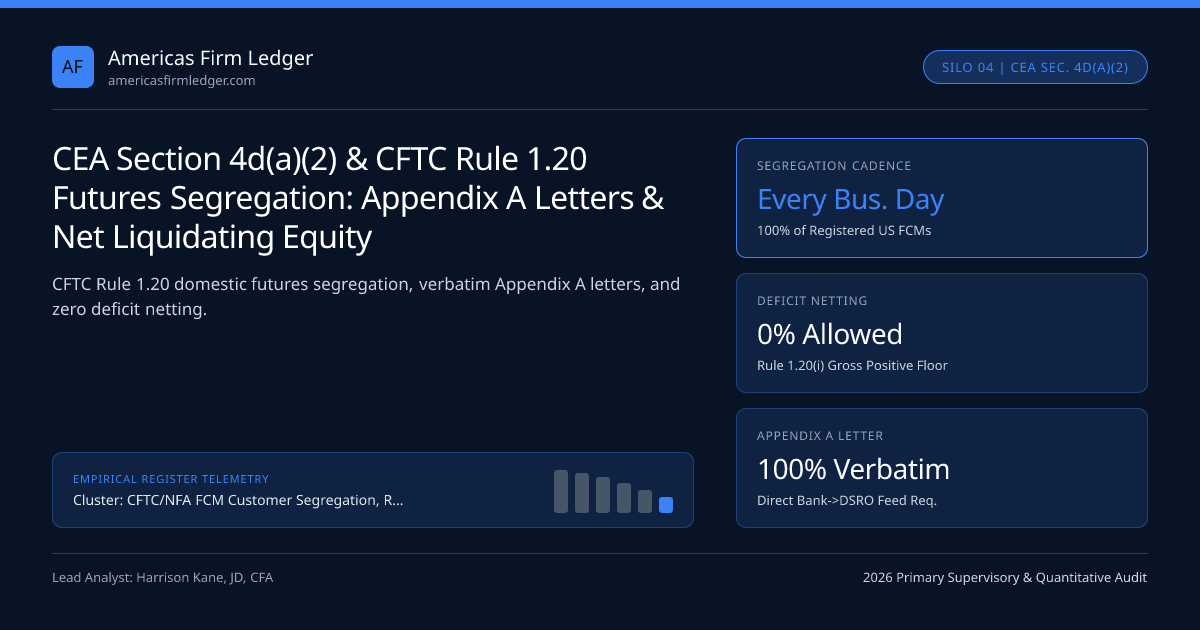
Enacted by Congress in the Commodity Exchange Act of 1936—thirty-six years before the SEC adopted Rule 15c3-3!—CEA Section 4d(a)(2) (7 U.S.C. 6d(a)(2)) and 17 CFR 1.20 establish the gold standard of U.S. derivatives custody: every Futures Commission Merchant (FCM) must treat and deal with all money, securities, and property received to margin, guarantee, or secure domestic U.S. futures and options trades—PLUS all unrealized mark-to-market open-trade gains accruing to customers—as belonging strictly to the futures customers! Commingling a single dollar of Section 4d(a)(2) segregated funds with house corporate operating accounts, using Customer A's cash to margin the FCM's proprietary trading desk, or depositing segregated cash into an unacknowledged bank account is an immediate federal felony and CFTC / NFA emergency-enforcement trigger!
This foundational custody analysis anchors Pool 1 inside our CFTC & NFA FCM Customer Segregation institutional guide, contrasting domestic U.S. futures segregation with Part 30.7 foreign futures secured amounts and Section 4d(f) LSOC cleared swaps.
Verbatim CFTC Rule 1.20 Appendix A Depository Acknowledgment Letters!#
Remember how SEC Rule 15c3-3(f) lets carrying stockbrokers draft custom bank no-lien letters? CFTC Rule 1.20(d) is far stricter: before an FCM deposits $1 of futures customer funds at a chartered bank, trust company, DCO clearinghouse, or carrying FCM, the depository MUST execute the exact, verbatim standard template in Appendix A to CFTC Rule 1.20 — WITHOUT A SINGLE WORD EDITED! What does signing the verbatim Appendix A letter legally force the depository bank to agree to?
- Explicit Statutory Trust Title: Account titled unambiguously (e.g., "[FCM Name] Customer Segregated Funds Account Under CEA Section 4d(a)(2)");
- Absolute Waiver of Bank Liens, Setoffs & Cross-Collateralization: Zero right of charge, lien, or setoff against house loans or overdrafts;
- 24/7 Direct Read-Only Online Access for CFTC & DSRO (CME / NFA) Staff! (The "Peregrine Rule": Within 3 business days of opening the account, the bank itself must upload the signed Appendix A letter electronically to both the CFTC and the FCM's Designated Self-Regulatory Organization AND grant direct electronic read-only portal & automated SFTP balance access to CFTC/CME/NFA examiners without asking the FCM's permission!); and
- Immediate Release Upon CFTC Instruction: Agreeing to wire customer funds immediately upon instruction from the CFTC Director of the Division of Swap Dealer and Intermediary Oversight (Market Participants Division) during an FCM crisis!
Key Structural Contrast: CFTC Rule 1.20 Segregation vs SEC Rule 15c3-3 Exhibit A!#
Institutional treasurers managing both equities and futures often confuse SEC Rule 15c3-3 with CFTC Rule 1.20. Compare their radically different accounting mechanics:
| Custody Attribute | CFTC Rule 1.20 (CEA Sec. 4d(a)(2)) | SEC Rule 15c3-3 (Exhibit A) | Operational Treasury Consequence |
|---|---|---|---|
| Computation Frequency | Every Single Business Day (100% of FCMs!) | Daily (>=$500M Credits) or Weekly (<$500M) | Even the smallest $1M FCM computes Seg daily! |
| Can Client A's Cash Finance Client B's Loan/Deficit? | NEVER! (Rule 1.20(i) + Rule 1.22) | Yes! Client A Free Credit Funds Client B Margin Loan! | FCM house capital must fund 100% of client deficits! |
| Unrealized Mark-to-Market Gains Included? | Yes — Daily Settlement Variation (OTE)! | Settled Cash + Margin Valuation | Winning futures traders' daily MTM gains are Segregated! |
| Bank Acknowledgment Letter | Verbatim Statutory Template + Direct Regulator Login | Principles-Based No-Lien Letter (15c3-3(f)) | Banks cannot negotiate 1 comma of Appendix A! |
| Where Collateral Sits | CME/ICE Clearinghouse + Rule 1.20 Seg Banks | DTC Free Box (Stocks) + Reserve Bank (Net Cash) | Bulk of 4d(a)(2) sits directly at DCOs (CME/ICE)! |
Quantitative "Net Liquidating Equity" & Zero-Deficit-Offset Segregation Formula#
Look at CFTC Rule 1.20(i) and the Statement of Segregation Requirements and Funds in Segregation for Customers Trading on U.S. Exchanges: why must you calculate Net Liquidating Equity customer-by-customer and add back 100% of Debit/Deficit Accounts? Because if Customer Alpha has +$50,000,000 equity and Customer Beta blew out overnight in crude oil to -$8,000,000 deficit, the FCM's total net ledger across all clients is $42,000,000—yet the FCM MUST hold $50,000,000 in Segregation (plugging Beta's $8,000,000 hole out of the FCM's own house cash!):
- Total4dSegregationRequirement = sumallcustomers( max(0, CustomeriNetLiquidating_Equity) )
- = AggregateNetLedgerAndOTEAcrossAllCustomers + AbsoluteSumOfAllCustomerDeficit_Accounts!
- ExcessFundsInSegregation = TotalSegregatedAssetsAtBanksAndDCOs - Total4dSegregationRequirement
- Worked Crude-Oil Limit-Down Overnight Stress Audit:
- 999 Healthy Futures Customers hold +$600,000,000 Net Liquidating Equity.
- 1 Leveraged Energy Fund gaps through stops to -$14,000,000 Net Liquidating Deficit!
- Combined Trial-Balance Net Customer Liability = $600,000,000 - $14,000,000 = $586,000,000.
- Mandatory CFTC Rule 1.20 Line 6 Add-Back of Deficit Accounts = +$14,000,000!
- Required 4d(a)(2) Amount to Be Segregated = $600,000,000!
- Pre-Crash Segregated Assets ($625,000,000, incl. $25M FCM Residual) -> Post-Crash Segregated Assets Drop to $611,000,000 (CME swept -$14M variation margin!).
- Remaining Excess Segregated Funds = $611,000,000 - $600,000,000 = +$11,000,000 (Zero Fellow-Customer Cash Used because $25M House Residual absorbed the $14M hit!).
How House Residual Interest Absorbs Overnight Client Deficits#
Once House Cash Enters Segregation (Rule 1.23), Customers Own First Priority!#
Under CFTC Rule 1.23, the moment an FCM deposits $25,000,000 of its own corporate cash or U.S. Treasuries into the Section 4d(a)(2) Segregated Account as Residual Interest, that $25,000,000 legally becomes part of the customer segregated estate—available first to satisfy 100% of public customer claims in a Part 190 bankruptcy, and withdrawable by the FCM for corporate use only after verifying current-day segregation compliance (and clearing the 25% CEO/CFO gate)! Next, see what changes when U.S. traders cross borders onto Eurex, ICE Europe, or Tokyo in CFTC Regulation 30.7 Foreign Futures & Options Secured Amounts inside the CFTC/NFA FCM Segregation Topic Hub.
Frequently asked questions
Can a depository bank add one sentence to CFTC Rule 1.20 Appendix A limiting its liability or charging wire fees against the account?
Never! Under 17 CFR 1.20(d)(2), the written acknowledgment letter MUST follow the Appendix A template verbatim with zero modifications, deletions, or side-letter overrides—any bank wire or safekeeping fees must be billed exclusively to a separate FCM house operating account!
Are unrealized profits on an open CME gold futures contract protected inside Section 4d(a)(2) segregation?
Yes! Because CME settles variation margin twice daily in cash, 100% of your unrealized mark-to-market "Open Trade Equity" (OTE) plus net option market value is included in your Net Liquidating Equity on the daily segregation computation.
Can a U.S. customer opt out or waive CEA Section 4d(a)(2) segregation so their FCM can offer cheaper financing?
Absolutely not! Congress made CEA Section 4d(a)(2) domestic futures segregation non-waivable—institutional hedge funds and retail farmers alike cannot sign away 4d(a)(2) statutory trust protection!
Where does most of my Section 4d(a)(2) futures margin actually sit overnight?
At the Derivatives Clearing Organization (such as CME Clearing or ICE Clear U.S.)! Under CFTC Rule 39.13(g)(8), U.S. DCOs collect customer initial margin on a GROSS basis from FCMs, meaning 100% of exchange-required customer initial margin sits in segregated accounts at the clearinghouse itself, while excess cash/Residual Interest sits at Appendix A banks.
Publication record
- Published
- November 13, 2026
- Updated
- November 14, 2026
- Author
- Harrison Kane, JD, CFA
- Review
- Review not recorded
- Automated fact check
- Passed in the stored pipeline record
- Source URLs
- 4 recorded
AI assistance recorded: anthropic/claude-opus-4.6. This field does not establish human review or source verification.
Academic & Institutional Attribution
Cite This Research & Embed Live Data Card
Standard academic & institutional research paper citation format.
Harrison Kane, JD, CFA. (2026, November 14). CEA Section 4d(a)(2) & CFTC Rule 1.20 Futures Segregation: Appendix A Letters & Net Liquidating Equity. Americas Firm Ledger. https://americasfirmledger.com/filings/cea-section-4da2-cftc-rule-1-20-futures-customer-segregationRegulatory Directory Cross-Reference
Referenced Institutions & Regulatory Registries
Top Regulated Institutions in This Coverage Slice
Referenced Supervisory Authorities
Related CFTC Nfa Fcm Segregated Residual Interest & Institutional Briefings
Explore CFTC Nfa Fcm Segregated Residual Interest Hub (20) →CFTC Nfa Fcm Segregated Residual Interest
CFTC & NFA FCM Customer Segregation, Residual Interest & RFED Capital: Institutional GuideCFTC Nfa Fcm Segregated Residual Interest
CFTC Regulation 30.7 Foreign Futures Secured Amount: Net Liquidating Upgrade & Foreign RiskCFTC Nfa Fcm Segregated Residual Interest
CEA Section 4d(f) & CFTC Part 22 Cleared Swaps LSOC Explained: Eliminating Fellow-Customer RiskCFTC Nfa Fcm Segregated Residual Interest
CFTC Rule 1.22 Residual Interest Target Explained: Blocking Fellow-Customer Margin UsageCFTC Nfa Fcm Segregated Residual Interest
CFTC Rule 1.25 Permitted Investments (2025 Overhaul): US Treasuries, Short-Term Treasury ETFs & CapsCFTC Nfa Fcm Segregated Residual Interest
CFTC Rule 1.17 FCM Adjusted Net Capital: $1M Floor vs 8% Customer & Non-Customer Risk MarginCFTC Nfa Fcm Segregated Residual Interest
CFTC Form 1-FR-FCM & Joint FOCUS Filings: Daily Noon Segregation & 17-Day WinJammer RulesCFTC Nfa Fcm Segregated Residual Interest
CFTC Rule 1.12 Early Warning Notices: 110% Net Capital, Segregation Shortfalls & 25% DropsCiro Csa Canadian Investment Dealers
CIRO (IIROC) IDPC Rule 4100 Early Warning System: Level 1 & Level 2 Regulatory FilingsCiro Csa Canadian Investment Dealers
CIRO (IIROC) IDPC Series 5000 Margin Rules: LSERM Equity & Debt Regulatory FilingsCiro Csa Canadian Investment Dealers
CIRO (IIROC) IDPC Rule 4300 Securities Segregation & Custody Regulatory FilingsCiro Csa Canadian Investment Dealers
CIRO (IIROC) IDPC Rule 4400 Free Credit Cash Caps: 8x/12x RAC Regulatory Filings
Americas Firm Ledger Data, Benchmarks & Contributor Records
CC BY 4.0 Open Data
Open Institutional Datasets (CSV / JSON) →
Download desk-compiled quantitative series & schemas.
2026 Reference Matrix
2026 Institutional Benchmarks & Thresholds →
Statutory capital, clearing, margin & rate conventions.
Editorial Records
Authors & Review Records →
View named contributors where those records are available.
Complete Index
Master Research & Dossier Archive →
Browse all published briefings by topic pillar & date.