
CFTC Nfa Fcm Segregated Residual Interest
CFTC Regulation 30.7 Foreign Futures Secured Amount: Net Liquidating Upgrade & Foreign Risk
When U.S.-domiciled customers trade Brent crude on ICE Futures Europe, Bunds on Eurex, or Nikkei futures on JPX, CFTC Regulation 30.7 requires 100% Net Liquidating Equity segregation—yet exposes cross-border traders to foreign broker omnibus insolvency regimes disclosed under Rule 1.55.
In October 2011, global commodities broker MF Global Inc. collapsed with a breathtaking $900+ million shortfall concentrated heavily inside its CFTC Regulation 30.7 Foreign Futures and Options Secured Amount accounts! How did that happen legally on paper until the final chaotic days? Because pre-2013 CFTC rules permitted an infamous "Alternative Method" where U.S. FCMs only had to set aside the minimum initial margin required by foreign exchanges (~$1B), leaving hundreds of millions of dollars of excess U.S. customer cash sitting completely unsegregated inside house corporate accounts in London! In its sweeping 2013 Customer Protection Final Rule, the CFTC permanently abolished the Alternative Method—upgrading 17 CFR 30.7 to the exact same 100% Net Liquidating Equity + Residual Interest formula as domestic Section 4d(a)(2)!
This cross-border custody analysis anchors Pool 2 inside our CFTC & NFA FCM Customer Segregation institutional guide, contrasting foreign futures custody with Section 4d(a)(2) domestic futures segregation and Part 190 bankruptcy account-class waterfalls.
Post-MF Global Parity — AND the Crucial Foreign Insolvency Caveat!#
While NFA and the CFTC harmonized the dollar calculation, daily Noon WinJammer reporting, Rule 1.22 Residual Interest, and 25% CEO withdrawal sign-offs of Part 30.7 with domestic Rule 1.20, one massive legal risk difference CANNOT be legislated away by Washington: Foreign Sovereign & Foreign Broker Insolvency Law!
- Who Belongs in the Part 30.7 Pool?: Under CFTC Rule 30.1(f), "30.7 Customers" now include BOTH U.S.-domiciled AND foreign-domiciled customers of a U.S. FCM trading futures or options on foreign boards of trade (such as Eurex in Frankfurt, ICE Futures Europe in London, Montreal Exchange in Canada, or SGX in Singapore)!
- Six Permissible 30.7 Depository Categories (17 CFR 30.7(b)):
- A U.S. bank or trust company;
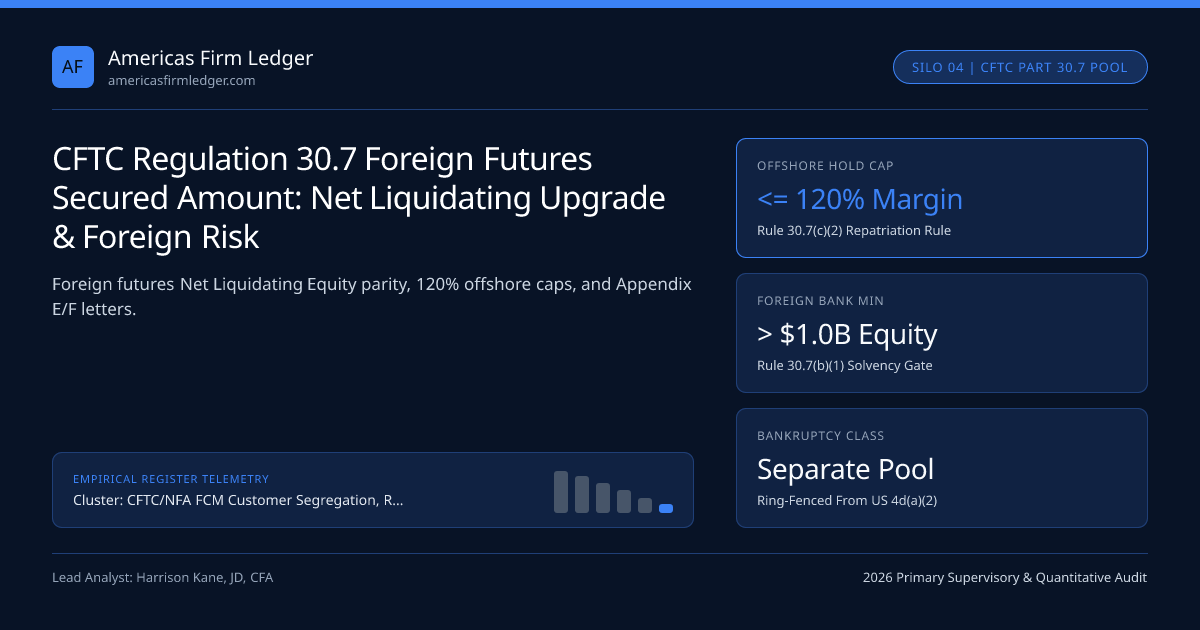
- A foreign bank with > $1 billion in regulatory capital (or whose commercial paper/long-term debt carries highest credit ratings);
- Another registered U.S. FCM;
- The clearing organization of any foreign board of trade;
- A member of any foreign board of trade (i.e., a local London/Frankfurt/Tokyo carrying broker!); or
- Such foreign member's or clearing organization's designated depositories!
- The Foreign Omnibus Subordination Risk: Once a U.S. FCM wires EUR or JPY margin to a local carrying broker or foreign clearinghouse in Frankfurt, London, or emerging markets, local bankruptcy courts in that foreign country—NOT a U.S. Bankruptcy Judge enforcing CEA Section 4d—govern whether those assets return intact if the FOREIGN broker or foreign bank fails!
The CFTC Rule 30.7(c) "20% Foreign Broker Cap" (Stopping Offshore Cash Parking!)#
How did the CFTC stop another MF Global from wiring $700 million of U.S. customers' excess idle cash to a London affiliate to plug European repo liquidity holes? Look at 17 CFR 30.7(c)(2) — one of the smartest quantitative ring-fences in global derivatives law! A U.S. FCM is strictly PROHIBITED from holding customer funds with a foreign broker or foreign clearinghouse in an amount that exceeds 120% (i.e., required exchange margin + a maximum 20% operational buffer) of the actual margin required on those foreign trades! Every dollar of excess 30.7 customer cash above that 20% operational foreign-currency working cushion MUST stay parked onshore inside U.S. banks or U.S. Treasuries!
| Custodial Dimension | Domestic 4d(a)(2) Pool (Rule 1.20) | Foreign 30.7 Secured Pool (Rule 30.7) | Institutional Treasury Action |
|---|---|---|---|
| Exchanges Covered | US DCMs (CME, CBOT, NYMEX, ICE US, Cboe) | Foreign Boards (ICE Europe, Eurex, MX, JPX, ASX) | Separate Account Origin Code (F vs S / 30.7) |
| Formula Standard | 100% Net Liquidating Equity (Zero Deficit Net) | 100% Net Liquidating Equity (Identical!) | Compute Daily by Noon CT via WinJammer |
| Max Cash Held Offshore at Foreign Broker | N/A (100% Domestic US) | Capped at <= 120% of Required Foreign Margin! | Sweep Excess >120% Back to US 30.7 Bank Daily! |
| Bank Acknowledgment Template | Rule 1.20 Appendix A / B | Part 30 Appendix E (Bank) / Appendix F (Foreign Broker) | Mandatory Direct DSRO Balance Access |
| Part 190 US Bankruptcy Account Class | Futures Account Class | Separate Foreign Futures Account Class! | Pool Losses Do NOT Cross-Infect 4d(a)(2)! |
Quantitative Rule 30.7(c) Onshore Repatriation Formula!#
Run this daily international treasury sweep test on a U.S. FCM whose clients trade Eurex Bunds and ICE Brent Crude:
- MaxPermittedOffshoreBrokerHold = 1.20 * ForeignExchangeRequiredMarginAtForeignBroker
- MandatoryOnshoreUS307Lockup = Total307SecuredRequirement - min(ActualOffshoreHold, MaxPermittedOffshoreBroker_Hold)
- Worked Daily London / Frankfurt Sweep Audit:
- Total U.S. FCM Part 30.7 Customer Net Liquidating Equity = $400,000,000
- Actual Initial + Variation Margin Required on Eurex & ICE Futures Europe = $150,000,000
- Maximum Permitted Balance Held at London Carrying Affiliate (120% Cap) = 1.20 * $150,000,000 = $180,000,000!
- Suppose intraday European closes push London affiliate balance to $215,000,000!
- Mandatory CFTC Rule 30.7(c)(2) Action: Repatriate at least $35,000,000 ($215M - $180M) BACK to an onshore U.S. 30.7 Bank Account (bringing minimum onshore U.S. 30.7 safe-harbor holdings to >= $220,000,000 + FCM Residual Interest)!
Rule 30.7(c) Onshore Lockup vs 120% Offshore Broker Cap#
Ring-Fencing 4d(a)(2) From 30.7: Why Separate Part 190 Account Classes Matter!#
Under CFTC Part 190 (Bankruptcy Rules), Domestic Futures (4d(a)(2)) and Foreign Futures (30.7) constitute two completely separate bankruptcy "Account Classes"! If a rogue foreign sub-custodian in an overseas market defaults and creates a 15% shortfall in the FCM's Part 30.7 pool, Part 30.7 customers bear that pro-rata loss while pure domestic CME 4d(a)(2) agricultural/Treasury futures customers stay 100% insulated! For that exact reason, sophisticated institutional hedgers instruct their FCMs to sweep any idle excess cash out of their 30.7 sub-account back into their domestic 4d(a)(2) sub-account every afternoon! Next, inspect Pool 3—the most advanced anti-fellow-customer-risk model in derivatives—in CEA Section 4d(f) & Part 22 Cleared Swaps LSOC inside the CFTC/NFA FCM Segregation Topic Hub.
Frequently asked questions
What was the pre-2013 CFTC "Alternative Method" under Rule 30.7 and why was it repealed?
Prior to 2013, the Alternative Method allowed U.S. FCMs to segregate only required foreign exchange margin plus open trades rather than 100% of customer net liquidating equity—leaving excess client cash unsegregated in house accounts, which directly enabled MF Global's 2011 30.7 shortfall.
Why do institutional CTAs sweep idle excess cash from their 30.7 foreign futures sleeve back into their 4d(a)(2) domestic futures sleeve?
Because 4d(a)(2) funds sit 100% inside U.S. statutory trust jurisdiction (CME/ICE U.S. and U.S. Appendix A banks), whereas the portion of 30.7 funds wired abroad to foreign carrying brokers remains exposed to foreign insolvency courts in a systemic crisis!
Are non-U.S. residents who open an account at a Chicago CFTC-registered FCM to trade Eurex Bunds included in the 30.7 Secured Amount?
Yes! Following the 2013 amendments to CFTC Rule 30.1(f), "30.7 Customer" covers BOTH U.S.-domiciled and foreign-domiciled customers trading foreign futures through a U.S. FCM (improving pro-rata clarity in a Part 190 liquidation).
Can an FCM automatically move cash between my 4d(a)(2) domestic futures account and my 30.7 foreign futures account overnight to prevent margin calls?
Yes, provided you signed an explicit written standing authorization under CFTC Rules 1.20/30.7 permitting automated excess-equity sweeps between your own origin sub-accounts on the FCM's books!
Publication record
- Published
- November 13, 2026
- Updated
- November 15, 2026
- Author
- Harrison Kane, JD, CFA
- Review
- Review not recorded
- Automated fact check
- Passed in the stored pipeline record
- Source URLs
- 4 recorded
AI assistance recorded: anthropic/claude-opus-4.6. This field does not establish human review or source verification.
Academic & Institutional Attribution
Cite This Research & Embed Live Data Card
Standard academic & institutional research paper citation format.
Harrison Kane, JD, CFA. (2026, November 15). CFTC Regulation 30.7 Foreign Futures Secured Amount: Net Liquidating Upgrade & Foreign Risk. Americas Firm Ledger. https://americasfirmledger.com/filings/cftc-part-30-7-foreign-futures-secured-amount-omnibus-riskRegulatory Directory Cross-Reference
Referenced Institutions & Regulatory Registries
Top Regulated Institutions in This Coverage Slice
Related CFTC Nfa Fcm Segregated Residual Interest & Institutional Briefings
Explore CFTC Nfa Fcm Segregated Residual Interest Hub (20) →CFTC Nfa Fcm Segregated Residual Interest
CFTC & NFA FCM Customer Segregation, Residual Interest & RFED Capital: Institutional GuideCFTC Nfa Fcm Segregated Residual Interest
CEA Section 4d(f) & CFTC Part 22 Cleared Swaps LSOC Explained: Eliminating Fellow-Customer RiskCFTC Nfa Fcm Segregated Residual Interest
CFTC Rule 1.22 Residual Interest Target Explained: Blocking Fellow-Customer Margin UsageCFTC Nfa Fcm Segregated Residual Interest
CFTC Rule 1.25 Permitted Investments (2025 Overhaul): US Treasuries, Short-Term Treasury ETFs & CapsCFTC Nfa Fcm Segregated Residual Interest
CFTC Rule 1.17 FCM Adjusted Net Capital: $1M Floor vs 8% Customer & Non-Customer Risk MarginCFTC Nfa Fcm Segregated Residual Interest
CFTC Form 1-FR-FCM & Joint FOCUS Filings: Daily Noon Segregation & 17-Day WinJammer RulesCFTC Nfa Fcm Segregated Residual Interest
CFTC Rule 1.12 Early Warning Notices: 110% Net Capital, Segregation Shortfalls & 25% DropsCFTC Nfa Fcm Segregated Residual Interest
Retail Foreign Exchange Dealers (RFEDs) Under CFTC Rule 5.7: $20M Capital, 5% Add-On & No Seg!Ciro Csa Canadian Investment Dealers
CIRO (IIROC) IDPC Series 5000 Margin Rules: LSERM Equity & Debt Regulatory FilingsCiro Csa Canadian Investment Dealers
CIRO (IIROC) IDPC Rule 4300 Securities Segregation & Custody Regulatory FilingsCiro Csa Canadian Investment Dealers
CIRO (IIROC) IDPC Rule 4400 Free Credit Cash Caps: 8x/12x RAC Regulatory FilingsCiro Csa Canadian Investment Dealers
CIPF CAD $1M Coverage Rules: CIRO General vs. Separate Registered Filings
Americas Firm Ledger Data, Benchmarks & Contributor Records
CC BY 4.0 Open Data
Open Institutional Datasets (CSV / JSON) →
Download desk-compiled quantitative series & schemas.
2026 Reference Matrix
2026 Institutional Benchmarks & Thresholds →
Statutory capital, clearing, margin & rate conventions.
Editorial Records
Authors & Review Records →
View named contributors where those records are available.
Complete Index
Master Research & Dossier Archive →
Browse all published briefings by topic pillar & date.