
CFTC Nfa Fcm Segregated Residual Interest
CEA Section 4d(f) & CFTC Part 22 Cleared Swaps LSOC Explained: Eliminating Fellow-Customer Risk
Adopted under Dodd-Frank CEA Section 4d(f) and 17 CFR Part 22, the Legally Segregated, Operationally Commingled (LSOC) model protects cleared interest-rate and credit-default swap customers from "Fellow-Customer Risk".
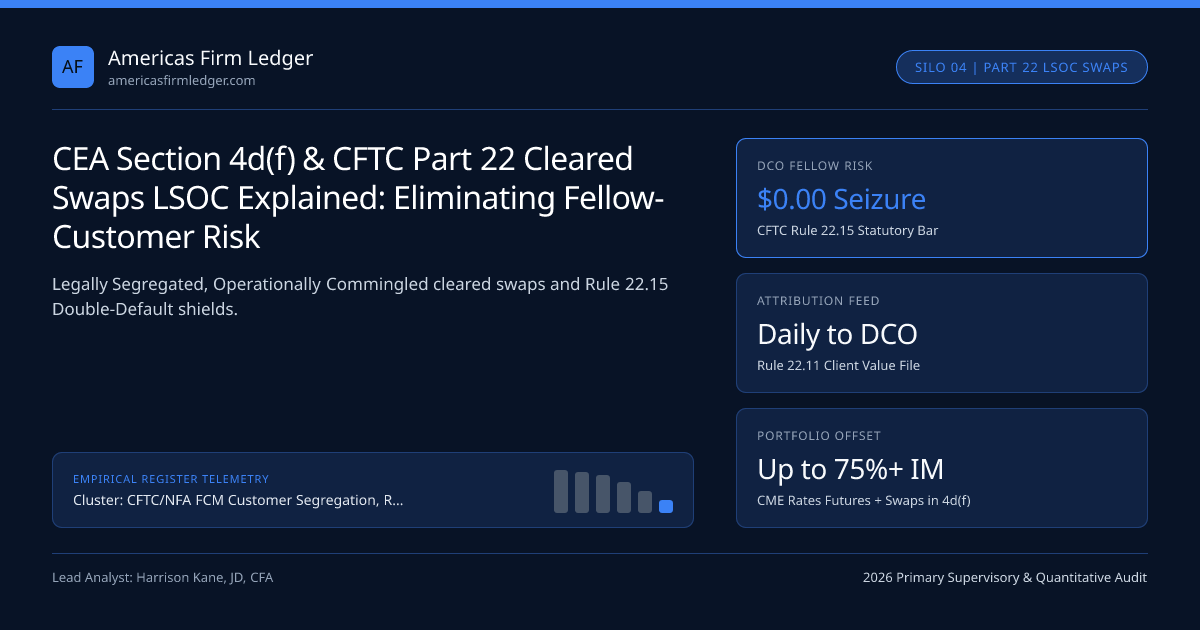
When Title VII of the Dodd-Frank Act forced trillions of dollars of over-the-counter interest-rate swaps (SOFR OIS) and credit-default swap indices (CDX) into mandatory central clearing through Futures Commission Merchants, pension funds and asset managers raised a fierce objection: "In traditional 4d(a)(2) futures, if another hedge fund at our FCM blows up by $2 billion AND bankrupts the FCM (a Double Default), CME Clearing can legally seize OUR omnibus futures initial margin at the DCO to cure the defaulting hedge fund's hole (Fellow-Customer Risk)! We refuse to expose $50 billion of pension swap collateral to Fellow-Customer Risk!" To solve that dilemma without paying the astronomical operational fees of 10,000 individual physical custodian vaults, the CFTC invented LSOC — Legally Segregated, Operationally Commingled under CEA Section 4d(f) (7 U.S.C. 6d(f)) and 17 CFR Part 22!
This cleared-swaps architecture guide completes the Three-Pool trilogy inside our CFTC & NFA FCM Customer Segregation institutional guide, contrasting LSOC with Section 4d(a)(2) futures and Rule 1.22 Residual Interest buffers.
How "Legally Segregated, Operationally Commingled" (LSOC) Actually Works!#
Look at the two halves of the phrase LSOC (17 CFR 22.2 – 22.15):
- "Operationally Commingled" (Zero Physical Sub-Custodian Fee Drag): Day to day, the FCM and the Derivatives Clearing Organization (DCO—such as CME Clearing, LCH Ltd., or ICE Clear Credit) hold cleared swap customers' cash and U.S. Treasury collateral inside one single pooled omnibus Cleared Swaps Customer Account—avoiding thousands of wire fees and individual Tri-Party custody charges!
- "Legally Segregated" (Daily Customer-by-Customer Attribution to the DCO — Rule 22.11 & Rule 22.15): At least once every business day, every FCM must electronically transmit to the DCO an individual customer-by-customer collateral value ledger identifying the exact dollar value of collateral belonging to each individual Cleared Swaps Customer (LEI / account ID)!
- The Ironclad Rule 22.15 Double-Default Firewall: If Hedge Fund Z defaults on a massive interest-rate swap AND bankrupts its clearing FCM ("Double Default"), CFTC Rule 22.15 strictly PROHIBITS the DCO from touching $0.01 of the collateral attributed to Non-Defaulting Cleared Swaps Customers A, B, and C at the DCO! Instead, the DCO can seize only Defaulting Hedge Fund Z's attributed slice, then the FCM's own house capital/guaranty-fund contribution, and then the DCO's own default waterfall—while porting Non-Defaulting Customers A, B, and C + 100% of their attributed DCO initial margin intact to a new solvent FCM!
Wait — What Risk Does LSOC NOT Eliminate? ("FCM Operational / Excess Buffer Risk"!)#
Read the fine print that institutional pension consultants test on every exam: LSOC protects collateral sitting AT THE DCO (or value reported to the DCO)—it does NOT eliminate pro-rata shortfall risk if an FCM commits operational fraud or under-segregation inside its OWN bank accounts BEFORE transmitting excess collateral to the DCO! Compare all three segregation models side by side:
| Risk Scenario | Traditional 4d(a)(2) Futures (Rule 1.20) | Standard 4d(f) LSOC (Part 22) | LSOC With Excess at DCO |
|---|---|---|---|
| Fellow-Customer Double Default at DCO | Exposed! DCO can tap omnibus Customer Pool! | PROTECTED ($0 DCO Seizure of Innocent IM)! | PROTECTED (Both IM + Excess Protected at DCO!) |
| Post-Default Position Porting Speed | Slower if omnibus DCO margin depleted | Rapid Porting (100% Required IM Intact at DCO!) | Rapid Porting (IM + Excess Intact!) |
| FCM Operational Fraud / Theft in FCM Bank | Exposed (Pro-Rata Pool Share) | Exposed ONLY on un-transmitted excess left at FCM! | Minimized (Excess Pushed Up to DCO!) |
| Specific Securities CUSIP Return? | Value-Based / Pro-Rata (Part 190) | Value-Based (Dollar Value Protected, Not Specific CUSIP!) | Value-Based Dollar Protection |
| Custody Cost Drag | Lowest (Omnibus) | Low (Omnibus Pool + Electronic Ledger) | Low-to-Moderate DCO Fee |
Quantitative Double-Default Recovery Comparison: 4d(a)(2) vs Part 22 LSOC!#
Run the exact numbers on a catastrophic $400,000,000 Double Default where a rogue macro fund loses $450M overnight ($50M posted IM -> -$400M unpaid loss), wiping out the FCM's $150,000,000 house capital & residual interest—leaving a $250,000,000 uncovered hole at the DCO alongside $2,000,000,000 of innocent customers' initial margin sitting at the DCO:
- LossToInnocentClients4da2 = UncoveredDoubleDefault_Hole (DCO Taps Omnibus Futures Pool -> 12.5% Haircut on Innocent Clients!)
- LossToInnocentClientsLSOC = $0.00! (Rule 22.15 Forces DCO Default Waterfall / Mutualized Guaranty Fund to Eat the $250M!)
- Worked Pension Fund Impact ($100,000,000 Initial Margin Posted at DCO, Zero Excess Left at FCM):
- If Held in 4d(a)(2) Omnibus Futures Pool:
- DCO seizes $250M / $2,000M = 12.5% from omnibus pool -> Pension Fund loses $12,500,000 to Fellow-Customer Risk!
- If Held in 4d(f) Part 22 LSOC Cleared Swaps Pool:
- Rule 22.15 bars DCO from seizing $0.01 of Pension Fund's $100,000,000 attributed value!
- DCO absorbs $250M via DCO Skin-in-the-Game + Solvent Clearing Members' Default Fund!
- Pension Fund Recovery & Ported Margin to New Solvent FCM = $100,000,000 (100.0% WHOLE!).
$100M Pension Fund Recovery in a $250M Double Default#
Smart Institutional Optimization: Portfolio Margining Treasury Futures INTO 4d(f) LSOC!#
Here is how the largest fixed-income asset managers on Wall Street get BOTH massive margin savings (up to 70%–80% initial margin offset!) AND superior LSOC Fellow-Customer protection: when trading CME Interest-Rate Futures (2Y/5Y/10Y/SOFR Futures) hedged against CME Cleared Interest-Rate Swaps, institutional clients apply for CFTC-approved Cross/Portfolio Margining inside the Section 4d(f) Cleared Swaps Account—moving those interest-rate futures into the Part 22 LSOC pool! Next, examine how the CFTC hardened 4d(a)(2) and 30.7 against fellow-customer risk via house-funded Residual Interest Targets in CFTC Rule 1.22 Residual Interest buffers & T+1 6:00 PM deadlines inside the CFTC/NFA FCM Segregation Topic Hub.
Frequently asked questions
Why didn't the CFTC mandate individual physical custodial vaults instead of LSOC for cleared swaps?
Individual physical segregation ("Full Physical Segregation") would require thousands of separate tri-party custodian sub-accounts, tripling wire costs and preventing operational bulk netting—whereas LSOC eliminates DCO fellow-customer risk electronically at a fraction of the cost!
If I post a specific off-the-run 2032 U.S. Treasury Note as Cleared Swaps margin under LSOC, am I guaranteed that exact CUSIP back in bankruptcy?
Not necessarily that exact CUSIP! LSOC is a VALUE-segregation regime—you are legally protected for the full dollar market value of your attributed collateral (avoiding fellow-customer loss), though a Part 190 trustee or DCO may return cash or pro-rata equivalent value.
What is the difference between standard LSOC and "LSOC With Excess"?
In standard LSOC, any extra cash cushion you leave above exchange initial margin sits in the FCM's omnibus Cleared Swaps bank account (exposed to FCM bank-level shortfall risk); in "LSOC With Excess" (where supported by the DCO/FCM), that excess cushion is pushed all the way up to the DCO and legally attributed to your ID!
Can a retail futures trader put standalone corn or crude oil futures into a Part 22 LSOC account?
No. Section 4d(f) LSOC applies only to Cleared Swaps (and specific CFTC/DCO-approved commingled futures positions—such as interest-rate futures risk-offsetting cleared interest-rate swaps—under formal portfolio-margining orders).
Publication record
- Published
- November 13, 2026
- Updated
- November 14, 2026
- Author
- Harrison Kane, JD, CFA
- Review
- Review not recorded
- Automated fact check
- Passed in the stored pipeline record
- Source URLs
- 4 recorded
AI assistance recorded: anthropic/claude-opus-4.6. This field does not establish human review or source verification.
Academic & Institutional Attribution
Cite This Research & Embed Live Data Card
Standard academic & institutional research paper citation format.
Harrison Kane, JD, CFA. (2026, November 14). CEA Section 4d(f) & CFTC Part 22 Cleared Swaps LSOC Explained: Eliminating Fellow-Customer Risk. Americas Firm Ledger. https://americasfirmledger.com/filings/cea-section-4df-part-22-cleared-swaps-lsoc-segregation-modelRelated CFTC Nfa Fcm Segregated Residual Interest & Institutional Briefings
Explore CFTC Nfa Fcm Segregated Residual Interest Hub (20) →CFTC Nfa Fcm Segregated Residual Interest
CFTC & NFA FCM Customer Segregation, Residual Interest & RFED Capital: Institutional GuideCFTC Nfa Fcm Segregated Residual Interest
CFTC Rule 1.22 Residual Interest Target Explained: Blocking Fellow-Customer Margin UsageCFTC Nfa Fcm Segregated Residual Interest
CFTC Rule 1.25 Permitted Investments (2025 Overhaul): US Treasuries, Short-Term Treasury ETFs & CapsCFTC Nfa Fcm Segregated Residual Interest
CFTC Rule 1.17 FCM Adjusted Net Capital: $1M Floor vs 8% Customer & Non-Customer Risk MarginCFTC Nfa Fcm Segregated Residual Interest
CFTC Form 1-FR-FCM & Joint FOCUS Filings: Daily Noon Segregation & 17-Day WinJammer RulesCFTC Nfa Fcm Segregated Residual Interest
CFTC Rule 1.12 Early Warning Notices: 110% Net Capital, Segregation Shortfalls & 25% DropsCFTC Nfa Fcm Segregated Residual Interest
Retail Foreign Exchange Dealers (RFEDs) Under CFTC Rule 5.7: $20M Capital, 5% Add-On & No Seg!CFTC Nfa Fcm Segregated Residual Interest
NFA Section 12 Retail Forex Security Deposits: 2% Major Currency (50:1) & 5% Exotic CapsCiro Csa Canadian Investment Dealers
CIRO (IIROC) IDPC Rule 4300 Securities Segregation & Custody Regulatory FilingsCiro Csa Canadian Investment Dealers
CIRO (IIROC) IDPC Rule 4400 Free Credit Cash Caps: 8x/12x RAC Regulatory FilingsCiro Csa Canadian Investment Dealers
CIPF CAD $1M Coverage Rules: CIRO General vs. Separate Registered FilingsCiro Csa Canadian Investment Dealers
CIPF vs. CDIC CAD $100k Deposit Insurance: Chartered Bank GIC & Cash ETF Filings
Americas Firm Ledger Data, Benchmarks & Contributor Records
CC BY 4.0 Open Data
Open Institutional Datasets (CSV / JSON) →
Download desk-compiled quantitative series & schemas.
2026 Reference Matrix
2026 Institutional Benchmarks & Thresholds →
Statutory capital, clearing, margin & rate conventions.
Editorial Records
Authors & Review Records →
View named contributors where those records are available.
Complete Index
Master Research & Dossier Archive →
Browse all published briefings by topic pillar & date.