
CFTC Nfa Fcm Segregated Residual Interest
CFTC Part 190 & Bankruptcy Code Subchapter IV FCM Liquidation: Account Classes & Porting
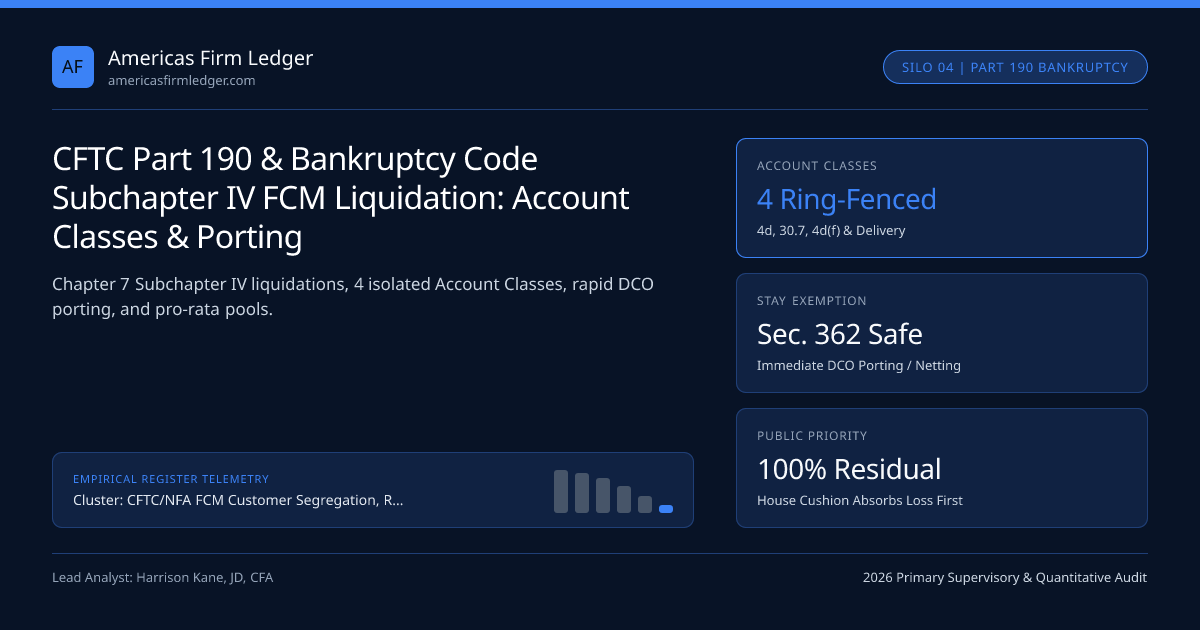
Futures Commission Merchants never reorganize in Chapter 11—they liquidate exclusively under Bankruptcy Code Chapter 7 Subchapter IV (11 U.S.C. 761-767) and modernized CFTC Part 190, granting public customers super-priority over House Residual Interest, rapid bulk position porting.
What actually happens at 2:00 AM if a registered Futures Commission Merchant goes bankrupt? First, forget Chapter 11 corporate reorganization: under 11 U.S.C. 109(d), commodity brokers are categorically barred from Chapter 11! Instead, a standalone FCM liquidates under Subchapter IV of Chapter 7 of the U.S. Bankruptcy Code (11 U.S.C. 761–767) governed by the CFTC's comprehensive 2021 overhaul of 17 CFR Part 190 (86 FR 19324)—while a joint SEC Broker-Dealer / CFTC FCM (like Lehman Brothers Inc. in 2008 or MF Global Inc. in 2011!) liquidates inside a SIPA proceeding where the SIPA Trustee MUST strictly apply Subchapter IV and CFTC Part 190 to all futures and cleared-swap Account Classes (15 U.S.C. 78fff-1(b))!
This insolvency waterfall guide pairs directly with our SIPA securities liquidation guide and Three-Pool CFTC Segregation Hub.
The Four Separate CFTC Part 190 "Account Classes" (17 CFR 190.01)!#
Under modernized CFTC Part 190, customer property is NOT thrown into one giant melting pot! Instead, the Chapter 7 / SIPA Trustee partitions customer claims and segregated assets into four hermetically sealed Account Classes:
- Futures Account Class (CEA Section 4d(a)(2) domestic futures & options);
- Foreign Futures Account Class (CFTC Part 30.7 foreign futures & options);
- Cleared Swaps Account Class (CEA Section 4d(f) / Part 22 LSOC cleared swaps); AND
- Delivery Account Class (Added / modernized in the 2021 Part 190 Final Rule! — Isolates physical warehouse receipts, COMEX gold bars, NYMEX crude delivery obligations, and cash held exclusively for physical commodity delivery outside cash-settled trading!).
Crucial Ring-Fencing Rule: Each Account Class shares pro-rata ONLY in the Customer Property recovered for that specific Account Class (plus any shortfall supplement swept from the FCM's House Residual Interest in that pool or traceable shortfall recovery under Rule 190.08/190.09)!
Side-by-Side Insolvency Comparison: SIPA (Securities BD) vs Subchapter IV / Part 190 (Futures FCM)!#
Even inside a single joint BD/FCM collapse (like Lehman Brothers Inc. or MF Global Inc.), a hedge fund's securities account and futures account obey two completely different sets of rules:
| Bankruptcy Dimension | Securities Account (SIPA / SEC 15c3-3) | Futures / Swaps Account (Subchapter IV / CFTC Part 190) | Practical Impact on Hedgers |
|---|---|---|---|
| Statutory Insurance Fund Backstop | Yes — $500,000 SIPC ($250k Cash) | $0.00 Statutory Fund! | Futures rely 100% on Segregation + Residual! |
| Treatment of Open Derivative Hedges | Options often closed out; Stocks transferred | Top Priority: Port Open Futures/Swaps Intact (Rule 190.07)! | Grain/oil hedgers keep live futures hedges! |
| Specific CUSIP vs Dollar Value Return! | SIPA delivers exact stock CUSIPs in-kind! | Value-Based Pro-Rata Pool! Treasury collateral may be liquidated/valued pro-rata (Rule 190.08)! | Posting T-Bills in 4d(a)(2) still shares % pool shortfall! |
| Automatic Stay (11 U.S.C. 362(b)(6)) | Limited SIPA stay on customer property | Broad Safe Harbor for DCOs (CME/LCH) to net/close/port immediately! | Zero courtroom freeze blocking CME clearing! |
| Clawback of Pre-Bankruptcy Margin Transfers? | Subject to Ponzi/preference rules | 11 U.S.C. 546(e) & 764(b) Safe Harbor! CFTC-approved bulk customer ports cannot be clawed back! | Solvent receiving FCMs accept ported books safely! |
Quantitative Part 190 Pro-Rata "Net Equity" & Residual-Absorbed Payout Formula!#
Look at one critical surprise for institutional treasurers who post $50,000,000 of specific U.S. Treasury Bills instead of cash as futures initial margin in a 4d(a)(2) account, thinking "My specific T-Bill CUSIP can't suffer a haircut if the FCM has a cash shortfall!": WRONG! Under 11 U.S.C. 766(h) and CFTC Rule 190.08/190.09, ALL customer cash AND customer-owned securities in an Account Class pool together on a pro-rata Net Equity VALUE basis (except ultra-rare "specifically identifiable property" essentially eliminated in modern omnibus book-entry clearing)! However, 100% of the FCM's House Residual Interest in that pool is wiped out FIRST before public customers lose a dime:
- PublicCustomerRecoveryPct = min(1.00, TotalAccountClassCustomerProperty / TotalAllowedPublicCustomerNetEquity_Claims)
- IndividualCustomerPayout = CustomerAllowedNetEquityClaim * PublicCustomerRecovery_Pct
- Worked Part 190 Futures Account Class Distribution:
- Total Public Customer Allowed Net Equity Claims in 4d(a)(2) Class = $1,000,000,000
- (Includes Client X who posted $50,000,000 of specific T-Bills + 999 Clients who posted $950,000,000 Cash!)
- Case A (Double-Default Loss = $40M; FCM Held $60M House Residual Interest):
- Pool Assets Remaining = $1,060M - $40M = $1,020,000,000 >= $1,000,000,000 Claims!
- Public Customer Recovery = 100.0% ($50,000,000 to Client X; $20M Surplus Residual flows to House/Other Shortfalls!).
- Case B (Massive Fraud Leaves Only $920,000,000 Total in 4d(a)(2) Class After Residual Exhausted):
- Public Customer Recovery = $920,000,000 / $1,000,000,000 = 92.0% ACROSS ALL CLIENTS!
- Client X (who posted T-Bills!) STILL takes an 8.0% pro-rata haircut ($46,000,000 recovered; $4,000,000 general-estate claim)!
2021 CFTC Part 190 Modernization Upgrades#
Busting the "Post T-Bills Instead of Cash to Escape FCM Shortfall Risk" Myth!#
Make sure every pension board and corporate risk committee understands what we just proved mathematically above: while posting U.S. Treasury Bills instead of cash to an FCM saves interest spread, posting T-Bills into a 4d(a)(2) or 4d(f) account does NOT give you super-priority ahead of cash-posting customers in a Part 190 shortfall—every public customer in that Account Class shares the exact same 92.0% pro-rata recovery percentage! Next, examine the internal governance unit mandated at every FCM to prevent insolvency in the first place: CFTC Rule 1.11 FCM Risk Management Program (RMP) & Quarterly Exposure Reports inside the CFTC/NFA FCM Segregation Topic Hub.
Frequently asked questions
If I post U.S. Treasury Bills instead of cash in my CME futures account, do I get 100% of my T-Bills back ahead of cash customers if the FCM has a vault fraud?
No! That is one of the biggest institutional myths in futures trading. Under Bankruptcy Code Section 766(h) and CFTC Part 190, customer-owned securities and customer cash within an Account Class pool together and share pro-rata based on Net Equity value!
Why does CFTC Part 190 prioritize "porting" open futures positions over liquidating everything to cash?
For an airline hedging jet fuel or a grain elevator hedging 10 million bushels of corn, forced cash liquidation during a volatile week destroys their commercial hedge and triggers tax/basis shocks—so Subchapter IV and Section 764(b) empower rapid bulk transfers of live positions + margin to solvent FCMs!
If a giant bank firm like Goldman Sachs & Co. LLC or J.P. Morgan Securities LLC is BOTH a Broker-Dealer and an FCM, does SIPC or the CFTC run its liquidation?
Under SIPA 15 U.S.C. 78fff-1(b), a single SIPA Trustee administers the joint entity—applying SIPA (and $500k SIPC advances) strictly to securities accounts, while applying Bankruptcy Code Subchapter IV and CFTC Part 190 (with $0 SIPC advances) strictly to the futures and cleared-swap Account Classes!
Did futures customers in the 2011 MF Global Inc. bankruptcy eventually recover their money?
Yes—after intense SIPA/Part 190 Trustee litigation against parent estates and counterparties, public 4d(a)(2) and 30.7 customers of MF Global Inc. ultimately received 100% distributions of their allowed principal claims (though tied up during multi-year recovery waves for the final 30.7 slice)!
Publication record
- Published
- November 13, 2026
- Updated
- November 14, 2026
- Author
- Harrison Kane, JD, CFA
- Review
- Review not recorded
- Automated fact check
- Passed in the stored pipeline record
- Source URLs
- 4 recorded
AI assistance recorded: anthropic/claude-opus-4.6. This field does not establish human review or source verification.
Academic & Institutional Attribution
Cite This Research & Embed Live Data Card
Standard academic & institutional research paper citation format.
Harrison Kane, JD, CFA. (2026, November 14). CFTC Part 190 & Bankruptcy Code Subchapter IV FCM Liquidation: Account Classes & Porting. Americas Firm Ledger. https://americasfirmledger.com/filings/us-bankruptcy-code-subchapter-iv-cftc-part-190-fcm-insolvencyRegulatory Directory Cross-Reference
Referenced Institutions & Regulatory Registries
Top Regulated Institutions in This Coverage Slice
Related CFTC Nfa Fcm Segregated Residual Interest & Institutional Briefings
Explore CFTC Nfa Fcm Segregated Residual Interest Hub (20) →CFTC Nfa Fcm Segregated Residual Interest
CFTC & NFA FCM Customer Segregation, Residual Interest & RFED Capital: Institutional GuideCFTC Nfa Fcm Segregated Residual Interest
CFTC Rule 1.11 FCM Risk Management Program (RMP): Independent RMU & Quarterly CFTC ReportsCFTC Nfa Fcm Segregated Residual Interest
CFTC Rule 1.44 Separate Account Margining & Rule 39.13(g)(8) Gross Margin Collection GuideCFTC Nfa Fcm Segregated Residual Interest
Joint SEC Broker-Dealer / CFTC FCM Portfolio Margining: OCC-CME & FICC-CME Cross-MarginingCFTC Nfa Fcm Segregated Residual Interest
CFTC Rule 23.101 Swap Dealer Capital Adequacy: Bank Prudential vs NFA Net Liquid Assets & 8% MarginCFTC Nfa Fcm Segregated Residual Interest
Independent vs Guaranteed Introducing Brokers (IBs): $45,000 Capital vs CFTC Form 1-FR-IB Part BCFTC Nfa Fcm Segregated Residual Interest
Non-Intermediated CFTC DCO Clearing vs FCM Intermediation: Digital Assets & Event ContractsCFTC Nfa Fcm Segregated Residual Interest
CEA Section 4d(a)(2) & CFTC Rule 1.20 Futures Segregation: Appendix A Letters & Net Liquidating EquityCiro Csa Canadian Investment Dealers
Canadian Crypto Platforms (CSA SN 21-332): Mandatory CIRO & FINTRAC FilingsCiro Csa Canadian Investment Dealers
CSA Value-Referenced Crypto Assets (VRCA) & CIRO 80% Cold Custody FilingsCiro Csa Canadian Investment Dealers
CIRO (IIROC) UMIR Rules: PFOF Ban, Short-Sale Pre-Borrow & Regulatory FilingsCiro Csa Canadian Investment Dealers
FINTRAC PCMLTFA Rules for CIRO Dealers & MSBs: CAD $10k EFTR & STR Filings
Americas Firm Ledger Data, Benchmarks & Contributor Records
CC BY 4.0 Open Data
Open Institutional Datasets (CSV / JSON) →
Download desk-compiled quantitative series & schemas.
2026 Reference Matrix
2026 Institutional Benchmarks & Thresholds →
Statutory capital, clearing, margin & rate conventions.
Editorial Records
Authors & Review Records →
View named contributors where those records are available.
Complete Index
Master Research & Dossier Archive →
Browse all published briefings by topic pillar & date.