
SEC Rule 15c3 3 Customer Reserve Sipc
Physical Possession or Control Under SEC Rule 15c3-3(b): Fully Paid & 140% Margin Rules
SEC Rule 15c3-3(b)(1) obligates every carrying broker-dealer to promptly obtain and thereafter maintain physical possession or control of all fully paid customer securities and all margin securities whose market value exceeds 140% of the customer's adjusted debit balance.
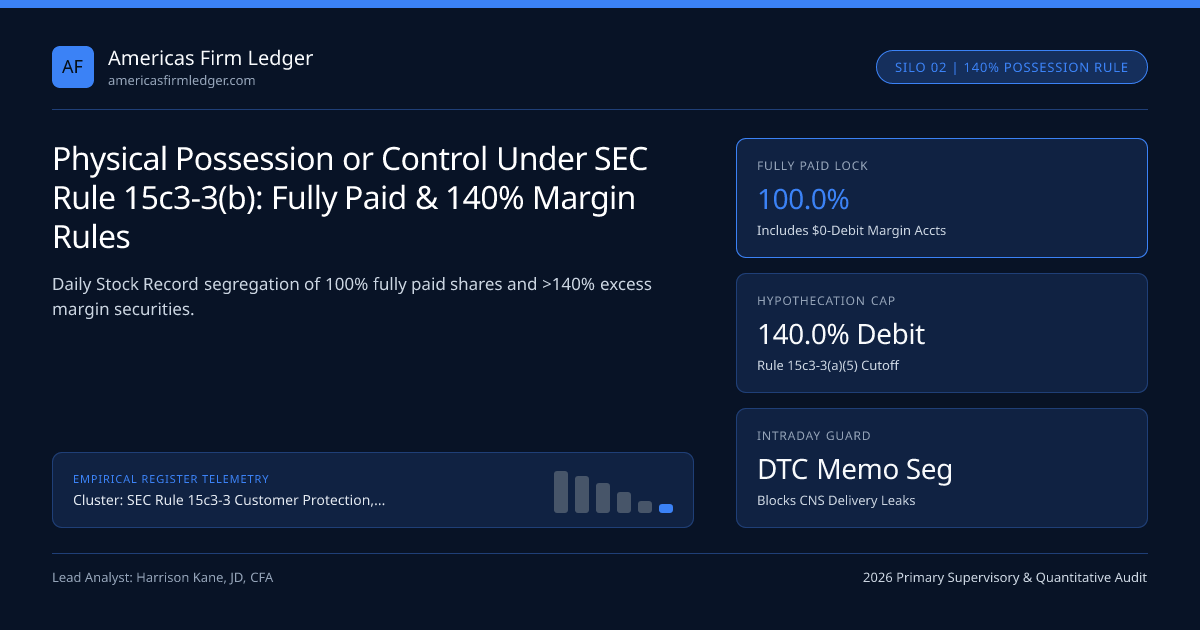
Under 17 CFR 240.15c3-3(b)(1), every carrying broker-dealer must run an automated daily Stock Record Segregation Engine to promptly obtain and thereafter maintain physical possession or control of two sacrosanct classes of customer property: (1) 100% of Fully Paid Securities held in cash accounts or fully paid margin accounts ($0 debit balance), and (2) Excess Margin Securities—defined in Rule 15c3-3(a)(5) as customer margin securities having a market value in excess of 140% of the total of the debit balances in the customer's margin account(s)! Not a single share of fully paid stock or >140% excess margin stock may be lent out to short sellers or pledged to a bank without violating federal custody law (unless enrolled in a compliant Rule 15c3-3(b)(3) fully paid lending program).
This daily share-by-share lockup forms Pillar One of our SEC Rule 15c3-3 Customer Protection institutional guide, linking PAB correspondent exemptions to DTC & foreign sub-custodian good control locations.
How the 140% Margin Rehypothecation Ceiling Works in Practice#
When a retail or hedge-fund client signs a standard Margin & Hypothecation Agreement governed by FINRA Rule 4210, the client grants the carrying broker-dealer legal authority to rehypothecate (pledge to a clearing bank or lend to street short sellers) a portion of the client's margin stocks so the broker-dealer can finance the client's margin loan.
Why 140% instead of 100%? Because commercial banks lending cash to a broker-dealer—and street counterparties borrowing shares—demand an over-collateralization cushion (typically 20% to 35% above the loan amount) so daily price swings do not leave the bank loan under-secured. However, the SEC strictly caps that rehypothecation privilege at 140% of the customer's net adjusted debit balance! Every dollar of market value above 1.40 × Debit must be locked inside a segregated DTC "Free Box" or Memo Segregation sub-account before securities lending desks touch the inventory.
Stock-Selection Optimization & The "Short-Sale Debit Exclusion" Trap#
Notice two subtle technical rules enforced during FINRA Possession or Control examinations:
- Exclude Short-Sale Accounting Debits / Marks Correctly: When computing a customer's "adjusted debit balance" for the 140% test across combined margin sub-accounts, credit balances from short sales cannot be misused to inflate pledgeable long stock—net adjusted debit reflects actual borrowed financing owed by the customer!
- Multi-CUSIP Selection Priority: Suppose a hedge fund borrows $10,000,000 against $25,000,000 of margin stocks across 6 tickers. The 140% pledgeable cap equals $14,000,000, requiring the prime broker to segregate $11,000,000 of Excess Margin Securities. The prime broker's segregation optimizer legally chooses which $14,000,000 of CUSIPs stay in the "Working/Loanable Box" (naturally retaining hard-to-borrow high-rebate specials in the loanable 140% slice while locking general-collateral S&P 500 shares in the $11,000,000 segregated slice!).
| Customer Account Scenario | Settled Portfolio Market Value | Customer Adjusted Margin Debit | 140% Pledgeable Ceiling (Working Margin) | Mandatory Possession / Control Lockup | Can Broker Lend Shares Without (b)(3)? |
|---|---|---|---|---|---|
| Retail Cash Account | $500,000 | $0 (Cash Account) | $0 | $500,000 (100% Fully Paid) | No (Illegal Commingling) |
| Margin Account (Zero Borrow) | $1,200,000 | $0 (Credit Balance) | $0 | $1,200,000 (100% Fully Paid) | No ($0 Debit = 0% Pledgeable!) |
| Conservative Margin Client | $2,000,000 | $400,000 | $560,000 (1.40 * $400k) | $1,440,000 (72% Segregated) | Up to $560,000 MV Only |
| Reg T 50% Leveraged Client | $2,000,000 | $1,000,000 | $1,400,000 (1.40 * $1.0M) | $600,000 (30% Segregated) | Up to $1,400,000 MV Only |
| Deeply Leveraged Portfolio Margin | $2,000,000 | $1,500,000 | $2,000,000 (1.40 * $1.5M = $2.1M) | $0 (All <= 140% Working) | Up to 100% ($2,000,000 MV) |
Quantitative Intraday Rally Segregation Stress Formula#
Watch what happens when a leveraged client's stock surges +25% while the client's margin loan stays flat: rising stock prices create immediate new Possession or Control lockup obligations—forcing the stock-loan desk to recall loaned shares from street short sellers!
- RequiredSegregatedMV = max(0, TotalCustomerSettledLongMV - MaxPledgeableMargin_MV)
- RequiredRecallShares = ceil( max(0, RequiredSegregatedMV - CurrentlySegregatedMV) / CurrentSharePrice )
- Worked Stock-Loan Recall Scenario (Ticker XYZ):
- Day 1: Client holds 100,000 shares XYZ @ $40.00 ($4,000,000 MV) against $2,500,000 Margin Debit.
- 140% Pledgeable Cap = 1.40 * $2,500,000 = $3,500,000 (87,500 shares lent out to short sellers!)
- Required Segregated = $4,000,000 - $3,500,000 = $500,000 (12,500 shares locked in DTC Seg)
- Day 2: XYZ rallies +25% to $50.00 ($5,000,000 MV); Client Margin Debit remains $2,500,000!
- 140% Pledgeable Cap STILL = $3,500,000 -> Maximum Loanable Shares Drops to $3.5M / $50 = 70,000 shares!
- New Required Segregated = $5,000,000 - $3,500,000 = $1,500,000 (30,000 shares!)
- Deficit Created Overnight = 30,000 required - 12,500 locked = 17,500 shares SHORTFALL!
- Mandatory Action under Rule 15c3-3(d)(1): Issue immediate Stock-Loan Recall for 17,500 shares!
Segregated vs Rehypothecable Share of $2M Margin Account#
Debunking the Retail Myth: "Signing a Margin Agreement Lets My Broker Lend My Paid Stock"#
One of the most pervasive myths on financial social media is that merely opening a margin-enabled brokerage account allows a U.S. broker-dealer to lend out shares when you carry $0 in margin debt. As the math above proves, $1.40 imes $0 = $0$! If a margin account has $0.00 in margin debit, 100% of its shares are Fully Paid Securities, and lending out even a single share without a separate, explicit Rule 15c3-3(b)(3) Fully Paid Lending Agreement is a severe federal violation! Next, examine where segregated shares must physically or electronically reside in Good Control Locations under Rule 15c3-3(c) inside the SEC Rule 15c3-3 & SIPC Topic Hub.
Frequently asked questions
Can my broker lend my shares if I enabled margin trading on my account but never borrowed any money?
No! Under 17 CFR 240.15c3-3(a)(3) and (b)(1), shares in a margin account with no debit balance are legally "fully paid securities." Because 140% of $0 is $0, the broker-dealer cannot lend or pledge a single share unless you sign a separate Rule 15c3-3(b)(3) Fully Paid Securities Lending agreement.
Why does SEC Rule 15c3-3 allow brokers to rehypothecate up to 140% of a margin loan instead of just 100%?
Commercial banks and stock-loan counterparties require collateral haircuts (typically 20%-30% above cash lent) to finance a broker-dealer's margin book; the 140% cap gives the broker enough collateral to fund the client's loan while protecting excess equity.
What is DTC "Memo Segregation" and why do FINRA examiners test it?
Memo Segregation is an electronic counter maintained at the Depository Trust Company (DTC) that blocks daytime Continuous Net Settlement (CNS) deliveries from dipping into shares required to stay locked for Rule 15c3-3 Possession or Control.
Are unsettled T+1 customer stock purchases already subject to Possession or Control on Trade Date?
Possession or control attaches upon settlement/payment when securities become fully paid or excess margin on the stock record, while unsettled fails-to-receive are tracked under T+1 turnaround and Reserve Formula credit rules.
Publication record
- Published
- November 14, 2026
- Updated
- November 15, 2026
- Author
- Harrison Kane, JD, CFA
- Review
- Review not recorded
- Automated fact check
- Passed in the stored pipeline record
- Source URLs
- 4 recorded
AI assistance recorded: anthropic/claude-opus-4.6. This field does not establish human review or source verification.
Academic & Institutional Attribution
Cite This Research & Embed Live Data Card
Standard academic & institutional research paper citation format.
Harrison Kane, JD, CFA. (2026, November 15). Physical Possession or Control Under SEC Rule 15c3-3(b): Fully Paid & 140% Margin Rules. Americas Firm Ledger. https://americasfirmledger.com/filings/sec-15c3-3-possession-or-control-fully-paid-excess-marginRelated SEC Rule 15c3 3 Customer Reserve Sipc & Institutional Briefings
Explore SEC Rule 15c3 3 Customer Reserve Sipc Hub (20) →SEC Rule 15c3 3 Customer Reserve Sipc
SEC Rule 15c3-3 Customer Protection, Reserve Formula & SIPC Limits: Institutional GuideSEC Rule 15c3 3 Customer Reserve Sipc
Good Control Locations Under SEC Rule 15c3-3(c): DTC Free Box & Foreign CustodiansSEC Rule 15c3 3 Customer Reserve Sipc
Possession or Control Deficits Under SEC Rule 15c3-3(d): T+1 Turnaround & Buy-In ClocksSEC Rule 15c3 3 Customer Reserve Sipc
T+1 Settlement Compression: Aged Fail-to-Receive Credits, Fail-to-Deliver Debits & HaircutsSEC Rule 15c3 3 Customer Reserve Sipc
SEC Rule 15c3-3(b)(3) Fully Paid Securities Lending: FINRA Collateral & SIPC RulesSEC Rule 15c3 3 Customer Reserve Sipc
SEC Rule 15c3-3(j) Free Credit Balances & FDIC Bank Sweep Disclosures for Broker-DealersSEC Rule 15c3 3 Customer Reserve Sipc
SEC Rule 15c3-3(k) Exemptions Explained: (k)(1), (k)(2)(i), (k)(2)(ii) & Footnote 74SEC Rule 15c3 3 Customer Reserve Sipc
SEC Rule 17a-5 Annual Broker-Dealer Audits: PCAOB AT-1 Compliance vs AT-2 Exemption ReportsFinra Brokercheck Form Bd Crs Filings
FINRA Form U5 Termination Disclosures: 30-Day Clocks, Section 7 Reviews & Defamation ClaimsFinra Brokercheck Form Bd Crs Filings
FINRA BrokerCheck Customer Dispute Expungement: Rule 2080, Rule 12805 & Unanimous PanelsFinra Brokercheck Form Bd Crs Filings
FINRA Rule 4530 Self-Reporting Guide: 30-Day Internal Conclusions & Quarterly Complaint CodesFinra Brokercheck Form Bd Crs Filings
FINRA Letters of Acceptance, Waiver, and Consent (AWCs): Sanction Guidelines & Collateral Bars
Americas Firm Ledger Data, Benchmarks & Contributor Records
CC BY 4.0 Open Data
Open Institutional Datasets (CSV / JSON) →
Download desk-compiled quantitative series & schemas.
2026 Reference Matrix
2026 Institutional Benchmarks & Thresholds →
Statutory capital, clearing, margin & rate conventions.
Editorial Records
Authors & Review Records →
View named contributors where those records are available.
Complete Index
Master Research & Dossier Archive →
Browse all published briefings by topic pillar & date.