
SEC Rule 15c3 3 Customer Reserve Sipc
T+1 Settlement Compression: Aged Fail-to-Receive Credits, Fail-to-Deliver Debits & Haircuts
Under SEC Rule 15c3-1(c)(2)(ix) and Rule 15c3-3a, the North American T+1 settlement cycle (Rule 15c6-1) compresses fail-to-deliver aging clocks to 5 business days past settlement for Net Capital haircuts while enforcing a hard 30-calendar-day cutoff on Exhibit A customer fail debits.
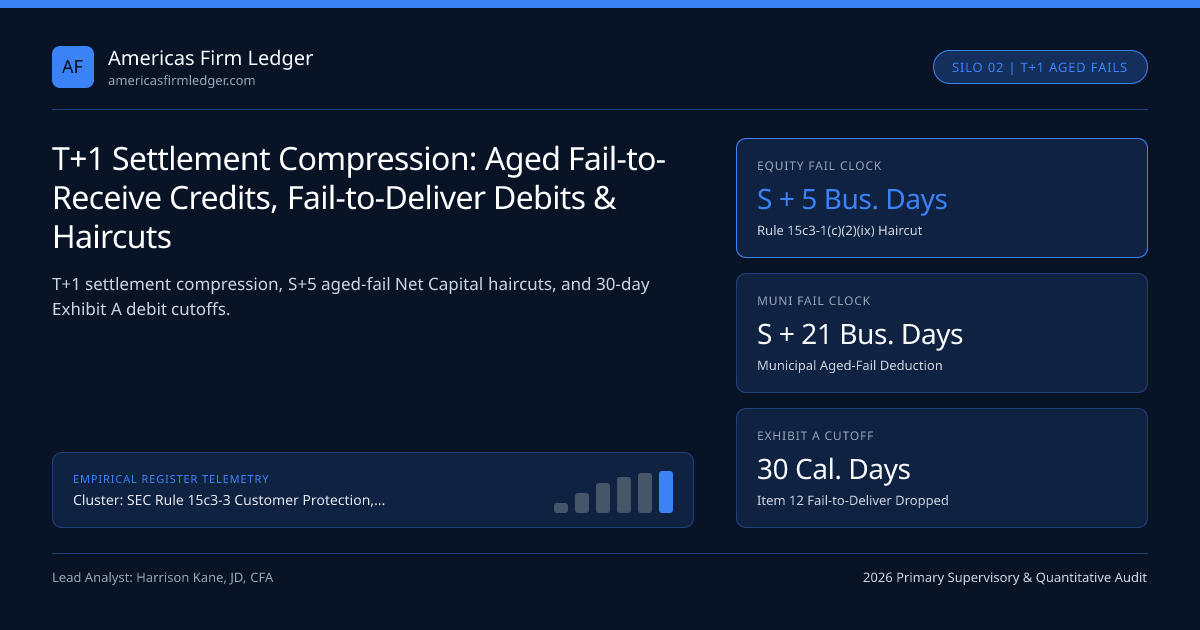
When the United States (SEC Rule 15c6-1(a)) and Canada (CSA National Instrument 24-101 / CIRO) transitioned North American equities, corporate debt, and municipal bonds to T+1 standard settlement in May 2024, settlement-fail clocks began ticking 24 hours earlier on every unmatched cross-border DVP/RVP allocation, ADR conversion, and stock-loan recall! For carrying broker-dealers, unsettled street Fails-to-Deliver and Fails-to-Receive simultaneously impact three regulatory engines: (1) 5-business-day (or 21-business-day municipal) Net Capital deductions under SEC Rule 15c3-1 paragraph (c)(2)(ix), (2) Item 4 Credit vs Item 12 Debit asymmetric cutoffs on the SEC Rule 15c3-3 Exhibit A Reserve Formula, and (3) 30-calendar-day mandatory buy-ins under Rule 15c3-3(d)(2).
This T+1 settlement nexus connects our SEC Rule 15c3-3 Customer Protection institutional guide directly to Rule 15c3-3(d) deficit turnaround clocks and Rule 15c3-3(b)(3) securities lending recalls.
The Three Regulatory Clocks Triggered by a Single T+1 Fail-to-Deliver#
Suppose an institutional DVP buyer or street dealer fails to settle against a broker-dealer's delivery on T+1 (Settlement Date S). Watch how each subsequent day triggers escalating FINRA and SEC capital/reserve penalties:
- Net Capital Aged Fail Charge — Rule 15c3-1(c)(2)(ix) (S + 5 Business Days): Once a Fail-to-Deliver ages 5 business days or more past settlement date (21 business days for municipal securities!), the broker-dealer must deduct from Net Capital the applicable proprietary haircut percentage (e.g., 15% for listed equities, 2%–9% for IG corporate bonds) on the contract/market value of the aged fail—PLUS any mark-to-market loss (where contract receivable < current market value) or minus mark-to-market gain!
- Exhibit A Customer Reserve Asymmetry (S + 30 Calendar Days):
- Customer Fails-to-Receive (Exhibit A Item 4 — Credit): Remains in Credit Items indefinitely (100% counted even if aged 45 or 90 days!) until settled or closed out!
- Customer Fails-to-Deliver (Exhibit A Item 12 — Debit): Countable as an offsetting Debit Item only up to 30 calendar days past settlement! On Calendar Day 31, the Customer Fail-to-Deliver is 100% stripped out of Exhibit A Debits, forcing the broker-dealer to wire fresh proprietary cash into its Special Reserve Bank Account by 10:00 AM ET!
Cross-Border FX & ADR T+1 Funding Mismatches#
While the U.S., Canada, and Mexico moved synchronously to T+1 under the North American Licensing & Market Standard, major European, UK, and Asian equity markets operated on T+2 during 2024–2026 (ahead of UK/EU 2027 T+1 cutovers), and spot wholesale FX CLS settlement defaults to T+2 unless pre-funded on T+0/T+1! When a European fund buys U.S. equities DVP in New York without pre-positioned USD by T+1 morning, bilateral non-CNS institutional fails spike—directly hitting broker-dealer aged-fail charges if unresolved by S+5 business days.
| Fail Type & Aging Status | Governing Rule Citation | Net Capital Charge (Rule 15c3-1) | Customer Reserve Impact (Rule 15c3-3a) | Possession / Control Impact |
|---|---|---|---|---|
| Equity Fail-to-Deliver (Days S+1 to S+4) | 15c3-1 / 15c3-3a Item 12 | $0 Haircut | 100% Allowable Customer Debit (Less 2%/3%) | Neutral (Shares already delivered/sold) |
| Equity Fail-to-Deliver (Day S+5 Bus. to 30 Cal.) | 15c3-1(c)(2)(ix) | 15% MV +/- Mark-to-Market Loss | Still Allowable Customer Debit (<=30d) | Neutral |
| Equity Fail-to-Deliver (Day 31+ Calendar) | 15c3-3a Item 12 Cutoff | 15% MV +/- Mark-to-Market Loss | 0% Disallowed! (Reserve Deposit Jumps!) | Neutral |
| Municipal Bond Fail-to-Deliver (Day S+21 Bus.) | 15c3-1(c)(2)(ix) | 1% - 7% Para (B) +/- Mark Loss | Disallowed from Item 12 past 30 Cal. Days | Neutral |
| Customer Fail-to-Receive (Day 31+ Calendar) | 15c3-3(d)(2) & Item 4 | Deduct Unresolved Mark Loss | Stays 100% Credit Item! | Triggers Mandatory Buy-In Clock! |
Quantitative Worked Model: Aged Fail Double-Whammy on Day 31#
Watch how a $10,000,000 bilateral institutional customer equity Fail-to-Deliver (contract price $10,000,000; current stock market value dropped to $9,200,000, creating an $800,000 unrealized gain—or conversely if market value rose to $10,600,000, creating a $600,000 mark loss? Careful: on a Fail-to-Deliver, the broker-dealer is owed $10.0M cash upon delivering shares worth $10.6M—if the buyer defaults and refuses delivery when stock drops to $9.2M, the broker-dealer only gets $9.2M in the market vs $10.0M contract price = $800,000 unsecured mark loss!):
- FailToDeliverMarkGain = max(0, CurrentSecurityMV - ContractReceivablePrice)
- AgedFailNetCapitalCut = max(0, (HaircutRate * CurrentSecurityMV) + FailToDeliverMarkLoss - FailToDeliverMark_Gain)
- Day31ReserveCashSpike = 0.98 * ContractReceivablePrice [For Daily 2% Alt Std Firm Losing Item 12 Debit!]
- Worked Aged Fail Audit (100,000 Shares Sold @ $100 = $10,000,000 Contract; Current Price Dropped to $92 = $9,200,000 MV):
- 1. At Business Day S+5 (Rule 15c3-1(c)(2)(ix) Aged Fail Charge):
- 15% Equity Haircut on $9,200,000 MV = $1,380,000
- + Mark-to-Market Loss ($10.0M - $9.2M) = $800,000 (Buyer has incentive to walk away!)
- Total Net Capital Deduction on Line 3590 = $2,180,000!
- 2. At Calendar Day 31 (Rule 15c3-3a Item 12 Disallowance):
- $10,000,000 Customer Fail-to-Deliver is kicked out of Exhibit A Item 12!
- Extra Cash Required in Special Reserve Bank Account by 10:00 AM ET = $9,800,000 (Daily 2% Firm)!
Treasury Impact of $10M Equity Fail-to-Deliver ($9.2M MV)#
SEC Rule 15c6-2 Same-Day Institutional Trade Affirmation Governance#
To keep bilateral DVP fails from hitting S+5 and Day 31 cliffs, SEC Rule 15c6-2 requires every broker-dealer engaging in institutional DVP/RVP execution to maintain written policies and procedures (or binding customer/advisor agreements with Registered Investment Advisers tracked on IARD) reasonably designed to complete allocations, confirmations, and affirmations no later than the end of Trade Date (T+0)—measured via DTCC TradeSuite ID affirmation metrics during FINRA exams. Next, see how T+1 recall speed impacts retail revenue-sharing programs in Rule 15c3-3(b)(3) Fully Paid Securities Lending inside the SEC Rule 15c3-3 & SIPC Topic Hub.
Frequently asked questions
Why does a stock price DROP create a mark-to-market loss on a Fail-to-Deliver?
In a Fail-to-Deliver, the broker-dealer sold shares at $100 and is waiting to receive $100 cash upon delivery. If the stock drops to $80 and the failing buyer defaults, the broker-dealer is stuck holding shares worth only $80 instead of the $100 contract receivable—an $20/share credit exposure!
Do NSCC Continuous Net Settlement (CNS) fails age the same way as bilateral ex-clearing fails?
No. In NSCC CNS, open fails are marked-to-the-market daily through NSCC cash settlement (resetting the contract price to current market value and eliminating mark losses) and face strict Reg SHO Rule 204 close-outs at S+1/S+3 long before hitting S+5!
Why did my Reserve Bank requirement jump by $5 million overnight when no customers deposited cash?
Check your Fail-to-Deliver aging report! The morning an institutional customer Fail-to-Deliver crosses 30 calendar days past settlement, it drops to $0 in Exhibit A Item 12 Debits—increasing your required Reserve deposit dollar-for-dollar (less the 2%/3% haircut).
Did Canada switch to T+1 settlement on the same schedule as the United States?
Yes. Canadian markets regulated by the CSA and CIRO transitioned to T+1 on May 27, 2024—one business day ahead of the U.S. May 28, 2024 Memorial Day cutover—preventing cross-border arbitrage fails on dual-listed NYSE/TSX securities.
Publication record
- Published
- November 14, 2026
- Updated
- November 15, 2026
- Author
- Harrison Kane, JD, CFA
- Review
- Review not recorded
- Automated fact check
- Passed in the stored pipeline record
- Source URLs
- 4 recorded
AI assistance recorded: anthropic/claude-opus-4.6. This field does not establish human review or source verification.
Academic & Institutional Attribution
Cite This Research & Embed Live Data Card
Standard academic & institutional research paper citation format.
Harrison Kane, JD, CFA. (2026, November 15). T+1 Settlement Compression: Aged Fail-to-Receive Credits, Fail-to-Deliver Debits & Haircuts. Americas Firm Ledger. https://americasfirmledger.com/filings/sec-15c3-3-t1-settlement-aged-fail-to-receive-fail-deliverRegulatory Directory Cross-Reference
Referenced Institutions & Regulatory Registries
Top Regulated Institutions in This Coverage Slice
Related SEC Rule 15c3 3 Customer Reserve Sipc & Institutional Briefings
Explore SEC Rule 15c3 3 Customer Reserve Sipc Hub (20) →SEC Rule 15c3 3 Customer Reserve Sipc
SEC Rule 15c3-3 Customer Protection, Reserve Formula & SIPC Limits: Institutional GuideSEC Rule 15c3 3 Customer Reserve Sipc
SEC Rule 15c3-3(b)(3) Fully Paid Securities Lending: FINRA Collateral & SIPC RulesSEC Rule 15c3 3 Customer Reserve Sipc
SEC Rule 15c3-3(j) Free Credit Balances & FDIC Bank Sweep Disclosures for Broker-DealersSEC Rule 15c3 3 Customer Reserve Sipc
SEC Rule 15c3-3(k) Exemptions Explained: (k)(1), (k)(2)(i), (k)(2)(ii) & Footnote 74SEC Rule 15c3 3 Customer Reserve Sipc
SEC Rule 17a-5 Annual Broker-Dealer Audits: PCAOB AT-1 Compliance vs AT-2 Exemption ReportsSEC Rule 15c3 3 Customer Reserve Sipc
SIPC $500,000 Coverage & $250,000 Cash Sublimit: Separate Capacity Series 100-500 RulesSEC Rule 15c3 3 Customer Reserve Sipc
SIPA Broker-Dealer Liquidation Explained: Customer Property Pool, Net Equity & TransfersSEC Rule 15c3 3 Customer Reserve Sipc
Excess SIPC Insurance Explained: Lloyd's Aggregate Firm Caps, Cash Sublimits & TriggersFinra Brokercheck Form Bd Crs Filings
FINRA Letters of Acceptance, Waiver, and Consent (AWCs): Sanction Guidelines & Collateral BarsFinra Brokercheck Form Bd Crs Filings
FINRA Rule 4111 Restricted Firm Obligations: Numeric Thresholds, Escrow Cash & BrokerCheck FlagsFinra Brokercheck Form Bd Crs Filings
Consolidated Audit Trail (CAT) Compliance: 50ms/100us Clock Sync, T+1 8:00 AM & Error FinesFinra Brokercheck Form Bd Crs Filings
CAT Customer & Account Information System (CAIS): FDIDs, CCIDs & SEC PII Relief Explained
Americas Firm Ledger Data, Benchmarks & Contributor Records
CC BY 4.0 Open Data
Open Institutional Datasets (CSV / JSON) →
Download desk-compiled quantitative series & schemas.
2026 Reference Matrix
2026 Institutional Benchmarks & Thresholds →
Statutory capital, clearing, margin & rate conventions.
Editorial Records
Authors & Review Records →
View named contributors where those records are available.
Complete Index
Master Research & Dossier Archive →
Browse all published briefings by topic pillar & date.