
SEC Rule 15c3 3 Customer Reserve Sipc
PAB Reserve Computations for Proprietary Accounts of Broker-Dealers Under SEC Rule 15c3-3
Codified in 17 CFR 240.15c3-3(a)(16) and (e), the PAB Reserve framework requires carrying clearing firms to segregate net cash credits owed to domestic introducing and correspondent broker-dealers inside a dedicated PAB Special Reserve Bank Account.
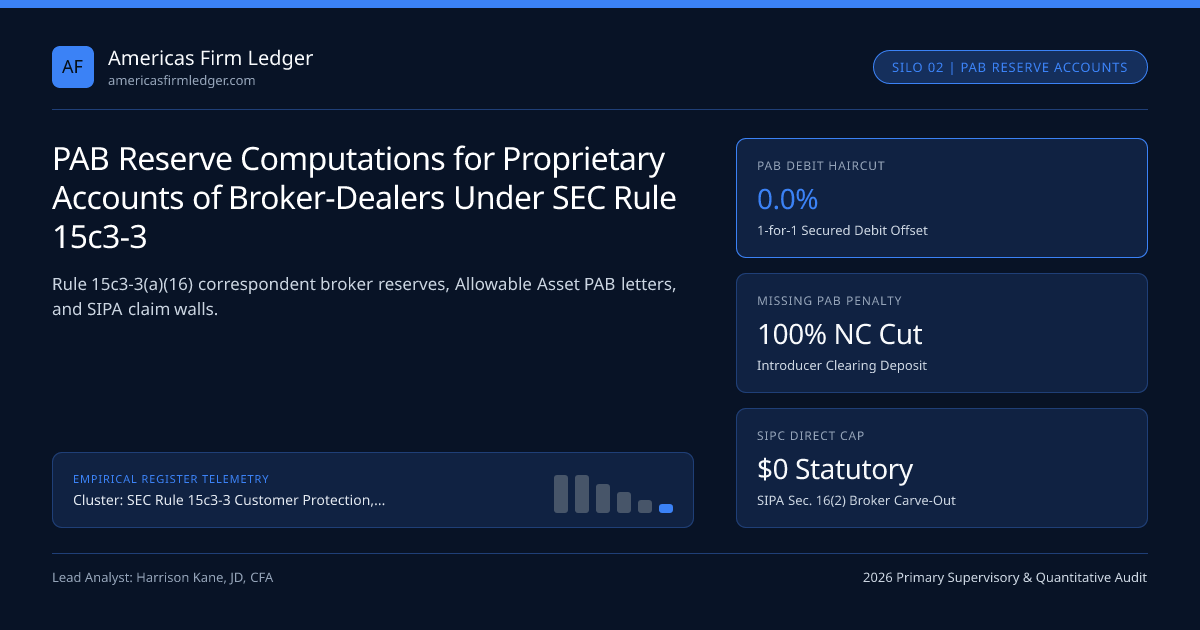
Under the Securities Investor Protection Act (SIPA Section 16(2), 15 U.S.C. 78lll(2)), a registered broker-dealer is statutorily barred from receiving $500,000 SIPC advances for its own proprietary trading or clearing-deposit accounts held at another failed clearing broker! To prevent the domino collapse of hundreds of introducing broker-dealers and market makers if a major clearing house fails—and to allow introducing brokers to count clearing deposits as allowable assets under SEC Rule 15c3-1—the SEC codified mandatory PAB (Proprietary Accounts of Broker-Dealers) Reserve Computations inside 17 CFR 240.15c3-3(a)(16) and (e).
This inter-dealer segregation ringfence connects our SEC Rule 15c3-3 Customer Protection institutional guide directly to qualified U.S. Treasury reserve deposits and fully paid / excess margin possession rules.
What Is a "PAB Account" Under Rule 15c3-3(a)(16)?#
Prior to 2013, PAB segregation operated via voluntary "PAIB" no-action letters; SEC Release No. 34-70072 made PAB Reserve accounts mandatory federal law. Under Rule 15c3-3(a)(16), a PAB account means any proprietary securities account of a U.S.-registered broker or dealer (including a foreign broker-dealer only to the extent specified or opted out) carried by another carrying broker-dealer, excluding:
- Delivery-versus-Payment / Receipt-versus-Payment (DVP/RVP) institutional execution accounts that settle cleanly against payment;
- Omnibus Customer Accounts carried under FINRA Rule 4311 (because an omnibus account holds retail customers' assets of the introducing broker and therefore belongs inside the Customer Reserve Formula, NOT the PAB Reserve Formula!); and
- Foreign broker-dealers or banks that are not SEC-registered Section 15(b) broker-dealers (unless covered under specific cross-entity rules).
Key Formula Differences: Customer Exhibit A vs PAB Exhibit A#
While the Carrying Firm computes its PAB Reserve using the same Exhibit A framework on Form X-17A-5 FOCUS Part II, three critical formula differences distinguish PAB from the retail Customer Reserve:
- Separate Bank Account & Separate No-Lien Letter: PAB funds and Treasuries must never be commingled inside the retail Customer Special Reserve Bank Account; the bank account must be titled "[Firm Name] Special Reserve Bank Account for Brokers and Dealers" with its own Rule 15c3-3(f) no-lien letter!
- Zero 1% or 3% Aggregate Debit Haircut!: Unlike retail Customer Exhibit A (which deducts 1% under Note E(3) plus 1% or 3% off aggregate customer debits), PAB Exhibit A does not apply the 1% Note E(3) margin reduction or the 1%/3% aggregate debit haircut—meaning PAB credits and secured PAB margin debits offset 1-for-1!
- Permissive Pledge/Use Notice for Excess PAB Securities: Unlike retail customers (where Rule 15c3-3(b) strictly mandates segregating fully paid and >140% excess margin securities), a carrying broker-dealer is not required to maintain physical possession or control of PAB proprietary securities provided it delivers written notice to the correspondent PAB broker-dealer under Rule 15c3-3(b)(5) warning that its proprietary securities may be used in the carrying firm's business!
| Regulatory Feature | Retail Customer Reserve (15c3-3) | PAB Broker-Dealer Reserve (15c3-3 PAB) | Omnibus Account of Introducing BD |
|---|---|---|---|
| Account Holder Identity | Public Retail & Institutional Investors | Proprietary Account of SEC-Registered BD | Underlying Customers of Introducing BD |
| Reserve Bank Account Pool | Customer Special Reserve Account | Separate PAB Special Reserve Account | Customer Special Reserve Account |
| Exhibit A Aggregate Debit Haircut | 3.0% (Weekly Alt) / 2.0% (Daily Alt) | 0.0% (Dollar-for-Dollar Debit Offset) | Included in Customer 2%/3% Formula |
| Possession or Control (15c3-3(b)) | Mandatory (Fully Paid & >140% Margin) | Optional with Rule 15c3-3(b)(5) Notice | Mandatory Inside Customer Control |
| SIPC $500k Advance Eligible? | Yes ($500k / $250k Cash) | No ($0 SIPA Advance; Relies on PAB Pool) | Yes (Pass-Through per Customer) |
Quantitative Worked Model: Carrying Firm PAB Run + Introducing Firm Net Capital Impact#
Let us trace a clearing firm carrying 45 introducing broker-dealers and 8 proprietary equity market-making correspondents:
- PABDebits = SecuredPABMarginLoans + StockBorrowedForPABShorts + PABOCCClearing_Margin
- RequiredPABReserveDeposit = max(0, PABCredits - PAB_Debits) [Zero 1% or 3% Debit Haircut!]
- Worked Inter-Broker Clearing Calculation:
- 45 Introducing BDs' Cash Clearing Deposits ($250k avg) = $11,250,000
- 8 Market-Maker PAB Free Credit & Short Credit Balances = $184,750,000
- Total PAB Credit Items = $196,000,000
- Secured PAB Market-Maker Margin Financing Debits = $142,000,000
- Securities Borrowed for PAB Short Sales + OCC Margin = $31,500,000
- Total Allowable PAB Debit Items = $173,500,000
- Required PAB Special Reserve Bank Deposit = $196,000,000 - $173,500,000 = $22,500,000
- Impact on Introducing Broker #14 ($250,000 Deposit, Minimum NC = $50,000, Total NC = $290,000):
- With Signed PAB Agreement: Allowable Deposit = $250,000 -> Excess NC = +$240,000 (Compliant)
- Missing Signed PAB Agreement: Allowable Deposit = $0 -> Actual NC = $40,000 -> -$10,000 VIOLATION!
Customer vs PAB Reserve Comparison ($200M Cred / $170M Deb)#
FINRA Audit Checklist for Both Sides of a PAB Relationship#
Every introducing broker-dealer undergoing a FINRA or PCAOB audit must keep its signed PAB Account Agreement (and its clearing agreement approved by FINRA under Rule 4311) on file; if a clearing firm updates its legal charter or transfers clearing books, both firms must re-verify PAB addenda immediately. Next, shift from cash reserves to securities segregation in our deep dive on physical possession or control of fully paid & 140% excess margin securities inside the SEC Rule 15c3-3 & SIPC Topic Hub.
Frequently asked questions
Should an introducing broker's Omnibus Customer Account be placed in the PAB Reserve or Customer Reserve?
Always in the retail Customer Reserve! Under Rule 15c3-3(a)(1) and FINRA Rule 4311, an omnibus account holds the underlying public customers' cash and securities of the introducing firm, not the introducing broker's own corporate capital.
Does a carrying broker-dealer have to segregate fully paid stocks owned by a market-making PAB correspondent?
Not if the carrying broker-dealer provides the correspondent broker-dealer with the written notice specified in SEC Rule 15c3-3(b)(5) stating that proprietary securities carried in the PAB account may be used in the carrying firm's business.
Are sister U.S. broker-dealers owned by the same parent holding company included in the PAB Reserve computation?
Yes. Proprietary accounts of affiliated U.S.-registered broker-dealers carried by the clearing affiliate fall within the Rule 15c3-3(a)(16) PAB definition, ensuring every registered BD's inter-broker assets remain Allowable Assets for Net Capital.
Can excess funds in the Customer Reserve Account cover a shortfall in the PAB Reserve Account?
Never! Customer Special Reserve Bank Accounts and PAB Special Reserve Bank Accounts are legally siloed pools; a surplus in Customer Reserve cannot cure a deficit in PAB Reserve (or vice versa) without executing compliant separate computations and transfers.
Publication record
- Published
- November 14, 2026
- Updated
- November 15, 2026
- Author
- Harrison Kane, JD, CFA
- Review
- Review not recorded
- Automated fact check
- Passed in the stored pipeline record
- Source URLs
- 4 recorded
AI assistance recorded: anthropic/claude-opus-4.6. This field does not establish human review or source verification.
Academic & Institutional Attribution
Cite This Research & Embed Live Data Card
Standard academic & institutional research paper citation format.
Harrison Kane, JD, CFA. (2026, November 16). PAB Reserve Computations for Proprietary Accounts of Broker-Dealers Under SEC Rule 15c3-3. Americas Firm Ledger. https://americasfirmledger.com/filings/sec-15c3-3-pab-proprietary-accounts-broker-dealers-reserveRegulatory Directory Cross-Reference
Referenced Institutions & Regulatory Registries
Top Regulated Institutions in This Coverage Slice
Related SEC Rule 15c3 3 Customer Reserve Sipc & Institutional Briefings
Explore SEC Rule 15c3 3 Customer Reserve Sipc Hub (20) →SEC Rule 15c3 3 Customer Reserve Sipc
SEC Rule 15c3-3 Customer Protection, Reserve Formula & SIPC Limits: Institutional GuideSEC Rule 15c3 3 Customer Reserve Sipc
Physical Possession or Control Under SEC Rule 15c3-3(b): Fully Paid & 140% Margin RulesSEC Rule 15c3 3 Customer Reserve Sipc
Good Control Locations Under SEC Rule 15c3-3(c): DTC Free Box & Foreign CustodiansSEC Rule 15c3 3 Customer Reserve Sipc
Possession or Control Deficits Under SEC Rule 15c3-3(d): T+1 Turnaround & Buy-In ClocksSEC Rule 15c3 3 Customer Reserve Sipc
T+1 Settlement Compression: Aged Fail-to-Receive Credits, Fail-to-Deliver Debits & HaircutsSEC Rule 15c3 3 Customer Reserve Sipc
SEC Rule 15c3-3(b)(3) Fully Paid Securities Lending: FINRA Collateral & SIPC RulesSEC Rule 15c3 3 Customer Reserve Sipc
SEC Rule 15c3-3(j) Free Credit Balances & FDIC Bank Sweep Disclosures for Broker-DealersSEC Rule 15c3 3 Customer Reserve Sipc
SEC Rule 15c3-3(k) Exemptions Explained: (k)(1), (k)(2)(i), (k)(2)(ii) & Footnote 74Finra Brokercheck Form Bd Crs Filings
FINRA Form U4 Item 14 Disclosures: $5k Written Complaints, $15k Settlements & 30-Day LiensFinra Brokercheck Form Bd Crs Filings
FINRA Form U5 Termination Disclosures: 30-Day Clocks, Section 7 Reviews & Defamation ClaimsFinra Brokercheck Form Bd Crs Filings
FINRA BrokerCheck Customer Dispute Expungement: Rule 2080, Rule 12805 & Unanimous PanelsFinra Brokercheck Form Bd Crs Filings
FINRA Rule 4530 Self-Reporting Guide: 30-Day Internal Conclusions & Quarterly Complaint Codes
Americas Firm Ledger Data, Benchmarks & Contributor Records
CC BY 4.0 Open Data
Open Institutional Datasets (CSV / JSON) →
Download desk-compiled quantitative series & schemas.
2026 Reference Matrix
2026 Institutional Benchmarks & Thresholds →
Statutory capital, clearing, margin & rate conventions.
Editorial Records
Authors & Review Records →
View named contributors where those records are available.
Complete Index
Master Research & Dossier Archive →
Browse all published briefings by topic pillar & date.