
SEC Rule 15c3 3 Customer Reserve Sipc
Possession or Control Deficits Under SEC Rule 15c3-3(d): T+1 Turnaround & Buy-In Clocks
SEC Rule 15c3-3(d) recognizes that normal T+1 clearing creates temporary Possession or Control deficits, granting carrying broker-dealers cause-specific cure clocks—from next-day bank loan releases and 5-day stock-loan recalls to 30-day fail buy-ins—before a deficit becomes a violation.
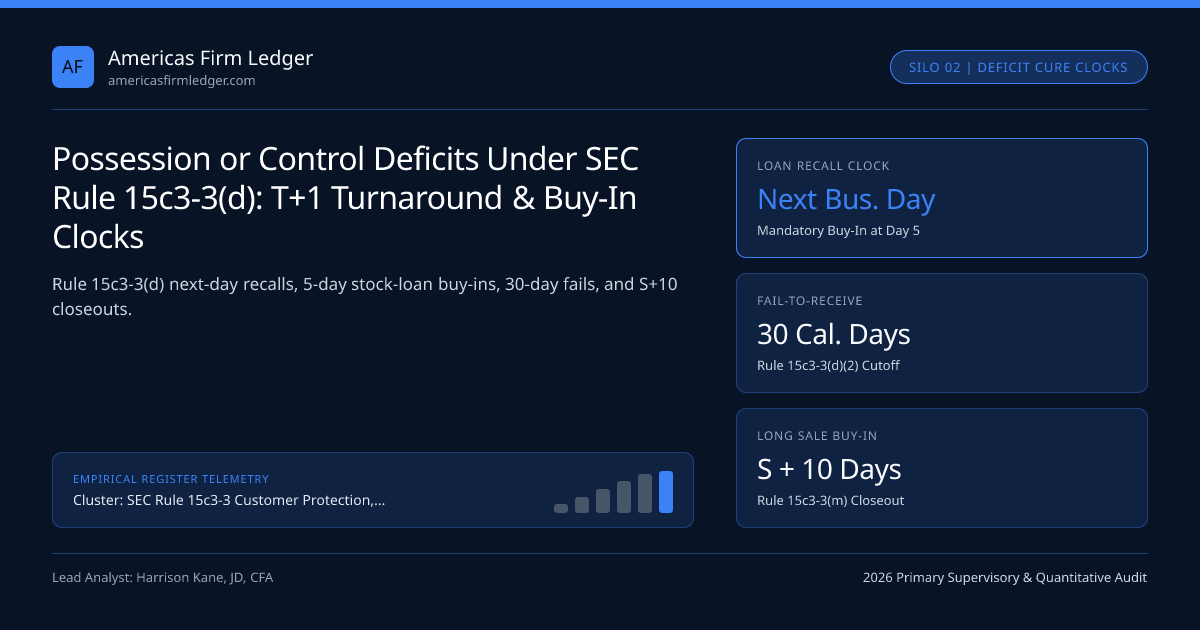
A common misconception among junior compliance analysts is that any Possession or Control deficit appearing on a morning Stock Record run means the broker-dealer just broke federal law. In reality, 17 CFR 240.15c3-3(d) recognizes that intraday customer margin repayments, share rallies, dividend reinvestments, and street fails-to-receive inevitably create temporary turnaround deficits! Under Rule 15c3-3(d)(1)–(4), a carrying broker-dealer remains in full legal compliance provided it identifies the exact root cause of every deficit share each business day, issues the required release or recall instruction on the next business day, and forces physical delivery or executes a mandatory street buy-in before the statutory cure clock expires!
This operational cure matrix powers back-office Stock Record governance inside our SEC Rule 15c3-3 Customer Protection institutional guide, directly enforcing Good Control Location audits and T+1 aged fail settlement rules.
The Exact Statutory Cure Clocks Under Rule 15c3-3(d)(1)–(4) & (m)#
Every morning, the broker-dealer's Deficit Allocation System attributes each missing share of fully paid or >140% excess margin stock to its specific non-control location and starts an unforgiving countdown verified by FINRA and PCAOB AT-1 auditors:
- Paragraph (d)(1) — Securities Subject to Bank Hypothecation Lien: If a customer pays down a margin loan at 3:45 PM ET, shares sitting in the firm's bank hypothecation box suddenly become excess/fully paid. The broker-dealer must issue instructions no later than the next business day to release the lien and obtain physical control within 2 business days (same/next day via electronic DTC Pledge Release)!
- Paragraph (d)(1) — Securities Loaned to Another Broker-Dealer: Issue a formal Stock-Loan Recall Notice no later than the next business day after the deficit arises; if the borrowing broker fails to return the shares within 5 business days (aligned with shortened T+1 operational recall cycles, down from legacy T+2/T+3 conventions; statutory outer text specifies prompt recall and buy-in within 5 business days after recall notice if unreturned!), the lending broker must execute a mandatory buy-in!
- Paragraph (d)(2) — Bona Fide Fail-to-Receive > 30 Calendar Days: If customer shares are missing because a street seller failed to deliver on a customer purchase, the carrying broker must take prompt steps (buy-in or borrow) to obtain possession or control once the fail-to-receive ages past 30 calendar days (or 60 calendar days for certain foreign/municipal restructurings).
- Paragraph (d)(3) — Receivable as Stock Dividend / Split / Merger > 45 Calendar Days: Corporate action receivables aged over 45 calendar days past payable date require prompt buy-in or claim resolution.
- Rule 15c3-3(m) — Customer Long Sale Not Delivered Within 10 Business Days: If a customer sells a security long (other than an exempted short sale) and fails to deliver the physical/transferred shares within 10 business days after settlement date (S+10), the broker-dealer must close out the customer via mandatory buy-in!
Interaction Between Rule 15c3-3(d) & Regulation SHO Rule 204!#
Modern clearing firms must coordinate SEC Rule 15c3-3(d) (custody deficits) with SEC Regulation SHO Rule 204 (CNS settlement fails-to-deliver). Under Reg SHO Rule 204, if a clearing participant has a CNS fail-to-deliver at NSCC, it faces much faster close-out clocks—T+2 morning (S+1) for short sales and T+4 morning (S+3) for long sales or bona fide market making—preventing firms from intentionally failing to NSCC to hoard shares in their Rule 15c3-3 box! Conversely, Rule 15c3-3(b)(2) strictly prohibits intentionally creating or increasing a Possession or Control deficit by delivering segregated customer shares to settle another client's short sale!
| Deficit Root Cause on Stock Record | Rule Citation | Instruction Deadline | Mandatory Buy-In / Cure Cutoff | FOCUS Part II Reporting? | Violation Trigger |
|---|---|---|---|---|---|
| Bank Hypothecation Pledge Box | 15c3-3(d)(1) | Next Business Day | Obtain Control Within 2 Bus. Days | Schedule III Info Line | Failing to send next-day release |
| Customer Shares Out on Stock Loan | 15c3-3(d)(1) | Recall Next Bus. Day | Buy-In After 5 Bus. Days Unreturned | Schedule III Info Line | Skipping recall or missing Day 5 buy-in |
| Street Fail-to-Receive (Customer Buy) | 15c3-3(d)(2) | Monitor Daily Aging | Buy-In / Cure > 30 Calendar Days | Schedule III + Exhibit A Cred | Carrying >30d fail without buy-in |
| Corporate Action / Stock Dividend | 15c3-3(d)(3) | Monitor Receivable | Cure > 45 Calendar Days | Schedule III Info Line | Ignoring >45d uncollected split |
| Customer Long Sale Undelivered | 15c3-3(m) | Track Settlement +1 | Buy-In at S + 10 Business Days | Operational Audit Trail | Letting customer fail >S+10 without FINRA ext. |
| Intentional Delivery From Memo Seg | 15c3-3(b)(2) | 0 Days (Immediate!) | Zero Grace Window | Immediate AT-1 Deficiency! | Overriding Memo Seg to settle firm short! |
Quantitative Deficit Aging & Schedule III Reporting Model#
On Form X-17A-5 FOCUS Part II Information Relating to Possession or Control Requirements, the FinOp reports the exact dollar market value and number of items for which the firm issued instructions under (d)(1) or failed to issue instructions on time:
- CompliantTurnaroundDeficit = BankLoanRecallInWindow + StockLoanRecallUnder5d + FailToReceiveUnder30d
- ReportableViolationDeficit = TotalSegregationDeficitShares - CompliantTurnaround_Deficit
- Worked Daily Stock Record Deficit Audit (Ticker ABC @ $80.00/share):
- Required Customer Segregation = 250,000 shares ($20,000,000)
- Good Control (DTC Free Seg) = 190,000 shares ($15,200,000) -> Gross Deficit = 60,000 shares ($4,800,000)
- Attribution & Cure Clock Audit:
- 15,000 shares in Bank Pledge (Day 1 Deficit; Release sent 8:15 AM today) -> COMPLIANT Turnaround
- 25,000 shares Out on Stock Loan (Day 3 post-Recall; Buy-In set for Day 5) -> COMPLIANT Turnaround
- 12,000 shares Fail-to-Receive (Calendar Day 18 <= 30-Day Cap) -> COMPLIANT Turnaround
- 8,000 shares Out on Stock Loan (Day 8 post-Recall; Desk skipped buy-in!) -> VIOLATION! ($640,000 Breach!)
- Mandatory Action: Execute immediate market buy-in for 8,000 shares + Log Control Exception for PCAOB AT-1!
SEC Rule 15c3-3(d) & (m) Deficit Cure Clocks#
FINRA REX Extensions & PCAOB AT-1 Material Weakness Risks#
Under Rule 15c3-3(n), FINRA's Regulatory Extension (REX) portal may grant limited, exceptional extensions on paragraph (d)(2), (d)(3), or (m) buy-in deadlines (for instance, when a foreign transfer halt or probate estate delays physical certificate delivery)—never for routine stock-loan desk reluctance to buy in a favored hedge-fund borrower! Furthermore, under PCAOB AT-1 compliance examinations, systemic coding bugs in deficit-attribution logic constitute a reportable Material Weakness in Internal Control Over Compliance. Next, examine how the May 2024 T+1 settlement cycle reshaped aged fail charges across both Net Capital and Reserve formulas in T+1 settlement aged fails inside the SEC Rule 15c3-3 & SIPC Topic Hub.
Frequently asked questions
Does having a deficit on FOCUS Part II Possession or Control lines automatically mean our firm violated Rule 15c3-3?
Not if the shares sit on the "instructions issued" line within their permitted turnaround window! FOCUS Part II separates permissible turnaround deficits (where timely recall/release instructions were issued under 15c3-3(d)) from uninstructed or past-due violation deficits.
Can a stock-loan desk borrow shares from a second dealer instead of executing a market buy-in on Day 5?
Obtaining physical possession or control of equivalent shares into DTC Free Segregation cures the customer control deficit, provided the borrow does not violate Regulation SHO Rule 204 "sham close-out" rules if tied to a CNS fail-to-deliver.
How does a carrying broker request an extension on a Rule 15c3-3(m) S+10 customer buy-in?
Prior to expiration of the 10th business day after settlement, the carrying broker submits an electronic extension request via FINRA's Regulatory Extension (REX) system under Rule 15c3-3(n), documenting exceptional good-faith circumstances.
What happens if a nighttime software bug suppresses stock-loan recall notices for three weeks?
Every un-recalled deficit becomes an active Rule 15c3-3 violation, requiring immediate Rule 17a-11(e) internal-control inadequacy notification to the SEC and FINRA and mandatory disclosure in the firm's annual PCAOB AT-1 Compliance Report!
Publication record
- Published
- November 14, 2026
- Updated
- November 14, 2026
- Author
- Harrison Kane, JD, CFA
- Review
- Review not recorded
- Automated fact check
- Passed in the stored pipeline record
- Source URLs
- 4 recorded
AI assistance recorded: anthropic/claude-opus-4.6. This field does not establish human review or source verification.
Academic & Institutional Attribution
Cite This Research & Embed Live Data Card
Standard academic & institutional research paper citation format.
Harrison Kane, JD, CFA. (2026, November 14). Possession or Control Deficits Under SEC Rule 15c3-3(d): T+1 Turnaround & Buy-In Clocks. Americas Firm Ledger. https://americasfirmledger.com/filings/sec-15c3-3-possession-deficits-turnaround-buy-in-timelinesRegulatory Directory Cross-Reference
Referenced Institutions & Regulatory Registries
Top Regulated Institutions in This Coverage Slice
Related SEC Rule 15c3 3 Customer Reserve Sipc & Institutional Briefings
Explore SEC Rule 15c3 3 Customer Reserve Sipc Hub (20) →SEC Rule 15c3 3 Customer Reserve Sipc
SEC Rule 15c3-3 Customer Protection, Reserve Formula & SIPC Limits: Institutional GuideSEC Rule 15c3 3 Customer Reserve Sipc
T+1 Settlement Compression: Aged Fail-to-Receive Credits, Fail-to-Deliver Debits & HaircutsSEC Rule 15c3 3 Customer Reserve Sipc
SEC Rule 15c3-3(b)(3) Fully Paid Securities Lending: FINRA Collateral & SIPC RulesSEC Rule 15c3 3 Customer Reserve Sipc
SEC Rule 15c3-3(j) Free Credit Balances & FDIC Bank Sweep Disclosures for Broker-DealersSEC Rule 15c3 3 Customer Reserve Sipc
SEC Rule 15c3-3(k) Exemptions Explained: (k)(1), (k)(2)(i), (k)(2)(ii) & Footnote 74SEC Rule 15c3 3 Customer Reserve Sipc
SEC Rule 17a-5 Annual Broker-Dealer Audits: PCAOB AT-1 Compliance vs AT-2 Exemption ReportsSEC Rule 15c3 3 Customer Reserve Sipc
SIPC $500,000 Coverage & $250,000 Cash Sublimit: Separate Capacity Series 100-500 RulesSEC Rule 15c3 3 Customer Reserve Sipc
SIPA Broker-Dealer Liquidation Explained: Customer Property Pool, Net Equity & TransfersFinra Brokercheck Form Bd Crs Filings
FINRA Rule 4530 Self-Reporting Guide: 30-Day Internal Conclusions & Quarterly Complaint CodesFinra Brokercheck Form Bd Crs Filings
FINRA Letters of Acceptance, Waiver, and Consent (AWCs): Sanction Guidelines & Collateral BarsFinra Brokercheck Form Bd Crs Filings
FINRA Rule 4111 Restricted Firm Obligations: Numeric Thresholds, Escrow Cash & BrokerCheck FlagsFinra Brokercheck Form Bd Crs Filings
Consolidated Audit Trail (CAT) Compliance: 50ms/100us Clock Sync, T+1 8:00 AM & Error Fines
Americas Firm Ledger Data, Benchmarks & Contributor Records
CC BY 4.0 Open Data
Open Institutional Datasets (CSV / JSON) →
Download desk-compiled quantitative series & schemas.
2026 Reference Matrix
2026 Institutional Benchmarks & Thresholds →
Statutory capital, clearing, margin & rate conventions.
Editorial Records
Authors & Review Records →
View named contributors where those records are available.
Complete Index
Master Research & Dossier Archive →
Browse all published briefings by topic pillar & date.