
SEC Rule 15c3 3 Customer Reserve Sipc
SEC Rule 15c3-3(k) Exemptions Explained: (k)(1), (k)(2)(i), (k)(2)(ii) & Footnote 74
Over 88% of U.S. registered broker-dealers never maintain a Special Reserve Bank Account because they operate under SEC Rule 15c3-3(k)(1), (k)(2)(i), or (k)(2)(ii) exemptions—or as Footnote 74 non-custodial firms—subject to strict noon-next-business-day transmission clocks.
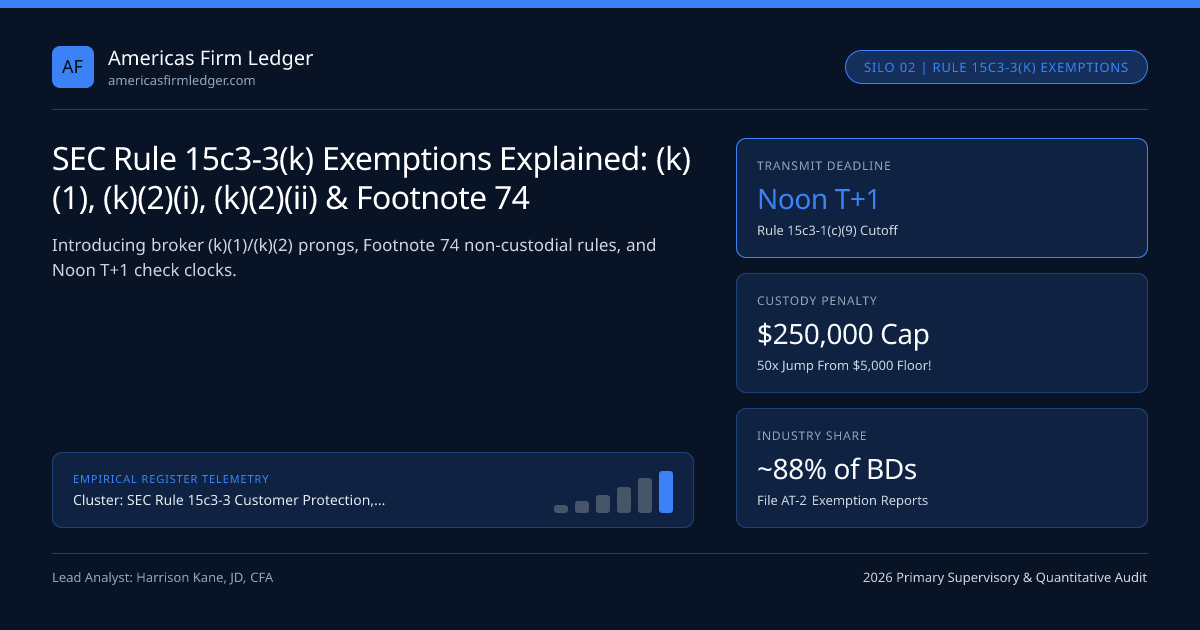
Out of roughly 3,300 FINRA-member broker-dealers operating in the United States, fewer than 160 carry customer accounts! The remaining 88%+ of U.S. broker-dealers—spanning retail introducing wealth firms, M&A investment banks, private placement agents, ATS dark pools, and wholesaler distributors—legally avoid Exhibit A reserve computations by operating strictly inside 17 CFR 240.15c3-3(k) exemptions or the SEC's Footnote 74 Non-Custodial Framework. Yet a single mishandled customer check held inside an introducing branch drawer past 12:00 Noon of the next business day instantly blows a (k)(2)(ii) exemption, triggers a $250,000 Net Capital deficiency under SEC Rule 15c3-1, and forces an exception onto the firm's annual PCAOB Exemption Report!
This exemption matrix anchors introducing-firm architecture inside our SEC Rule 15c3-3 Customer Protection institutional guide, linking directly to PCAOB AT-2 Exemption Reports and FINRA Rule 4311 carrying agreements.
The Four Non-Carrying Broker-Dealer Categories#
Every broker-dealer's FINRA Membership Agreement (MAP) and FOCUS Part IIA filing locks the firm into one exact custodial posture supervised by the SEC and FINRA:
- Paragraph (k)(1) — Mutual Fund & Variable Insurance Subscription Firms ($5,000 / $25,000 Net Capital): Available solely to broker-dealers whose transactions are limited to redeemable shares of registered investment companies (mutual funds) or variable insurance contracts, and who promptly transmit all funds and deliver all securities received.
- Paragraph (k)(2)(i) — Special Bank Account Self-Settling Exemption ($100,000 Minimum Net Capital): Carries zero margin accounts, promptly transmits all customer funds and delivers all securities, and effectuates all financial transactions with customers through one or more bank accounts designated as "Special Account for the Exclusive Benefit of Customers of [Firm Name]" (commonly used by DVP/RVP institutional dealers or direct subscription platforms).
- Paragraph (k)(2)(ii) — Fully Disclosed Introducing Broker ($5,000 or $50,000 Minimum Net Capital): Introduces 100% of customer transactions and accounts on a fully disclosed basis to another SEC-registered carrying/clearing broker-dealer under FINRA Rule 4311, and promptly transmits any accidentally received customer checks or stock certificates to the clearing broker by Noon of the next business day!
- "Footnote 74" Non-Covered Firms (Exchange Act Release No. 34-70073, Footnote 74) ($5,000 Minimum Net Capital): Pure M&A advisors, private-placement finders (using independent bank escrow), proprietary trading desks, and institutional ATS venues that do not directly or indirectly receive, hold, or owe funds or securities for customers and do not carry accounts—filing an Exemption Report citing Footnote 74 rather than claiming a technical (k) prong!
Side-by-Side Prudential Matrix: Carrying vs (k)(1) vs (k)(2)(i) vs (k)(2)(ii) vs Footnote 74#
Compare how custodial status dictates minimum Net Capital under SEC Rule 15c3-1, FOCUS report schedules, and annual PCAOB audit scope:
| Broker-Dealer Classification | Rule Citation | Minimum Net Capital Floor | Permitted to Touch Checks Payable to Firm? | FOCUS Filing Form | Annual PCAOB Audit Attestation |
|---|---|---|---|---|---|
| Full Carrying / Clearing BD | 15c3-3 Full | $250,000 (or 2% Debits) | Yes (Full Custody + Reserve) | FOCUS Part II | PCAOB AT-1 Compliance Exam |
| Special Account Settler | 15c3-3(k)(2)(i) | $100,000 | Thru Special Customer Bank Acct | FOCUS Part IIA | PCAOB AT-2 Exemption Review |
| Fully Disclosed Introducer (Recv) | 15c3-3(k)(2)(ii) | $50,000 (Receives Securities) | Checks Payable to Clearing BD Only | FOCUS Part IIA | PCAOB AT-2 Exemption Review |
| Fully Disclosed Introducer (Pure) | 15c3-3(k)(2)(ii) | $5,000 (No Funds/Stock Held) | Forward Clearing Checks by Noon T+1 | FOCUS Part IIA | PCAOB AT-2 Exemption Review |
| Mutual Fund / VA Distributor | 15c3-3(k)(1) | $5,000 ($25k Wire Order) | Payable to Fund / Underwriter | FOCUS Part IIA | PCAOB AT-2 Exemption Review |
| Pure M&A / ATS / Escrow Placement | Footnote 74 | $5,000 | Never (Third-Party Escrow Only) | FOCUS Part IIA | PCAOB AT-2 (Footnote 74) |
Quantitative Noon-Transmission Clock & Inadvertent Custody Penalty#
Look at 17 CFR 240.15c3-1(c)(9)-(10) to see why branch-office check Blotters are the #1 audit focus for (k)(2)(ii) introducing firms:
- "Promptly Transmit" = Noon of Next Business Day: If an elderly client mails a paper check payable to the Clearing Firm (e.g., Pershing LLC or Apex Clearing) to the introducing broker's suburban branch on Monday at 2:00 PM, the branch must log the check on its Checks Received & Forwarded Blotter and place it into overnight courier / remote deposit to the clearing firm by 12:00 Noon Tuesday!
- Check Payable to the Introducing Firm = Instant $250,000 Net Capital Requirement: If the client accidentally writes the check payable to "Main Street Wealth Advisors LLC" (the $5,000 introducing BD) and the branch deposits that check into its operating bank account to wire onward, the introducing firm just received customer funds—retroactively hiking its minimum Net Capital from $5,000 to $250,000!
- NetCapitalDeficiencyIfDeposited = FirmActualNet_Capital - 250000
- Worked Introducing Broker Branch Check Audit ($38,000 Actual Net Capital, $5,000 Minimum Standard):
- Case A (Compliant): Client mails $50,000 check payable to "Pershing LLC" arriving Mon 3:00 PM.
- Logged on Blotter; FedEx'd to Pershing Tue 10:30 AM (<= 12:00 PM Noon!).
- Required Net Capital = $5,000 -> Excess Net Capital = +$33,000 (COMPLIANT, 0 AT-2 Exceptions).
- Case B (Hold Past Noon): Branch advisor leaves "Pershing LLC" check on desk until Thursday!
- Missed Tue 12:00 PM Noon cutoff -> Reportable Exception on Annual PCAOB AT-2 Exemption Report!
- Case C (Fatal Deposit!): Client writes $50,000 check payable to IB; IB deposits into IB bank & wires to Pershing!
- IB held customer funds -> Statutory Minimum Net Capital jumps to $250,000!
- Net Capital Deficiency = $38,000 - $250,000 = -$212,000 VIOLATION! Immediate Rule 17a-11 Halt + SEC Notice!
Minimum Net Capital Jump Upon Customer Custody Breach#
Private Placement Rule 15c2-4 Escrow Traps for Footnote 74 Firms#
Placement agents raising capital under SEC Regulation D (such as fintech or institutional digital-asset placement conduits comparable to non-custodial advisers in our registry) must pair Footnote 74 status with SEC Rule 15c2-4: investor subscription wires in "all-or-none" or "part-or-none" private offerings must go directly to an unaffiliated bank acting as written escrow agent (never a law firm IOLTA account and never an issuer-controlled checking account before contingency closing!). Next, see how independent auditors examine Compliance Reports versus Exemption Reports in SEC Rule 17a-5 & PCAOB AT-1 / AT-2 audits inside the SEC Rule 15c3-3 & SIPC Topic Hub.
Frequently asked questions
What should an introducing broker branch do if a customer mails a check made payable to the introducing broker?
Never deposit the check! Log the receipt on the firm's check blotter, photocopy the check for Rule 17a-4 records, and return the uncashed check directly to the customer by Noon of the next business day with instructions to make it payable to the clearing firm.
Why did the SEC create "Footnote 74" status in 2013 and expand it in 2020?
Pure M&A boutiques, ATS venues, and placement agents do not carry customer accounts, yet they also do not fit neatly into (k)(1) (mutual funds) or (k)(2)(ii) (clearing broker). Footnote 74 lets non-custodial firms file an Exemption Report accurately reflecting their zero-custody business.
Does every late check forwarded at 2:00 PM instead of 12:00 Noon have to be disclosed on the Exemption Report?
Yes! Under SEC Rule 17a-5(d)(4), an introducing broker must disclose in its annual Exemption Report EVERY identified exception to its (k)(2)(ii) exemption conditions during the fiscal year—even a single check forwarded two hours past Noon without financial loss!
Can a private placement broker use an attorney IOLTA trust account for an all-or-none Reg D offering?
No! Under SEC Rule 15c2-4(b), contingent offering funds must be transmitted directly to a "bank" (as defined in Exchange Act Section 3(a)(6)) that has agreed in writing to hold the funds in escrow; using a law firm trust account violates Rule 15c2-4 and jeopardizes the firm's $5,000 Net Capital exemption.
Publication record
- Published
- November 13, 2026
- Updated
- November 14, 2026
- Author
- Harrison Kane, JD, CFA
- Review
- Review not recorded
- Automated fact check
- Passed in the stored pipeline record
- Source URLs
- 4 recorded
AI assistance recorded: anthropic/claude-opus-4.6. This field does not establish human review or source verification.
Academic & Institutional Attribution
Cite This Research & Embed Live Data Card
Standard academic & institutional research paper citation format.
Harrison Kane, JD, CFA. (2026, November 14). SEC Rule 15c3-3(k) Exemptions Explained: (k)(1), (k)(2)(i), (k)(2)(ii) & Footnote 74. Americas Firm Ledger. https://americasfirmledger.com/filings/sec-15c3-3k-exemptive-provisions-k2i-vs-k2ii-introducingRegulatory Directory Cross-Reference
Referenced Institutions & Regulatory Registries
Top Regulated Institutions in This Coverage Slice
Related SEC Rule 15c3 3 Customer Reserve Sipc & Institutional Briefings
Explore SEC Rule 15c3 3 Customer Reserve Sipc Hub (20) →SEC Rule 15c3 3 Customer Reserve Sipc
SEC Rule 15c3-3 Customer Protection, Reserve Formula & SIPC Limits: Institutional GuideSEC Rule 15c3 3 Customer Reserve Sipc
SEC Rule 17a-5 Annual Broker-Dealer Audits: PCAOB AT-1 Compliance vs AT-2 Exemption ReportsSEC Rule 15c3 3 Customer Reserve Sipc
SIPC $500,000 Coverage & $250,000 Cash Sublimit: Separate Capacity Series 100-500 RulesSEC Rule 15c3 3 Customer Reserve Sipc
SIPA Broker-Dealer Liquidation Explained: Customer Property Pool, Net Equity & TransfersSEC Rule 15c3 3 Customer Reserve Sipc
Excess SIPC Insurance Explained: Lloyd's Aggregate Firm Caps, Cash Sublimits & TriggersSEC Rule 15c3 3 Customer Reserve Sipc
SEC Special Purpose Broker-Dealers (SPBDs): Rule 15c3-3 Digital Asset Custody & SIPASEC Rule 15c3 3 Customer Reserve Sipc
FINRA Rule 4311 Carrying Agreements: Fully Disclosed vs Omnibus Clearing & SIPA PrioritySEC Rule 15c3 3 Customer Reserve Sipc
Hypothecation of Customer Securities Under SEC Rules 8c-1 & 15c2-1: Three Anti-Commingling BansFinra Brokercheck Form Bd Crs Filings
CAT Customer & Account Information System (CAIS): FDIDs, CCIDs & SEC PII Relief ExplainedFinra Brokercheck Form Bd Crs Filings
FINRA Rule 3110 Supervision Overhaul: Residential Supervisory Locations (RSL) & Remote PilotFinra Brokercheck Form Bd Crs Filings
SEC Rule 17a-4 Electronic Recordkeeping: WORM vs Audit-Trail Alternative & WhatsApp FinesFinra Brokercheck Form Bd Crs Filings
FINRA Rule 3310 AML Compliance: $5,000 FinCEN SAR Clocks, CDD 25% Owners & Independent Audits
Americas Firm Ledger Data, Benchmarks & Contributor Records
CC BY 4.0 Open Data
Open Institutional Datasets (CSV / JSON) →
Download desk-compiled quantitative series & schemas.
2026 Reference Matrix
2026 Institutional Benchmarks & Thresholds →
Statutory capital, clearing, margin & rate conventions.
Editorial Records
Authors & Review Records →
View named contributors where those records are available.
Complete Index
Master Research & Dossier Archive →
Browse all published briefings by topic pillar & date.