
SEC Rule 15c3 3 Customer Reserve Sipc
SEC Rule 15c3-3(b)(3) Fully Paid Securities Lending: FINRA Collateral & SIPC Rules
SEC Rule 15c3-3(b)(3) and FINRA Rule 4330 permit broker-dealers to borrow fully paid or excess margin securities from retail and institutional clients only under a separate written agreement backed by daily mark-to-market cash or Treasury collateral and explicit SIPC loss disclosures.
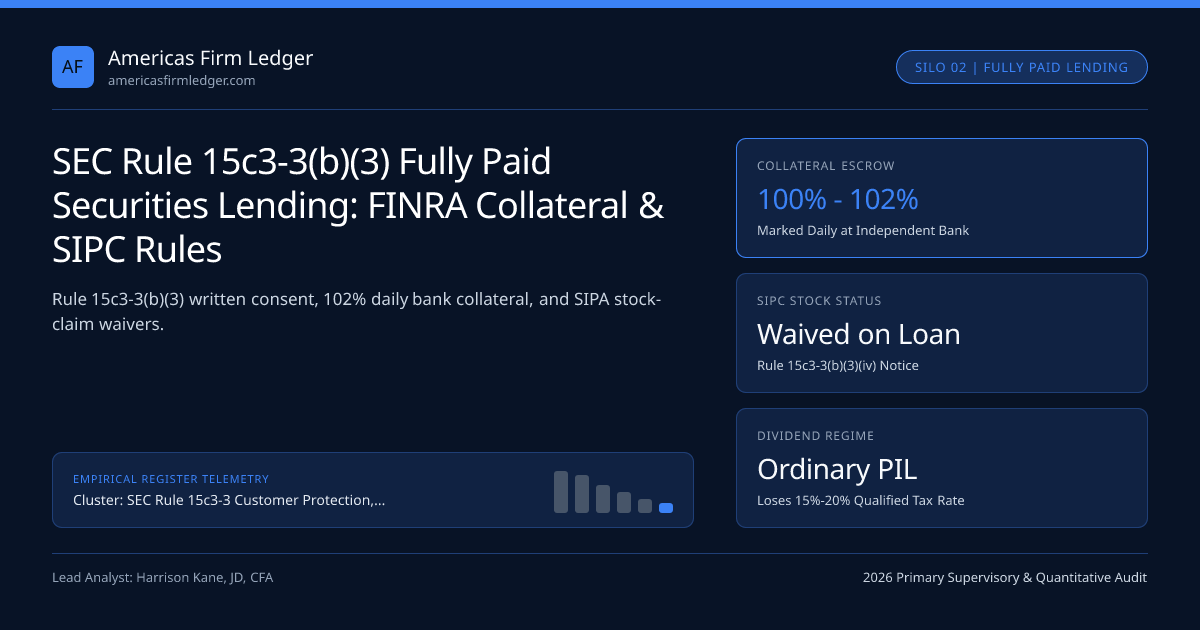
Retail zero-commission brokerages and institutional prime brokers aggressively market "Stock Yield Enhancement" or Fully Paid Securities Lending (FPSL) programs—sharing hard-to-borrow short-sale rebate revenue with clients who hold cash-account equities. Yet borrowing a single fully paid share without strict adherence to 17 CFR 240.15c3-3(b)(3) and FINRA Rule 4330 violates federal custody law! Unlike margin rehypothecation (capped at 140% of a customer's margin loan), FPSL borrows shares from clients with $0 in margin debt, stripping those loaned shares of statutory SIPC securities protection for the duration of the loan.
This lending-program audit connects directly to our SEC Rule 15c3-3 Customer Protection institutional guide, contrasting FPSL escrow mechanics with 140% excess margin possession rules and SIPC $500,000 separate capacity protections.
Four Mandatory Pillars of Rule 15c3-3(b)(3) & SEC No-Action Relief#
When SEC and FINRA examiners review a broker-dealer's retail FPSL enrollment flow (a major source of multi-million-dollar FINRA Letters of Acceptance, Waiver, and Consent when firms auto-enrolled retail investors via buried terms-of-service checkboxes), they test four statutory requirements:
- Separate Written Master Securities Lending Agreement (MSLA) & Appropriateness: Under FINRA Rule 4330(b)(2), a broker-dealer borrowing from non-institutional customers must make an affirmative reasonable-basis appropriateness determination BEFORE enrollment and deliver clear, prominent written disclosures outside standard account-opening boilerplate.
- 100% Daily Mark-to-Market Collateral at an Independent Bank: Rule 15c3-3(b)(3)(iii) requires the borrowing broker-dealer to provide the lending customer—and mark to market every business day—collateral consisting of cash, U.S. Treasury bills/notes, or irrevocable bank letters of credit equal to at least 100% (typically 102% market convention) of the market value of the loaned shares, held at an unaffiliated bank custodian or compliant Rule 15c3-3 structure per the SEC's landmark October 22, 2020 FPSL No-Action Letter!
- Explicit SIPC Protection Loss Warning: Rule 15c3-3(b)(3)(iv) mandates bold written notice stating that the provisions of SIPA may not protect the lender with respect to the loaned securities—therefore, the cash collateral delivered to the independent bank trustee may constitute the lender's only source of satisfaction if the broker-dealer fails to return the shares!
- Substitute Payments ("Manufactured Dividends") Tax Penalty Disclosure: While shares sit out on loan over a corporate dividend record date, the client receives a cash payment-in-lieu (PIL) taxed at ordinary federal income rates (up to 37%) rather than qualified dividend rates (15%–20%), and loses corporate proxy voting rights unless shares are recalled prior to record date.
Comparing Margin Rehypothecation vs Fully Paid Lending vs Unsecured Borrowing#
Institutional treasurers and retail investors alike must distinguish how SEC Rule 15c3-3 and SIPC treat three completely different stock-borrowing channels:
| Lending Channel | Legal Authority | Client Debt Required? | Collateral Held For Client | SIPC Securities Coverage | Dividend & Proxy Treatment |
|---|---|---|---|---|---|
| Margin Rehypothecation (<=140%) | 15c3-3(a)(5) & 8c-1 | Yes (Active Margin Debit) | Funded via Exhibit A / Bank Line | Full SIPA Stock Claim ($500k Cap) | PIL Risk on Lent Slice; Proxy Reduced |
| Fully Paid Lending (FPSL) | 15c3-3(b)(3) & FINRA 4330 | No ($0 Cash Account) | 100%-102% Cash at Third-Party Bank | No SIPA Stock Claim (Look to Escrow!) | Cash PIL (Ordinary Tax); Zero Proxy Vote |
| Institutional Repo / Stock Loan | Master SLA / 15c3-1 | Institutional Counterparty | Bilateral Daily Variation Margin | Counterparty Bilateral Claim | Contractual Manufactured Dividend |
| Auto-Enrollment Without Consent | Illegal Violation! | $0 Cash Account | Missing / Internal Journal Only | FINRA AWC Restitution + Fine! | Illegal Conversion of Customer Stock |
Quantitative Net After-Tax FPSL Yield Model#
Why did FINRA sanction retail apps that auto-enrolled dividend investors into FPSL for stocks trading at general-collateral (GC) lending rates of 0.25% annualized? Look at the math when a high-bracket taxpayer loses qualified dividend treatment on a 4.00% dividend payer:
- PILTaxPenalty = CashDividendPaidWhileLoaned * (MarginalOrdinaryTaxRate - QualifiedDividendTaxRate)
- NetClientEconomicGain = GrossClientLendingFee - PILTaxPenalty
- Worked Retail Appropriateness Failure Audit ($200,000 Dividend Utility Position, 30 Days on Loan over Ex-Date):
- Street Borrow Rate = 0.40% annualized; Broker Revenue Split = 50% (Client earns 0.20% annualized)
- Gross Client Lending Fee (30 Days) = $200,000 * 0.0020 * (30 / 360) = $33.33
- Quarterly Dividend Paid While Loaned (1.00% quarterly = $2,000.00 Paid as Payment-in-Lieu!)
- Tax Penalty (37% Ordinary + 3.8% NIIT vs 20% Qualified + 3.8% NIIT = 17.0% Spread):
- PILTaxPenalty = $2,000.00 * 0.17 = $340.00 EXTRA IRS TAX!
- NetClientEconomic_Gain = $33.33 - $340.00 = -$306.67 NET LOSS TO CUSTOMER!
FPSL After-Tax Yield: Hard-to-Borrow vs Dividend Stock#
The SEC October 2020 No-Action Guardrail Against Internal Journal Collateral#
Prior to 2020, several retail clearing firms attempted to satisfy Rule 15c3-3(b)(3) simply by journaling "collateral cash" into the customer's brokerage account (which immediately cycled back into the firm's omnibus Exhibit A calculation!). In its October 22, 2020 Staff Letter, the SEC Division of Trading and Markets clarified that keeping FPSL collateral inside the borrowing broker-dealer undermines SIPA bankruptcy remoteness—requiring cash collateral to sit inside an independent bank trust/escrow account pledged directly for the lending customers' benefit! Next, examine how uninvested brokerage cash moves off Exhibit A into multi-bank deposit networks in Rule 15c3-3(j) free credit balances & FDIC bank sweeps inside the SEC Rule 15c3-3 & SIPC Topic Hub.
Frequently asked questions
Am I still protected by SIPC up to $500,000 on stocks lent out through a Fully Paid Lending program?
No! Under SEC Rule 15c3-3(b)(3)(iv), SIPA securities protection generally does not cover shares loaned out to your broker-dealer. Instead, your protection comes from the 100%-102% cash or U.S. Treasury collateral locked daily at an unaffiliated bank custodian.
Can I sell my stock immediately if my broker has lent it out under Rule 15c3-3(b)(3)?
Yes. Every retail FPSL program allows you to sell your shares immediately during normal market hours without waiting for the street borrower to return them; the broker-dealer automatically terminates the loan and manages T+1 settlement.
Why did my Form 1099-MISC report "Substitute Payments in Lieu of Dividends" instead of Form 1099-DIV?
When a short seller borrows your shares over the dividend record date, the corporate issuer pays the actual qualified dividend to the new buyer of the shorted stock, while the borrower pays you an equivalent cash substitute taxed as ordinary income.
Can a broker-dealer turn on Fully Paid Securities Lending automatically via a fine-print terms update?
No. FINRA Rule 4330(b)(2) strictly prohibits auto-enrollment without a separate written agreement, upfront appropriateness review, and clear prominent disclosure of SIPC, proxy voting, and dividend tax consequences.
Publication record
- Published
- November 14, 2026
- Updated
- November 14, 2026
- Author
- Harrison Kane, JD, CFA
- Review
- Review not recorded
- Automated fact check
- Passed in the stored pipeline record
- Source URLs
- 4 recorded
AI assistance recorded: anthropic/claude-opus-4.6. This field does not establish human review or source verification.
Academic & Institutional Attribution
Cite This Research & Embed Live Data Card
Standard academic & institutional research paper citation format.
Harrison Kane, JD, CFA. (2026, November 14). SEC Rule 15c3-3(b)(3) Fully Paid Securities Lending: FINRA Collateral & SIPC Rules. Americas Firm Ledger. https://americasfirmledger.com/filings/sec-15c3-3b3-fully-paid-securities-lending-collateral-escrowRegulatory Directory Cross-Reference
Referenced Institutions & Regulatory Registries
Top Regulated Institutions in This Coverage Slice
Referenced Supervisory Authorities
Related SEC Rule 15c3 3 Customer Reserve Sipc & Institutional Briefings
Explore SEC Rule 15c3 3 Customer Reserve Sipc Hub (20) →SEC Rule 15c3 3 Customer Reserve Sipc
SEC Rule 15c3-3 Customer Protection, Reserve Formula & SIPC Limits: Institutional GuideSEC Rule 15c3 3 Customer Reserve Sipc
SEC Rule 15c3-3(j) Free Credit Balances & FDIC Bank Sweep Disclosures for Broker-DealersSEC Rule 15c3 3 Customer Reserve Sipc
SEC Rule 15c3-3(k) Exemptions Explained: (k)(1), (k)(2)(i), (k)(2)(ii) & Footnote 74SEC Rule 15c3 3 Customer Reserve Sipc
SEC Rule 17a-5 Annual Broker-Dealer Audits: PCAOB AT-1 Compliance vs AT-2 Exemption ReportsSEC Rule 15c3 3 Customer Reserve Sipc
SIPC $500,000 Coverage & $250,000 Cash Sublimit: Separate Capacity Series 100-500 RulesSEC Rule 15c3 3 Customer Reserve Sipc
SIPA Broker-Dealer Liquidation Explained: Customer Property Pool, Net Equity & TransfersSEC Rule 15c3 3 Customer Reserve Sipc
Excess SIPC Insurance Explained: Lloyd's Aggregate Firm Caps, Cash Sublimits & TriggersSEC Rule 15c3 3 Customer Reserve Sipc
SEC Special Purpose Broker-Dealers (SPBDs): Rule 15c3-3 Digital Asset Custody & SIPAFinra Brokercheck Form Bd Crs Filings
FINRA Rule 4111 Restricted Firm Obligations: Numeric Thresholds, Escrow Cash & BrokerCheck FlagsFinra Brokercheck Form Bd Crs Filings
Consolidated Audit Trail (CAT) Compliance: 50ms/100us Clock Sync, T+1 8:00 AM & Error FinesFinra Brokercheck Form Bd Crs Filings
CAT Customer & Account Information System (CAIS): FDIDs, CCIDs & SEC PII Relief ExplainedFinra Brokercheck Form Bd Crs Filings
FINRA Rule 3110 Supervision Overhaul: Residential Supervisory Locations (RSL) & Remote Pilot
Americas Firm Ledger Data, Benchmarks & Contributor Records
CC BY 4.0 Open Data
Open Institutional Datasets (CSV / JSON) →
Download desk-compiled quantitative series & schemas.
2026 Reference Matrix
2026 Institutional Benchmarks & Thresholds →
Statutory capital, clearing, margin & rate conventions.
Editorial Records
Authors & Review Records →
View named contributors where those records are available.
Complete Index
Master Research & Dossier Archive →
Browse all published briefings by topic pillar & date.