
CFTC Nfa Fcm Segregated Residual Interest
CFTC Rule 1.11 FCM Risk Management Program (RMP): Independent RMU & Quarterly CFTC Reports
Under 17 CFR 1.11, every Futures Commission Merchant carrying customer accounts must establish a governing-body-approved Risk Management Program (RMP) run by an independent Risk Management Unit.
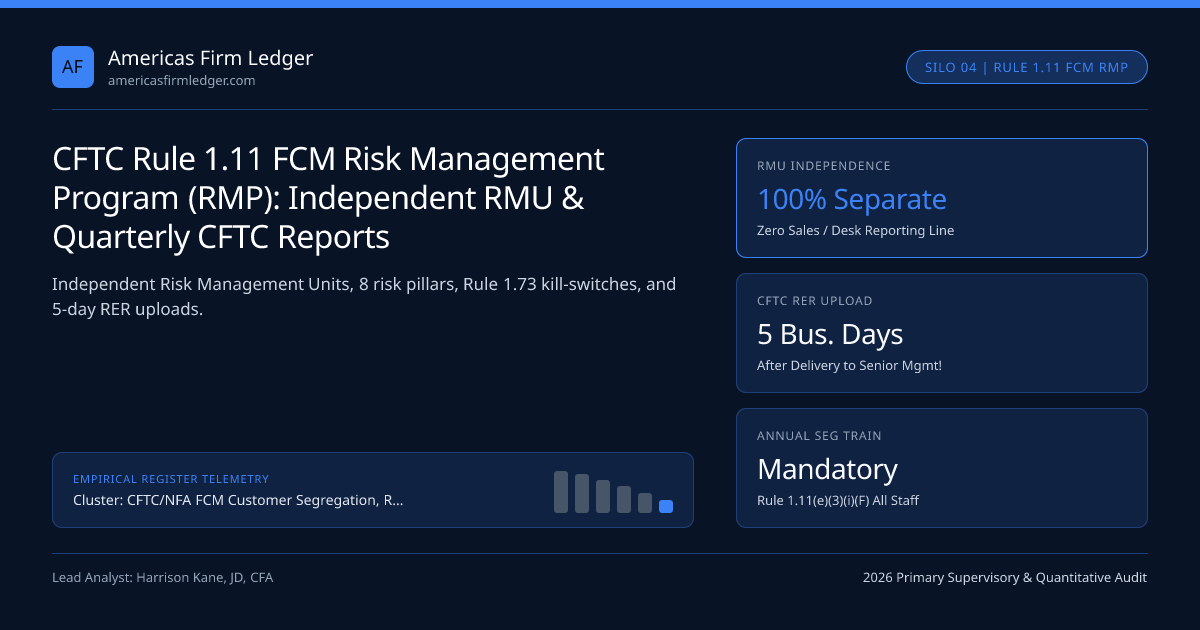
Before 2014, a small or mid-sized Futures Commission Merchant could let its top revenue-producing sales executive double as "head of credit risk"—waiving intraday margin limits for a favorite hedge fund right up until a limit-up coffee or natural-gas squeeze bankrupted the firm (as happened at OptionSellers.com and Volume Investors)! Under 17 CFR 1.11 (Risk Management Program for Futures Commission Merchants), every FCM that carries customer accounts MUST maintain a written, board-approved Risk Management Program (RMP) administered by an independent Risk Management Unit (RMU) whose personnel and compensation are strictly insulated from commercial business-unit revenue!
This enterprise risk-governance guide anchors internal supervisory architecture inside our CFTC & NFA FCM Customer Segregation institutional guide, directly governing Rule 1.22 Residual Interest Target calibration and Rule 1.25 depository due diligence.
Structural Independence of the Risk Management Unit (RMU, Rule 1.11(d)) & The Eight Mandatory Risk Pillars (Rule 1.11(e))#
When CFTC and DSRO (CME / NFA) examiners conduct annual RMP reviews, they test two non-negotiable pillars: (A) Structural Independence (RMU reports directly to Senior Management, has sufficient authority and automated kill-switch resources, and is completely independent from the business unit!), and (B) Quantitative Risk Tolerance Limits across Eight Statutory Risk Categories:
- Market Risk: Stress testing extreme tail price moves on both proprietary and concentrated customer option/futures books;
- Credit Risk: Setting pre-trade Automated Order-Routing (Rule 1.73) credit limits for every customer and clearing counterparty;
- Liquidity Risk: Modeling worst-case intraday DCO variation margin spikes (6:30 AM & 1:30 PM CME sweeps) against uncommitted vs committed bank liquidity lines;
- Foreign Currency (FX) Risk: Haircuts and mismatch limits across 30.7 EUR/JPY/GBP/CAD margin pools;
- Legal Risk: Enforcing enforceable netting, Appendix A/E/F letters, and give-up agreements;
- Operational Risk: Automated reconciliation breaks, cyber-resilience (NFA ISSP!), and disaster recovery;
- Settlement Risk: T+1 wire cutoff failure stress tests; AND
- Segregation Risk (Rule 1.11(e)(3)(i) — Special Deep Mandate!): Written policies governing depository bank selection/creditworthiness, Rule 1.25 investment valuation, annual training of all finance/treasury staff, AND the statistical methodology setting Targeted Residual Interest!
Exact Filing Clocks for Quarterly Risk Exposure Reports (RERs, Rule 1.11(e)(2))!#
Watch the two-step clock in 17 CFR 1.11(e)(2) that catches FCM compliance officers off guard during NFA/CME exams:
- Quarterly Preparation & Delivery to Senior Management + Governing Body: Within 60 calendar days after the end of each fiscal quarter (and immediately upon detecting any material change in risk exposure!); AND
- Electronic Upload to the CFTC (WinJammer): Copies of every quarterly (and ad-hoc) Risk Exposure Report (RER) MUST be furnished electronically to the CFTC within 5 business days of providing such report to Senior Management! (Trap: If your Chief Risk Officer emails the Q2 RER packet to the CEO on Day 32 after quarter-end, your 5-business-day CFTC upload clock starts on Day 32—NOT Day 60!)
| Rule 1.11 Deliverable | Statutory Frequency | Approval / Recipient | CFTC Filing Deadline (WinJammer) |
|---|---|---|---|
| Written Risk Management Program (RMP) | Initial + Upon Material Change | Governing Body (Board of Directors) | Within 30 Days of Any Material Revision (1.11(c)(4)) |
| Quarterly Risk Exposure Report (RER) | Quarterly (<= 60d Post-Qtr) | Senior Management + Governing Body | Within 5 Business Days After Giving to Senior Mgmt! |
| Material Risk Change Interim RER | Immediately Upon Detection | Senior Management + Governing Body | Within 5 Business Days After Giving to Senior Mgmt! |
| Targeted Residual Interest Review | At Least Quarterly (Inside RER) | RMU + Senior Management | Reported Inside Quarterly RER + NFA BASIC |
| Independent RMP Testing & Review | At Least Every 12 Months (1.11(f)) | Qualified Internal Audit or External Consultant | Documented for DSRO / CFTC Examination |
Quantitative Pre-Trade Order Credit Filter (CFTC Rule 1.73) & Stress-Loss Formula!#
Working hand-in-hand with Rule 1.11 is CFTC Regulation 1.73 (Clearing FCM Risk Management): every clearing FCM MUST run automated pre-execution order screening (kill-switches and maximum fat-finger / initial-margin credit caps) BEFORE any electronic customer order hits CME Globex or ICE—AND conduct at least weekly (daily in practice) stress tests across every account's uncovered tail loss:
- AggregateTop2ClientStressLoss = StressShortfallLargestClient1 + StressShortfallLargestClient_2
- LiquidityAndCapitalSurvivalTest = (FCMExcessNetCapital + CommittedLiquidityLines) - AggregateTop2ClientStressLoss (MUST_BE > $0!)
- Worked Naked Short-Option Tail-Risk Audit (Why Short Deep-OTM Commodity Options Blow Up FCMs!):
- Retail CTA Account holds $2,000,000 Net Liquidating Equity; sells 800 Out-of-the-Money Natural Gas Call Options.
- Normal Exchange SPAN Maintenance Margin = $1,400,000 (Looks "70% Margined" on a Calm Day!).
- Rule 1.11 / 1.73 Extreme +35% Polar-Vortex Volatility + Price-Jump Stress Simulation:
- Simulated 2-Day Portfolio Loss = -$9,800,000 -> Unsecured Tail Deficit = -$7,800,000!
- Compliant RMU Action BEFORE Winter: Impose 250% House Margin Multiplier OR hard-cap short naked option vega/gamma so Simulated Tail Deficit <= $0!
Top Four CFTC Rule 1.11 & 1.73 Enforcement Violations#
Don't Skip the Mandatory Annual Segregation Training (Rule 1.11(e)(3)(i)(F))!#
Here is an easy-to-miss statutory requirement buried inside 17 CFR 1.11(e)(3)(i)(F) that DSRO auditors ask for on Day 1 of every annual exam: every FCM's Risk Management Program must provide for ANNUAL TRAINING of ALL finance, treasury, operations, regulatory, compliance, settlement, and other relevant officers and employees regarding the segregation requirements for customer funds, procedures for disbursements, and the personal obligation to report suspected violations directly to the Chief Compliance Officer or DSRO! Next, examine the brand-new CFTC Rule 1.44 governing multi-manager institutional separate accounts in CFTC Rule 1.44 Separate Account Margin Treatment & Gross Margining inside the CFTC/NFA FCM Segregation Topic Hub.
Frequently asked questions
When does the 5-business-day CFTC filing clock start for a quarterly Risk Exposure Report (RER)?
Watch this trap! Under 17 CFR 1.11(e)(2)(ii), the 5-business-day WinJammer upload clock starts on the actual day you provide the RER to Senior Management—so if you give it to the CEO on Day 30 after quarter-end, it is due at the CFTC on Business Day 35, NOT Day 65!
Does a non-carrying Introducing Broker (IB) have to establish a CFTC Rule 1.11 Risk Management Program?
No! By its express terms (17 CFR 1.11(a)), Rule 1.11 applies only to Futures Commission Merchants that carry accounts for customers (requiring customer segregation under 4d(a)(2), 30.7, or 4d(f)). Swap Dealers follow parallel CFTC Rule 23.600.
Can the FCM's Chief Compliance Officer or Internal Audit team perform the annual Rule 1.11(f) review of the RMP?
Qualified internal audit staff or an external consultant may perform the annual Rule 1.11(f) review and testing ONLY IF they are independent of both the commercial business unit AND independent of the Risk Management Unit staff who operate the RMP day-to-day!
What is CFTC Rule 1.73 and how does it interact with Rule 1.11?
CFTC Rule 1.73 requires clearing FCMs to implement automated pre-trade risk-based limits in their electronic order-routing gateways (blocking fat-finger or un-creditworthy orders in milliseconds before hitting CME/ICE) and to stress-test customer and house portfolios regularly.
Publication record
- Published
- November 13, 2026
- Updated
- November 14, 2026
- Author
- Harrison Kane, JD, CFA
- Review
- Review not recorded
- Automated fact check
- Passed in the stored pipeline record
- Source URLs
- 4 recorded
AI assistance recorded: anthropic/claude-opus-4.6. This field does not establish human review or source verification.
Academic & Institutional Attribution
Cite This Research & Embed Live Data Card
Standard academic & institutional research paper citation format.
Harrison Kane, JD, CFA. (2026, November 14). CFTC Rule 1.11 FCM Risk Management Program (RMP): Independent RMU & Quarterly CFTC Reports. Americas Firm Ledger. https://americasfirmledger.com/filings/cftc-rule-1-11-fcm-risk-management-program-quarterly-exposureRegulatory Directory Cross-Reference
Referenced Institutions & Regulatory Registries
Top Regulated Institutions in This Coverage Slice
Related CFTC Nfa Fcm Segregated Residual Interest & Institutional Briefings
Explore CFTC Nfa Fcm Segregated Residual Interest Hub (20) →CFTC Nfa Fcm Segregated Residual Interest
CFTC & NFA FCM Customer Segregation, Residual Interest & RFED Capital: Institutional GuideCFTC Nfa Fcm Segregated Residual Interest
CFTC Rule 1.44 Separate Account Margining & Rule 39.13(g)(8) Gross Margin Collection GuideCFTC Nfa Fcm Segregated Residual Interest
Joint SEC Broker-Dealer / CFTC FCM Portfolio Margining: OCC-CME & FICC-CME Cross-MarginingCFTC Nfa Fcm Segregated Residual Interest
CFTC Rule 23.101 Swap Dealer Capital Adequacy: Bank Prudential vs NFA Net Liquid Assets & 8% MarginCFTC Nfa Fcm Segregated Residual Interest
Independent vs Guaranteed Introducing Brokers (IBs): $45,000 Capital vs CFTC Form 1-FR-IB Part BCFTC Nfa Fcm Segregated Residual Interest
Non-Intermediated CFTC DCO Clearing vs FCM Intermediation: Digital Assets & Event ContractsCFTC Nfa Fcm Segregated Residual Interest
CEA Section 4d(a)(2) & CFTC Rule 1.20 Futures Segregation: Appendix A Letters & Net Liquidating EquityCFTC Nfa Fcm Segregated Residual Interest
CFTC Regulation 30.7 Foreign Futures Secured Amount: Net Liquidating Upgrade & Foreign RiskCiro Csa Canadian Investment Dealers
CSA Value-Referenced Crypto Assets (VRCA) & CIRO 80% Cold Custody FilingsCiro Csa Canadian Investment Dealers
CIRO (IIROC) UMIR Rules: PFOF Ban, Short-Sale Pre-Borrow & Regulatory FilingsCiro Csa Canadian Investment Dealers
FINTRAC PCMLTFA Rules for CIRO Dealers & MSBs: CAD $10k EFTR & STR FilingsCiro Csa Canadian Investment Dealers
OBSI CAD $350k Investment Ombudsman: CIRO & CSA 90-Day Complaint Filings
Americas Firm Ledger Data, Benchmarks & Contributor Records
CC BY 4.0 Open Data
Open Institutional Datasets (CSV / JSON) →
Download desk-compiled quantitative series & schemas.
2026 Reference Matrix
2026 Institutional Benchmarks & Thresholds →
Statutory capital, clearing, margin & rate conventions.
Editorial Records
Authors & Review Records →
View named contributors where those records are available.
Complete Index
Master Research & Dossier Archive →
Browse all published briefings by topic pillar & date.