
CFTC Nfa Fcm Segregated Residual Interest
Joint SEC Broker-Dealer / CFTC FCM Portfolio Margining: OCC-CME & FICC-CME Cross-Margining
Dual-registered SEC Broker-Dealer / CFTC Futures Commission Merchants unlock up to 75%-85% initial margin reductions on hedged equity-index and Treasury basis books—bridging SEC Rule 15c3-3 SIPA accounts and CEA Section 4d(a)(2) futures pools via CFTC/SEC Joint Cross-Margining Orders.
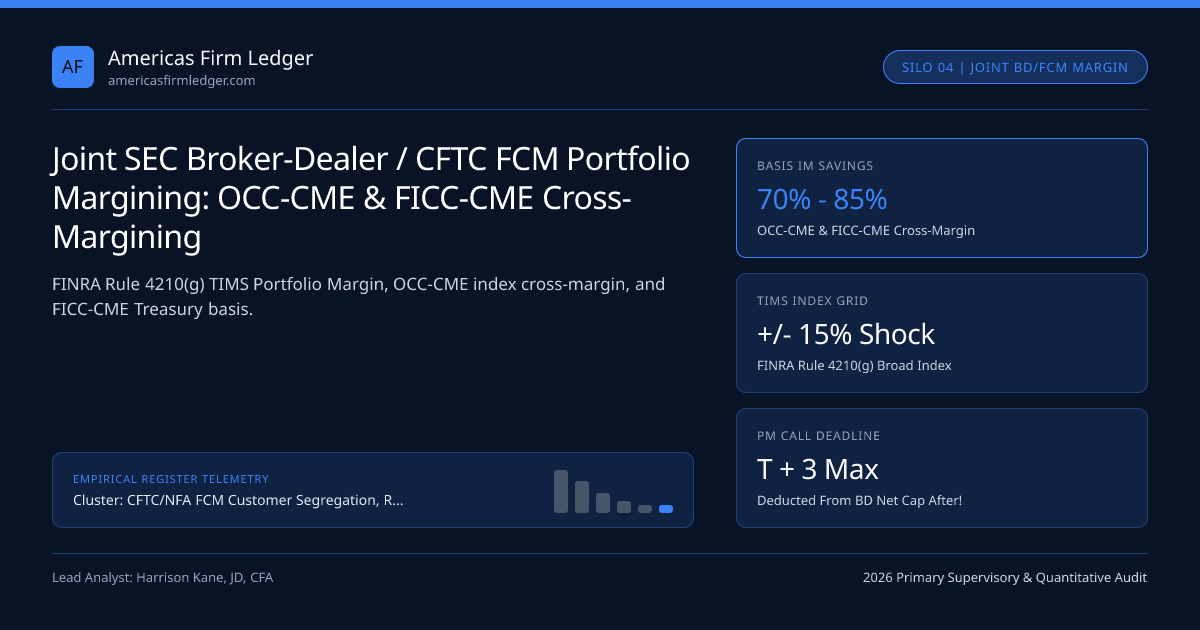
Suppose an equity-volatility hedge fund or market maker (comparable to systematic derivatives firms like Acacia Trading) is Long $500,000,000 of SPX Listed Index Options (cleared at OCC — an SEC Security!) and Short $500,000,000 of CME E-mini S&P 500 Futures (cleared at CME — a CFTC Commodity Future!)—or a fixed-income relative-value desk is Long $2 billion Cash U.S. Treasury Notes (cleared at FICC) and Short $2 billion CME 10-Year Ultra Treasury Futures! If held in two siloed accounts without cross-agency recognition, two separate clearinghouses charge $75,000,000+ of duplicate initial margin on a near-zero-delta hedged spread! Bridging that statutory divide between the SEC and the CFTC is the crown jewel of Joint SEC Broker-Dealer / CFTC FCM Prime Brokerage!
This cross-agency architecture guide links Silo 1 (SEC Rule 15c3-1), Silo 2 (SEC Rule 15c3-3 & SIPC), and Silo 4 (CFTC FCM Segregation).
Three Distinct Cross-Product Margining Programs Across SEC & CFTC Jurisdiction!#
Institutional prime-brokerage lawyers and risk officers must never conflate three legally distinct margin-offset structures—because each sits in a different bankruptcy estate (SIPA vs Part 190):
- FINRA Rule 4210(g) Customer Portfolio Margin (Held Inside the SEC Rule 15c3-3 Securities Account — SIPA Covered!):
- Uses the OCC's TIMS (Theoretical Intermarket Margining System, +/-15% broad-index / -8% to +8% high-cap equidistant price-shock grid) rather than flat Reg T 50%;
- Covers equities, listed equity/index options, single-stock futures (Security Futures jointly regulated by SEC & CFTC!), and related index ETFs (minimum $100,000–$500,000+ house equity gates + Series 24/4 options approval);
- Limitation: Pure CFTC-regulated broad-based CME E-mini futures (ES, NQ) cannot sit directly inside a standard retail Rule 4210(g) securities account without formal SEC/CFTC cross-margin exemptive orders!
- OCC–CME Cross-Margining (Proprietary, Market-Maker & Eligible Customer Index Option / Futures Programs):
- Governed by joint SEC/CFTC exemptive orders linking The Options Clearing Corporation (OCC) and CME Clearing;
- Pairs OCC-cleared broad-based index options (SPX, NDX, RUT) directly against CME-cleared index futures (ES, NQ, RTY) inside a dedicated Cross-Margin Account—slashing hedged initial margin by 70% to 85%!
- CRITICAL BANKRUPTCY ELECTION: Customer OCC–CME cross-margin accounts are typically carried under CEA Section 4d / CFTC Part 190 Appendix A Cross-Margining Rules (requiring the customer to sign an explicit subordination/SIPA-election agreement acknowledging that cross-margined securities options inside that pool liquidate under Part 190 / joint clearinghouse lien rules rather than standalone retail SIPC!).
- FICC–CME Cash Treasury / Futures Cross-Margining (Expanded Under the SEC Treasury Clearing Mandate!):
- Pairs Fixed Income Clearing Corporation (FICC GSD) cash U.S. Treasury notes/repos against CME Group interest-rate & Treasury futures (SOFR, ZN, ZB)—massively expanded across 2024–2026 to support the SEC's mandatory central clearing of U.S. Treasury cash and repo transactions!
Complete Regulatory Matrix Across All Four Multi-Asset Margining Buckets#
Compare margin methodology, custody pool, and insolvency waterfall before signing prime-brokerage cross-margining addenda:
| Margin Program | Eligible Offsetting Instruments | Clearinghouse Link | Governing Custody Pool | Insolvency Regime (SIPA vs Part 190) |
|---|---|---|---|---|
| Reg T Margin (12 CFR 220 / FINRA 4210) | US Equities & ETFs (50% Initial / 25% Maint) | DTCC / NSCC / OCC | SEC Rule 15c3-3 | SIPA + $500,000 SIPC |
| FINRA Rule 4210(g) Portfolio Margin | Stocks + Listed Options + Security Futures | DTCC + OCC (TIMS) | SEC Rule 15c3-3 | SIPA + $500,000 SIPC |
| OCC–CME Cross-Margining | SPX/NDX Index Options vs ES/NQ Index Futures | OCC <-> CME Joint Lien | Joint X-Margin Account | CFTC Part 190 Cross-Margin Rules (SIPA Waived on Slice!) |
| FICC–CME Treasury Cross-Margin | Cash US Treasuries/Repos vs CME Treasury/SOFR Fut. | FICC GSD <-> CME | Proprietary / Eligible Accts | Joint FICC–CME Cross-Guaranty Lien |
| CME 4d(f) Rates Portfolio Margin | Cleared SOFR/IRS Swaps vs CME Treasury Futures | CME Clearing Internal | CEA Sec. 4d(f) LSOC! | Part 190 Cleared Swaps Class ($0 SIPC) |
Quantitative Capital Efficiency Gain: Siloed Margin vs OCC–CME Cross-Margining!#
Run the exact capital-efficiency math on a $250,000,000 Delta-Neutral S&P 500 Dispersion / Index Arbitrage Book (Long 1,000 SPX At-the-Money Calls + Short 1,000 SPX Puts @ OCC hedged tick-for-tick against Short 1,000 CME E-mini S&P 500 Futures):
- CrossMarginedNetRiskMargin = JointOCCCMESPANPrismaWorstScenarioLoss (NetOf99PctSPXESCorrelation!)
- FreedInstitutionalLiquidity = SiloedUnhedgedInitialMargin - CrossMarginedNetRisk_Margin
- Worked $250,000,000 S&P 500 Synthetic Long Option vs Short ES Futures Basis Audit:
- 1. Siloed Accounts (Options in SEC 15c3-3 Account; Futures in CFTC 4d(a)(2) Account):
- OCC Standalone Margin on $250M Synthetic Long SPX Options = $27,500,000 (11.0%)
- CME Standalone Margin on $250M Short E-mini S&P Futures = $13,750,000 (5.5%)
- Total Siloed Margin Locked = $27,500,000 + $13,750,000 = $41,250,000! (Plus intraday variation mismatch: on a +3% rally, OCC gains stay trapped while CME demands -$7.5M cash at 1:30 PM!)
- 2. Unified Joint BD/FCM OCC-CME Cross-Margin Account:
- Jointly modeled basis/pin/expiration risk = $5,800,000 (2.32% combined!)
- Freed Working Cash = $41,250,000 - $5,800,000 = +$35,450,000 (85.9% Margin Reduction + Single Netted Daily Variation Sweep!).
Margin Required on $250M Hedged SPX / ES Basis Book#
Notice the Bonus Win for the Prime Broker's Own Balance Sheet!#
Did you notice Step 4 in the chart above? Under CFTC Rule 1.17, an FCM must hold 8% of Customer Risk Maintenance Margin in Adjusted Net Capital! When OCC–CME or FICC–CME cross-margining slashes a hedge fund's required risk margin from $41.25M down to $5.80M, it simultaneously slashes the Joint BD/FCM's own regulatory Net Capital requirement on that client from $3.30M down to $464k—which is why prime brokers pass dramatically tighter financing spreads to cross-margined clients! Next, inspect the Dodd-Frank capital rules for uncleared OTC derivatives dealers in CFTC Rule 23.101 Swap Dealer Capital Adequacy and CEA Section 4d(a)(2) futures segregation inside the CFTC/NFA FCM Segregation Topic Hub.
Frequently asked questions
Can a retail investor with $150,000 cross-margin CME E-mini S&P futures against SPX index options in a Schwab or IBKR Portfolio Margin account?
Watch the account split! Standard retail FINRA Rule 4210(g) Portfolio Margin covers stocks, ETFs, and OCC-listed options (like SPY + SPX options) inside your SEC securities account, whereas CME E-mini futures sit in your separate CFTC 4d(a)(2) futures sub-account unless enrolled in an eligible institutional/market-maker OCC-CME cross-margin program!
Why did FICC-CME Treasury Cross-Margining become a top Wall Street priority in 2025-2026?
Because the SEC's Treasury Central Clearing Rule (Rule 17ad-22(e)(18)) mandates central clearing of eligible cash U.S. Treasury and repo trades through FICC across 2026-2027—making FICC-CME cross-margining essential so Treasury basis funds don't face doubled margin on cash-vs-futures trades!
How fast must a FINRA Rule 4210(g) Portfolio Margin deficiency be met before hitting the broker-dealer's Net Capital?
Under FINRA Rule 4210(g)(10), Portfolio Margin calls must be met within 3 business days (T+3)—and any deficiency remaining unsatisfied after T+3 must be deducted 100% from the broker-dealer's SEC Rule 15c3-1 Net Capital (in practice, prime brokers auto-liquidate on T+1)!
Can any FINRA broker-dealer turn on FINRA Rule 4210(g) Portfolio Margin for customers tomorrow?
No! Under FINRA Rule 4210(g)(1), a carrying firm must apply for and receive prior written approval from FINRA (and SEC risk-monitoring clearance) proving real-time intraday TIMS stress-monitoring infrastructure before offering Customer Portfolio Margin.
Publication record
- Published
- November 13, 2026
- Updated
- November 15, 2026
- Author
- Harrison Kane, JD, CFA
- Review
- Review not recorded
- Automated fact check
- Passed in the stored pipeline record
- Source URLs
- 4 recorded
AI assistance recorded: anthropic/claude-opus-4.6. This field does not establish human review or source verification.
Academic & Institutional Attribution
Cite This Research & Embed Live Data Card
Standard academic & institutional research paper citation format.
Harrison Kane, JD, CFA. (2026, November 15). Joint SEC Broker-Dealer / CFTC FCM Portfolio Margining: OCC-CME & FICC-CME Cross-Margining. Americas Firm Ledger. https://americasfirmledger.com/filings/joint-sec-bd-cftc-fcm-portfolio-margining-cross-margin-locksRegulatory Directory Cross-Reference
Referenced Institutions & Regulatory Registries
Mentioned Regulated Institutions
Related CFTC Nfa Fcm Segregated Residual Interest & Institutional Briefings
Explore CFTC Nfa Fcm Segregated Residual Interest Hub (20) →CFTC Nfa Fcm Segregated Residual Interest
CFTC & NFA FCM Customer Segregation, Residual Interest & RFED Capital: Institutional GuideCFTC Nfa Fcm Segregated Residual Interest
CFTC Rule 23.101 Swap Dealer Capital Adequacy: Bank Prudential vs NFA Net Liquid Assets & 8% MarginCFTC Nfa Fcm Segregated Residual Interest
Independent vs Guaranteed Introducing Brokers (IBs): $45,000 Capital vs CFTC Form 1-FR-IB Part BCFTC Nfa Fcm Segregated Residual Interest
Non-Intermediated CFTC DCO Clearing vs FCM Intermediation: Digital Assets & Event ContractsCFTC Nfa Fcm Segregated Residual Interest
CEA Section 4d(a)(2) & CFTC Rule 1.20 Futures Segregation: Appendix A Letters & Net Liquidating EquityCFTC Nfa Fcm Segregated Residual Interest
CFTC Regulation 30.7 Foreign Futures Secured Amount: Net Liquidating Upgrade & Foreign RiskCFTC Nfa Fcm Segregated Residual Interest
CEA Section 4d(f) & CFTC Part 22 Cleared Swaps LSOC Explained: Eliminating Fellow-Customer RiskCFTC Nfa Fcm Segregated Residual Interest
CFTC Rule 1.22 Residual Interest Target Explained: Blocking Fellow-Customer Margin UsageCiro Csa Canadian Investment Dealers
FINTRAC PCMLTFA Rules for CIRO Dealers & MSBs: CAD $10k EFTR & STR FilingsCiro Csa Canadian Investment Dealers
OBSI CAD $350k Investment Ombudsman: CIRO & CSA 90-Day Complaint FilingsCiro Csa Canadian Investment Dealers
U.S. SEC Rule 15a-6 vs. CSA NI 31-103 s. 8.18: Cross-Border CIRO & FINRA FilingsRegulatory Compliance
NEWS: SEC enforcement actions drop to lowest level since 1991 - AML Intelligence
Americas Firm Ledger Data, Benchmarks & Contributor Records
CC BY 4.0 Open Data
Open Institutional Datasets (CSV / JSON) →
Download desk-compiled quantitative series & schemas.
2026 Reference Matrix
2026 Institutional Benchmarks & Thresholds →
Statutory capital, clearing, margin & rate conventions.
Editorial Records
Authors & Review Records →
View named contributors where those records are available.
Complete Index
Master Research & Dossier Archive →
Browse all published briefings by topic pillar & date.