
SEC Rule 15c3 3 Customer Reserve Sipc
SIPA Broker-Dealer Liquidation Explained: Customer Property Pool, Net Equity & Transfers
When a carrying broker-dealer fails, SIPC petitions federal court to appoint a SIPA Trustee who freezes accounts as of the Filing Date, transfers intact customer books in bulk to solvent brokers, distributes Customer Property pro-rata by Net Equity, and advances up to $500,000 per capacity.
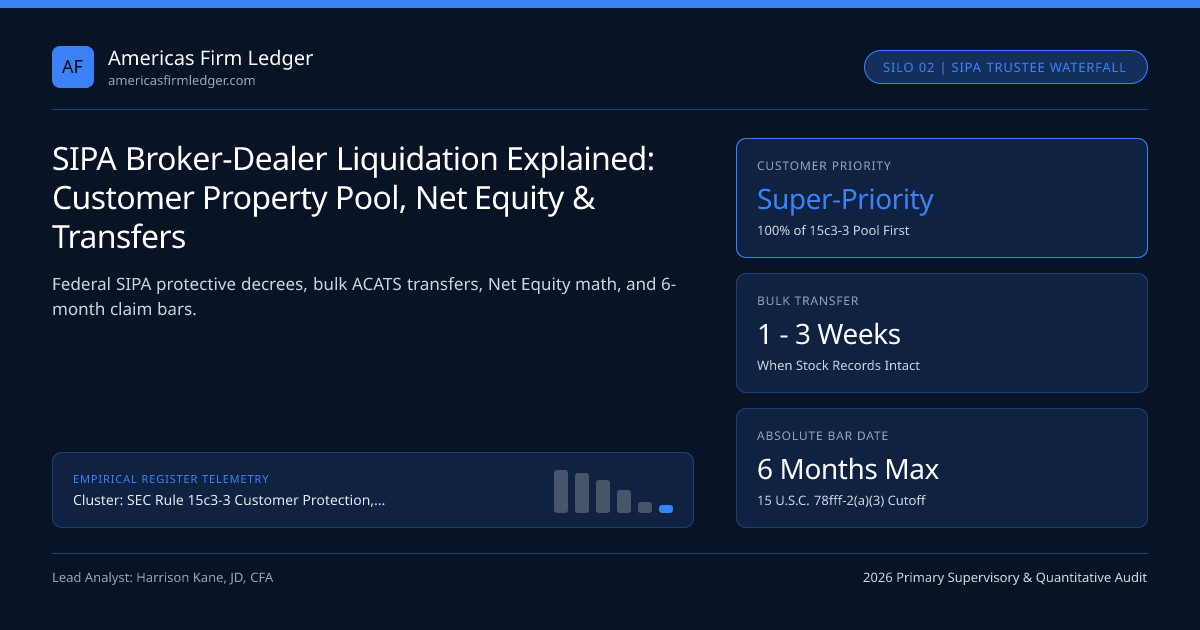
Stockbrokers never liquidate under ordinary Chapter 11 corporate reorganization! Under Section 109(d) of the U.S. Bankruptcy Code, failed securities broker-dealers liquidate either under Subchapter III of Chapter 7 or—whenever public customers exist—through a specialized federal protective decree under the Securities Investor Protection Act (SIPA, 15 U.S.C. 78eee–78lll) initiated by SIPC and removed immediately to U.S. Bankruptcy Court. From Lehman Brothers Inc. (2008, >$106 billion returned to 111,000+ customer accounts with 100% customer recovery and $0 SIPC Fund loss) to Bernard L. Madoff Investment Securities LLC (2008, >$14.7 billion recovered via clawbacks), SIPA's Customer Property Super-Priority Waterfall governs every penny!
This insolvency guide extends our SEC Rule 15c3-3 Customer Protection institutional guide, linking SIPC $500,000 separate-capacity advances to Excess SIPC Lloyd's surety triggers.
Four-Stage Mechanics of a Federal SIPA Liquidation Proceeding#
When the SEC or FINRA notifies SIPC that a carrying member has failed or is in danger of failing to meet customer obligations, SIPA executes a rapid statutory sequence:
- Protective Decree & "Filing Date" Valuation Freeze (15 U.S.C. 78eee & 78lll(7)): SIPC applies to U.S. District Court for a Protective Decree, appointing an independent SIPA Trustee (or SIPC itself in small cases under $100M). Every customer's "Net Equity" claim is legally fixed as of the Filing Date!
- Bulk Account Transfer (15 U.S.C. 78fff-2(f)) — Days, Not Years!: Whenever the failed broker's SEC Rule 15c3-3 Stock Record and Special Reserve Bank Account are largely intact (as in Lehman Brothers Inc.'s retail wealth book), the SIPA Trustee executes an automated ACATS / bulk account transfer to a solvent acquiring broker-dealer within 1 to 3 weeks—restoring client market access without waiting for individual claim forms!
- Marshaling the "Fund of Customer Property" (15 U.S.C. 78lll(4)): All securities in DTC Possession or Control, all cash/Treasuries in the Special Reserve Bank Account, plus any recovered customer property traced or clawed back by the Trustee form a bankruptcy-remote Customer Property Pool—ranked ahead of all general creditors, bondholders, landlords, and proprietary counterparties!
- In-Kind Share Delivery ("Purchase on Open Market") & SIPC Advance (78fff-2(d)): To the greatest extent practicable, the SIPA Trustee delivers the exact same CUSIP and share count owed to the customer (buying missing shares in the open market up to the Filing Date Net Equity + $500k SIPC cap), so customers retain unrealized tax basis!
The "Net Investment Method" vs "Last Statement Method" in Fraud Cases!#
What if a crooked broker never bought any stocks at all and printed fake monthly statements showing imaginary 12% returns for 20 years (the Bernard Madoff Ponzi litigation, In re Bernard L. Madoff Investment Securities LLC, 654 F.3d 229, 2d Cir. 2011, cert. denied U.S. Supreme Court)?
- Legitimate Custodial Failure (Actual Trades Executed): Net Equity equals the market value of actual securities positions and cash reflected on books and records on the Filing Date (less margin loans owed by the customer).
- Fictitious Ponzi Statements ("Cash-In / Cash-Out" Net Investment Method): The Second Circuit upheld SIPC and the Trustee: honoring fake statement profits would steal real money from newer victims to pay imaginary gains to older investors! Therefore, in a fictitious-statement fraud, Net Equity = Cumulative Real Cash Deposited minus Cumulative Real Cash Withdrawn ("Net Losers"), and "Net Winners" face Bankruptcy Code Section 548 2-year fraudulent-transfer clawbacks of fictitious profits!
| SIPA Claimant / Creditor Tier | Statutory Priority Rank | Access to 15c3-3 Customer Property Pool? | Eligible for $500k SIPC Fund Advance? | Residual Recovery Source |
|---|---|---|---|---|
| Public Securities Customers | Tier 1 (Super-Priority) | Yes — 100% Exclusive First Claim | Yes (Up to $500k / $250k Cash) | Excess SIPC + General Estate Share |
| SIPC Subrogation Claim | Tier 1B (Subrogated) | Reimbursed After Customer Equity Met | Fund Reimburses Itself | General Estate Parity |
| PAB Carrying Broker-Dealers | PAB Reserve Pool | Separate PAB Reserve Bank Account | No (Brokers Excluded From SIPC $500k!) | General Estate for Shortfall |
| Unsecured General Creditors / Repo | Tier 2 (General Estate) | Zero Access to Customer Pool | No ($0 SIPC) | General Corporate Assets Only |
| FINRA Rule 4110 Subordinated Lenders | Tier 3 (Subordinated) | Zero Access | No ($0 SIPC) | Wiped Out Until Gen Creditors 100% Paid |
| Broker-Dealer Equity / >5% Owners | Tier 4 (Last / Subordinated) | Excluded From SIPC Advances (78fff-3) | No ($0 SIPC) | Residual Equity Only |
Quantitative SIPA "Net Equity" & In-Kind Share Restoration Math#
Understand how in-kind share delivery works when stock prices move between the Filing Date and the Distribution Date (15 U.S.C. 78fff-2(c)(2) & (d)):
- InKindShareEntitlement = ExactShareQuantityHeldOnFilingDate (provided NetEquity_Claim <= Pool + $500k)
- Worked Post-Filing Rally Example (Customer Owned 5,000 Shares of NVDA, $0 Margin Debt):
- SIPA Filing Date Price = $80.00/share -> Filing Date Net Equity Claim = 5,000 * $80 = $400,000 (<= $500k Cap!)
- Failed Broker Misappropriated 1,000 of the 5,000 shares (4,000 sit in DTC; 1,000 missing!)
- Distribution Date (45 Days Later): NVDA rallies to $110.00/share!
- SIPA Trustee Action: Delivers the 4,000 pool shares + uses SIPC funds (capped at $500k total advance)
- to purchase the missing 1,000 shares @ $110 ($110,000 <= $500,000 SIPC Advance Ceiling!)
- Customer Receives: ALL 5,000 SHARES OF NVDA IN KIND (Worth $550,000, zero capital-gains realization!)
SIPA Bankruptcy Priority & Historical Recovery by Claimant Class#
The Unforgiving 6-Month Statutory Claim Bar Date!#
One trap has cost tardy institutional investors millions: under 15 U.S.C. 78fff-2(a)(3), no claim of a customer or other creditor received by the SIPA Trustee after the expiration of six months beginning on the date of publication of notice of the SIPA proceeding shall be allowed (with ultra-narrow exceptions solely for infants, incompetents, or government entities without knowledge)! Unlike Chapter 11 "excusable neglect" extensions, SIPA's 6-month outer claim deadline is jurisdictional and absolute. Next, evaluate what happens when a $50 million family office faces a severe vault shortfall beyond SIPC's $500,000 cap in Excess SIPC surety policies at Lloyd's of London inside the SEC Rule 15c3-3 & SIPC Topic Hub.
Frequently asked questions
Can a U.S. bankruptcy judge extend the 6-month SIPA customer claim deadline for "excusable neglect"?
No! Federal appellate courts uniformly hold that 15 U.S.C. 78fff-2(a)(3)'s 6-month outer bar date is an absolute statutory cutoff (except for minors, incompetent persons, or government units), and late claims lose SIPA customer-advance priority.
What happens to my margin loan if my broker-dealer enters SIPA liquidation?
If your account is not transferred intact via bulk ACATS, your Net Equity equals your securities' Filing Date value minus your margin loan debit; with Trustee approval under 78fff-2(c)(2), you may pay off your debit balance to receive 100% of your underlying securities.
Are other broker-dealers (correspondent introducing brokers) eligible for the $500,000 SIPC advance on firm accounts?
No! Under 15 U.S.C. 78fff-3(a)(5), banks and broker-dealers acting for their own proprietary accounts are excluded from SIPC Fund advances—which is why SEC Rule 15c3-3(e) requires a separate PAB Special Reserve Bank Account for inter-broker assets.
Did public brokerage customers lose money in the 2008 SIPA liquidation of Lehman Brothers Inc.?
No! In the largest SIPA proceeding in U.S. history, the SIPA Trustee transferred and distributed over $106 billion to more than 111,000 retail and institutional customer accounts—achieving a 100% recovery on allowed customer claims.
Publication record
- Published
- November 13, 2026
- Updated
- November 14, 2026
- Author
- Harrison Kane, JD, CFA
- Review
- Review not recorded
- Automated fact check
- Passed in the stored pipeline record
- Source URLs
- 4 recorded
AI assistance recorded: anthropic/claude-opus-4.6. This field does not establish human review or source verification.
Academic & Institutional Attribution
Cite This Research & Embed Live Data Card
Standard academic & institutional research paper citation format.
Harrison Kane, JD, CFA. (2026, November 14). SIPA Broker-Dealer Liquidation Explained: Customer Property Pool, Net Equity & Transfers. Americas Firm Ledger. https://americasfirmledger.com/filings/sipa-broker-dealer-liquidation-customer-property-net-equityRegulatory Directory Cross-Reference
Referenced Institutions & Regulatory Registries
Top Regulated Institutions in This Coverage Slice
Referenced Supervisory Authorities
Related SEC Rule 15c3 3 Customer Reserve Sipc & Institutional Briefings
Explore SEC Rule 15c3 3 Customer Reserve Sipc Hub (20) →SEC Rule 15c3 3 Customer Reserve Sipc
SEC Rule 15c3-3 Customer Protection, Reserve Formula & SIPC Limits: Institutional GuideSEC Rule 15c3 3 Customer Reserve Sipc
Excess SIPC Insurance Explained: Lloyd's Aggregate Firm Caps, Cash Sublimits & TriggersSEC Rule 15c3 3 Customer Reserve Sipc
SEC Special Purpose Broker-Dealers (SPBDs): Rule 15c3-3 Digital Asset Custody & SIPASEC Rule 15c3 3 Customer Reserve Sipc
FINRA Rule 4311 Carrying Agreements: Fully Disclosed vs Omnibus Clearing & SIPA PrioritySEC Rule 15c3 3 Customer Reserve Sipc
Hypothecation of Customer Securities Under SEC Rules 8c-1 & 15c2-1: Three Anti-Commingling BansSEC Rule 15c3 3 Customer Reserve Sipc
SEC Rule 15c3-3a Exhibit A Customer Reserve Formula: Credit vs Debit Line AuditSEC Rule 15c3 3 Customer Reserve Sipc
Daily vs Weekly SEC Rule 15c3-3 Reserve Computations: The $500M Total Credits RuleSEC Rule 15c3 3 Customer Reserve Sipc
Special Reserve Bank Accounts Under SEC Rule 15c3-3: No-Lien Letters & 15% Bank CapsFinra Brokercheck Form Bd Crs Filings
FINRA Rule 3310 AML Compliance: $5,000 FinCEN SAR Clocks, CDD 25% Owners & Independent AuditsFinra Brokercheck Form Bd Crs Filings
Dual-Registrant BD/RIA Filings: Reconciling Web CRD Form BD With IARD Form ADV Part 1A & 2AFinra Brokercheck Form Bd Crs Filings
SEC Rule 606 Order Routing & Payment for Order Flow (PFOF) Disclosures: XML & Rule 5310 AuditFinra Brokercheck Form Bd Crs Filings
FINRA Rule 5123 Private Placement Filings & SEC Form D: 15-Day Clocks, Rule 506(d) & RN 23-08
Americas Firm Ledger Data, Benchmarks & Contributor Records
CC BY 4.0 Open Data
Open Institutional Datasets (CSV / JSON) →
Download desk-compiled quantitative series & schemas.
2026 Reference Matrix
2026 Institutional Benchmarks & Thresholds →
Statutory capital, clearing, margin & rate conventions.
Editorial Records
Authors & Review Records →
View named contributors where those records are available.
Complete Index
Master Research & Dossier Archive →
Browse all published briefings by topic pillar & date.