
SEC Rule 15c3 3 Customer Reserve Sipc
SEC Special Purpose Broker-Dealers (SPBDs): Rule 15c3-3 Digital Asset Custody & SIPA
Under the SEC's Special Purpose Broker-Dealer (SPBD) Statement and subsequent 2025 Division of Trading and Markets Rule 15c3-3 crypto FAQs, broker-dealers custodying digital asset securities must prove exclusive cryptographic private-key control, block non-security commingling where restricted.
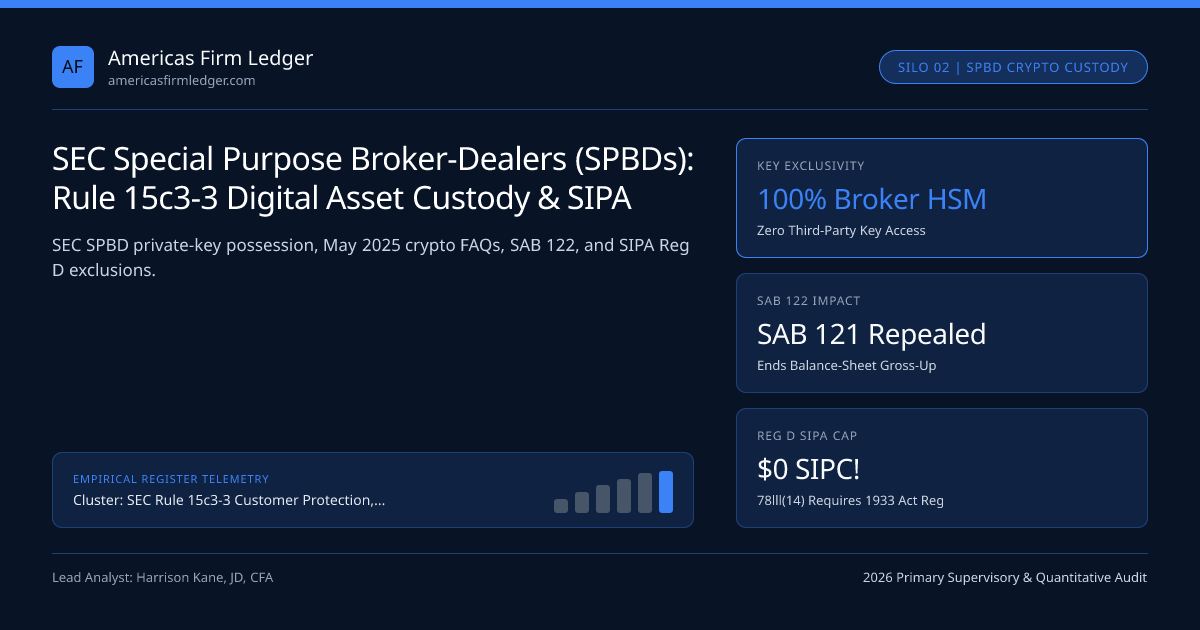
How can a broker-dealer prove "physical possession or control" under SEC Rule 15c3-3(b) when a tokenized corporate bond or digital asset security lives on a distributed blockchain ledger rather than inside a Depository Trust Company (DTC) vault—where anyone who copies a 256-bit cryptographic private key can irreversibly transfer customer property in 12 seconds? To bridge 1970 paper-era custody rules with cryptographic bearer assets, the SEC issued its December 23, 2020 Statement on Custody of Digital Asset Securities by Special Purpose Broker-Dealers (Release No. 34-90788), followed in May 2025 by transformative SEC Division of Trading and Markets & FINRA Crypto Custody / Transfer Agent FAQs!
This digital-custody deep dive connects institutional blockchain infrastructure—across SEC-registered digital-asset managers like Bitwise (801-122073), enterprise validators like Blockdaemon, and NYDFS BitLicense trusts—to our SEC Rule 15c3-3 Customer Protection institutional guide and Good Control Location rules.
Core Conditions of the SEC SPBD Safe Harbor & May 2025 Evolution#
Originally, the 2020 SPBD Statement created a tightly walled 5-year no-enforcement safe harbor (adopted by pioneering FINRA-approved SPBDs such as Prometheum Ember Capital) requiring nine strict conditions—several of which the SEC Division of Trading and Markets modernized in its May 15, 2025 Crypto Custody FAQs (withdrawing the restrictive 2019 Joint SEC/FINRA Statement!):
- Exclusive Private-Key Possession (Rule 15c3-3(b) Cryptographic Control): To establish possession, no other person—neither the customer, the token issuer, nor any third-party cloud vendor—may have access to the cryptographic private keys necessary to transfer the digital asset security without the broker-dealer's multi-party computation (MPC) / hardware security module (HSM) authorization!
- Blockchain Network Governance & 51%-Attack Assessment: Written policies must evaluate every underlying distributed ledger's consensus mechanism, smart-contract freeze/clawback functions, hard-fork protocols, and cyber vulnerabilities BEFORE custodying any tokenized security.
- 2020 Exclusivity vs 2025 Dual Traditional + Crypto Broker-Dealer Clarification: Under the original 2020 SPBD Statement, an SPBD could carry only digital asset securities (barred from carrying traditional DTC stocks or non-security Bitcoin/Ether!). Crucially, the May 2025 SEC Trading & Markets FAQs clarified that:
- Rule 15c3-3 applies ONLY to "securities"—meaning a standard carrying broker-dealer is not barred by Rule 15c3-3 itself from also facilitating non-security spot crypto (subject to strict non-commingling, Net Capital deductions, and state/NYDFS rules); AND
- Tokenized equities or funds recorded via a registered SEC Transfer Agent using a blockchain master securityholder file alongside off-chain authoritative records can satisfy Rule 15c3-3(c) Good Control Locations for traditional carrying broker-dealers!
- Upfront Written SIPA / SIPC Uncertainty Disclosures: Because SIPA's 1970 definition of "security" (15 U.S.C. 78lll(14)) requires an effective Securities Act registration statement for unregistered investment contracts!
The Hidden SIPA Statutory Bomb: Why Reg D Digital Securities Get $0 SIPC!#
Read 15 U.S.C. 78lll(14) with extreme care—this is one of the sharpest legal traps in North American capital markets! Under the Securities Exchange Act of 1934, an unregistered Regulation D 506(c) tokenized fund or investment contract is a "security" (requiring a broker-dealer and Rule 15c3-3 compliance). Yet under SIPA Section 78lll(14), an "investment contract or certificate of interest" qualifies as a SIPA-protected "security" ONLY IF it is the subject of a registration statement with the Commission pursuant to the provisions of the Securities Act of 1933!
Compare all five North American digital-asset custody structures side-by-side:
| Digital Asset Custody Structure | Primary Regulator | Rule 15c3-3 Applies? | Bankruptcy Estate Isolation | Statutory SIPC ($500k) Coverage? |
|---|---|---|---|---|
| Spot Bitcoin / Ether ETF at Carrying BD | SEC / FINRA | Yes (DTC Good Control) | SIPA Customer Property Pool | Yes — $500,000 SIPC (S-1 Registered!) |
| S-1 Registered Tokenized Stock/Bond | SEC / FINRA (BD / TA) | Yes (SPBD or TA Control) | SIPA Customer Property Pool | Yes — $500,000 SIPC (Traditional Security) |
| Reg D Unregistered Investment-Contract Token | SEC / FINRA (SPBD) | Yes (15c3-3 Applies!) | UCC Art. 8 / SIPA Question | NO — Excluded Under 78lll(14)! |
| NYDFS Limited Purpose Crypto Trust | NYDFS (23 NYCRR 200) | No (State Banking Law) | NY Banking Law Custodial Trust | No SIPC / No FDIC |
| Unregistered Offshore Spot Exchange | Unregulated / MSB Only | No | Commingled Omnibus Risk! | $0 SIPC / $0 FDIC |
Quantitative Net Capital Charge on Proprietary Crypto vs Custodied Tokens#
Under SEC Rule 15c3-1(c)(2)(iv), any native spot cryptocurrency (BTC, ETH, SOL) held on a broker-dealer's own balance sheet without a recognized SEC haircut grid suffers a 100% non-allowable asset deduction—whereas SEC-listed Spot Bitcoin/Ether ETFs qualify for standard 15% equity haircuts (verified by SEC staff guidance):
- NetCapitalAllowableValue(SECListedSpotBTCETF) = MarketValue * (1 - 0.15StandardHaircut - Concentration_Addon)
- Worked Broker-Dealer Balance Sheet Capital Efficiency Comparison ($10,000,000 House Crypto Exposure):
- Option A: Hold $10,000,000 Native Spot Bitcoin directly in House Cold Wallet
- Rule 15c3-1 Non-Allowable Deduction = 100% ($10,000,000 deducted from Net Capital!)
- Countable Net Capital Contribution = $0.00!
- Option B: Hold $10,000,000 SEC-Listed Spot Bitcoin ETF (DTC-Cleared Exchange-Traded Share)
- Rule 15c3-1(c)(2)(vi)(J) Haircut = 15% ($1,500,000 deduction, assuming <=10% concentration)
- Countable Net Capital Contribution = $8,500,000 (+$8.5M Capital Efficiency Gain!)
Net Capital Recognition Across Digital Asset Structures#
Rescission of SAB 121 (SAB 122) & SIPA Trustee Key-Succession Escrow#
Notice two landmark 2025 structural shifts that unlocked institutional crypto custody in the United States:
- SEC Staff Accounting Bulletin No. 122 (Rescinding SAB 121): In January 2025, the SEC rescinded SAB 121—eliminating the punitive accounting rule that had forced public custodians and broker-dealers to gross up off-balance-sheet custodied client crypto onto their own GAAP liabilities (which had previously blown up Aggregate Indebtedness and Basel leverage ratios!).
- SIPA Trustee Cryptographic Key Succession: Every digital-asset broker-dealer must maintain audited disaster-recovery key shards so a court-appointed SIPA Trustee can sweep customer wallets even if firm founders disappear! Next, examine how clearing and introducing brokers allocate custody liability in FINRA Rule 4311 carrying agreements inside the SEC Rule 15c3-3 & SIPC Topic Hub.
Frequently asked questions
Why are unregistered Reg D tokenized investment contracts excluded from SIPC $500,000 coverage?
While Reg D investment contracts are "securities" under the 1934 Exchange Act, SIPA's narrower definition in 15 U.S.C. 78lll(14) covers investment contracts ONLY if they are the subject of an effective 1933 Securities Act registration statement.
What changed when the SEC issued Staff Accounting Bulletin No. 122 (SAB 122) in 2025?
SAB 122 rescinded SAB 121, meaning custodians and broker-dealers no longer have to record a massive safeguarding liability and offsetting asset on their own balance sheet merely for holding client cryptographic keys—assessing contingent loss liabilities under standard ASC 450 instead.
Can a customer share a 2-of-2 multisig wallet with a broker-dealer and satisfy Rule 15c3-3 possession?
No, if the customer or a third party can block a court-appointed SIPA Trustee from moving customer property or unilaterally transfer the token! Exclusive operational control and SIPA Trustee key-recovery mechanisms are mandatory.
How did the May 2025 SEC Trading and Markets FAQs help tokenized mutual funds and equities?
They clarified that when an SEC-registered transfer agent maintains the official master securityholder file (using distributed ledger technology alongside off-chain control records), carrying broker-dealers can establish Good Control under Rule 15c3-3(c) just like uncertificated mutual funds.
Publication record
- Published
- November 13, 2026
- Updated
- November 15, 2026
- Author
- Harrison Kane, JD, CFA
- Review
- Review not recorded
- Automated fact check
- Passed in the stored pipeline record
- Source URLs
- 4 recorded
AI assistance recorded: anthropic/claude-opus-4.6. This field does not establish human review or source verification.
Academic & Institutional Attribution
Cite This Research & Embed Live Data Card
Standard academic & institutional research paper citation format.
Harrison Kane, JD, CFA. (2026, November 15). SEC Special Purpose Broker-Dealers (SPBDs): Rule 15c3-3 Digital Asset Custody & SIPA. Americas Firm Ledger. https://americasfirmledger.com/filings/sec-special-purpose-broker-dealer-spbd-digital-asset-custodyRegulatory Directory Cross-Reference
Referenced Institutions & Regulatory Registries
Mentioned Regulated Institutions
Referenced Supervisory Authorities
Related SEC Rule 15c3 3 Customer Reserve Sipc & Institutional Briefings
Explore SEC Rule 15c3 3 Customer Reserve Sipc Hub (20) →SEC Rule 15c3 3 Customer Reserve Sipc
SEC Rule 15c3-3 Customer Protection, Reserve Formula & SIPC Limits: Institutional GuideSEC Rule 15c3 3 Customer Reserve Sipc
FINRA Rule 4311 Carrying Agreements: Fully Disclosed vs Omnibus Clearing & SIPA PrioritySEC Rule 15c3 3 Customer Reserve Sipc
Hypothecation of Customer Securities Under SEC Rules 8c-1 & 15c2-1: Three Anti-Commingling BansSEC Rule 15c3 3 Customer Reserve Sipc
SEC Rule 15c3-3a Exhibit A Customer Reserve Formula: Credit vs Debit Line AuditSEC Rule 15c3 3 Customer Reserve Sipc
Daily vs Weekly SEC Rule 15c3-3 Reserve Computations: The $500M Total Credits RuleSEC Rule 15c3 3 Customer Reserve Sipc
Special Reserve Bank Accounts Under SEC Rule 15c3-3: No-Lien Letters & 15% Bank CapsSEC Rule 15c3 3 Customer Reserve Sipc
Qualified Securities in SEC Rule 15c3-3 Reserve Accounts: U.S. Treasury Rules & HaircutsSEC Rule 15c3 3 Customer Reserve Sipc
PAB Reserve Computations for Proprietary Accounts of Broker-Dealers Under SEC Rule 15c3-3Finra Brokercheck Form Bd Crs Filings
SEC Rule 606 Order Routing & Payment for Order Flow (PFOF) Disclosures: XML & Rule 5310 AuditFinra Brokercheck Form Bd Crs Filings
FINRA Rule 5123 Private Placement Filings & SEC Form D: 15-Day Clocks, Rule 506(d) & RN 23-08CFTC Nfa Fcm Segregated Residual Interest
CEA Section 4d(a)(2) & CFTC Rule 1.20 Futures Segregation: Appendix A Letters & Net Liquidating EquityCFTC Nfa Fcm Segregated Residual Interest
CFTC Regulation 30.7 Foreign Futures Secured Amount: Net Liquidating Upgrade & Foreign Risk
Americas Firm Ledger Data, Benchmarks & Contributor Records
CC BY 4.0 Open Data
Open Institutional Datasets (CSV / JSON) →
Download desk-compiled quantitative series & schemas.
2026 Reference Matrix
2026 Institutional Benchmarks & Thresholds →
Statutory capital, clearing, margin & rate conventions.
Editorial Records
Authors & Review Records →
View named contributors where those records are available.
Complete Index
Master Research & Dossier Archive →
Browse all published briefings by topic pillar & date.