
SEC Rule 15c3 3 Customer Reserve Sipc
Excess SIPC Insurance Explained: Lloyd's Aggregate Firm Caps, Cash Sublimits & Triggers
Major U.S. carrying broker-dealers advertise "Excess of SIPC" insurance through Underwriters at Lloyd's of London or CAPCO—yet institutional due-diligence teams must audit firm-wide aggregate loss caps ($150M to $1B), strict per-client cash sublimits.
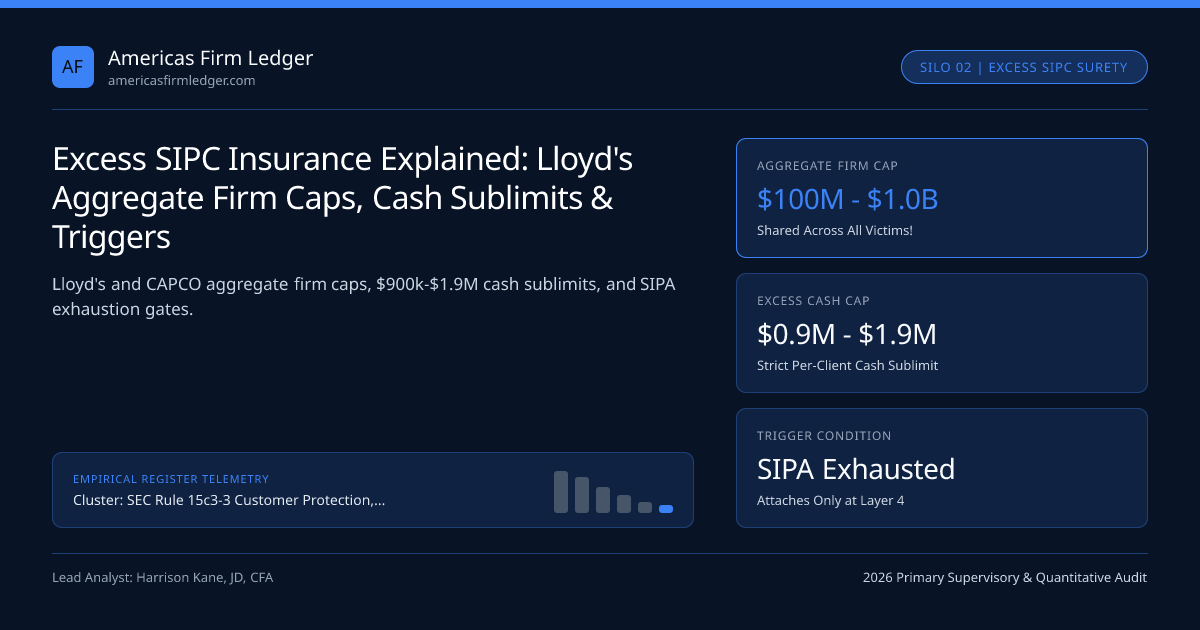
Open the footer of almost any major Wall Street prime broker or retail clearing custodian and you will read marketing copy touting *"Excess of SIPC protection up to $150 million (or unlimited) per customer, underwritten by Certain Underwriters at Lloyd's of London or the Customer Asset Protection Company (CAPCO)."* Yet institutional operational due-diligence (ODD) analysts never stop at the per-customer headline! Unlike statutory SIPC or FDIC insurance backed by a U.S. Treasury credit line, Excess SIPC is a private commercial surety/fidelity policy subject to a hard firm-wide aggregate loss limit (commonly $100 million to $1.0 billion shared across ALL customers of the failed firm), tight cash sublimits, and strict SIPA exhaustion prerequisites!
This commercial-surety audit complements our SEC Rule 15c3-3 Customer Protection institutional guide, building directly on SIPC $500,000 separate-capacity limits and SIPA trustee liquidation waterfalls.
Three Structural Realities Hidden Inside Excess SIPC Policies#
Under FINRA Rule 2210 (Communications with the Public) and SIPC advertising rules, broker-dealers mentioning Excess SIPC must never imply federal backing—and fiduciary allocators must evaluate three contractual constraints:
- The Firm-Wide Aggregate Loss Cap ("Shared Pie" Dilution): Suppose a $500 billion clearing broker advertises "Excess SIPC with no per-customer dollar limit on securities, subject to a $600 million aggregate firm-wide policy limit." If a massive cyber-custody theft or rogue treasury fraud creates a $3.0 billion unrecovered customer property hole after SEC Rule 15c3-3 pool distributions and statutory $500,000 SIPC advances, the $600 million Lloyd's syndicate bond pays at most 20 cents on the dollar of the remaining shortfall!
- Per-Customer Unswept Cash Sublimits ($900,000 to $1,900,000 Typical): Even when an Excess SIPC policy advertises "unlimited" per-customer securities protection, virtually every Lloyd's and CAPCO policy caps claims for uninvested brokerage cash at $900,000 to $1,900,000 per customer (on top of SIPC's $250,000 cash sublimit)—making Rule 2a-7 Treasury Money Market Funds or multi-bank FDIC sweeps vastly superior for parking $25 million of corporate cash!
- Strict "Exhaustion of SIPA Remedies" Condition Precedent: Excess SIPC never pays on Day 1 of a broker freeze! Commercial excess policies trigger only AFTER (a) a formal SIPA liquidation commences, (b) the SIPA Trustee completes marshaling and distributing the entire Rule 15c3-3 Customer Property Pool, AND (c) SIPC pays out its full statutory $500,000 ($250,000 cash) advance—meaning Excess SIPC payouts arrive at the very tail end of a multi-year SIPA liquidation!
Comparing Statutory SIPC vs Lloyd's Excess SIPC vs CAPCO Captive Insurance#
Many investors do not realize that Wall Street clearing giants formed CAPCO (Customer Asset Protection Company)—a licensed New York/Vermont captive surety insurer funded by participating clearing firms—alongside Syndicates at Lloyd's of London:
| Protection Attribute | Statutory SIPC | Excess SIPC (Lloyd's Syndicates) | Excess SIPC (CAPCO Captive) | Rule 2a-7 Treasury MMF |
|---|---|---|---|---|
| Legal Backing | Federal Statute (15 U.S.C. 78aaa) + $2.5B US Treasury Line | Private Commercial Insurance Syndicates | Broker-Owned Licensed Captive Insurer | Direct Ownership of US Treasury Bills |
| Per-Customer Securities Cap | $500,000 per Capacity | Typically $25M – $150M (or No Per-Client Cap) | Often No Per-Customer Securities Cap | 100% of Fund Share NAV + $500k SIPC |
| Per-Customer Cash Sublimit | $250,000 per Capacity | $900,000 – $1,900,000 Typical | $1,150,000 – $1,900,000 Typical | N/A (Fund Shares Are Securities!) |
| Firm-Wide Aggregate Cap | None (~$4.5B Fund + $2.5B Treasury) | $100,000,000 – $600,000,000 Hard Cap! | $600,000,000 – $1,000,000,000 Cap! | None ($100B+ Segregated Custody) |
| Covers Market Loss / Crypto / Futures? | Never | Never (Follows SIPA Definition!) | Never (Follows SIPA Definition!) | Market Treasury Yield |
Quantitative Aggregate-Cap Dilution Stress Test Formula#
Institutional family offices holding $50,000,000 at a single clearing broker should run this exact stress formula comparing a 99% intact custody failure versus a catastrophic 85% custody shortfall at a $20 billion mid-sized custodian carrying a $150,000,000 Excess SIPC Aggregate Policy:
- ExcessPolicyPayoutRatio = min(1.0, FirmAggregateExcessSIPCCap / max(1, PostSIPCFirmwideShortfall))
- ClientExcessSIPCRecovery = min(ClientPerAccountCap, ClientRemainingShortfall) * ExcessPolicyPayout_Ratio
- Worked Catastrophic Custody Shortfall Stress Test ($20B Custodian, 90% Pool Intact -> $2.0B Missing!):
- Total Firmwide Customer Pool Shortfall = $2,000,000,000
- Total Statutory SIPC Advances Across 4,000 Accounts = $800,000,000
- Remaining Unsatisfied Firmwide Shortfall = $1,200,000,000
- Broker's Lloyd's Excess SIPC Aggregate Cap = $150,000,000 -> Payout Ratio = $150M / $1,200M = 12.5%!
- Impact on $50,000,000 Family Office Securities Account:
- 1. Layer 1 (90% Rule 15c3-3 Pool) = $45,000,000 recovered
- 2. Layer 2 (Statutory SIPC Cap) = $500,000 paid -> Remaining Shortfall = $4,500,000
- 3. Layer 4 (Diluted Excess SIPC) = $4,500,000 * 12.5% = $562,500 paid!
- 4. Uninsured Family Office Loss = $3,937,500 (Despite "$50M Per-Account Excess SIPC" Ad!)
Aggregate-Cap Dilution Stress on a $50M Institutional Account#
Operational Due-Diligence Checklist for $25M+ Treasury & Family-Office Accounts#
How do institutional endowments and family offices eliminate Excess SIPC dilution risk?
- Sweep Idle Cash Into Rule 2a-7 Treasury Money Market Funds or Direct T-Bills: Never leave >$1.4 million of raw uninvested free credit cash sitting against an Excess SIPC cash sublimit!
- Compare Aggregate Cap to Total Firm Customer Assets (AggregateCap / CustomerAssets): A $500M aggregate policy at a $15B boutique custodian represents a 3.33% buffer, whereas a $1.0B aggregate policy at a $5 trillion mega-custodian represents 0.02%—meaning your real protection at mega-custodians is PCAOB AT-1 audited SEC Rule 15c3-3 segregation and DTC Memo Seg, not the surety bond! Next, explore the frontier of blockchain securities custody in SEC Special Purpose Broker-Dealers (SPBDs) for digital asset securities inside the SEC Rule 15c3-3 & SIPC Topic Hub.
Frequently asked questions
If my broker advertises "Unlimited Excess SIPC per account," can I still lose money in a custodian fraud?
Yes, if total uncovered losses across all customers of the failed firm exceed the policy's firm-wide aggregate limit (for example, $500 million or $1 billion)! When the aggregate cap is breached, claimants share the Excess SIPC policy proceeds pro-rata.
Does Excess SIPC cover $10 million of uninvested cash sitting in my brokerage account?
Almost never! Virtually every Excess SIPC policy imposes a hard per-customer cash sublimit—typically $900,000 to $1,900,000 on top of SIPC's $250,000 cash limit. Parking $10 million in direct U.S. Treasury bills or a Rule 2a-7 Government Money Market Fund converts cash into segregated securities.
Can a broker-dealer reduce or cancel its Excess SIPC insurance policy?
Yes. Unlike statutory SIPC membership (which is mandatory by federal law for registered public broker-dealers), Excess SIPC is a voluntary annual commercial insurance policy that a firm may modify or decline to renew.
Does Excess SIPC speed up getting my money back when a broker-dealer freezes accounts?
No. Excess SIPC insurers pay out only AFTER the SIPA Trustee formally determines each customer's final unsatisfied Net Equity shortfall following distribution of Customer Property and statutory SIPC advances.
Publication record
- Published
- November 13, 2026
- Updated
- November 14, 2026
- Author
- Harrison Kane, JD, CFA
- Review
- Review not recorded
- Automated fact check
- Passed in the stored pipeline record
- Source URLs
- 4 recorded
AI assistance recorded: anthropic/claude-opus-4.6. This field does not establish human review or source verification.
Academic & Institutional Attribution
Cite This Research & Embed Live Data Card
Standard academic & institutional research paper citation format.
Harrison Kane, JD, CFA. (2026, November 14). Excess SIPC Insurance Explained: Lloyd's Aggregate Firm Caps, Cash Sublimits & Triggers. Americas Firm Ledger. https://americasfirmledger.com/filings/excess-sipc-insurance-lloyds-aggregate-caps-cash-exclusionsRegulatory Directory Cross-Reference
Referenced Institutions & Regulatory Registries
Top Regulated Institutions in This Coverage Slice
Referenced Supervisory Authorities
Related SEC Rule 15c3 3 Customer Reserve Sipc & Institutional Briefings
Explore SEC Rule 15c3 3 Customer Reserve Sipc Hub (20) →SEC Rule 15c3 3 Customer Reserve Sipc
SEC Rule 15c3-3 Customer Protection, Reserve Formula & SIPC Limits: Institutional GuideSEC Rule 15c3 3 Customer Reserve Sipc
SEC Special Purpose Broker-Dealers (SPBDs): Rule 15c3-3 Digital Asset Custody & SIPASEC Rule 15c3 3 Customer Reserve Sipc
FINRA Rule 4311 Carrying Agreements: Fully Disclosed vs Omnibus Clearing & SIPA PrioritySEC Rule 15c3 3 Customer Reserve Sipc
Hypothecation of Customer Securities Under SEC Rules 8c-1 & 15c2-1: Three Anti-Commingling BansSEC Rule 15c3 3 Customer Reserve Sipc
SEC Rule 15c3-3a Exhibit A Customer Reserve Formula: Credit vs Debit Line AuditSEC Rule 15c3 3 Customer Reserve Sipc
Daily vs Weekly SEC Rule 15c3-3 Reserve Computations: The $500M Total Credits RuleSEC Rule 15c3 3 Customer Reserve Sipc
Special Reserve Bank Accounts Under SEC Rule 15c3-3: No-Lien Letters & 15% Bank CapsSEC Rule 15c3 3 Customer Reserve Sipc
Qualified Securities in SEC Rule 15c3-3 Reserve Accounts: U.S. Treasury Rules & HaircutsFinra Brokercheck Form Bd Crs Filings
Dual-Registrant BD/RIA Filings: Reconciling Web CRD Form BD With IARD Form ADV Part 1A & 2AFinra Brokercheck Form Bd Crs Filings
SEC Rule 606 Order Routing & Payment for Order Flow (PFOF) Disclosures: XML & Rule 5310 AuditFinra Brokercheck Form Bd Crs Filings
FINRA Rule 5123 Private Placement Filings & SEC Form D: 15-Day Clocks, Rule 506(d) & RN 23-08CFTC Nfa Fcm Segregated Residual Interest
CEA Section 4d(a)(2) & CFTC Rule 1.20 Futures Segregation: Appendix A Letters & Net Liquidating Equity
Americas Firm Ledger Data, Benchmarks & Contributor Records
CC BY 4.0 Open Data
Open Institutional Datasets (CSV / JSON) →
Download desk-compiled quantitative series & schemas.
2026 Reference Matrix
2026 Institutional Benchmarks & Thresholds →
Statutory capital, clearing, margin & rate conventions.
Editorial Records
Authors & Review Records →
View named contributors where those records are available.
Complete Index
Master Research & Dossier Archive →
Browse all published briefings by topic pillar & date.