
SEC Rule 15c3 3 Customer Reserve Sipc
FINRA Rule 4311 Carrying Agreements: Fully Disclosed vs Omnibus Clearing & SIPA Priority
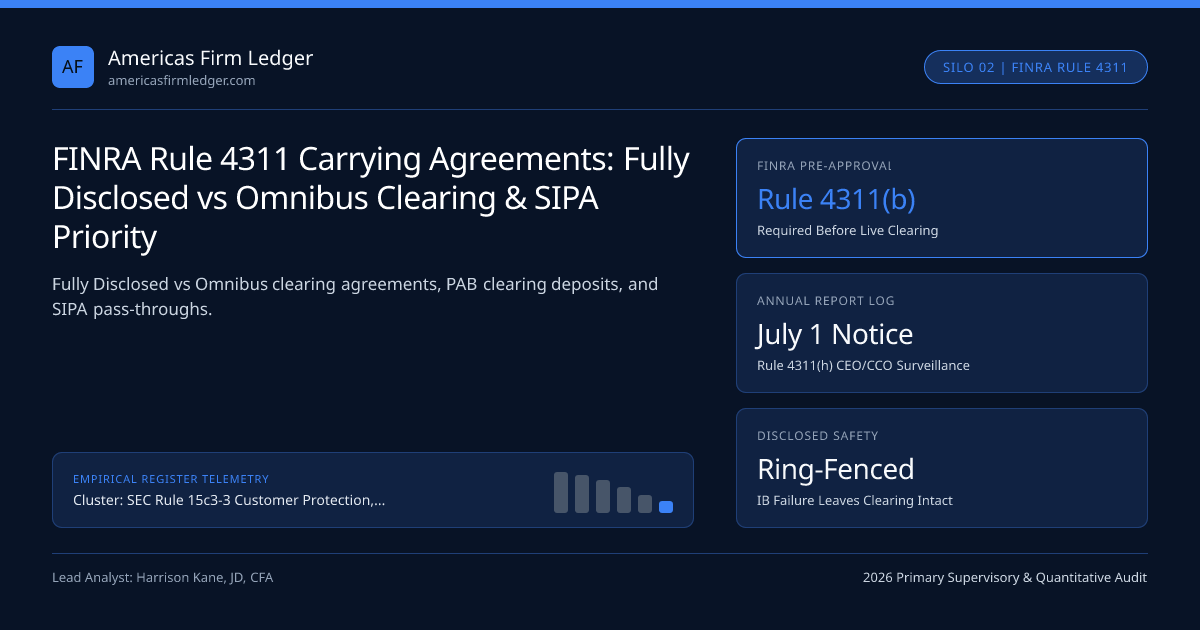
FINRA Rule 4311 governs every correspondent clearing relationship in U.S. brokerage—allocating SEC Rule 15c3-3 custody, FINRA Rule 4210 margin calls, AML monitoring, and SIPA $500,000 customer-by-customer claims between Introducing Firms and Carrying Clearing Firms.
When you open a retail brokerage account at an independent wealth advisor, fintech trading app, or regional institutional broker, look at the bottom of your trade confirmation: "Cleared through Pershing LLC / Apex Clearing Corporation / National Financial Services LLC / Interactive Brokers Corp." Every contractual right and regulatory duty between that Introducing Broker-Dealer and its Carrying (Clearing) Broker-Dealer is governed by FINRA Rule 4311 (Carrying Agreements)! Critically, whether a correspondent agreement is structured on a Fully Disclosed basis versus an Omnibus basis completely transforms who computes SEC Rule 15c3-3 reserves, who owns $250,000 Net Capital floors, and which entity's SIPC membership protects end investors!
This clearing-architecture analysis anchors counterparty structure inside our SEC Rule 15c3-3 Customer Protection institutional guide, linking Rule 15c3-3(k)(2)(ii) introducing exemptions to PAB inter-broker reserve accounts.
Prior FINRA Approval & Mandatory Allocation Matrix Under Rule 4311(c)#
Under FINRA Rule 4311(b), no FINRA member may enter into a carrying agreement—or make material modifications to an existing one—without prior electronic submission and approval by FINRA via the FINRA Rule 4311 Carrying Agreement System! Every agreement must explicitly allocate (and disclose in writing to every new customer upon account opening under Rule 4311(d)) at least nine core functions:
- Opening and approving accounts (KYC, suitability / Reg BI, options & margin approval — almost always Introducing Firm);
- Acceptance of orders (typically Introducing Firm, subject to clearing risk filters);
- Transmission of orders for execution;
- Execution of orders;
- Extension of credit (Reg T & FINRA Rule 4210 margin house calls) — legally carried by the Clearing Firm, though introducing firms often indemnify unsecured customer margin deficits!;
- Receipt and delivery of funds and securities (100% Clearing Firm in Fully Disclosed (k)(2)(ii) setups);
- Safeguarding of funds and securities under SEC Rule 15c3-3 (Clearing Firm);
- Maintenance of books and records under SEC Rules 17a-3 and 17a-4; and
- Monitoring of customer accounts (supervision, surveillance exception reports provided to the Introducing Firm under Rule 4311(h)).
Deep Comparison: Fully Disclosed Clearing vs Omnibus Clearing (Domestic & Foreign)#
Why do some cross-border fintechs and international brokers (comparable to global multi-entity dealers like Velocity Trade or foreign bank affiliates) choose Omnibus Clearing while 95% of domestic wealth firms choose Fully Disclosed Clearing? Compare every regulatory consequence:
| Clearing Dimension | Fully Disclosed Clearing (15c3-3(k)(2)(ii)) | Domestic US Omnibus Clearing | Foreign Broker Omnibus Account |
|---|---|---|---|
| End-Customer Identity at US Clearing BD | Known (Individual Name, Tax ID, Statements) | Hidden (Single Pooled Customer Account) | Hidden (Foreign Omnibus Account) |
| Introducing / Omnibus Firm Net Capital | $5,000 or $50,000 (15c3-1(a)(2)) | $250,000+ Carrying BD (2% Alt Standard!) | Home-Country Capital (e.g., CIRO RAC / FCA) |
| Who Runs Rule 15c3-3 Exhibit A Reserve? | US Clearing Firm Only | BOTH Omnibus Firm AND Clearing Firm! | US Clearing Firm (Treats Omnibus as 1 Customer!) |
| Annual PCAOB Audit of Fronting Firm | PCAOB AT-2 Exemption Report | PCAOB AT-1 Full Compliance Examination! | Local Statutory Audit (e.g., CIRO Form 1) |
| Form 1099 Tax Reporting & Trade Confirms | Issued Directly by US Clearing Firm | Issued by Omnibus Carrying Firm | Issued by Foreign Broker (W-8IMY / QI at US BD) |
| End-Investor $500k SIPC Claim If US Clearing Fails? | YES — $500,000 PER END CUSTOMER! | Covered via Omnibus SIPA / Good Control | WARNING: Foreign Omnibus = ONE $500k Claim Unless Pass-Through Applies! |
Quantitative Unsecured Customer Margin Deficit Charge Back to the Introducing Broker!#
Here is a hidden balance-sheet landmine that has bankrupted dozens of $50,000 Fully Disclosed Introducing Brokers during flash crashes and meme-stock short squeezes: Contractual Clearing Indemnification & Clearing Deposits! Under virtually every FINRA Rule 4311 Fully Disclosed Clearing Agreement, the Introducing Broker pledges a $100,000 to $1,000,000 Clearing Deposit (held in a PAB account so it stays an allowable asset!) AND contractually indemnifies the Clearing Firm for 100% of unsecured customer margin debits! Under SEC Rule 15c3-1 Appendix A / (c)(2)(iv), the instant an introduced client's account goes negative after liquidation, that unsecured deficit hits the Introducing Broker's Net Capital dollar-for-dollar:
- IBAdjustedNetCapitalPostCrash = IBPreCrashNetCapital - IntroducedClientUnsecuredDeficit
- Worked Flash-Crash Short-Squeeze Contagion on a Fully Disclosed Introducing Broker:
- Introducing Broker Pre-Crash Net Capital = $320,000 (Minimum Required = $50,000; Excess = $270,000)
- IB holds $250,000 Allowable PAB Clearing Deposit at Clearing Firm X
- One Retail Client shorts volatile microcap biotech; stock gaps +600% overnight!
- Clearing Firm X buys in client short -> Client Account Equity = -$410,000 UNSECURED DEFICIT!
- Clearing Firm X debits IB's $250,000 Clearing Deposit + bills IB $160,000 under Rule 4311 Indemnity!
- IB Post-Crash Net Capital = $320,000 - $410,000 = -$90,000 INSOLVENT!
- Mandatory Action: Immediate Rule 17a-11 Halt + Form BDW Wind-Down (While IB's OTHER Clients Stay 100% Safe at Clearing Firm X!)
Rule 4311 Ring-Fencing: Why Other IB Clients Stay 100% Safe#
Why Fully Disclosed Clearing Protects Innocent Investors When an Introducing App Fails!#
Look at the beauty of the architecture in the example above: even though the small Introducing Broker went completely bankrupt (-$90,000 Net Capital) and shut its doors on Tuesday morning, its 5,000 innocent retail customers did not even need a SIPA liquidation! Because their cash and stocks sat in Fully Disclosed individual accounts directly on the books of solvent Clearing Firm X, their portfolios stayed 100% live, liquid, and tradeable through the clearing firm's service desk! Finally, close out Silo 2 by examining the foundational 1940 rules forbidding customer stock commingling in SEC Rules 8c-1 and 15c2-1 hypothecation bans inside the SEC Rule 15c3-3 & SIPC Topic Hub.
Frequently asked questions
If my small retail trading app goes out of business, is my account frozen in bankruptcy if it uses Apex or Pershing?
No, provided the app operates as a Fully Disclosed Introducing Broker under FINRA Rule 4311 and SEC Rule 15c3-3(k)(2)(ii)! Your cash and securities are legally carried by the solvent clearing broker (e.g., Pershing or Apex), so your assets are never part of the introducing app's bankruptcy estate.
Why must a Fully Disclosed Introducing Broker sign a PAB attachment for its Clearing Deposit?
Under SEC Rule 15c3-1(c)(2)(iv)(E) and FINRA Rule 4311(e), an introducing broker's clearing deposit counts as an allowable asset for Net Capital ONLY if the clearing broker holds it in a Proprietary Account of Broker-Dealers (PAB) protected under SEC Rule 15c3-3(e).
Do customers of a foreign broker clearing through a U.S. broker on an Omnibus basis get $500,000 SIPC each?
Be very careful! Under SIPA 15 U.S.C. 78fff-3(a)(5), pass-through $500,000 per-underlying-customer SIPC coverage applies automatically to domestic registered broker-dealers/banks, whereas foreign non-member omnibus structures often collapse into a single $500,000 cap or non-customer claim unless strict statutory criteria are met.
What is the annual July 1 notification required under FINRA Rule 4311(h)?
By July 1 of each year, every carrying firm must notify the Chief Executive Officer and Chief Compliance Officer of each introducing firm in writing of the complete list of supervisory exception and surveillance reports offered—and which specific reports the introducing firm actually elected to receive!
Publication record
- Published
- November 13, 2026
- Updated
- November 14, 2026
- Author
- Harrison Kane, JD, CFA
- Review
- Review not recorded
- Automated fact check
- Passed in the stored pipeline record
- Source URLs
- 4 recorded
AI assistance recorded: anthropic/claude-opus-4.6. This field does not establish human review or source verification.
Academic & Institutional Attribution
Cite This Research & Embed Live Data Card
Standard academic & institutional research paper citation format.
Harrison Kane, JD, CFA. (2026, November 14). FINRA Rule 4311 Carrying Agreements: Fully Disclosed vs Omnibus Clearing & SIPA Priority. Americas Firm Ledger. https://americasfirmledger.com/filings/finra-rule-4311-carrying-agreements-omnibus-fully-disclosedRegulatory Directory Cross-Reference
Referenced Institutions & Regulatory Registries
Mentioned Regulated Institutions
Related SEC Rule 15c3 3 Customer Reserve Sipc & Institutional Briefings
Explore SEC Rule 15c3 3 Customer Reserve Sipc Hub (20) →SEC Rule 15c3 3 Customer Reserve Sipc
SEC Rule 15c3-3 Customer Protection, Reserve Formula & SIPC Limits: Institutional GuideSEC Rule 15c3 3 Customer Reserve Sipc
Hypothecation of Customer Securities Under SEC Rules 8c-1 & 15c2-1: Three Anti-Commingling BansSEC Rule 15c3 3 Customer Reserve Sipc
SEC Rule 15c3-3a Exhibit A Customer Reserve Formula: Credit vs Debit Line AuditSEC Rule 15c3 3 Customer Reserve Sipc
Daily vs Weekly SEC Rule 15c3-3 Reserve Computations: The $500M Total Credits RuleSEC Rule 15c3 3 Customer Reserve Sipc
Special Reserve Bank Accounts Under SEC Rule 15c3-3: No-Lien Letters & 15% Bank CapsSEC Rule 15c3 3 Customer Reserve Sipc
Qualified Securities in SEC Rule 15c3-3 Reserve Accounts: U.S. Treasury Rules & HaircutsSEC Rule 15c3 3 Customer Reserve Sipc
PAB Reserve Computations for Proprietary Accounts of Broker-Dealers Under SEC Rule 15c3-3SEC Rule 15c3 3 Customer Reserve Sipc
Physical Possession or Control Under SEC Rule 15c3-3(b): Fully Paid & 140% Margin RulesFinra Brokercheck Form Bd Crs Filings
FINRA Rule 5123 Private Placement Filings & SEC Form D: 15-Day Clocks, Rule 506(d) & RN 23-08CFTC Nfa Fcm Segregated Residual Interest
CEA Section 4d(a)(2) & CFTC Rule 1.20 Futures Segregation: Appendix A Letters & Net Liquidating EquityCFTC Nfa Fcm Segregated Residual Interest
CFTC Regulation 30.7 Foreign Futures Secured Amount: Net Liquidating Upgrade & Foreign RiskCFTC Nfa Fcm Segregated Residual Interest
CEA Section 4d(f) & CFTC Part 22 Cleared Swaps LSOC Explained: Eliminating Fellow-Customer Risk
Americas Firm Ledger Data, Benchmarks & Contributor Records
CC BY 4.0 Open Data
Open Institutional Datasets (CSV / JSON) →
Download desk-compiled quantitative series & schemas.
2026 Reference Matrix
2026 Institutional Benchmarks & Thresholds →
Statutory capital, clearing, margin & rate conventions.
Editorial Records
Authors & Review Records →
View named contributors where those records are available.
Complete Index
Master Research & Dossier Archive →
Browse all published briefings by topic pillar & date.