
SEC Rule 15c3 3 Customer Reserve Sipc
Special Reserve Bank Accounts Under SEC Rule 15c3-3: No-Lien Letters & 15% Bank Caps
Under SEC Rule 15c3-3(e)(5) and (f), cash deposited in a Special Reserve Bank Account for the Exclusive Benefit of Customers requires a signed bank no-lien acknowledgment letter, zero affiliated-bank cash placement, and a hard cap of 15% of the bank's equity capital.
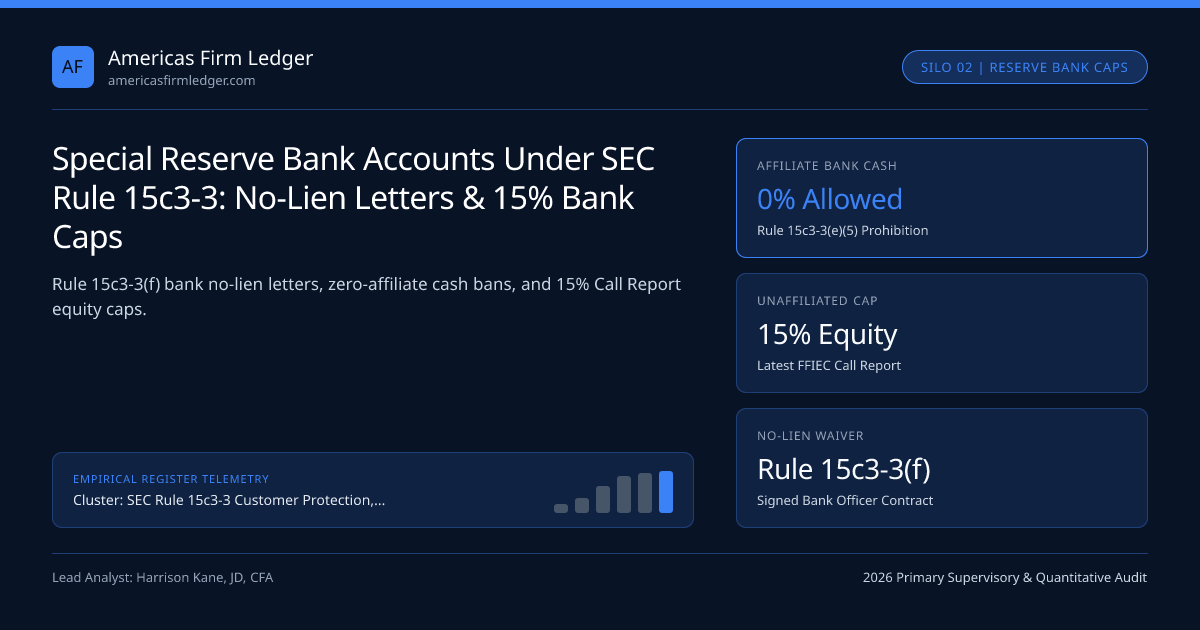
Wiring $200 million into a commercial bank account earns zero regulatory credit under 17 CFR 240.15c3-3 unless three strict legal conditions in paragraphs (e)(1), (e)(5), and (f) are satisfied simultaneously: (1) the account is titled verbatim "[Broker-Dealer Name] Special Reserve Bank Account for the Exclusive Benefit of Customers" (separate from PAB and operating accounts); (2) the U.S. chartered bank executes a Rule 15c3-3(f) Written Notification ("No-Lien") Letter waiving every banker's lien, right of setoff, cross-collateralization, or counterclaim; and (3) cash deposits are never held at an affiliated parent/sister bank and never exceed 15% of the unaffiliated bank's equity capital as reported on its most recent Call Report!
These bank-ringfencing mandates protect the SIPC customer estate throughout our SEC Rule 15c3-3 Customer Protection institutional guide, governing daily $500M morning reserve wires and qualified U.S. Treasury reserve deposits.
Statutory Account Titling & Rule 15c3-3(f) Bank No-Lien Letters#
Why is a single missing phrase in a bank signature card treated by FINRA and PCAOB AT-1 auditors as a catastrophic 100% Reserve Deficiency? Under state Uniform Commercial Code (UCC) and common-law banking principles, if a broker-dealer defaults on an intraday clearing loan or parent credit revolver at Bank X, Bank X automatically asserts a right of setoff against general deposit accounts held by that borrower.
To extinguish bank setoff rights in a SIPA liquidation, Rule 15c3-3(f) requires the carrying broker-dealer to obtain and preserve a written contract/acknowledgment signed by an authorized bank officer stating explicitly that:
- All cash and/or qualified securities in the account are held solely for the exclusive benefit of customers of the broker-dealer in accordance with SEC Rule 15c3-3;
- Deposits will be kept completely separate from any other house, margin-financing, or PAB accounts of the broker-dealer; and
- Cash and securities in the account shall at no time be used directly or indirectly as security for a loan to the broker-dealer by the bank and shall be subject to no right, charge, security interest, lien, or claim of any kind in favor of the bank or any person claiming through the bank!
The Affiliated-Bank Cash Ban & 15% Bank Equity Capital Ceiling#
Following the 2008 Lehman Brothers and 2011 MF Global crises, the SEC adopted Rule 15c3-3(e)(5) in 2013 (Release No. 34-70072) to eliminate two systemic contagion risks:
- Total Ban on Cash at Affiliated Banks: If a bank-owned broker-dealer (for instance, a brokerage subsidiary of a regional or G-SIB bank holding company supervised by the Federal Reserve and FDIC) deposits cash in a Special Reserve Bank Account at its own affiliated sister bank, 100% of that cash is excluded when determining whether the broker-dealer met its Reserve requirement! (Note: Affiliated banks can still act as custodial safekeeping agents for qualified U.S. Treasury securities, because Treasuries sit off the bank's balance sheet—only cash deposits are banned at affiliates!)
- 15% Unaffiliated Bank Equity Capital Cap: Even at an unaffiliated U.S. bank, a broker-dealer must exclude the amount of any Reserve cash deposit (aggregated across both its Customer Reserve and PAB Reserve cash at that bank!) that exceeds 15% of the bank's equity capital, as reported by the bank in its most recent FFIEC Consolidated Report of Condition and Income (Call Report)!
| Depository Institution & Relationship | Instrument Deposited | Bank Call Report Equity | Amount Wired to Reserve | Allowable Reserve Credit | Disallowed Excess (Deficiency Risk!) |
|---|---|---|---|---|---|
| Sister / Parent Affiliated US Bank | Cash Demand Deposit | $18,000,000,000 | $100,000,000 | $0 (100% Banned!) | $100,000,000 Disallowed |
| Sister / Parent Affiliated US Bank | Segregated US T-Bills | $18,000,000,000 | $100,000,000 | $100,000,000 (Allowed!) | $0 (Off-Balance-Sheet Custody) |
| Unaffiliated Regional US Bank A | Cash Demand Deposit | $400,000,000 | $85,000,000 | $60,000,000 (15% Cap) | $25,000,000 Disallowed (>15%) |
| Unaffiliated G-SIB Custodian Bank B | Cash Demand Deposit | $28,000,000,000 | $500,000,000 | $500,000,000 (<15% Cap) | $0 (15% Cap = $4.2B) |
| Money Market Mutual Fund / Credit Union | Shares / Deposits | N/A | $50,000,000 | $0 (Not Sec. 3(a)(6) Bank!) | $50,000,000 Disallowed |
Quantitative Multi-Bank Reserve Allocation Formula#
Notice the trap in Row 5 above: Rule 2a-7 Money Market Mutual Funds do NOT qualify as cash or qualified securities inside a Rule 15c3-3 Special Reserve Bank Account, nor do overseas foreign banks outside Exchange Act Section 3(a)(6)! Let us compute allowable Reserve cash across a multi-bank treasury grid:
- MaxAllowableCashAtBank(b) = 0.15 * BankbLatestCallReportEquityCapital [if Unaffiliated Sec. 3(a)(6) Bank]
- CountableReserveValue = Sumb [ min(CustomerPlusPABCashb, MaxAllowableCashAtBank(b)) + QualifiedUSTreasuriesb ]
- Worked Multi-Bank Concentration Audit (Required Customer Reserve = $190,000,000; PAB = $20,000,000):
- 1. Unaffiliated Community Bank X (Call Report Equity = $320,000,000):
- 15% Bank Equity Cap = 0.15 * $320,000,000 = $48,000,000
- Broker-Dealer holds $45M Customer Reserve Cash + $15M PAB Reserve Cash = $60,000,000 Total Cash!
- Disallowed Excess Above 15% Cap = $60,000,000 - $48,000,000 = $12,000,000 DISALLOWED!
- 2. Unaffiliated National Bank Y (Call Report Equity = $6,000,000,000 -> 15% Cap = $900,000,000):
- Broker-Dealer holds $55,000,000 Customer Reserve Cash -> 100% Countable ($55,000,000)
- 3. Safekeeping Box at Bank Y: $92,000,000 Market Value US Treasury Notes -> 100% Countable ($92,000,000)
- Countable Customer + PAB Reserve = $48M + $55M + $92M = $195,000,000 vs $210,000,000 Required!
- Result: $15,000,000 RESERVE DEFICIENCY (Triggered by ignoring combined Customer+PAB 15% cap at Bank X!)
Rule 15c3-3 Reserve Eligibility by Asset & Bank Type#
Monitoring Quarterly Bank Call Reports After Regional Bank Stress#
As Silicon Valley Bank and Signature Bank demonstrated in 2023, a regional commercial bank's GAAP equity capital on its quarterly FFIEC Call Report can plunge 35% in a single quarter due to unrealized bond losses or deposit outflows—silently shrinking the broker-dealer's 15% cash cap overnight! Institutional FinOps maintain automated quarterly Call Report feeds across at least two unaffiliated Tier-1 custody banks and hold the bulk of long-term core reserves in direct U.S. Treasury obligations, whose qualification rules we dissect next in qualified securities & Treasury concentration in Reserve accounts inside the SEC Rule 15c3-3 & SIPC Topic Hub.
Frequently asked questions
Can a bank-owned broker-dealer custody U.S. Treasury bills in a Special Reserve Account at its own affiliated bank?
Yes, for qualified U.S. Treasury securities! Rule 15c3-3(e)(5) prohibits holding CASH deposits at an affiliated bank (because bank cash becomes a general credit claim on the affiliate's balance sheet), whereas segregated U.S. Treasuries remain off-balance-sheet customer property.
Why can't a carrying broker-dealer hold Vanguard or BlackRock Treasury Money Market Funds in its Special Reserve Account?
Rule 15c3-3(a)(6) strictly defines "qualified securities" as securities issued or guaranteed as to principal and interest by the United States. Shares of an Investment Company Act Rule 2a-7 mutual fund are equity shares of a fund, not direct sovereign obligations.
Do Customer Reserve cash and PAB Reserve cash share a single 15% bank equity cap at the same bank?
Yes. FINRA and SEC interpretations aggregate total Rule 15c3-3(e) reserve cash (Customer plus PAB) deposited at the same unaffiliated bank when testing the 15% Call Report bank equity capital ceiling.
What happens if a Reserve Bank changes its legal name after a bank merger?
Whenever a depository bank merges, re-charters, or updates custodial account numbers, the broker-dealer must promptly execute an updated Rule 15c3-3(f) no-lien notification letter reflecting the surviving bank charter and exact statutory account title.
Publication record
- Published
- November 14, 2026
- Updated
- November 15, 2026
- Author
- Harrison Kane, JD, CFA
- Review
- Review not recorded
- Automated fact check
- Passed in the stored pipeline record
- Source URLs
- 4 recorded
AI assistance recorded: anthropic/claude-opus-4.6. This field does not establish human review or source verification.
Academic & Institutional Attribution
Cite This Research & Embed Live Data Card
Standard academic & institutional research paper citation format.
Harrison Kane, JD, CFA. (2026, November 15). Special Reserve Bank Accounts Under SEC Rule 15c3-3: No-Lien Letters & 15% Bank Caps. Americas Firm Ledger. https://americasfirmledger.com/filings/sec-15c3-3-special-reserve-bank-account-no-lien-lettersRegulatory Directory Cross-Reference
Referenced Institutions & Regulatory Registries
Top Regulated Institutions in This Coverage Slice
Referenced Supervisory Authorities
Related SEC Rule 15c3 3 Customer Reserve Sipc & Institutional Briefings
Explore SEC Rule 15c3 3 Customer Reserve Sipc Hub (20) →SEC Rule 15c3 3 Customer Reserve Sipc
SEC Rule 15c3-3 Customer Protection, Reserve Formula & SIPC Limits: Institutional GuideSEC Rule 15c3 3 Customer Reserve Sipc
Qualified Securities in SEC Rule 15c3-3 Reserve Accounts: U.S. Treasury Rules & HaircutsSEC Rule 15c3 3 Customer Reserve Sipc
PAB Reserve Computations for Proprietary Accounts of Broker-Dealers Under SEC Rule 15c3-3SEC Rule 15c3 3 Customer Reserve Sipc
Physical Possession or Control Under SEC Rule 15c3-3(b): Fully Paid & 140% Margin RulesSEC Rule 15c3 3 Customer Reserve Sipc
Good Control Locations Under SEC Rule 15c3-3(c): DTC Free Box & Foreign CustodiansSEC Rule 15c3 3 Customer Reserve Sipc
Possession or Control Deficits Under SEC Rule 15c3-3(d): T+1 Turnaround & Buy-In ClocksSEC Rule 15c3 3 Customer Reserve Sipc
T+1 Settlement Compression: Aged Fail-to-Receive Credits, Fail-to-Deliver Debits & HaircutsSEC Rule 15c3 3 Customer Reserve Sipc
SEC Rule 15c3-3(b)(3) Fully Paid Securities Lending: FINRA Collateral & SIPC RulesFinra Brokercheck Form Bd Crs Filings
SEC Form CRS Relationship Summary Audit: 2-Page vs 4-Page Caps, Prompts & Fee ConflictsFinra Brokercheck Form Bd Crs Filings
SEC Regulation Best Interest (Reg BI) Rule 15l-1: Care, RCAP Alternatives & Conflict MitigationFinra Brokercheck Form Bd Crs Filings
FINRA Form U4 Item 14 Disclosures: $5k Written Complaints, $15k Settlements & 30-Day LiensFinra Brokercheck Form Bd Crs Filings
FINRA Form U5 Termination Disclosures: 30-Day Clocks, Section 7 Reviews & Defamation Claims
Americas Firm Ledger Data, Benchmarks & Contributor Records
CC BY 4.0 Open Data
Open Institutional Datasets (CSV / JSON) →
Download desk-compiled quantitative series & schemas.
2026 Reference Matrix
2026 Institutional Benchmarks & Thresholds →
Statutory capital, clearing, margin & rate conventions.
Editorial Records
Authors & Review Records →
View named contributors where those records are available.
Complete Index
Master Research & Dossier Archive →
Browse all published briefings by topic pillar & date.