
SEC Rule 15c3 3 Customer Reserve Sipc
Qualified Securities in SEC Rule 15c3-3 Reserve Accounts: U.S. Treasury Rules & Haircuts
Under SEC Rule 15c3-3(a)(6), carrying broker-dealers may satisfy Customer and PAB Reserve obligations using direct U.S. Government obligations valued at daily market value—earning full interest yield for the firm while incurring Rule 15c3-1 maturity haircuts on Net Capital.
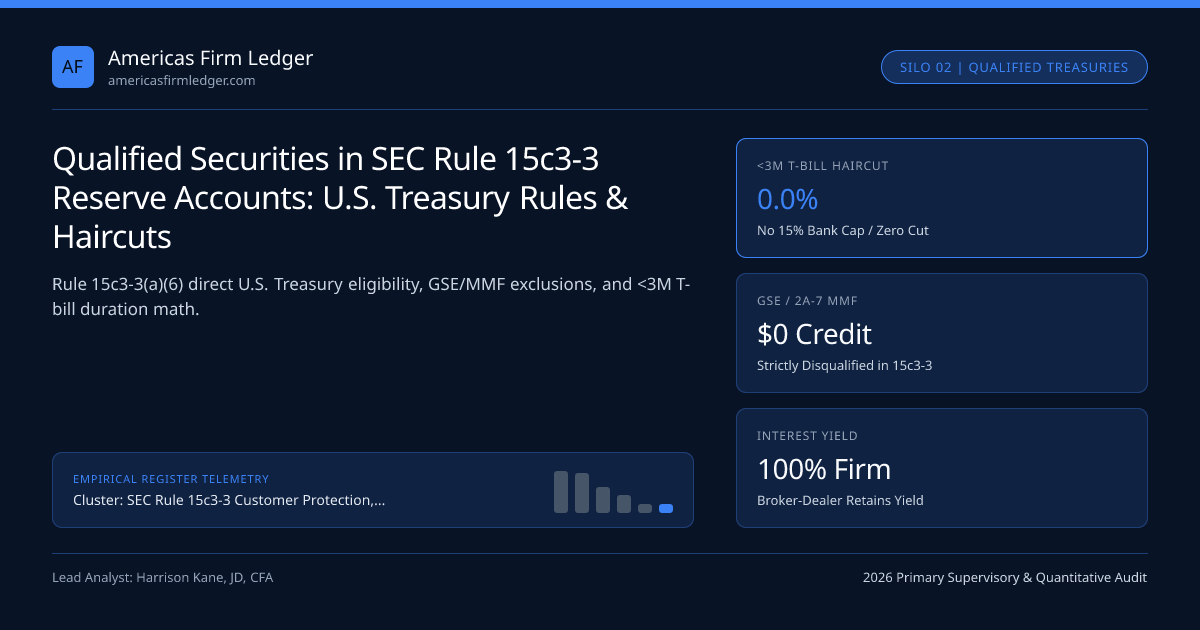
Under 17 CFR 240.15c3-3(e)(1) and (a)(6), a carrying broker-dealer is not forced to leave billions of dollars of customer reserve lockups sitting in low-yielding commercial bank checking accounts—and is entitled by statute to retain 100% of the interest yield earned on Qualified Securities deposited into its Special Reserve Bank Account! However, Rule 15c3-3(a)(6) defines "qualified security" with razor-thin precision: only a security issued by the United States or guaranteed by the United States with respect to both principal and interest qualifies. Fannie Mae debentures, Freddie Mac MBS, Federal Home Loan Bank notes, municipal bonds, and Rule 2a-7 Treasury money market funds are strictly disqualified!
This sovereign yield engine powers retail and institutional brokerage economics across our SEC Rule 15c3-3 Customer Protection institutional guide, pairing Special Reserve Bank no-lien rules with Rule 15c3-1 Treasury maturity-bucket haircuts.
Direct Full-Faith-and-Credit Guarantee vs Implied GSE Status#
New treasury officers frequently confuse Paragraph (A) of Rule 15c3-1 (which grants low haircuts to both U.S. Treasuries and federal agency GSEs like Fannie Mae, Freddie Mac, and FHLB) with Rule 15c3-3(a)(6)! Inside a Special Reserve Bank Account:
- Eligible Qualified Securities: Marketable U.S. Treasury Bills, Treasury Notes, Treasury Bonds, Floating Rate Notes (FRNs), TIPS, STRIPS, and explicitly U.S.-guaranteed Ginnie Mae (GNMA) obligations backed by the full faith and credit of the United States!
- Ineligible Securities ($0 Reserve Value): FNMA (Fannie Mae), FHLMC (Freddie Mac), FHLB (Federal Home Loan Banks), Farm Credit System notes, World Bank supranational bonds, state general-obligation bonds, and BlackRock/Fidelity government money market mutual funds!
- Source of Deposited Treasuries: Any U.S. Treasury deposited into the Reserve Account must be unencumbered proprietary Treasuries owned by the broker-dealer (or Treasuries acquired via a properly structured reverse repurchase agreement where the broker-dealer holds absolute legal right to re-pledge/segregate into Reserve without third-party encumbrance and subject to strict FINRA reverse-repo reserve interpretations!). A broker-dealer can never deposit a customer's own fully paid Treasury bond to satisfy Exhibit A cash reserve obligations!
The Duration Trap: Why Locking 10-Year Notes in Reserve Triggers Two Simultaneous Hits#
During the 2022–2023 Federal Reserve hiking cycle, several mid-tier clearing firms reached for yield by substituting 5-year and 10-year U.S. Treasury notes inside their Special Reserve Bank Accounts instead of <3-month Treasury bills. Look at the double regulatory penalty when 10-year yields jump +45 bps:
- Net Capital Hit (SEC Rule 15c3-1): Unlike <3-month T-bills (0% haircut), $500M of 10-year Treasury notes owned by the firm suffers an immediate $22,500,000 (4.5%) proprietary Net Capital haircut plus immediate mark-to-market equity loss when bond prices fall!
- Reserve Deficiency Hit (Rule 15c3-3(e)): Qualified securities in the Special Reserve Account are valued at current market value! If rising yields knock 3.2% ($16,000,000) off the market value of those 10-year notes between computations, the Reserve Account instantaneously falls underfunded unless cushioned by excess T-bills!
| Candidate Reserve Instrument | Rule 15c3-3(a)(6) Qualified? | Subject to 15% Bank Equity Cap? | Rule 15c3-1 Net Capital Haircut | Daily Price / Yield Shock Risk | Institutional Treasury Verdict |
|---|---|---|---|---|---|
| Unaffiliated Bank Demand Cash | Yes (Cash) | Yes (<=15% Bank Equity) | 0.0% | Zero Price Risk | Intraday liquidity buffer only |
| < 3-Month U.S. Treasury Bills | Yes (Qualified) | No (Unlimited!) | 0.0% (Cat 1 Sub i) | Near-Zero (<5 bps DV01) | Gold Standard Reserve Asset |
| U.S. Treasury Floating Rate Notes | Yes (Qualified) | No (Unlimited!) | 0.0% - 0.5% (Reset Bucket) | Minimal Spread Drift | High-yield daily reserve core |
| 5-to-10-Year U.S. Treasury Notes | Yes (Qualified) | No (Unlimited!) | 4.0% - 4.5% | High! (+50 bps = ~-3.8% MV) | Dangerous without fat surplus |
| FHLB / Fannie Mae Agency Notes | No ($0 Credit!) | N/A (Ineligible) | 0% - 6% Prop Only | N/A | 100% Reserve Violation if Used |
| Rule 2a-7 Treasury Money Fund | No ($0 Credit!) | N/A (Ineligible) | 2.0% Prop Only | N/A | 100% Reserve Violation if Used |
Quantitative Treasury Comparison: <3M T-Bills vs 7-Year Notes vs Bank Cash#
Let us model a carrying broker-dealer locking $800,000,000 in its Special Reserve Account, comparing <3-month Treasury bills against 7-year Treasury notes during a +40 bps single-week rate selloff:
- ReserveCushionSurplus = ReserveAccountMarketValue - RequiredExhibitAReserve
- NetCapitalCostofReserve = Sumk [ OwnedReserveTreasuryMVk * Rule15c31ParaARate_k ]
- Worked Yield-Shock Stress Test (Required Exhibit A Reserve = $800,000,000; Deposited = $812,000,000 [1.5% Buffer]):
- Strategy A (100% <3-Month U.S. Treasury Bills, Modified Duration = 0.12 yrs):
- Rule 15c3-1 Net Capital Haircut (0.0% * $812M) = $0
- +40 bps Rate Spike Price Change (-0.12 * 0.0040 * $812M)= -$389,760
- Post-Shock Reserve Value = $811,610,240 (>= $800M Required -> $11.61M Surplus SAFE!)
- Strategy B (100% 7-Year U.S. Treasury Notes, Modified Duration = 6.10 yrs, 4.0% Haircut):
- Immediate Rule 15c3-1 Net Capital Haircut (4.0% * $812M)= $32,480,000 Capital Consumed!
- +40 bps Rate Spike Price Change (-6.10 * 0.0040 * $812M)= -$19,812,800
- Post-Shock Reserve Value = $792,187,200 (< $800M Required -> -$7,812,800 DEFICIENCY!)
Capital + Rate-Shock Cost on $812M Reserve Portfolio#
Strict Rules on Reverse-Repo Treasuries Used for Reserve Deposits#
Many major prime brokers source U.S. Treasuries for their Special Reserve Account via overnight reverse repurchase agreements rather than buying Treasuries outright (avoiding the 4.0%–6.0% proprietary Net Capital haircut!). Under FINRA interpretations of Rule 15c3-3(e), reverse-repo Treasuries placed into Reserve cannot come from an affiliated counterparty if encumbered, cannot sit in a bilateral Hold-in-Custody repo, and must move physically into the Reserve Bank's Fedwire book-entry account free of any seller recall lien prior to withdrawal substitution. Next, explore the twin reserve computation required for correspondent broker-dealers in PAB Reserve computations under Rule 15c3-3(e) inside the SEC Rule 15c3-3 & SIPC Topic Hub.
Frequently asked questions
Who keeps the interest earned on U.S. Treasury bills locked inside a Customer Special Reserve Bank Account?
The carrying broker-dealer! Provided all required reserves remain satisfied, coupon and discount interest earned on qualified U.S. Treasury securities in the Special Reserve Account accrues to the broker-dealer (which separately sets whatever contractual cash sweep rate it pays customers).
Why are Fannie Mae and Federal Home Loan Bank notes excluded from Rule 15c3-3(a)(6) Qualified Securities?
Although GSE agency debentures receive favorable treatment under Rule 15c3-1 Net Capital haircuts, they carry implied agency sponsorship rather than an explicit statutory full-faith-and-credit guarantee of the United States as required by Rule 15c3-3(a)(6).
What happens on the morning a U.S. Treasury bill inside the Special Reserve Account matures?
Principal redemption cash wired by the Federal Reserve stays locked inside the Special Reserve Bank Account! Watch out for the 15% bank-equity cash cap on maturity morning: if $500M of maturing T-bills turns into cash at a small bank, you must immediately roll into new T-bills!
Can a broker-dealer substitute cash for U.S. Treasuries in its Reserve Account mid-day without a full Exhibit A run?
Dollar-for-dollar same-day substitution of cash for equal-or-greater market-value qualified U.S. Treasuries (keeping total countable Reserve value unchanged or higher) is permitted under custodial substitution controls, whereas net withdrawals always require a fresh Exhibit A computation.
Publication record
- Published
- November 14, 2026
- Updated
- November 14, 2026
- Author
- Harrison Kane, JD, CFA
- Review
- Review not recorded
- Automated fact check
- Passed in the stored pipeline record
- Source URLs
- 4 recorded
AI assistance recorded: anthropic/claude-opus-4.6. This field does not establish human review or source verification.
Academic & Institutional Attribution
Cite This Research & Embed Live Data Card
Standard academic & institutional research paper citation format.
Harrison Kane, JD, CFA. (2026, November 14). Qualified Securities in SEC Rule 15c3-3 Reserve Accounts: U.S. Treasury Rules & Haircuts. Americas Firm Ledger. https://americasfirmledger.com/filings/sec-15c3-3-qualified-securities-treasury-deposit-concentrationRegulatory Directory Cross-Reference
Referenced Institutions & Regulatory Registries
Top Regulated Institutions in This Coverage Slice
Related SEC Rule 15c3 3 Customer Reserve Sipc & Institutional Briefings
Explore SEC Rule 15c3 3 Customer Reserve Sipc Hub (20) →SEC Rule 15c3 3 Customer Reserve Sipc
SEC Rule 15c3-3 Customer Protection, Reserve Formula & SIPC Limits: Institutional GuideSEC Rule 15c3 3 Customer Reserve Sipc
PAB Reserve Computations for Proprietary Accounts of Broker-Dealers Under SEC Rule 15c3-3SEC Rule 15c3 3 Customer Reserve Sipc
Physical Possession or Control Under SEC Rule 15c3-3(b): Fully Paid & 140% Margin RulesSEC Rule 15c3 3 Customer Reserve Sipc
Good Control Locations Under SEC Rule 15c3-3(c): DTC Free Box & Foreign CustodiansSEC Rule 15c3 3 Customer Reserve Sipc
Possession or Control Deficits Under SEC Rule 15c3-3(d): T+1 Turnaround & Buy-In ClocksSEC Rule 15c3 3 Customer Reserve Sipc
T+1 Settlement Compression: Aged Fail-to-Receive Credits, Fail-to-Deliver Debits & HaircutsSEC Rule 15c3 3 Customer Reserve Sipc
SEC Rule 15c3-3(b)(3) Fully Paid Securities Lending: FINRA Collateral & SIPC RulesSEC Rule 15c3 3 Customer Reserve Sipc
SEC Rule 15c3-3(j) Free Credit Balances & FDIC Bank Sweep Disclosures for Broker-DealersFinra Brokercheck Form Bd Crs Filings
SEC Regulation Best Interest (Reg BI) Rule 15l-1: Care, RCAP Alternatives & Conflict MitigationFinra Brokercheck Form Bd Crs Filings
FINRA Form U4 Item 14 Disclosures: $5k Written Complaints, $15k Settlements & 30-Day LiensFinra Brokercheck Form Bd Crs Filings
FINRA Form U5 Termination Disclosures: 30-Day Clocks, Section 7 Reviews & Defamation ClaimsFinra Brokercheck Form Bd Crs Filings
FINRA BrokerCheck Customer Dispute Expungement: Rule 2080, Rule 12805 & Unanimous Panels
Americas Firm Ledger Data, Benchmarks & Contributor Records
CC BY 4.0 Open Data
Open Institutional Datasets (CSV / JSON) →
Download desk-compiled quantitative series & schemas.
2026 Reference Matrix
2026 Institutional Benchmarks & Thresholds →
Statutory capital, clearing, margin & rate conventions.
Editorial Records
Authors & Review Records →
View named contributors where those records are available.
Complete Index
Master Research & Dossier Archive →
Browse all published briefings by topic pillar & date.