
SEC Rule 15c3 1 Net Capital Haircuts
Appendix D Subordinated Loan Agreements & Revolving Subordinations Under FINRA Rule 4110
Under SEC Rule 15c3-1d (Appendix D) and FINRA Rule 4110(e), subordinated debt counts toward a broker-dealer's Net Capital only after written FINRA approval of standardized non-recourse subordination terms, minimum 1-year maturity, and mandatory payment-suspension locks.
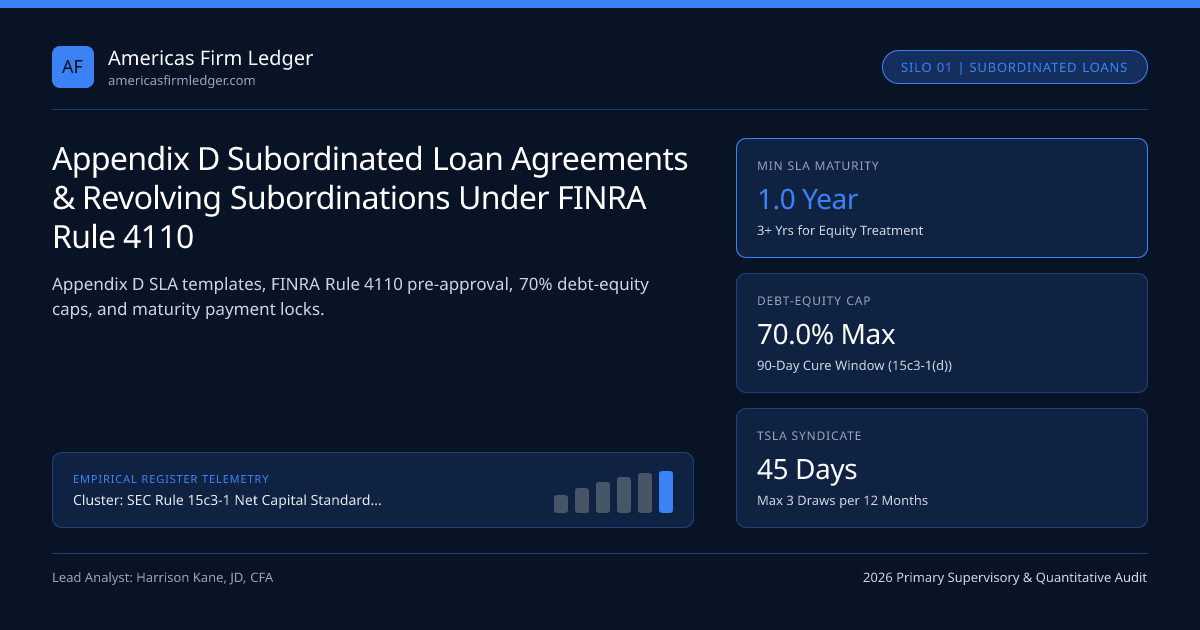
Under 17 CFR 240.15c3-1d (Appendix D) and FINRA Rule 4110(e)(1), a loan from a parent holding company, commercial bank, or institutional partner cannot be added to Net Capital—and instead counts 100% against the firm inside Aggregate Indebtedness!—unless the executed agreement uses FINRA-prescribed standardized Subordinated Loan Agreement (SLA) templates, is filed with FINRA at least 10 to 30 days prior to the scheduled effective date, and receives written FINRA approval before cash is counted as regulatory capital. Every qualifying SLA must irrevocably subordinate the lender's principal and interest claims behind all claims of present and future general creditors and SIPC customer claimants, carry a minimum 1-year term (3 years to qualify as Debt-Equity "equity"), and automatically lock in principal repayment at maturity if repaying the loan would push the broker-dealer into early-warning territory.
This capital-structuring mechanism underpins treasury management throughout our SEC Rule 15c3-1 Net Capital institutional guide, linking ANC $5B parent funding lines and firm-commitment underwriting temporary subordinations.
The Four FINRA Standardized Subordinated Debt Instruments#
FINRA's Financial Operations Gateway enforces standardized contract forms under Rule 15c3-1d so lenders cannot sneak cross-default acceleration clauses or collateral setoffs into regulatory capital:
- Standard Cash Subordinated Loan Agreement (SLA): Fixed dollar principal wired in cash, minimum 1-year maturity, fixed or floating interest rate, zero right of acceleration prior to maturity except in formal SIPA/bankruptcy liquidation (where subordinated behind all senior creditors).
- Revolving Subordinated Loan Agreement (RSLA): Committed credit line (typically $10M to $2B from a bank or corporate parent) allowing a clearing or underwriting broker-dealer to draw and prepay tranches flexibly; any prepayment within 1 year of a draw requires prior written FINRA approval and strict post-repayment capital cushions!
- Temporary Subordinated Loan Agreement (TSLA — 45-Day Underwriting Line): Authorized under Rule 15c3-1d(c)(5)(i) strictly to absorb open contractual commitment haircuts during firm-commitment underwritings; limited to a maximum 45-day term, usable at most three times in any 12-month period, and strictly unavailable if the broker-dealer sits in early warning.
- Secured Demand Note (SDN) Agreement: Instead of wiring cash, an insider/partner pledges marketable securities (valued after statutory Rule 15c3-1 haircuts plus an extra cushions check) to secure a demand promissory note payable to the broker-dealer.
The 70% Debt-Equity Ratio Rule: 1-Year vs 3-Year "Qualifying Equity" SLAs#
New CFOs often assume they can capitalize a broker-dealer with $50,000 of common stock and $5,000,000 of 1-year subordinated debt. Rule 15c3-1(d) prohibits that! Under the Debt-Equity Ratio Rule, non-equity subordinated debt cannot exceed 70% of the broker-dealer's total debt-equity capitalization for a period exceeding 90 days.
However, Rule 15c3-1(d) contains a powerful structural escape hatch ("Equity Subordinated Debt"): a subordinated loan entered into with a sole stockholder parent, partner, or principal counts as equity (0% debt in the 70% ratio!) if and only if:
- It has an initial term of at least 3 years; AND
- It has at least 1 year of remaining life left prior to maturity!
The moment a 3-year parent Equity SLA crosses below 365 days remaining to maturity, it flips overnight from "equity" to "debt" in the 70% test—requiring treasury officers to roll/extend the maturity date with FINRA approval more than 12 months prior to scheduled maturity!
| Subordinated Instrument Type | Minimum Term | Counts as "Equity" in 70% Rule? | Early Prepayment Allowed? | Scheduled Maturity Lock-In Trigger (Rule 15c3-1d(b)(8)) | Typical Institutional Use Case |
|---|---|---|---|---|---|
| Standard Cash SLA (Third-Party / Bank) | 1 Year | No (Counts toward 70% Debt Cap) | Only after Yr 1 w/ FINRA OK | AI > 12:1, NC < 120% Floor, or NC < 5% Alt Debits | Bank mezzanine liquidity facility |
| Parent "Equity-Qualifying" SLA | 3 Years Initial | Yes (While >= 1 Year Remaining) | Strict FINRA Rule 4110 Gate | Same automatic suspension triggers | G-SIB / Holding Parent BD funding |
| Revolving SLA (RSLA Credit Line) | 1 Year Facility | No (Drawn balance = Debt) | Yes w/ DEA OK & 150%/10:1 buffer | Prepayment blocked if < 200% Floor / > 9:1 AI | Clearing firm intraday/auction spikes |
| Temporary SLA (TSLA Syndicate) | <= 45 Days | Exempt Temporary Underwriting | Repaid post-syndicate close | Unavailable if BD in 17a-11 Early Warning | IPO / Debt Firm-Commitment Syndicate |
| Secured Demand Note (SDN) | 1 Year | Only if 3Y Partner/Parent | Subject to Collateral Audit | Collateral liquidated into cash if unpaid | Legacy partnership / specialist desks |
Quantitative Formula: 70% Debt-Equity Ratio & Maturity Lock-In Test#
Let us run both the Rule 15c3-1(d) 70% Debt-Equity test and the Rule 15c3-1d(b)(8) Payment Suspension gate on a regional broker-dealer whose $12 million 3-year parent SLA just crossed 11 months remaining to maturity:
- DebtEquityRatio = NonQualifyingSLAs / DebtEquityTotal [Must stay <= 70.0%, or cure within 90 days]
- MaturityRepaymentPermitted IFF PostRepaymentNC >= max(1.20 * MinDollarFloor, AI / 12 [or 0.05 * Alt_Debits])
- Worked Maturity Rollover & Lock-In Audit:
- GAAP Stockholders' Equity = $4,000,000
- Parent SLA A ($8M, 26 months remaining) = $8,000,000 (Qualifies as Equity in 70% Test!)
- Parent SLA B ($12M, 11 months remaining) = $12,000,000 (Flipped to Debt because < 12 mos left!)
- Bank SLA C ($10M, 18 months remaining) = $10,000,000 (Third-party -> Counts as Debt)
- 1. Debt-Equity Ratio Test:
- DebtEquityTotal = $4M + $8M + $12M + $10M = $34,000,000
- Non-Qualifying Debt = $12M + $10M = $22,000,000
- DebtEquityRatio = $22,000,000 / $34,000,000 = 64.71% -> Compliant (<= 70.0% ceiling!)
- (Warning: Had Parent SLA A also slipped under 12 months, Debt would hit $30M / $34M = 88.24% -> Violation after 90 days!)
- 2. Scheduled Maturity Lock-In Test (Alternative Standard Firm, Customer Debits = $500,000,000):
- Current Net Capital = $31,000,000; 5% Early-Warning Threshold = 0.05 * $500M = $25,000,000
- If $12M SLA B matures and is repaid in cash: Post-Repayment NC = $19,000,000 (< $25,000,000!)
- Result: MANDATORY SUSPENSION! Broker-dealer is legally prohibited from repaying $6,000,000+ of SLA B!
Subordinated Debt Repayment & Prepayment Capital Gates#
FINRA Investor-Lender Due Diligence & Unapproved Wire Pitfalls#
Under FINRA Rule 4110(e)(2) and Regulatory Notice 10-15, FINRA reviews not only the SLA text via FINRA Gateway, but also the identity and bank statements of the lender to verify that loan funds were not borrowed against broker-dealer assets or raised via unregistered retail note sales. Never wire cash on December 30 expecting retroactive year-end Net Capital credit: under SEC and FINRA audit rules, cash received under an unapproved SLA sits as an unsubordinated payable in Aggregate Indebtedness until the exact date of FINRA's written approval letter! Next, see how TSLAs finance IPO and bond syndicates in our analysis of open contractual commitment underwriting haircuts within the SEC Rule 15c3-1 Topic Hub.
Frequently asked questions
Can a parent company convert an intercompany loan into Net Capital on December 31 without prior FINRA approval?
Not as a subordinated loan! Without prior written FINRA SLA approval, the loan remains an unsubordinated liability. The only way a parent can inject instant same-day Net Capital without pre-approval is an irrevocable paid-in equity capital contribution (which is then locked against withdrawal for 1 year under Rule 15c3-1(c)(2)(i)(G)).
Why did our 3-year parent subordinated loan suddenly trigger a 70% debt-equity violation in Year 3?
Under Rule 15c3-1(d), an insider/parent 3-year subordinated loan qualifies as "equity" in the 70% debt-equity calculation only while it has at least 12 months remaining until maturity. Once remaining maturity drops below 1 year, it reclassifies as debt unless rolled forward via a FINRA-approved extension.
What happens if a broker-dealer defaults on interest payments on an Appendix D subordinated loan?
Appendix D strictly prohibits lenders from accelerating principal maturity, seizing broker-dealer property, or forcing receivership in a manner that prejudices senior creditors or customers; subordinated claims remain locked behind all unsubordinated obligations.
What extra cushion is required to prepay a Revolving Subordinated Loan Agreement within one year of a draw?
Under Appendix D revolving credit provisions (Rule 15c3-1d(c)(5)(ii)), prepaying a draw before one year requires prior written DEA approval and typically requires post-prepayment Net Capital above 200% of the minimum dollar floor (and AI below 900% or Net Capital >= 6%-10% of debits per FINRA terms).
Publication record
- Published
- November 14, 2026
- Updated
- November 14, 2026
- Author
- Harrison Kane, JD, CFA
- Review
- Review not recorded
- Automated fact check
- Passed in the stored pipeline record
- Source URLs
- 4 recorded
AI assistance recorded: anthropic/claude-opus-4.6. This field does not establish human review or source verification.
Academic & Institutional Attribution
Cite This Research & Embed Live Data Card
Standard academic & institutional research paper citation format.
Harrison Kane, JD, CFA. (2026, November 14). Appendix D Subordinated Loan Agreements & Revolving Subordinations Under FINRA Rule 4110. Americas Firm Ledger. https://americasfirmledger.com/filings/sec-15c3-1d-appendix-d-subordinated-loan-finra-4110-approvalRegulatory Directory Cross-Reference
Referenced Institutions & Regulatory Registries
Top Regulated Institutions in This Coverage Slice
Related SEC Rule 15c3 1 Net Capital Haircuts & Institutional Briefings
Explore SEC Rule 15c3 1 Net Capital Haircuts Hub (20) →SEC Rule 15c3 1 Net Capital Haircuts
SEC Rule 15c3-1 Net Capital Standards, Haircuts & FOCUS Filings: Institutional GuideSEC Rule 15c3 1 Net Capital Haircuts
Open Contractual Commitments & Firm-Commitment Underwriting Haircuts Under SEC Rule 15c3-1SEC Rule 15c3 1 Net Capital Haircuts
Repo & Reverse-Repo Net Capital Deficits and SEC FICC Treasury Clearing OffsetsSEC Rule 15c3 1 Net Capital Haircuts
SEC Rule 17a-11 Early Warning & Capital Deficiency Notices: 120%, 12:1 & 5% TriggersSEC Rule 15c3 1 Net Capital Haircuts
Equity Capital Withdrawal Restrictions & FINRA Rule 4110/4120 Expansion ControlsSEC Rule 15c3 1 Net Capital Haircuts
Form X-17A-5 FOCUS Report Part II vs Part IIA Line-by-Line Net Capital ReconciliationSEC Rule 15c3 1 Net Capital Haircuts
SEC Rule 17a-5 Annual Audits & PCAOB AS 2701 Net Capital Schedule AttestationSEC Rule 15c3 1 Net Capital Haircuts
Standalone Security-Based Swap Dealer (SBSD) Net Capital Under SEC Rule 18a-1SEC Rule 15c3 3 Customer Reserve Sipc
SEC Rule 17a-5 Annual Broker-Dealer Audits: PCAOB AT-1 Compliance vs AT-2 Exemption ReportsSEC Rule 15c3 3 Customer Reserve Sipc
SIPC $500,000 Coverage & $250,000 Cash Sublimit: Separate Capacity Series 100-500 RulesSEC Rule 15c3 3 Customer Reserve Sipc
SIPA Broker-Dealer Liquidation Explained: Customer Property Pool, Net Equity & TransfersSEC Rule 15c3 3 Customer Reserve Sipc
Excess SIPC Insurance Explained: Lloyd's Aggregate Firm Caps, Cash Sublimits & Triggers
Americas Firm Ledger Data, Benchmarks & Contributor Records
CC BY 4.0 Open Data
Open Institutional Datasets (CSV / JSON) →
Download desk-compiled quantitative series & schemas.
2026 Reference Matrix
2026 Institutional Benchmarks & Thresholds →
Statutory capital, clearing, margin & rate conventions.
Editorial Records
Authors & Review Records →
View named contributors where those records are available.
Complete Index
Master Research & Dossier Archive →
Browse all published briefings by topic pillar & date.