
SEC Rule 15c3 1 Net Capital Haircuts
SEC Rule 17a-11 Early Warning & Capital Deficiency Notices: 120%, 12:1 & 5% Triggers
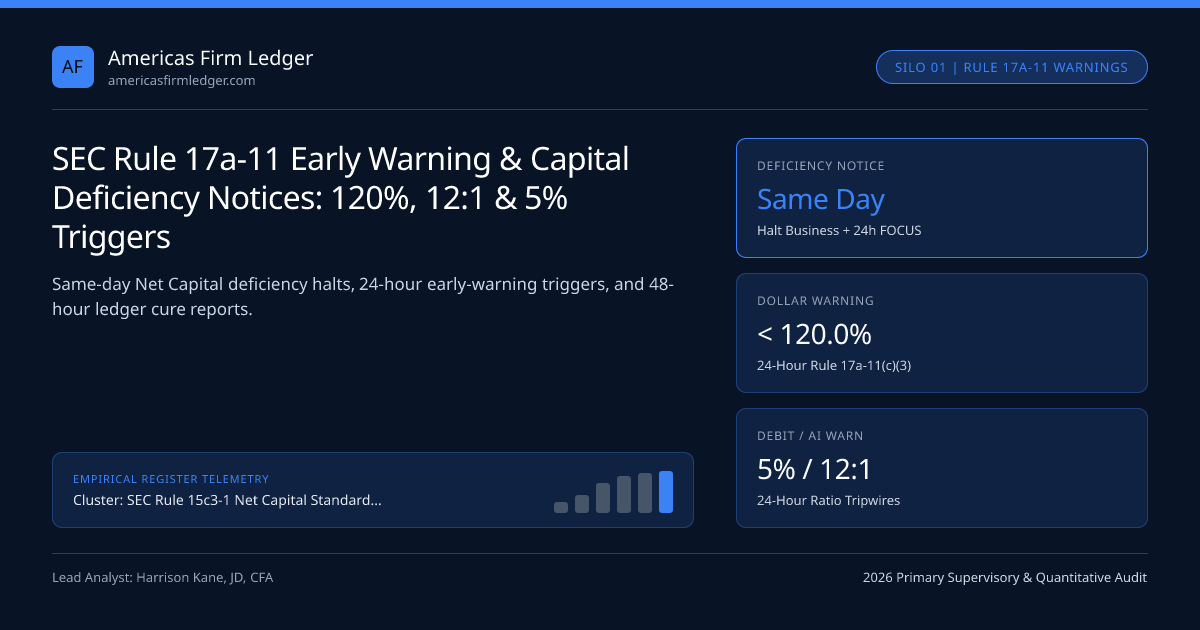
SEC Rule 17a-11 requires registered broker-dealers to transmit same-day notice to the SEC and FINRA upon any Net Capital deficiency, and 24-hour early-warning notice whenever Net Capital falls below 120% of its dollar floor, 5% of customer debits, or above 12:1 Aggregate Indebtedness.
17 CFR 240.17a-11 operates as the automated tripwire of U.S. broker-dealer supervision, compelling every registered firm to self-report solvency erosion, books-and-records breakdowns, or internal control material inadequacies electronically to the U.S. Securities and Exchange Commission (Washington headquarters plus the regional SEC office), its Designated Examining Authority (FINRA), and—if also registered as a Futures Commission Merchant—the CFTC. Missing a same-day Rule 17a-11(b)(1) deficiency notice or a 24-hour Rule 17a-11(c) early-warning notice transforms arecoverable treasury hiccup into a standalone willful statutory violation carrying personal FinOp Series 27 suspension risk.
This mandatory notification protocol connects every ratio across our SEC Rule 15c3-1 Net Capital institutional guide, pairing directly with FINRA Rule 4110/4120 capital withdrawal locks and repo/underwriting intraday charges.
Exact Statutory Clocks: Same-Day Violation vs 24-Hour Early Warning#
Compliance counsel and FinOps must distinguish four separate paragraphs of Rule 17a-11—each carrying its own filing clock and recipient list via FINRA Gateway's Regulatory Notifications portal (and SEC electronic Rule 17a-11 portal):
- Paragraph (b)(1) — Net Capital Deficiency (< 100% Minimum): If Net Capital drops below the required minimum under SEC Rule 15c3-1 (or if an ANC dealer drops below $5B TNC / $1B NC), the broker-dealer must immediately cease non-liquidating securities business, transmit same-day notice, and file a full Part II or Part IIA FOCUS Report within 24 hours! (Meanwhile, FINRA notifies SIPC under SIPA Section 5(a)(1) if customer property is jeopardized.)
- Paragraph (c) — Early-Warning Thresholds (24-Hour Notice): Notice must be transmitted within 24 hours of triggering any of four early-warning lines:
- Rule 17a-11(c)(1): Aggregate Indebtedness exceeds 1,200% (12:1) of Net Capital;
- Rule 17a-11(c)(2): Alternative Standard Net Capital drops below 5% of Aggregate Debit Items computed under SEC Rule 15c3-3;
- Rule 17a-11(c)(3): Total Net Capital falls below 120% of the broker-dealer's required minimum dollar Net Capital floor (e.g., <$6,000 for a $5k firm, <$120,000 for a $100k dealer, <$300,000 for a $250k carrying firm); or
- Rule 17a-11(b)(2): An ANC dealer's Tentative Net Capital falls below $6,000,000,000 (same-day/immediate notice).
- Paragraph (d) — Failure to Make & Keep Current Books and Records: If general ledgers, stock records, or Net Capital computations fall out of balance, same-day notice is required, followed within 48 hours by a written remediation report detailing corrective steps!
- Paragraph (e) — Material Inadequacy in Accounting Controls: Within 24 hours of discovering (or being informed by the PCAOB auditor of) a material inadequacy in internal controls over financial reporting or Rule 15c3-3 custody, notice must be filed, followed within 48 hours by a corrective plan.
Complete Matrix of Rule 17a-11 & Companion Rule 15c3-3 Triggers#
In addition to Net Capital triggers, broker-dealers must cross-check Rule 15c3-3(i)—which mandates immediate same-day notification to the SEC and FINRA whenever a carrying firm fails to make a required deposit into its Special Reserve Bank Account by 10:00 AM ET on the computation deadline!
| Trigger Event | Statutory Citation | Threshold Metric | Notification Deadline | Follow-Up Filing Requirement | Business Operations Impact |
|---|---|---|---|---|---|
| Net Capital Deficiency | Rule 17a-11(b)(1) | NC < 100% Statutory Minimum | Same Day (Immediate) | FOCUS Part II/IIA within 24 hrs | Immediate Suspension of Business |
| ANC Tentative NC Warning | Rule 17a-11(b)(2) | Tentative NC < $6,000,000,000 | Same Day | SEC Risk Supervision Review | Heightened Daily Liquidity Reporting |
| AI Ratio Early Warning | Rule 17a-11(c)(1) | Aggregate Indebtedness > 1,200% NC | Within 24 Hours | Monthly FOCUS Part IIA/II | Dividends Frozen (Frozen since 10:1!) |
| Alternative Debit Warning | Rule 17a-11(c)(2) | NC < 5.0% of 15c3-3 Debit Items | Within 24 Hours | Monthly/Biweekly FOCUS | Dividends & Expansion Frozen |
| Fixed Dollar Early Warning | Rule 17a-11(c)(3) | NC < 120% of Fixed Dollar Floor | Within 24 Hours | Monthly FOCUS for >= 3 Months | Dividends & Sub-Debt Payoff Frozen |
| Ledger / Stock Record Break | Rule 17a-11(d) | Books Not Current (Rule 17a-3) | Same Day | Written Cure Report within 48 hrs | Potential Clearing Restriction |
| Reserve Deposit Miss | Rule 15c3-3(i) | Missed 10:00 AM Reserve Wire | Immediate (Same Day) | Immediate Cure Confirmation | Severe Custody Enforcement Priority |
Quantitative Multi-Test Early-Warning Check#
A frequent error on Series 27 exams and real-world FinOp dashboards is checking only whether Excess Net Capital exceeds 20% of overall required capital rather than testing all applicable early-warning prongs independently:
- EarlyWarningTriggered = (NC < 1.20 * FixedDollarFloor) OR
- (Basic_Method AND (AI / NC > 12.0)) OR
- (AltMethod AND (NC < 0.05 * AggregateDebit_Items))
- Worked Multi-Trigger Diagnostic ($100,000 Proprietary Dealer on Basic AI Method):
- Fixed Dollar Floor = $100,000 -> 120% Dollar Early-Warning Floor = $120,000
- Aggregate Indebtedness (AI) = $1,680,000
- Required Minimum NC = max($100,000, $1,680,000 / 15) = max($100,000, $112,000) = $112,000
- Actual Net Capital (NC) = $135,000
- Test 1 (Deficiency): $135,000 >= $112,000 -> PASS (Excess NC = +$23,000)
- Test 2 (120% Dollar Floor, 17a-11(c)(3)): $135,000 >= $120,000 -> PASS
- Test 3 (12:1 AI Early Warning, 17a-11(c)(1)):
- AI / NC = $1,680,000 / $135,000 = 12.44:1 (1,244.4% > 1,200%!) -> TRIGGERED!
- Mandatory Action: Transmit Rule 17a-11(c)(1) Early-Warning Notice within 24 hours!
Supervisory Buffer Zones (Basic AI Broker-Dealer)#
Notice how even though Net Capital ($135,000) sits 20.5% above Required Minimum Net Capital ($112,000) and 35.0% above the $100,000 dollar floor, the 12.44:1 AI ratio crosses 1,200% and requires a 24-hour Rule 17a-11(c)(1) filing!
The "Retroactive Discovery" Filing Rule (Even If Already Cured!)#
What if a FinOp closing January books on February 12 discovers that an unrecorded $90,000 legal invoice pushed the firm below minimum Net Capital for three days on January 26–28, even though a $300,000 parent capital contribution on January 29 already restored massive excess capital? SEC and FINRA precedent is absolute: you MUST file a Rule 17a-11(b)(1) notice on the day of discovery (February 12) reporting the historic net capital deficiency, attach the reconstructed deficiency FOCUS calculation, and document the January 29 cure! Concealing a cured historical breach is prosecuted far more harshly than the underlying accrual error. Next, examine the equity withdrawal notices and insider distribution locks that pair with Rule 17a-11 in FINRA Rule 4110/4120 capital withdrawal restrictions across the SEC Rule 15c3-1 Topic Hub.
Frequently asked questions
If a parent holding company wires cash within two hours to cure an intraday Net Capital deficiency, is a Rule 17a-11 filing still required?
Yes! Because SEC Rule 15c3-1 requires continuous, moment-to-moment compliance, any intraday breach below 100% of minimum Net Capital must be reported same-day under Rule 17a-11(b)(1), noting both the breach and the subsequent parent capital injection.
How does triggering Rule 17a-11 early warning change a quarterly introducing firm's FOCUS filing schedule?
Under SEC Rule 17a-5(a) and FINRA Rule 4524/supervisory directives, a quarterly FOCUS Part IIA filer that crosses an early-warning threshold is typically required to file monthly FOCUS reports for at least three consecutive months demonstrating sustained excess capital.
Do dual-registered Broker-Dealer / Futures Commission Merchants file both SEC Rule 17a-11 and CFTC Rule 1.12 notices?
Yes. Rule 17a-11(f) and CFTC Regulation 1.12 require cross-notification so both the SEC/FINRA and CFTC/NFA receive immediate electronic copies whenever a dual registrant breaches either securities or futures early-warning lines.
Does the 120% early-warning rule apply to 120% of total ratio-required Net Capital or 120% of the minimum dollar floor?
Careful! Rule 17a-11(c)(3) tests 120% of the broker-dealer's required minimum DOLLAR Net Capital under Rule 15c3-1, while ratio early warnings are governed separately by 1,200% (12:1) AI in paragraph (c)(1) and 5% of debits in paragraph (c)(2)—though FINRA Rule 4120 also tests 120%/150% cushions.
Publication record
- Published
- November 14, 2026
- Updated
- November 14, 2026
- Author
- Harrison Kane, JD, CFA
- Review
- Review not recorded
- Automated fact check
- Passed in the stored pipeline record
- Source URLs
- 4 recorded
AI assistance recorded: anthropic/claude-opus-4.6. This field does not establish human review or source verification.
Academic & Institutional Attribution
Cite This Research & Embed Live Data Card
Standard academic & institutional research paper citation format.
Harrison Kane, JD, CFA. (2026, November 14). SEC Rule 17a-11 Early Warning & Capital Deficiency Notices: 120%, 12:1 & 5% Triggers. Americas Firm Ledger. https://americasfirmledger.com/filings/sec-rule-17a-11-early-warning-notices-120-percent-5-percentRegulatory Directory Cross-Reference
Referenced Institutions & Regulatory Registries
Top Regulated Institutions in This Coverage Slice
Related SEC Rule 15c3 1 Net Capital Haircuts & Institutional Briefings
Explore SEC Rule 15c3 1 Net Capital Haircuts Hub (20) →SEC Rule 15c3 1 Net Capital Haircuts
SEC Rule 15c3-1 Net Capital Standards, Haircuts & FOCUS Filings: Institutional GuideSEC Rule 15c3 1 Net Capital Haircuts
Equity Capital Withdrawal Restrictions & FINRA Rule 4110/4120 Expansion ControlsSEC Rule 15c3 1 Net Capital Haircuts
Form X-17A-5 FOCUS Report Part II vs Part IIA Line-by-Line Net Capital ReconciliationSEC Rule 15c3 1 Net Capital Haircuts
SEC Rule 17a-5 Annual Audits & PCAOB AS 2701 Net Capital Schedule AttestationSEC Rule 15c3 1 Net Capital Haircuts
Standalone Security-Based Swap Dealer (SBSD) Net Capital Under SEC Rule 18a-1SEC Rule 15c3 1 Net Capital Haircuts
Aggregate Indebtedness 15:1 vs 8:1 First-Year Ratio Mechanics Under SEC Rule 15c3-1SEC Rule 15c3 1 Net Capital Haircuts
Alternative Net Capital Standard: $250,000 Floor vs 2% of Rule 15c3-3 Debit ItemsSEC Rule 15c3 1 Net Capital Haircuts
SEC Rule 15c3-1 Minimum Dollar Net Capital Tiers: $5k, $50k, $100k, $250k & $1M FloorsSEC Rule 15c3 3 Customer Reserve Sipc
Excess SIPC Insurance Explained: Lloyd's Aggregate Firm Caps, Cash Sublimits & TriggersSEC Rule 15c3 3 Customer Reserve Sipc
SEC Special Purpose Broker-Dealers (SPBDs): Rule 15c3-3 Digital Asset Custody & SIPASEC Rule 15c3 3 Customer Reserve Sipc
FINRA Rule 4311 Carrying Agreements: Fully Disclosed vs Omnibus Clearing & SIPA PrioritySEC Rule 15c3 3 Customer Reserve Sipc
Hypothecation of Customer Securities Under SEC Rules 8c-1 & 15c2-1: Three Anti-Commingling Bans
Americas Firm Ledger Data, Benchmarks & Contributor Records
CC BY 4.0 Open Data
Open Institutional Datasets (CSV / JSON) →
Download desk-compiled quantitative series & schemas.
2026 Reference Matrix
2026 Institutional Benchmarks & Thresholds →
Statutory capital, clearing, margin & rate conventions.
Editorial Records
Authors & Review Records →
View named contributors where those records are available.
Complete Index
Master Research & Dossier Archive →
Browse all published briefings by topic pillar & date.