
SEC Rule 15c3 1 Net Capital Haircuts
Repo & Reverse-Repo Net Capital Deficits and SEC FICC Treasury Clearing Offsets
SEC Rule 15c3-1(c)(2)(iv)(F) imposes strict Net Capital deductions on under-collateralized reverse repurchase agreements and over-collateralized repurchase excess margin, directly driving Wall Street adoption of FICC Government Securities Division central clearing under SEC Rule 17ad-22(e)(18).
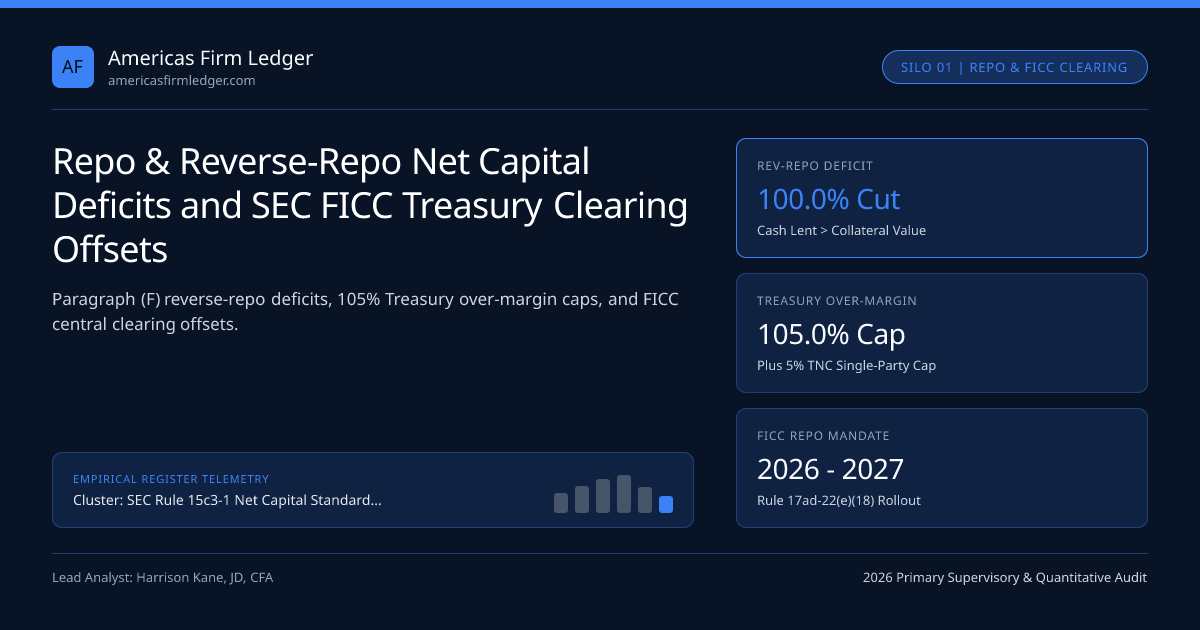
Under 17 CFR 240.15c3-1(c)(2)(iv)(F), fixed-income broker-dealers financing sovereign and corporate inventory via repurchase agreements (repos) and lending cash via reverse repos face asymmetric counterparty exposure deductions: a reverse-repo deficit (where cash lent plus accrued interest exceeds the market value of securities physically received) incurs a 100% dollar-for-dollar Net Capital deduction, whereas an excess repo margin (where the market value of securities delivered by the broker-dealer exceeds cash borrowed) incurs a tiered deduction whenever excess collateral surpasses 105% of cash received on U.S. Treasuries (or 110% / 120% on other collateral) or exceeds 300% of Tentative Net Capital across a single counterparty! With the SEC's landmark U.S. Treasury Central Clearing Mandate (Rule 17ad-22(e)(18)) phasing in cash and repo clearing through the Fixed Income Clearing Corporation (FICC) in 2026–2027, central novation fundamentally transforms both GAAP balance-sheet netting and Rule 15c3-1 repo deficit charges.
This repo treasury architecture connects our SEC Rule 15c3-1 Net Capital institutional guide directly to US Treasury maturity-bucket haircuts and Rule 17a-11 early-warning triggers.
Asymmetric Bilateral Repo vs Reverse-Repo Capital Deductions#
Matched-book repo dealers stand between cash-rich money-market lenders and leveraged macro hedge funds. Under Rule 15c3-1(c)(2)(iv)(F), bilateral (non-FICC-cleared) repo and reverse-repo legs trigger three distinct operational charges:
- Reverse-Repo Collateral Deficit — Paragraph (F)(1): If the contract price (cash wired out plus accrued interest) exceeds the current mark-to-market value of securities actually held in possession/control by the broker-dealer, 100% of the deficit is deducted immediately as an unsecured receivable! (Additionally, if a reverse repo to maturity exceeds 30 days without daily margining rights, extra maturity-bucket haircuts apply.)
- Repo Excess Collateral ("Over-Margin") — Paragraph (F)(2): When borrowing cash from a street lender or money fund that demands a 2%–8% initial haircut on pledged bonds, the broker-dealer delivers more securities value than cash received. Under Paragraph (F)(2)(i), the dealer must deduct the excess market value over 105% of contract price for U.S. Treasury/Agency repos (and over 110% for municipal/IG corporate or 120% for other securities)—plus, even within the 5% band, if aggregate repo excess collateral to a single counterparty exceeds the greater of $50,000 or 5% of Tentative Net Capital (or 300% of TNC aggregate repo excess), secondary concentration deductions hit Net Capital!
- Hold-in-Custody (HIC) Repo Prohibitions: Retaining customer repo collateral inside the dealer's own box without tri-party bank or FICC segregation triggers strict written disclosure, overnight-only restrictions, and SEC Rule 15c3-3 possession-or-control scrutiny.
How SEC FICC Central Clearing Mandate Reshapes Dealer Balance Sheets#
Under SEC Release No. 34-99149 (amending Rule 17ad-22(e)(18) and Rule 15c3-3a), Direct Participants of FICC's Government Securities Division must submit eligible secondary-market U.S. Treasury cash and repo/reverse-repo transactions for central clearing (with cash clearing effective December 31, 2026 and repo clearing effective June 30, 2027).
| Repo Microstructure & Clearing Venue | GAAP Balance-Sheet Netting (ASC 210-20) | Rule 15c3-1 Proprietary Haircut | Rule 15c3-1(c)(2)(iv)(F) Deficit / Excess Charge | Rule 15c3-3 Customer Margin / Reserve Treatment |
|---|---|---|---|---|
| Bilateral Ununcleared Repo (Hedge Fund) | Gross Assets & Liabilities (Unless Same-Day/Party) | Full Para (A) Haircut on Owned Long Bond | 100% Rev-Repo Deficit; >105% Repo Excess Cut | Cannot re-use customer cash freely |
| Tri-Party Bank Repo (BNY Mellon) | Gross Liabilities (Financing Leg) | Full Para (A) Haircut on Financed Inventory | Reduced operational fail; >105% / >5% TNC tested | Segregated tri-party custodial box |
| FICC Netting Member Matched Book | ASC 210-20 Netted (Same Maturity/FICC CCP) | Netted CUSIP/Bucket Duration Only | Novated to FICC; CCP Margin Exempt From 5% TNC | Direct FICC Clearing Fund Deposit |
| FICC Sponsored / Agent Cleared Repo | ASC 210-20 Netted Against Sponsored Reverse | Sponsor Guarantees Default Fund Slice | Eliminates Bilateral Hedge Fund Excess Penalty | Amended Rule 15c3-3a Allows FICC Margin Debit! |
Crucially, in tandem with the Treasury clearing mandate, the SEC amended Rule 15c3-3 Exhibit A so carrying broker-dealers can include customer Treasury clearing margin posted onward to FICC as an allowable Debit Item in the customer reserve formula—eliminating the massive liquidity trap that previously forced broker-dealers to fund customer FICC margin out of proprietary corporate cash!
Worked Quantitative Model: Bilateral Matched-Book vs FICC Sponsored Netting#
Consider a primary/institutional fixed-income dealer (TNC = $100,000,000) running a $1.5 billion 10-year U.S. Treasury matched repo book between a money-market lender demanding a 2% haircut and a macro fund posting a 1% haircut (after an intraday 60-bps yield spike drops bond value by $8M on an uncollected margin call):
- RepoExcessOver105 = max(0, DeliveredCollateralMV - 1.05 * RepoContract_Payable)
- SingleCounterpartyRepoExcessCharge = max(0, TotalCounterpartyRepo_Excess - max($50,000, 0.05 * TNC)) [Subject to Para F tiers]
- Worked Bilateral Matched-Book Stress Calculation (TNC = $100,000,000):
- 1. Reverse-Repo Leg (Cash Lent to Macro Fund = $1,500,000,000):
- Market Value of 10Y Treasuries Held After Yield Spike = $1,492,000,000 (Margin call pending!)
- ReverseRepoDeficit = $1,500,000,000 - $1,492,000,000 = $8,000,000 -> 100% Net Capital Cut!
- 2. Repo Leg (Cash Borrowed From Single Money Fund = $1,470,000,000; Treasuries Delivered = $1,508,000,000):
- Total Repo Excess Collateral Posted = $1,508,000,000 - $1,470,000,000 = $38,000,000 (2.59% <= 5% Band)
- 105% Cap Check: 1.05 * $1,470M = $1,543.5M -> RepoExcessOver_105 = $0
- Single-Counterparty 5% TNC Check: 0.05 * $100,000,000 = $5,000,000 Threshold
- Excess Repo Exposure to Single Counterparty ($38M - $5M = $33,000,000) -> Triggers Paragraph (F)(2) Charge!
- 3. Under FICC Sponsored Clearing:
- Both legs novate to FICC; ASC 210-20 nets $1.47B off GAAP balance sheet; twice-daily FICC intraday variation margin eliminates uncollected bilateral $8M deficit!
Paragraph (F) Repo Collateral & Concentration Gates#
Operational Margin Call Discipline for Fixed-Income Desks#
Note that while proprietary securities financed via bilateral repo remain on the broker-dealer's GAAP balance sheet and continue to incur their normal Paragraph (A) Treasury maturity haircut, securities received under a reverse repo (where the dealer has not sold them short) do not incur a proprietary market haircut—only the counterparty deficit risk under Paragraph (F)! Next, see what happens when repo deficits or trading losses push a broker-dealer across regulatory tripwires in our guide to SEC Rule 17a-11 early-warning & deficiency notices inside the SEC Rule 15c3-1 Topic Hub.
Frequently asked questions
Does financing a 10-year U.S. Treasury bond via repo eliminate its 4.5% Rule 15c3-1 haircut?
No! Under GAAP and SEC Rule 15c3-1, a security financed via repurchase agreement remains economically owned by the broker-dealer, so it continues to incur its full 4.5% Paragraph (A) market haircut—plus any Paragraph (F)(2) repo excess-collateral charge if over-margined.
Do securities received as collateral on a reverse repo incur proprietary inventory haircuts?
No, unless the broker-dealer sells those collateral securities short (creating a proprietary short position). On an unencumbered reverse repo, the dealer faces counterparty credit risk rather than price risk, governed by the 100% collateral-deficit rule in Paragraph (F)(1).
How does FICC Sponsored Clearing improve a broker-dealer's regulatory ratios?
When a sponsoring dealer clears both a cash-provider repo and a hedge-fund reverse repo with matching maturities through FICC, FICC becomes the central counterparty to both legs—allowing GAAP balance-sheet netting and eliminating bilateral 5%-of-TNC repo excess charges.
What are the SEC compliance deadlines for mandatory U.S. Treasury central clearing?
Following the SEC's phased extension schedule for Rule 17ad-22(e)(18), eligible secondary-market cash U.S. Treasury transactions transition to central clearing by December 31, 2026, followed by eligible U.S. Treasury repo and reverse-repo transactions by June 30, 2027.
Publication record
- Published
- November 14, 2026
- Updated
- November 14, 2026
- Author
- Harrison Kane, JD, CFA
- Review
- Review not recorded
- Automated fact check
- Passed in the stored pipeline record
- Source URLs
- 4 recorded
AI assistance recorded: anthropic/claude-opus-4.6. This field does not establish human review or source verification.
Academic & Institutional Attribution
Cite This Research & Embed Live Data Card
Standard academic & institutional research paper citation format.
Harrison Kane, JD, CFA. (2026, November 14). Repo & Reverse-Repo Net Capital Deficits and SEC FICC Treasury Clearing Offsets. Americas Firm Ledger. https://americasfirmledger.com/filings/sec-15c3-1-repo-reverse-repo-deficits-ficc-sponsored-clearingRegulatory Directory Cross-Reference
Referenced Institutions & Regulatory Registries
Top Regulated Institutions in This Coverage Slice
Related SEC Rule 15c3 1 Net Capital Haircuts & Institutional Briefings
Explore SEC Rule 15c3 1 Net Capital Haircuts Hub (20) →SEC Rule 15c3 1 Net Capital Haircuts
SEC Rule 15c3-1 Net Capital Standards, Haircuts & FOCUS Filings: Institutional GuideSEC Rule 15c3 1 Net Capital Haircuts
SEC Rule 17a-11 Early Warning & Capital Deficiency Notices: 120%, 12:1 & 5% TriggersSEC Rule 15c3 1 Net Capital Haircuts
Equity Capital Withdrawal Restrictions & FINRA Rule 4110/4120 Expansion ControlsSEC Rule 15c3 1 Net Capital Haircuts
Form X-17A-5 FOCUS Report Part II vs Part IIA Line-by-Line Net Capital ReconciliationSEC Rule 15c3 1 Net Capital Haircuts
SEC Rule 17a-5 Annual Audits & PCAOB AS 2701 Net Capital Schedule AttestationSEC Rule 15c3 1 Net Capital Haircuts
Standalone Security-Based Swap Dealer (SBSD) Net Capital Under SEC Rule 18a-1SEC Rule 15c3 1 Net Capital Haircuts
Aggregate Indebtedness 15:1 vs 8:1 First-Year Ratio Mechanics Under SEC Rule 15c3-1SEC Rule 15c3 1 Net Capital Haircuts
Alternative Net Capital Standard: $250,000 Floor vs 2% of Rule 15c3-3 Debit ItemsSEC Rule 15c3 3 Customer Reserve Sipc
SIPA Broker-Dealer Liquidation Explained: Customer Property Pool, Net Equity & TransfersSEC Rule 15c3 3 Customer Reserve Sipc
Excess SIPC Insurance Explained: Lloyd's Aggregate Firm Caps, Cash Sublimits & TriggersSEC Rule 15c3 3 Customer Reserve Sipc
SEC Special Purpose Broker-Dealers (SPBDs): Rule 15c3-3 Digital Asset Custody & SIPASEC Rule 15c3 3 Customer Reserve Sipc
FINRA Rule 4311 Carrying Agreements: Fully Disclosed vs Omnibus Clearing & SIPA Priority
Americas Firm Ledger Data, Benchmarks & Contributor Records
CC BY 4.0 Open Data
Open Institutional Datasets (CSV / JSON) →
Download desk-compiled quantitative series & schemas.
2026 Reference Matrix
2026 Institutional Benchmarks & Thresholds →
Statutory capital, clearing, margin & rate conventions.
Editorial Records
Authors & Review Records →
View named contributors where those records are available.
Complete Index
Master Research & Dossier Archive →
Browse all published briefings by topic pillar & date.