
SEC Rule 15c3 1 Net Capital Haircuts
ANC Broker-Dealers Under SEC Rule 15c3-1e: $5 Billion Tentative Net Capital & VaR Models
Under SEC Rule 15c3-1(a)(7) and Appendix E (17 CFR 240.15c3-1e), Commission-approved Alternative Net Capital (ANC) broker-dealers replace standardized haircuts with 99% 10-day Value-at-Risk models while maintaining at least $5 billion in Tentative Net Capital and $1 billion in Net Capital.
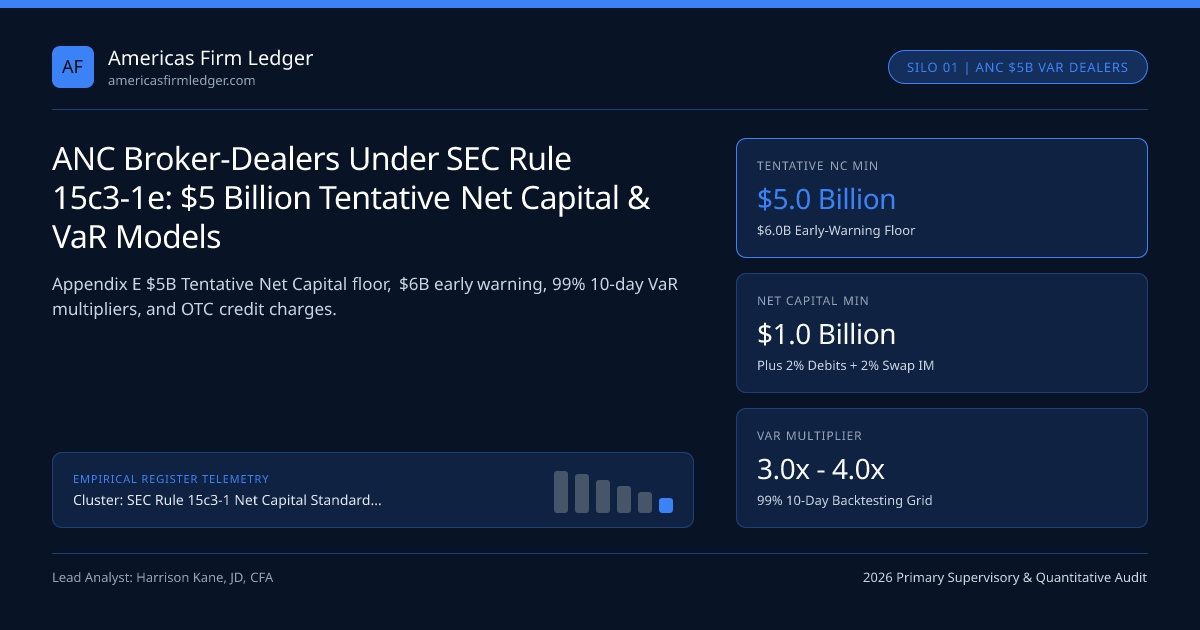
Under 17 CFR 240.15c3-1(a)(7) and Appendix E (Rule 15c3-1e), only a select cohort of bulge-bracket Wall Street institutions explicitly approved by order of the U.S. Securities and Exchange Commission—historically encompassing core U.S. broker-dealer subsidiaries of JPMorgan, Goldman Sachs, Morgan Stanley, Citigroup, Bank of America, Wells Fargo, and Barclays/BNP peers—may operate as Alternative Net Capital (ANC) broker-dealers. In exchange for permission to replace standardized 15% equity and maturity-bucket haircuts with Basel-aligned internal 99% 10-business-day Value-at-Risk (VaR) market-risk models and OTC derivatives credit-risk charges, an ANC broker-dealer must maintain at least $5,000,000,000 ($5 billion) in Tentative Net Capital, at least $1,000,000,000 ($1 billion) in Net Capital, and file immediate SEC early-warning notice if Tentative Net Capital ever dips below $6,000,000,000 ($6 billion).
This elite prudential tier sits at the institutional pinnacle of our SEC Rule 15c3-1 Net Capital institutional guide, contrasting sharply with standard Appendix A TIMS options arrays and aligning closely with standalone SBSD capital under Rule 18a-1.
Post-2008 Reforms & Current Dodd-Frank / Basel III Alignment#
Originally introduced in 2004 alongside the defunct Consolidated Supervised Entities (CSE) program, Rule 15c3-1e underwent sweeping post-2008 tightening—raising the statutory Tentative Net Capital floor fivefold from $1 billion to $5 billion (and early warning from $5B to $6 billion) under the SEC's 2019 Dodd-Frank Title VII Capital, Margin, and Segregation Final Rule (Release No. 34-86175). Today, every ANC U.S. broker-dealer is simultaneously consolidated inside a Federal Reserve-supervised Global Systemically Important Bank (G-SIB) or Intermediate Holding Company (IHC) filing public 10-K/FR Y-9C disclosures on SEC EDGAR Corporate Reporting and overseen by the Federal Reserve System.
Market-Risk VaR Multipliers & Backtesting Exceptions#
Under Appendix E paragraph (c), an ANC broker-dealer computes its market-risk deduction only for asset classes specifically approved by the SEC (any unapproved illiquid or exotic positions still revert to standard Rule 15c3-1 haircuts or 100% non-marketable deductions):
- 99% 10-Business-Day Value-at-Risk: Calculated daily using at least one year of historical market data, capturing interest rate, equity price, FX, commodity, and non-linear gamma/vega risks.
- Multiplication Factor (3.0x to 4.0x): Base VaR (and Stressed VaR where required by SEC order) is multiplied by a minimum factor of 3.00, escalating automatically up to 4.00 based on the number of daily backtesting exceptions (days when actual 1-day P&L loss exceeds 1-day 99% VaR) over the preceding 250 business days!
- Specific Risk Deduction: Captures issuer-specific jump-to-default and migration risk on corporate debt and single-name credit derivatives not captured by general market factor shifts.
| Backtesting Exceptions (Prior 250 Trading Days) | Traffic-Light Zone | Rule 15c3-1e(d)(1) VaR Multiplier | Capital Impact on $180M 10-Day VaR | Mandatory SEC Supervisory Action |
|---|---|---|---|---|
| 0 to 4 Exceptions | Green Zone (Expected 99% Tail) | 3.00x | $540,000,000 Deduction | Standard Monthly FOCUS Part II Supplemental VaR Report |
| 5 Exceptions | Yellow Zone (Model Drift) | 3.40x | $612,000,000 Deduction | Model calibration audit by SEC Office of Broker-Dealer Finances |
| 6 to 7 Exceptions | Yellow Zone (Elevated Drift) | 3.50x / 3.65x | $630M - $657M Deduction | Mandatory stress-scenario & correlation recalibration |
| 8 to 9 Exceptions | Yellow Zone (Severe Under-Prediction) | 3.75x / 3.85x | $675M - $693M Deduction | Potential revocation of specific desk VaR approval |
| 10 or More Exceptions | Red Zone (Model Failure) | 4.00x (Maximum) | $720,000,000 Deduction | Presumptive model deficiency; revert desk to standard haircuts |
OTC Derivatives Counterparty Credit Risk Under Appendix E#
Whereas non-ANC broker-dealers must deduct 100% of any uncollateralized mark-to-market receivable on an OTC swap as an unsecured non-allowable asset, Rule 15c3-1e(c)(3)–(4) permits an ANC firm (commonly dual-registered as a Security-Based Swap Dealer) to take a calibrated Credit Risk Charge instead:
- Counterparty Exposure Charge: Equals 8% multiplied by a counterparty credit risk-weight (20%, 50%, or 150% derived from internal probability-of-default ratings) multiplied by Maximum Potential Exposure (MPE) at 99% confidence net of legally enforceable ISDA Credit Support Annex (CSA) liquid collateral!
- Counterparty Concentration Charge: If net replacement value or MPE to any single counterparty exceeds 15% (or credit-tier thresholds) of the ANC dealer's Tentative Net Capital, steep concentration surcharges apply, alongside a portfolio concentration cap when aggregate credit exposure exceeds 50% of TNC.
- ANCCreditRiskCut = Sumi [ 0.08 * RiskWeighti * NetMPEi ] + CounterpartyConcentrationCharges
- ANCMinimumNC = max($1,000,000,000, (0.02 * Rule15c33Debits) + (0.02 * SBSDUnclearedSwapIM))
- Worked Wall Street ANC Broker-Dealer FOCUS Part II Snapshot:
- Tentative Net Capital (TNC) = $24,800,000,000 (> $6.0B Early-Warning Floor)
- 10-Day 99% General VaR ($210M * 3.00 Green Mult)= ($630,000,000)
- Stressed VaR & Specific Issuer Risk Charge = ($1,420,000,000)
- Standard Haircuts on Non-Model Inventory = ($390,000,000)
- Appendix E OTC Counterparty Credit Risk Charge = ($310,000,000)
- Actual Net Capital (NC) = $22,050,000,000
- Customer Rule 15c3-3 Aggregate Debit Items = $95,000,000,000 -> 2% = $1,900,000,000
- Uncleared Security-Based Swap Initial Margin = $18,000,000,000 -> 2% = $360,000,000
- Minimum Required NC = max($1.0B, $1.90B + $0.36B) = $2,260,000,000
- Excess Net Capital = $19,790,000,000
Institutional Capital Floors: Standard vs SBSD vs ANC#
Public Footnote Verification on SEC EDGAR#
Because every ANC broker-dealer files its annual audited Statement of Financial Condition (Form X-17A-5 Part III) publicly on EDGAR under PCAOB AS 2701, institutional credit officers can directly compare Tentative Net Capital, Net Capital, and Excess Net Capital across G-SIB broker-dealer entities (frequently $15B to $35B+ in Excess Net Capital each). Next, see how both mid-tier clearing firms and bulge-bracket dealers bolster regulatory capital using debt instruments in our deep dive on Appendix D subordinated loan agreements inside the SEC Rule 15c3-1 Topic Hub.
Frequently asked questions
Can a mid-sized quantitative broker-dealer elect ANC internal VaR models if it holds $50 million in capital?
No. Unlike the $250,000 Alternative Standard in Rule 15c3-1(a)(1)(ii), the ANC internal-model regime under Rule 15c3-1(a)(7) and Appendix E requires a formal Commission approval order and an absolute statutory floor of $5,000,000,000 in Tentative Net Capital.
How did Dodd-Frank Title VII modify the ANC minimum Net Capital formula?
For ANC broker-dealers also registered as Security-Based Swap Dealers (SBSDs) or handling cleared/uncleared security-based swaps, SEC Release 34-86175 added a 2% initial-margin risk factor alongside 2% of Rule 15c3-3 customer debit items above the $1 billion Net Capital floor.
What happens if an ANC broker-dealer's VaR model experiences 10 backtesting exceptions in 250 days?
Crossing 10 backtesting exceptions places the model in the Red Zone, escalating the VaR capital multiplier from 3.00x to the maximum 4.00x and authorizing the SEC to revoke internal-model approval for affected trading desks.
Are ANC broker-dealers exempt from SEC Rule 15c3-3 customer reserve lockups?
Never. ANC approval modifies only how market and credit risk haircuts are computed under Rule 15c3-1; every ANC carrying firm remains 100% subject to daily Rule 15c3-3 customer and PAB reserve computations and possession-or-control mandates.
Publication record
- Published
- November 14, 2026
- Updated
- November 14, 2026
- Author
- Harrison Kane, JD, CFA
- Review
- Review not recorded
- Automated fact check
- Passed in the stored pipeline record
- Source URLs
- 4 recorded
AI assistance recorded: anthropic/claude-opus-4.6. This field does not establish human review or source verification.
Academic & Institutional Attribution
Cite This Research & Embed Live Data Card
Standard academic & institutional research paper citation format.
Harrison Kane, JD, CFA. (2026, November 14). ANC Broker-Dealers Under SEC Rule 15c3-1e: $5 Billion Tentative Net Capital & VaR Models. Americas Firm Ledger. https://americasfirmledger.com/filings/sec-15c3-1e-alternative-net-capital-anc-5b-tentative-floorRegulatory Directory Cross-Reference
Referenced Institutions & Regulatory Registries
Top Regulated Institutions in This Coverage Slice
Related SEC Rule 15c3 1 Net Capital Haircuts & Institutional Briefings
Explore SEC Rule 15c3 1 Net Capital Haircuts Hub (20) →SEC Rule 15c3 1 Net Capital Haircuts
SEC Rule 15c3-1 Net Capital Standards, Haircuts & FOCUS Filings: Institutional GuideSEC Rule 15c3 1 Net Capital Haircuts
Appendix D Subordinated Loan Agreements & Revolving Subordinations Under FINRA Rule 4110SEC Rule 15c3 1 Net Capital Haircuts
Open Contractual Commitments & Firm-Commitment Underwriting Haircuts Under SEC Rule 15c3-1SEC Rule 15c3 1 Net Capital Haircuts
Repo & Reverse-Repo Net Capital Deficits and SEC FICC Treasury Clearing OffsetsSEC Rule 15c3 1 Net Capital Haircuts
SEC Rule 17a-11 Early Warning & Capital Deficiency Notices: 120%, 12:1 & 5% TriggersSEC Rule 15c3 1 Net Capital Haircuts
Equity Capital Withdrawal Restrictions & FINRA Rule 4110/4120 Expansion ControlsSEC Rule 15c3 1 Net Capital Haircuts
Form X-17A-5 FOCUS Report Part II vs Part IIA Line-by-Line Net Capital ReconciliationSEC Rule 15c3 1 Net Capital Haircuts
SEC Rule 17a-5 Annual Audits & PCAOB AS 2701 Net Capital Schedule AttestationSEC Rule 15c3 3 Customer Reserve Sipc
SEC Rule 15c3-3(k) Exemptions Explained: (k)(1), (k)(2)(i), (k)(2)(ii) & Footnote 74SEC Rule 15c3 3 Customer Reserve Sipc
SEC Rule 17a-5 Annual Broker-Dealer Audits: PCAOB AT-1 Compliance vs AT-2 Exemption ReportsSEC Rule 15c3 3 Customer Reserve Sipc
SIPC $500,000 Coverage & $250,000 Cash Sublimit: Separate Capacity Series 100-500 RulesSEC Rule 15c3 3 Customer Reserve Sipc
SIPA Broker-Dealer Liquidation Explained: Customer Property Pool, Net Equity & Transfers
Americas Firm Ledger Data, Benchmarks & Contributor Records
CC BY 4.0 Open Data
Open Institutional Datasets (CSV / JSON) →
Download desk-compiled quantitative series & schemas.
2026 Reference Matrix
2026 Institutional Benchmarks & Thresholds →
Statutory capital, clearing, margin & rate conventions.
Editorial Records
Authors & Review Records →
View named contributors where those records are available.
Complete Index
Master Research & Dossier Archive →
Browse all published briefings by topic pillar & date.