
SEC Rule 15c3 1 Net Capital Haircuts
SEC Rule 15c3-1 Net Capital Standards, Haircuts & FOCUS Filings: Institutional Guide
Registered US broker-dealers governed by SEC Rule 15c3-1 must maintain liquid net capital above statutory dollar floors ($5,000 to $5 billion), cap aggregate indebtedness at 15:1 or hold 2% of customer debit items, and reconcile proprietary haircuts monthly on FINRA Form X-17A-5 FOCUS filings.
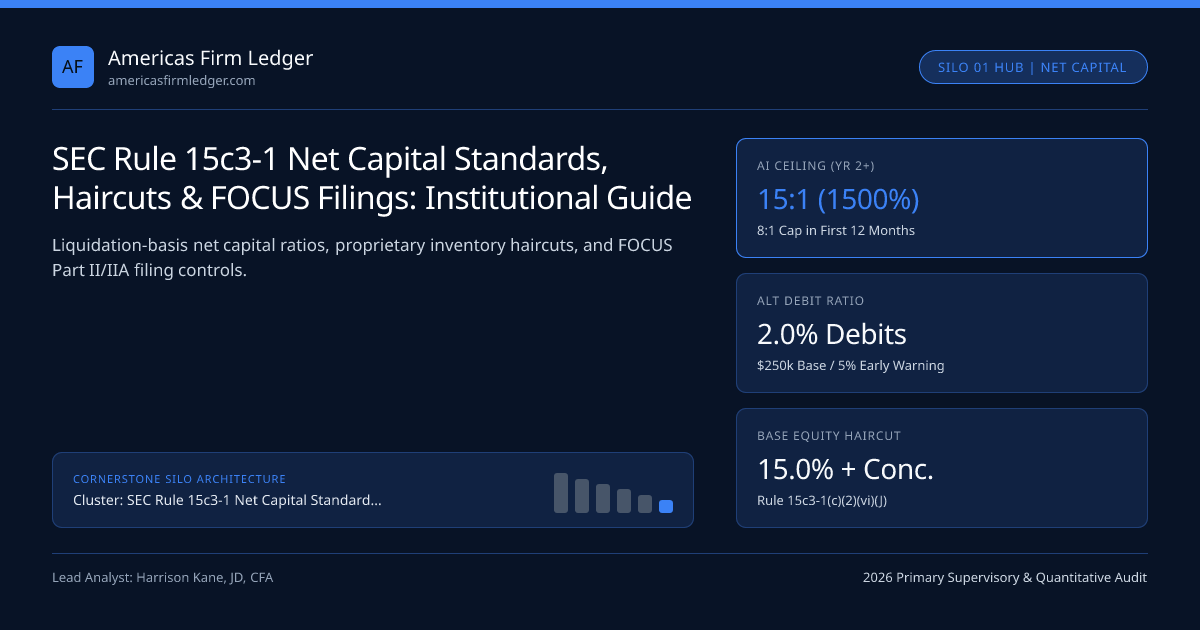
17 CFR 240.15c3-1 requires every broker-dealer registered with the U.S. Securities and Exchange Commission to maintain continuous, moment-to-moment liquid net capital sufficient to wind down customer and street-side obligations without judicial reorganization. Rather than measuring long-term solvency like Basel III bank Risk-Weighted Assets, the SEC Rule 15c3-1 Net Capital Standard enforces a conservative liquidation test: GAAP stockholders' equity is adjusted upward only for FINRA-approved subordinated debt, stripped of 100% of illiquid non-allowable assets, and reduced by security-specific market and concentration haircuts before comparison against either the 15-to-1 Aggregate Indebtedness ceiling or the 2% Alternative Standard.
Across the SECRule 15c3-1 Net Capital & FOCUS Topic Hub, institutional compliance teams, clearing treasury officers, and counterparty credit committees track five interlocking capital gates: base dollar floors, aggregate indebtedness vs debit-item ratios, non-allowable balance-sheet deductions, proprietary securities haircuts, and automated early-warning freezes under SEC Rule 17a-11 and FINRA Rules 4110 and 4120.
Statutory Architecture of Liquidation-Basis Net Capital#
Unlike commercial holding companies reporting consolidated GAAP equity via the SEC EDGAR Corporate Reporting System, a standalone broker-dealer computes net capital every business day on an unconsolidated, liquid-asset basis. If a firm slips below its minimum net capital requirement for even ten minutes during an intraday underwriting allotment or Treasury auction settlement spike, Rule 15c3-1(a) mandates immediate suspension of securities business and same-day telegraphic notice to Washington and the firm's Designated Examining Authority (DEA).
The computational waterfall moves through four sequential stages on Form X-17A-5:
- Ownership Equity Plus Allowable Subordinated Liabilities: Start with GAAP common stock, paid-in capital, and retained earnings, then add qualifying subordinated loans approved by FINRA under Appendix D (subordinated loan mechanics).
- Non-Allowable Asset & Operational Charge Deductions: Deduct 100% of fixed furniture, real estate, goodwill, exchange memberships, prepaid software licenses, and unsecured receivables (non-allowable asset rules), alongside aged clearing fails and fidelity-bond deductibles, yielding Tentative Net Capital (TNC).
- Proprietary Haircuts & Concentration Penalties: Subtract statutory percentages from marketable debt, equities, options, and underwriting commitments—such as the 15% base equity haircut (equity proprietary haircuts), maturity-bucket sovereign scales (Treasury & agency debt haircuts), and 10% TNC undue concentration charges (undue concentration add-ons)—producing Net Capital.
- Minimum Requirement & Excess Net Capital: Subtract the greater of the firm's fixed-dollar floor (minimum dollar capital tiers) or its elected ratio test to determine Excess Net Capital.
Aggregate Indebtedness vs Alternative & ANC Capital Regimes#
Newly chartered introducing firms default to the Aggregate Indebtedness (AI) Standard under Rule 15c3-1(a)(1)(i): AI cannot exceed 800% (8:1) of Net Capital in year one (15:1 vs 8:1 AI mechanics) and 1,500% (15:1) starting month 13. Self-clearing firms and custodial platforms—comparable in architecture to Axos Invest alongside SEC-supervised asset managers like Bitwise (801-122073)—elect the Alternative Standard under Rule 15c3-1(a)(1)(ii): greater of $250,000 or 2% of Aggregate Debit Items (2% debit-item alternative standard). Global dealers approved for VaR models under Rule 15c3-1e hold $5B Tentative Net Capital and $1B Net Capital (ANC $5B tentative floor), while swap dealers follow Rule 18a-1 SBSD capital.
| Broker-Dealer Cohort | 17 CFR Citation | Dollar Floor | Ratio Formula | Rule 17a-11 Early Warning | Registry Reference |
|---|---|---|---|---|---|
| Introducing BD (No Custody) | 240.15c3-1(a)(2)(vi) | $5,000 | 1/8 AI (Yr 1) or 1/15 AI (Yr 2+) | NC < $6,000 or AI > 12:1 | FINRA / SEC |
| Omnibus Introducing BD | 240.15c3-1(a)(2)(iv) | $50,000 | Max($50k, 6.67% AI) | NC < $60,000 or AI > 1,200% | FINRA Rule 4210 |
| Dealer / Underwriter | 240.15c3-1(a)(2)(iii) | $100,000 | Max($100k, 6.67% AI) | NC < $120,000 or AI > 1,200% | ABT Capital Markets |
| Carrying BD (Alt Standard) | 240.15c3-1(a)(1)(ii) | $250,000 | Max($250k, 2% Debits) | NC < 5% Customer Debits | Axos Invest |
| Internal-Model ANC Dealer | 240.15c3-1(a)(7) | $1,000,000,000 | $5B Tentative NC | TNC < $6,000,000,000 | PCAOB Standard |
Quantitative Net Capital & Haircut Stress Equation#
Series 27 FinOps model intraday capacity before funding repo books (repo deficit & FICC clearing charges) or firm-commitment syndicates (underwriting open contractual commitments):
- Net Capital (NC) = TNC - Sum(StandardHaircuts) - UndueConcentrationCharges - BlockageDeductions
- ExcessNetCapital = NC - max(DollarFloor, ElectedRatio_Requirement)
- Worked Carrying Broker-Dealer Calculation (Alternative Standard):
- GAAP Equity ($84.0M) + Approved Sub Debt ($30.0M) - Non-Allowable & Fails ($22.0M) = TNC $92,000,000
- Less Haircuts: UST 3% ($4.80M) + Equity ($11.25M) + Undue Conc. ($1.92M) = NC $74,030,000
- Aggregate Customer Debits = $1,850,000,000 -> Min Required NC (2%) = $37,000,000
- Rule 17a-11 Early Warning (5% * $1.85B = $92.50M) -> TRIGGERED ($74.03M < $92.50M!); Excess = $37,030,000
Even with $37.03M in Excess Net Capital, Net Capital ($74.03M) sits below 5% of Aggregate Debit Items ($92.50M)—tripping Rule 17a-11 early-warning notices and freezing equity withdrawals under FINRA capital withdrawal gates.
Proprietary Haircut Schedules Across Asset Classes#
Rule 15c3-1(c)(2)(vi) assigns deterministic liquidation discounts across proprietary inventory:
- Sovereign, Municipal & Corporate Debt: Zero percent under 3 months up to 6.0% on 25+ year Treasuries; 1%–7% on municipals and 2%–9% on NRSRO investment-grade corporate bonds (municipal & corporate bond haircuts).
- Equities, Options & Restricted Stock: 15% on greater long/short equity plus 15% above a 25% offset; OCC TIMS shocks on options (Appendix A option pricing haircuts); and 100% on SEC Regulation D or thin-quote tickers (non-marketable 100% blockage rules).
FOCUS Filings, Annual PCAOB Attestation & Cross-Registry Verification#
Every broker-dealer operationalizes Rule 15c3-1 through electronic Form X-17A-5 (FOCUS Report) submissions via FINRA eFOCUS within 17 business days after month-end or quarter-end (FOCUS Part II vs Part IIA reconciliation). Clearing and carrying firms submit the comprehensive FOCUS Part II monthly, whereas non-carrying introducing firms submit the streamlined FOCUS Part IIA quarterly.
Within 60 calendar days after fiscal year-end, SEC Rule 17a-5(d) requires every active registrant to file an annual financial report on EDGAR—recoverable through SEC EDGAR Registry lookups and our institutional verification portal—audited by an independent public accounting firm registered with the PCAOB. Under PCAOB Auditing Standard AS 2701, the external auditor must perform direct substantive testing on the Computation of Net Capital supplemental schedule and explicitly report any material inadequacies or reconciling differences between the firm's unaudited Q4 FOCUS filing and the audited year-end Net Capital schedule. Institutional counterparties benchmarking North American registrants on our prudential benchmarks matrix should always inspect Note 3/Note 4 (Net Capital Requirements) of a broker-dealer's public Statement of Financial Condition (Form X-17A-5 Part III) to verify real Excess Net Capital buffers relative to Rule 17a-11 early-warning lines.
Frequently asked questions
What happens if a broker-dealer falls below its SEC Rule 15c3-1 minimum net capital intraday?
Compliance with SEC Rule 15c3-1 is continuous, not merely end-of-day. A broker-dealer that drops below its required Net Capital intraday must immediately halt soliciting or executing proprietary and customer securities transactions (except liquidating unwinds) and transmit same-day Rule 17a-11(b)(1) deficiency notice to the SEC and FINRA.
How does Tentative Net Capital differ from Net Capital on a FOCUS Report?
Tentative Net Capital equals GAAP ownership equity plus FINRA-approved Appendix D subordinated loans minus 100% of non-allowable assets (such as goodwill, fixed equipment, prepaids, and unsecured receivables) and operational charges. Net Capital is the remaining balance after subtracting proprietary market haircuts and undue concentration charges.
When should a broker-dealer elect the 2% Alternative Net Capital Standard over Aggregate Indebtedness?
Clearing and prime brokerage firms with heavy street-side payables, stock-loan balances, and repo liabilities elect the Alternative Standard under Rule 15c3-1(a)(1)(ii) because customer-related debit items scale far more predictably at a 2% charge ($250,000 minimum) than paying a 6.67% (1/15) charge on unsubordinated operating liabilities.
Are annual broker-dealer Net Capital computations publicly accessible on SEC EDGAR?
Broker-dealers may request confidential treatment for income statements and supplemental schedules under Rule 17a-5(e)(3), but the audited Statement of Financial Condition (Form X-17A-5 Part III) and its Net Capital footnote—disclosing actual Net Capital, Required Net Capital, and Excess Net Capital—are public on SEC EDGAR.
Publication record
- Published
- November 14, 2026
- Updated
- November 14, 2026
- Author
- Harrison Kane, JD, CFA
- Review
- Review not recorded
- Automated fact check
- Passed in the stored pipeline record
- Source URLs
- 4 recorded
AI assistance recorded: anthropic/claude-opus-4.6. This field does not establish human review or source verification.
Academic & Institutional Attribution
Cite This Research & Embed Live Data Card
Standard academic & institutional research paper citation format.
Harrison Kane, JD, CFA. (2026, November 14). SEC Rule 15c3-1 Net Capital Standards, Haircuts & FOCUS Filings: Institutional Guide. Americas Firm Ledger. https://americasfirmledger.com/filings/sec-rule-15c3-1-net-capital-haircuts-focus-filing-guideRegulatory Directory Cross-Reference
Referenced Institutions & Regulatory Registries
Mentioned Regulated Institutions
Referenced Supervisory Authorities
Related SEC Rule 15c3 1 Net Capital Haircuts & Institutional Briefings
Explore SEC Rule 15c3 1 Net Capital Haircuts Hub (20) →SEC Rule 15c3 1 Net Capital Haircuts
Aggregate Indebtedness 15:1 vs 8:1 First-Year Ratio Mechanics Under SEC Rule 15c3-1SEC Rule 15c3 1 Net Capital Haircuts
Alternative Net Capital Standard: $250,000 Floor vs 2% of Rule 15c3-3 Debit ItemsSEC Rule 15c3 1 Net Capital Haircuts
SEC Rule 15c3-1 Minimum Dollar Net Capital Tiers: $5k, $50k, $100k, $250k & $1M FloorsSEC Rule 15c3 1 Net Capital Haircuts
Non-Allowable Assets Under SEC Rule 15c3-1(c)(2)(iv): Prepaids, Fixed Assets & ReceivablesSEC Rule 15c3 1 Net Capital Haircuts
Equity Proprietary Position Haircuts (15% Long/Short & 25% Offset) Under SEC Rule 15c3-1SEC Rule 15c3 1 Net Capital Haircuts
U.S. Treasury & Government Agency Debt Haircut Maturity Buckets Under SEC Rule 15c3-1SEC Rule 15c3 1 Net Capital Haircuts
Municipal Securities & Investment-Grade Corporate Bond Haircuts Under SEC Rule 15c3-1SEC Rule 15c3 1 Net Capital Haircuts
Undue Concentration Add-On Haircuts Under SEC Rule 15c3-1(c)(2)(vi)(M): 10% TNC RulesSEC Rule 15c3 3 Customer Reserve Sipc
SEC Rule 15c3-3 Customer Protection, Reserve Formula & SIPC Limits: Institutional GuideFinra Brokercheck Form Bd Crs Filings
Form BD, Form CRS, FINRA BrokerCheck & CAT Supervision: Institutional Filing GuideCFTC Nfa Fcm Segregated Residual Interest
CFTC & NFA FCM Customer Segregation, Residual Interest & RFED Capital: Institutional GuideCiro Csa Canadian Investment Dealers
Canadian CIRO (IIROC) Dealer Rules, Form 1 RAC & CIPF Regulatory Filings Guide
Americas Firm Ledger Data, Benchmarks & Contributor Records
CC BY 4.0 Open Data
Open Institutional Datasets (CSV / JSON) →
Download desk-compiled quantitative series & schemas.
2026 Reference Matrix
2026 Institutional Benchmarks & Thresholds →
Statutory capital, clearing, margin & rate conventions.
Editorial Records
Authors & Review Records →
View named contributors where those records are available.
Complete Index
Master Research & Dossier Archive →
Browse all published briefings by topic pillar & date.