
SEC Rule 15c3 1 Net Capital Haircuts
Equity Capital Withdrawal Restrictions & FINRA Rule 4110/4120 Expansion Controls
SEC Rule 15c3-1(e) and FINRA Rule 4110(c) prohibit broker-dealers from paying parent dividends or unsecured insider advances without 2-business-day SEC/FINRA prior notice above 30% of Excess Net Capital.
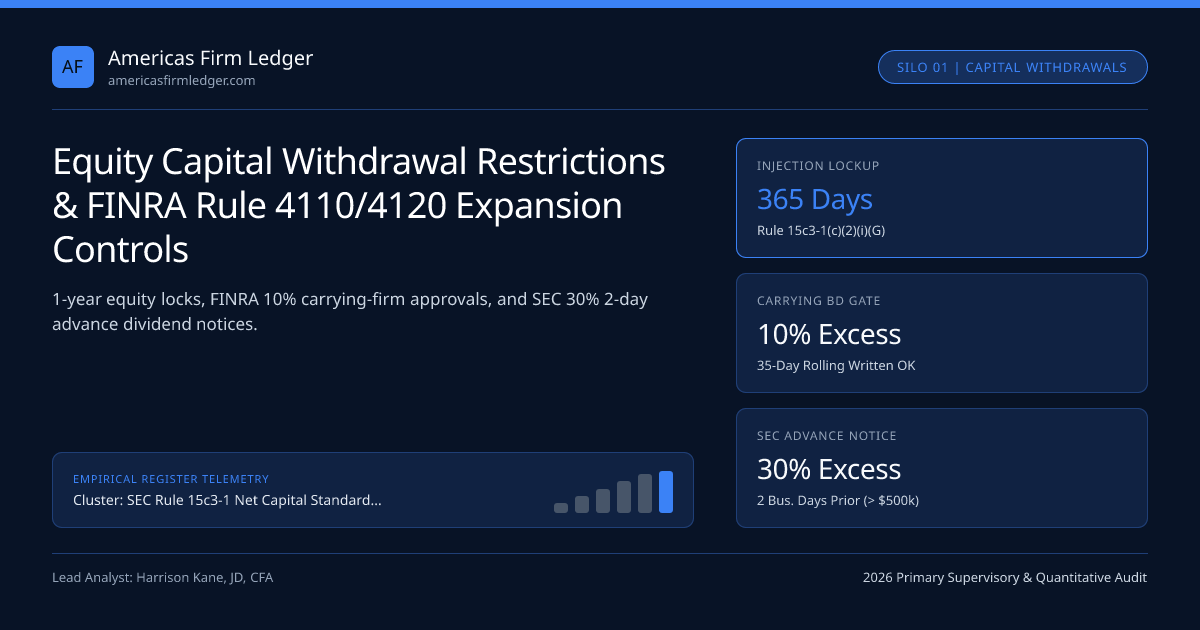
Corporate treasurers accustomed to sweeping subsidiary cash freely up to a Delaware parent holding company collide head-on with three overlapping locks inside 17 CFR 240.15c3-1 and the FINRA Financial Responsibility Rules: (1) 1-Year Permanent Equity Presumption under Rule 15c3-1(c)(2)(i)(G), barring withdrawal of any paid-in equity contribution within 365 days without written DEA permission; (2) Prior Written FINRA Approval above 10% of Excess Net Capital in any rolling 35-day window for carrying/clearing firms under FINRA Rule 4110(c)(2); and (3) 2-Business-Day Prior SEC & FINRA Notice above 30% of Excess Net Capital (if >$500,000) in any rolling 30-day window under SEC Rule 15c3-1(e)(1)—alongside an absolute statutory ban if post-withdrawal capital breaches 120% of minimum dollar capital, 10:1 Aggregate Indebtedness, or 5% of customer debits!
These cash-ringfencing gates protect customer and counterparty claims across our SEC Rule 15c3-1 Net Capital institutional guide, reinforcing Rule 17a-11 early-warning notices and FOCUS Part II/IIA monthly reconciliations.
What Counts as an "Equity Capital Withdrawal" Under Rule 15c3-1(e)?#
Crucially, Rule 15c3-1(e)(4) defines an equity withdrawal far broader than formal corporate dividends or LLC partner tax distributions. All of the following transactions by a stockholder, partner, sole proprietor, employee, or corporate parent/sister affiliate are aggregated together across rolling 30-day (SEC) and 35-day (FINRA) windows:
- Cash dividends, stock redemptions, or partnership capital withdrawals;
- Unsecured loans or cash advances made by the broker-dealer to any parent, sister subsidiary, officer, or stockholder (because unsecured affiliate advances immediately become 100% non-allowable assets, draining Net Capital identically to a dividend!); and
- Forgiveness of insider/affiliate debts owed to the broker-dealer.
Only bona fide recurring reimbursements of actual expenses already incurred under a written FINRA Notice 03-63 expense-sharing agreement (or loans 100% collateralized by liquid marketable securities after haircuts) escape treatment as an equity withdrawal!
The "Temporary Equity Injection" Trap — Rule 15c3-1(c)(2)(i)(G)#
Suppose a broker-dealer's parent company wires $5,000,000 as paid-in capital on March 28 to cushion a quarter-end trading haircut, intending to dividend that $5,000,000 back out on April 4. Under Rule 15c3-1(c)(2)(i)(G), any equity capital contributed to a broker-dealer and withdrawn within one year of contribution (unless approved in writing in advance by FINRA!) is presumed to have been a temporary debt liability all along!
If FINRA discovers an unapproved round-trip capital injection and withdrawal inside 12 months, FINRA retroactively strips the $5,000,000 out of equity and adds $5,000,000 into Aggregate Indebtedness for every day between March 28 and April 4—often turning the firm's March 31 FOCUS Report into a massive net capital violation!
| Regulatory Gate / Provision | Covered Firms | Rolling Lookback Window | Trigger Threshold | Required Regulatory Action | Emergency Freeze Power |
|---|---|---|---|---|---|
| Rule 15c3-1(c)(2)(i)(G) Lock | All Broker-Dealers | 365 Days From Injection | Any withdrawal of injected paid-in equity | Prior written DEA (FINRA) approval | Retroactive reclassification as AI debt |
| FINRA Rule 4110(c)(2) | Carrying / Clearing BDs | 35 Calendar Days | Net withdrawals > 10% of Excess NC | Prior written FINRA approval before wire | Immediate disciplinary & restitution order |
| SEC Rule 15c3-1(e)(1) Notice | All BDs (Withdrawal > $500k) | 30 Calendar Days | Net withdrawals > 30% of Excess NC | 2 Business Days prior notice to SEC & FINRA | SEC Rule 15c3-1(e)(3) 20-Day Freeze Order |
| Post-Withdrawal Hard Ban | All Broker-Dealers | Instantaneous Post-Wire | NC < 120% Floor (or <125% certain), AI > 10:1, Alt < 5% Debits | Strictly Prohibited (Zero exceptions) | Same-day violation & mandatory clawback |
| FINRA Rule 4120 Expansion/Reduction | All FINRA Member BDs | Continuous / 15 Bus. Days | AI > 10:1, NC < 150% Floor, or Alt < 5% (4% Reduce) | Halt new hires/branches; contract at 4% | Summary FINRA Rule 9557 suspension |
Quantitative Dividend Sizing Model (Carrying vs Non-Carrying Broker-Dealer)#
Note a critical arithmetic nuance in SEC Rule 15c3-1(e)(4)(iv): when testing whether a proposed dividend exceeds 30% of Excess Net Capital (or FINRA's 10% carrying-firm gate), Excess Net Capital is calculated AFTER deducting the proposed withdrawal itself! That makes the algebraic maximum without triggering the 30% notice equal to $0.30 / 1.30 = 23.0769%$ of pre-withdrawal Excess Net Capital!
- SEC30PctTest: WithdrawalW > 0.30 * PostWithdrawalExcessNC <=> W > (0.30 / 1.30) * PreWithdrawalExcessNC
- FINRA10PctTest: WithdrawalW > 0.10 * PostWithdrawalExcessNC <=> W > (0.10 / 1.10) * PreWithdrawalExcessNC
- Worked Dividend Capacity Audit (Carrying Broker-Dealer, Alternative Standard):
- Current Net Capital (All Equity > 1 Year Old) = $42,000,000
- Rule 15c3-3 Aggregate Customer Debit Items = $500,000,000
- Minimum Required NC (2% * $500M) = $10,000,000
- Pre-Withdrawal Excess Net Capital = $32,000,000
- 1. Absolute Rule 15c3-1(e)(2) 5% Debit Ban Ceiling:
- Post-Withdrawal NC must stay >= 5% * $500M = $25,000,000
- Absolute Maximum Legal Dividend = $42,000,000 - $25,000,000 = $17,000,000
- 2. Maximum Dividend WITHOUT Prior Written FINRA Rule 4110(c)(2) Approval (10% Gate):
- Wmaxno_FINRA = (0.10 / 1.10) * $32,000,000 = $2,909,090
- (Check: Post-wire Excess NC = $29,090,910; 10% = $2,909,091 -> Compliant!)
- 3. Threshold Triggering 2-Business-Day SEC Rule 15c3-1(e)(1) Notice (30% Gate):
- WtriggerSEC = (0.30 / 1.30) * $32,000,000 = $7,384,615 (Also requires written FINRA OK!)
Dividend Authorization Tiers ($32M Pre-Wire Excess NC)#
FINRA Rule 4120 Business Expansion & Contraction Powers#
Beyond restricting dividends, FINRA Rule 4120 empowers FINRA to freeze a broker-dealer's growth whenever capital thins—specifically if AI exceeds 1,000% (10:1), Net Capital falls below 150% of its minimum dollar requirement (for certain dealers), or Alternative Net Capital falls below 5% of Aggregate Debit Items for 15 consecutive business days. Under an expansion restriction, the firm cannot open branch offices, hire additional registered reps, underwrite firm-commitment deals, or expand market-making tickers; if ratios deteriorate further (AI > 1,200% or Alt NC < 4% of debits for 15 business days), Rule 4120(c) compels active business contraction. Next, trace every line item where these ratios are reported in Form X-17A-5 FOCUS Part II vs Part IIA reconciliation inside the SEC Rule 15c3-1 Topic Hub.
Frequently asked questions
Why did our dividend trigger the 30% SEC Rule 15c3-1(e) notice when we only withdrew 25% of Excess Net Capital?
Because Rule 15c3-1(e)(4)(iv) measures the 30% threshold against Excess Net Capital remaining AFTER deducting the scheduled withdrawal! Algebraically, 30% of post-withdrawal Excess Net Capital equals 23.08% (0.30 / 1.30) of pre-withdrawal Excess Net Capital.
Can an LLC broker-dealer distribute quarterly partner tax payments if Net Capital sits at 4.8% of Aggregate Debit Items?
No! Under Rule 15c3-1(e)(2)(vi), all equity withdrawals—including mandatory LLC operating-agreement tax distributions—are strictly prohibited whenever post-withdrawal Net Capital would be less than 5% of Rule 15c3-3 Aggregate Debit Items.
Does paying our parent company monthly rent under an expense-sharing agreement count as an equity withdrawal?
Reimbursing actual, documented operating expenses already incurred under a compliant FINRA Notice 03-63 expense-sharing agreement does not constitute an equity withdrawal; however, prepaying future months' parent expenses creates an unsecured parent advance that DOES count!
Can the SEC block a dividend even if the broker-dealer remains above all statutory ratios after the wire?
Yes. Under SEC Rule 15c3-1(e)(3), the Commission (and FINRA under Rule 4110) may issue an emergency order restricting withdrawals for up to 20 business days if it concludes the withdrawal may impair the firm's ability to settle obligations or protect customers.
Publication record
- Published
- November 14, 2026
- Updated
- November 14, 2026
- Author
- Harrison Kane, JD, CFA
- Review
- Review not recorded
- Automated fact check
- Passed in the stored pipeline record
- Source URLs
- 4 recorded
AI assistance recorded: anthropic/claude-opus-4.6. This field does not establish human review or source verification.
Academic & Institutional Attribution
Cite This Research & Embed Live Data Card
Standard academic & institutional research paper citation format.
Harrison Kane, JD, CFA. (2026, November 14). Equity Capital Withdrawal Restrictions & FINRA Rule 4110/4120 Expansion Controls. Americas Firm Ledger. https://americasfirmledger.com/filings/finra-rule-4120-capital-withdrawal-notices-insider-locksRegulatory Directory Cross-Reference
Referenced Institutions & Regulatory Registries
Top Regulated Institutions in This Coverage Slice
Related SEC Rule 15c3 1 Net Capital Haircuts & Institutional Briefings
Explore SEC Rule 15c3 1 Net Capital Haircuts Hub (20) →SEC Rule 15c3 1 Net Capital Haircuts
SEC Rule 15c3-1 Net Capital Standards, Haircuts & FOCUS Filings: Institutional GuideSEC Rule 15c3 1 Net Capital Haircuts
Form X-17A-5 FOCUS Report Part II vs Part IIA Line-by-Line Net Capital ReconciliationSEC Rule 15c3 1 Net Capital Haircuts
SEC Rule 17a-5 Annual Audits & PCAOB AS 2701 Net Capital Schedule AttestationSEC Rule 15c3 1 Net Capital Haircuts
Standalone Security-Based Swap Dealer (SBSD) Net Capital Under SEC Rule 18a-1SEC Rule 15c3 1 Net Capital Haircuts
Aggregate Indebtedness 15:1 vs 8:1 First-Year Ratio Mechanics Under SEC Rule 15c3-1SEC Rule 15c3 1 Net Capital Haircuts
Alternative Net Capital Standard: $250,000 Floor vs 2% of Rule 15c3-3 Debit ItemsSEC Rule 15c3 1 Net Capital Haircuts
SEC Rule 15c3-1 Minimum Dollar Net Capital Tiers: $5k, $50k, $100k, $250k & $1M FloorsSEC Rule 15c3 1 Net Capital Haircuts
Non-Allowable Assets Under SEC Rule 15c3-1(c)(2)(iv): Prepaids, Fixed Assets & ReceivablesSEC Rule 15c3 3 Customer Reserve Sipc
SEC Special Purpose Broker-Dealers (SPBDs): Rule 15c3-3 Digital Asset Custody & SIPASEC Rule 15c3 3 Customer Reserve Sipc
FINRA Rule 4311 Carrying Agreements: Fully Disclosed vs Omnibus Clearing & SIPA PrioritySEC Rule 15c3 3 Customer Reserve Sipc
Hypothecation of Customer Securities Under SEC Rules 8c-1 & 15c2-1: Three Anti-Commingling BansFinra Brokercheck Form Bd Crs Filings
SEC & FINRA Form BD Ownership Disclosures: Schedules A, B & C Beneficial Control Codes
Americas Firm Ledger Data, Benchmarks & Contributor Records
CC BY 4.0 Open Data
Open Institutional Datasets (CSV / JSON) →
Download desk-compiled quantitative series & schemas.
2026 Reference Matrix
2026 Institutional Benchmarks & Thresholds →
Statutory capital, clearing, margin & rate conventions.
Editorial Records
Authors & Review Records →
View named contributors where those records are available.
Complete Index
Master Research & Dossier Archive →
Browse all published briefings by topic pillar & date.