
SEC Rule 15c3 1 Net Capital Haircuts
U.S. Treasury & Government Agency Debt Haircut Maturity Buckets Under SEC Rule 15c3-1
SEC Rule 15c3-1(c)(2)(vi)(A) segments U.S. Treasury bills, notes, bonds, STRIPS, and federal agency securities into 4 maturity categories and 12 subcategories carrying net haircuts from 0% (<3 months) up to 6.0% (25+ years), with zero undue concentration penalties.
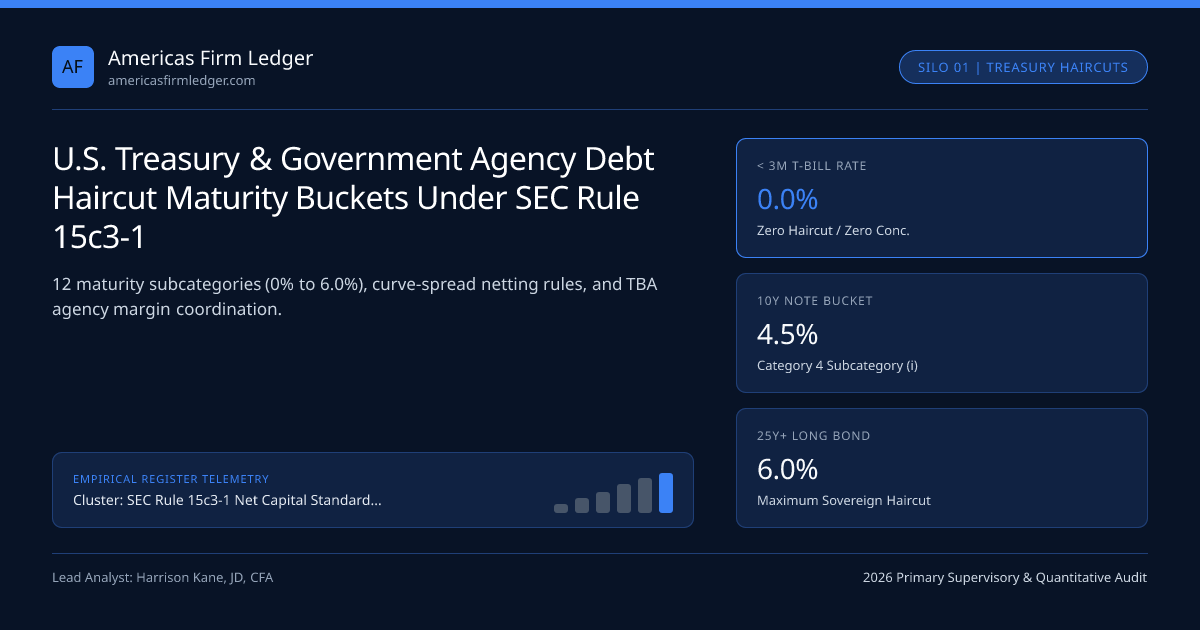
Under 17 CFR 240.15c3-1(c)(2)(vi)(A), securities issued or unconditionally guaranteed as to principal and interest by the United States Government or federal agencies carry zero default/undue-concentration surcharges and instead incur duration-calibrated interest-rate haircuts scaling across four broad Categories and twelve maturity Subcategories—rising from 0% for Treasury bills maturing in less than 3 months to 3.0% in the 3-to-5-year belly, 4.5% for 10-year benchmark notes, and 6.0% for 25-year+ long bonds and zero-coupon STRIPS. Primary dealers reporting to the Federal Reserve System and institutional fixed-income broker-dealers rely on Paragraph (A)'s intra-category and inter-category netting rules to carry multibillion-dollar sovereign yield-curve books on a fraction of the capital required for equities.
This sovereign haircut matrix sits inside our SEC Rule 15c3-1 Net Capital institutional guide, complementing equity proprietary inventory haircuts and municipal & corporate bond scales.
The Complete 12-Subcategory Treasury & Agency Haircut Schedule#
Paragraph (A)(1) groups proprietary long and short U.S. Treasury bills, notes, bonds, TIPS, and qualifying GSE/agency debentures (Fannie Mae, Freddie Mac, Ginnie Mae, Federal Home Loan Banks) by remaining time to maturity (or time to next reset for variable-rate notes trading near par). Zero-coupon U.S. Treasury STRIPS with 5 or more years to maturity are shifted upward in effective duration risk—taking the full 6.0% Category 4 long-bond rate once maturity reaches 20+ years and elevated subcategory placement below 20 years because they lack interim coupon cash flows.
| Category & Subcategory | Remaining Time to Maturity | Net Position Haircut (%) | Intra-Category Offset (Other Subcategories) | Inter-Category Hedging Offset Rule | Undue Concentration Charge? |
|---|---|---|---|---|---|
| Cat 1: Sub (i) / (ii) / (iii) | <3 mos / 3-6 mos / 6-9 mos | 0.0% / 0.5% / 0.75% | Net within Subcategory; 50% across Cat 1 | Allowed vs Cat 2 (Adjacent) | Exempt (0%) |
| Cat 1: Sub (iv) | 9 months to < 12 months | 1.0% | 50% offset across Cat 1 Subcategories | Allowed vs Cat 2 (Adjacent) | Exempt (0%) |
| Cat 2: Sub (i) / (ii) | 1 yr to < 2 yrs / 2 yrs to < 3 yrs | 1.5% / 2.0% | 50% of lesser net position across Cat 2 | 50% residual offset vs Cat 1 or Cat 3 | Exempt (0%) |
| Cat 3: Sub (i) / (ii) | 3 yrs to < 5 yrs / 5 yrs to < 10 yrs | 3.0% / 4.0% | 50% of lesser net position across Cat 3 | 50% residual offset vs Cat 2 or Cat 4 | Exempt (0%) |
| Cat 4: Sub (i) / (ii) | 10 yrs to < 15 yrs / 15 yrs to < 20 yrs | 4.5% / 5.0% | 50% of lesser net position across Cat 4 | 50% residual offset vs Cat 3; 1/3 Cat 2-4 | Exempt (0%) |
| Cat 4: Sub (iii) / (iv) | 20 yrs to < 25 yrs / 25 years or more | 5.5% / 6.0% | 50% of lesser net position across Cat 4 | Non-adjacent Cat 1 vs Cat 3/4 = 0% offset | Exempt (0%) |
How Curve-Steepener & Butterfly Hedging Offsets Work#
Fixed-income desks at FINRA member firms routinely trade 2s10s or 5s30s yield-curve flatteners and Treasury futures basis trades (linking CBOT Treasury futures inside Paragraph (A)(3) directly into the matching maturity subcategory of the deliverable cash Treasury basket!). Under Paragraph (A)(2), SEC Rule 15c3-1 grants structured curve-spread relief rather than charging full gross haircuts on both legs:
- Within the Same Subcategory (100% Netting): $200M long on-the-run 10-year notes (9.9 years remaining, Cat 3 Sub ii) and $190M short off-the-run 8-year notes (Cat 3 Sub ii) net directly to $10M net long, incurring $4.0% imes $10 ext{M} = $400,000$.
- Within the Same Category Across Subcategories (50% Offset): If the desk is net long $100M in Cat 4 Sub (i) (10–15Y, 4.5%) and net short $80M in Cat 4 Sub (iv) (25Y+, 6.0%), the $80M opposite-side balance offsets $80M of the long leg by 50%—leaving $40M of Cat 4 Sub (i) and $40M of Cat 4 Sub (iv) discarded from the hedged pair, plus the $20M unhedged long remainder!
- Across Adjacent Categories: Remaining net long exposure in Category 3 (3–10Y) can be partially offset against net short exposure in Category 4 (10Y+) or Category 2 (1–3Y), whereas extreme barbell mismatches (Category 1 T-bills vs Category 4 30-year bonds) receive zero hedging offset because short-rate policy pivots and long-end term premia frequently decouple.
Quantitative Worked Model: 5s30s Curve Trade + T-Bill Liquidity Reserve#
Let us compute the exact Net Capital haircut for a regional fixed-income dealer carrying $150M in 2-month Treasury bills as treasury liquidity alongside a duration-weighted $120M Long 5Y / $60M Short 30Y Treasury curve-steepener:
- IntraCatHedgedPairCut = 0.50 * (RateLong * MatchedMV + RateShort * MatchedMV) [or 50% MV Retention]
- UnhedgedResidualCut = RateResidual * UnmatchedMV
- Worked Sovereign Book Audit:
- 1. Cash Reserve: $150,000,000 Long 2-Month US T-Bills (Cat 1, Sub i: <3 mos)
- Haircut Rate = 0.0% -> Haircut = $0
- 2. Curve Belly: $120,000,000 Long 6-Year US Treasury Notes (Cat 3, Sub ii: 5-10 yrs, 4.0% Rate)
- Long Bond: $60,000,000 Short 29-Year US Treasury Bonds (Cat 4, Sub iv: 25+ yrs, 6.0% Rate)
- Without Adjacent-Category Hedging Relief (Gross Sum):
- ($120M * 4.0%) + ($60M * 6.0%) = $4,800,000 + $3,600,000 = $8,400,000
- With Adjacent Cat 3 vs Cat 4 Offset (50% Reduction on Matched $60M Pair):
- Matched Pair ($60M Cat 3 Long vs $60M Cat 4 Short):
- Retained 50% Cat 3 ($30M * 4.0%) = $1,200,000
- Retained 50% Cat 4 ($30M * 6.0%) = $1,800,000
- Unmatched Residual Cat 3 Long ($60M * 4.0%) = $2,400,000
- Total Paragraph (A) Net Capital Haircut = $1,200,000 + $1,800,000 + $2,400,000 = $5,400,000
- Capital Saved via Curve Offset = $3,000,000 (35.7% Haircut Reduction)
U.S. Sovereign Debt Haircut Curve by Maturity#
Mortgage-Backed Pass-Throughs & TBA Covered Agency Coordination#
Agency mortgage-backed pass-through securities (GNMA, FNMA, FHLMC) also qualify under Paragraph (A), slotted by stated maturity or FINRA-recognized weighted-average life conventions—though high-volatility Stripped Mortgage-Backed Securities (IO/PO strips) face heightened nonconvertible/derivative charges because prepayment convexity invalidates plain sovereign duration buckets. Furthermore, broker-dealers trading forward-settling To-Be-Announced (TBA) agency MBS must coordinate Paragraph (A) inventory haircuts with Covered Agency Transaction bilateral margin collection under amended FINRA Rule 4210: any uncollected counterparty mark-to-market or 2% maintenance margin deficit on a TBA forward must be deducted dollar-for-dollar from Net Capital unless covered by the small-cash-counterparty exception. Compare sovereign debt treatment against credit-sensitive debt in our next guide on municipal & investment-grade corporate bond haircuts and repo collateral deficits inside the SEC Rule 15c3-1 Topic Hub.
Frequently asked questions
Do 2-month U.S. Treasury bills incur any Net Capital haircut on a broker-dealer's balance sheet?
No. Under 17 CFR 240.15c3-1(c)(2)(vi)(A)(1)(i), direct U.S. Treasury obligations with less than 3 months remaining to maturity carry a 0.0% haircut and are completely exempt from undue concentration charges, outperforming Rule 2a-7 money market funds (which incur a 2.0% haircut).
Are Fannie Mae and Freddie Mac agency debentures treated the same as U.S. Treasuries under Paragraph (A)?
Yes, debt securities issued or guaranteed by federal government-sponsored enterprises (GSEs) authorized by Congress—such as FNMA, FHLMC, FHLB, and GNMA—fall within Paragraph (A) sovereign/agency maturity buckets rather than Paragraph (F) corporate bond scales.
Can a broker-dealer offset short 30-year Treasury bonds against long 6-month Treasury bills?
No. Paragraph (A) permits partial hedging offsets within the same category and across adjacent maturity categories (such as Category 3 3-10Y against Category 4 10Y+), but non-adjacent Category 1 (<1Y) positions cannot offset Category 4 (10Y+) bonds.
How are Treasury Inflation-Protected Securities (TIPS) and STRIPS slotted in the haircut table?
Coupon-bearing TIPS are slotted by remaining maturity at market value (including accrued inflation principal), whereas zero-coupon Treasury STRIPS face stricter placement—moving into Category 4 (up to 6.0%) earlier than coupon notes due to higher modified duration.
Publication record
- Published
- November 14, 2026
- Updated
- November 14, 2026
- Author
- Harrison Kane, JD, CFA
- Review
- Review not recorded
- Automated fact check
- Passed in the stored pipeline record
- Source URLs
- 4 recorded
AI assistance recorded: anthropic/claude-opus-4.6. This field does not establish human review or source verification.
Academic & Institutional Attribution
Cite This Research & Embed Live Data Card
Standard academic & institutional research paper citation format.
Harrison Kane, JD, CFA. (2026, November 14). U.S. Treasury & Government Agency Debt Haircut Maturity Buckets Under SEC Rule 15c3-1. Americas Firm Ledger. https://americasfirmledger.com/filings/sec-15c3-1-treasury-agency-maturity-bucket-debt-haircutsRegulatory Directory Cross-Reference
Referenced Institutions & Regulatory Registries
Top Regulated Institutions in This Coverage Slice
Referenced Supervisory Authorities
Related SEC Rule 15c3 1 Net Capital Haircuts & Institutional Briefings
Explore SEC Rule 15c3 1 Net Capital Haircuts Hub (20) →SEC Rule 15c3 1 Net Capital Haircuts
SEC Rule 15c3-1 Net Capital Standards, Haircuts & FOCUS Filings: Institutional GuideSEC Rule 15c3 1 Net Capital Haircuts
Municipal Securities & Investment-Grade Corporate Bond Haircuts Under SEC Rule 15c3-1SEC Rule 15c3 1 Net Capital Haircuts
Undue Concentration Add-On Haircuts Under SEC Rule 15c3-1(c)(2)(vi)(M): 10% TNC RulesSEC Rule 15c3 1 Net Capital Haircuts
Non-Marketable Securities, Restricted Rule 144 Stock & 100% Blockage Under SEC Rule 15c3-1SEC Rule 15c3 1 Net Capital Haircuts
SEC Rule 15c3-1a Appendix A Listed Options Theoretical Pricing Haircuts & OCC TIMSSEC Rule 15c3 1 Net Capital Haircuts
ANC Broker-Dealers Under SEC Rule 15c3-1e: $5 Billion Tentative Net Capital & VaR ModelsSEC Rule 15c3 1 Net Capital Haircuts
Appendix D Subordinated Loan Agreements & Revolving Subordinations Under FINRA Rule 4110SEC Rule 15c3 1 Net Capital Haircuts
Open Contractual Commitments & Firm-Commitment Underwriting Haircuts Under SEC Rule 15c3-1SEC Rule 15c3 3 Customer Reserve Sipc
Good Control Locations Under SEC Rule 15c3-3(c): DTC Free Box & Foreign CustodiansSEC Rule 15c3 3 Customer Reserve Sipc
Possession or Control Deficits Under SEC Rule 15c3-3(d): T+1 Turnaround & Buy-In ClocksSEC Rule 15c3 3 Customer Reserve Sipc
T+1 Settlement Compression: Aged Fail-to-Receive Credits, Fail-to-Deliver Debits & HaircutsSEC Rule 15c3 3 Customer Reserve Sipc
SEC Rule 15c3-3(b)(3) Fully Paid Securities Lending: FINRA Collateral & SIPC Rules
Americas Firm Ledger Data, Benchmarks & Contributor Records
CC BY 4.0 Open Data
Open Institutional Datasets (CSV / JSON) →
Download desk-compiled quantitative series & schemas.
2026 Reference Matrix
2026 Institutional Benchmarks & Thresholds →
Statutory capital, clearing, margin & rate conventions.
Editorial Records
Authors & Review Records →
View named contributors where those records are available.
Complete Index
Master Research & Dossier Archive →
Browse all published briefings by topic pillar & date.