
SEC Rule 15c3 1 Net Capital Haircuts
SEC Rule 15c3-1a Appendix A Listed Options Theoretical Pricing Haircuts & OCC TIMS
Under SEC Rule 15c3-1a (Appendix A), broker-dealers carrying proprietary listed options replace strategy-by-strategy deductions with OCC TIMS 10-point equidistant theoretical pricing shocks across +/-15% equity, +/-8% high-cap broad index, and +/-6% FX ranges.
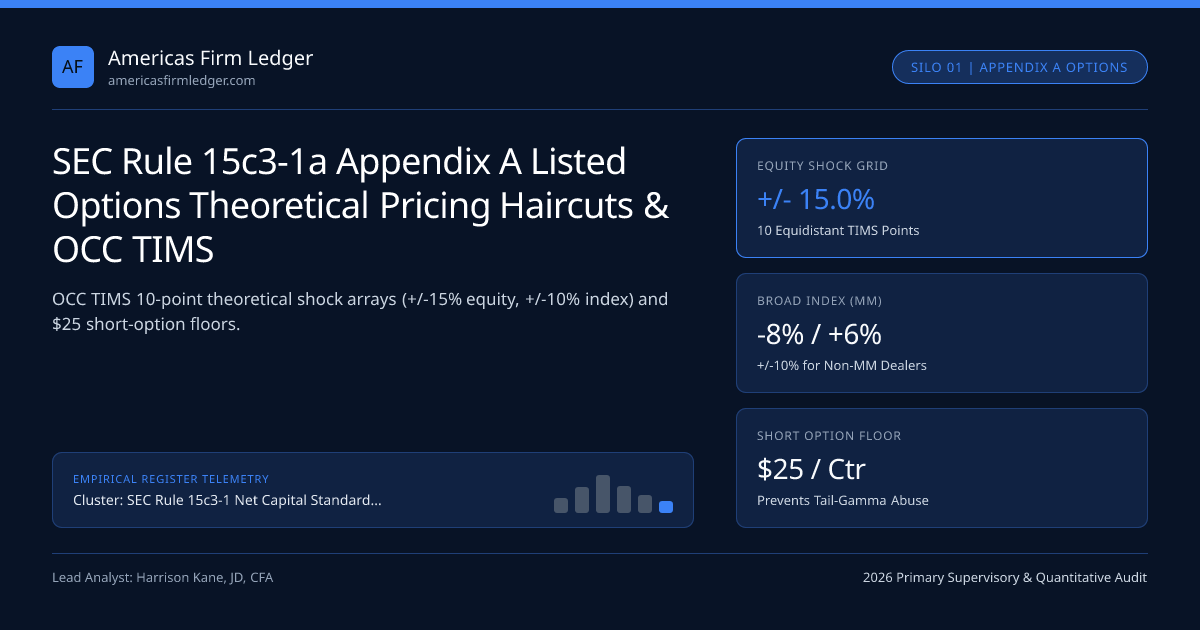
17 CFR 240.15c3-1a (Appendix A to SEC Rule 15c3-1) allows registered broker-dealers and market makers to calculate proprietary listed option haircuts using an SEC-approved theoretical option pricing model—universally implemented via the Options Clearing Corporation (OCC) Theoretical Intermarket Margining System (TIMS) or STANS theoretical arrays—testing 10 equidistant valuation points across a statutory underlying price shock range. For individual equity options and narrow-based sector indices, the underlying asset is shocked from -15% to +15%; for qualified high-capitalization broad-based indices such as the S&P 500 (SPX) or Russell 2000 (RUT), the shock range narrows to -10%/+10% for non-clearing dealers and -8%/+6% (or +/-8%) for clearing market makers, subject to an absolute $25 per-contract ($0.25/share) minimum charge on short options.
This risk-array methodology integrates directly into our SEC Rule 15c3-1 Net Capital institutional guide, superseding crude 100% non-marketable deductions and coordinating closely with ANC internal-model VaR dealers.
How the 10-Point Equidistant Theoretical Shock Array Works#
Before the SEC modernized Appendix A in 1997, non-specialist broker-dealers endured punitive strategy-based rules that failed to recognize delta-hedged gamma/vega books across expirations. Under current Rule 15c3-1a(b)(1), all listed calls, puts, underlying hedged stock shares, and offset-eligible futures on the same underlying instrument (a "Product Group" or "Class Group") are evaluated simultaneously across 10 equidistant points—five downside moves and five upside moves:
- Single-Stock & Narrow-Based Index Class (+/-15%): Valuation points sit at -15%, -12%, -9%, -6%, -3%, +3%, +6%, +9%, +12%, and +15% from current spot, incorporating OCC implied-volatility skew shifts.
- High-Capitalization Broad-Based Index Class: Market makers clearing through an OCC member test -8% to +6% (or symmetrical -8% to +8% / -10% to +10% for non-market-maker broker-dealers).
- Major Foreign Currency Options: Shocked across +/-6% for major deliverable currencies (EUR, JPY, GBP, CAD, CHF, AUD) and +/-20% for non-major currencies.
At each of the 10 points, OCC theoretical option values are recomputed and compared against current mark-to-market liquidation value. The largest net portfolio loss across all 10 points becomes the Class Group base haircut!
Cross-Class Portfolio Offsets & The $25 Short-Option Floor#
Appendix A prevents "deep out-of-the-money short tail gamma" abuse—where a dealer writes 50,000 deep OTM SPX or single-stock puts lying just outside the 15% shock boundary—via Rule 15c3-1a(b)(1)(iv)(B). Even if the 10-point TIMS array shows zero theoretical loss across +/-15%, every short option contract in the portfolio must carry a minimum charge of $25 per 100-share contract (reduced only where covered 1-for-1 inside a tight vertical/box spread).
Additionally, broad-based index product groups supervised jointly across securities and CFTC futures venues (such as SPX options hedged with CME E-mini S&P 500 or Nasdaq-100 futures) qualify for Product Group Cross-Offsets ranging from 70% to 90% between correlated broad-based indices, dramatically lowering Net Capital charges compared with standalone FINRA Rule 4210 customer strategy rules.
| Underlying Instrument Category | Appendix A Shock Range (Non-MM BD) | Appendix A Shock Range (Market Maker) | Equidistant Step Interval | Cross-Group Portfolio Offset | Minimum Short Contract Floor |
|---|---|---|---|---|---|
| Individual Listed US Equities | -15.0% to +15.0% | -15.0% to +15.0% | 3.0% per step (10 pts) | 0% (Single-issuer isolated) | $25.00 per contract ($0.25/sh) |
| Narrow-Based Sector ETFs / Indices | -15.0% to +15.0% | -15.0% to +15.0% | 3.0% per step (10 pts) | 50% - 75% (Approved sectors) | $25.00 per contract |
| High-Cap Broad Index (SPX, NDX, RUT) | -10.0% to +10.0% | -8.0% to +6.0% (or +/-8%) | 2.0% (BD) / ~1.5% (MM) | Up to 85% - 90% Across Broad | $25.00 per contract |
| Major Deliverable FX Options | -6.0% to +6.0% | -6.0% to +6.0% | 1.2% per step (10 pts) | Approved G10 FX Basket Rules | $25.00 equivalent |
Quantitative Worked Model: Delta-Hedged Short Iron Condor & Tail Put Book#
Let us compute the exact Appendix A Net Capital deduction for an equity derivatives market-making desk carrying a delta-hedged NVDA volatility book alongside 4,000 deep-OTM short puts:
- RawTIMSHaircut = max{j = 1..10} ( max(0, PointLoss(j)) )
- ShortOptionMinimumFloor = $25 * TotalUncoveredShortOption_Contracts
- ClassAppendixAHaircut = max(RawTIMSHaircut, ShortOptionMinimumFloor)
- Worked Listed Equity Options Desk Audit (Underlying Spot = $120.00):
- Position: +50,000 shares Underlying Stock ($6,000,000 Long)
- +1,000 ATM $120 Put Contracts, -1,500 OTM $135 Call Contracts
- 4,000 Deep-OTM $90 Put Contracts (25% below spot -> outside -15% shock!)
- 1. Evaluate 10 Equidistant TIMS Points (-15% [$102.00] to +15% [$138.00]):
- At -15% ($102.00): Long stock loses $900k; Long $120 Puts gain $1,420k; Short $90 Puts lose $180k (vega/decay) -> Net Gain +$340k
- At +12% ($134.40): Net Loss = $195,000
- At +15% ($138.00): Long stock gains $900k; Long $120 Puts lose $380k; Short $135 Calls lose $810k -> Net Portfolio Loss = $290,000
- Worst-Case 10-Point Loss (RawTIMSHaircut) = $290,000
- 2. Test $25 Per-Contract Short Floor:
- Uncovered Short Contracts = 500 net short calls + 4,000 deep-OTM short puts = 4,500 contracts
- ShortOptionMinimum_Floor = 4,500 * $25 = $112,500 (Plus OCC clearing house margin add-ons!)
- 3. Final Appendix A Net Capital Haircut = max($290,000, $112,500) = $290,000
- (Compare vs unhedged 15% Paragraph J stock haircut alone of $900,000 -> Saves $610,000!)
Appendix A Underlying Price Shock Ranges#
Avoiding OCC Clearing Margin vs Net Capital Double-Counting Traps#
Two operational reconciliations dominate FINRA examinations of options market makers:
- Never Double-Count Delta-Hedged Shares in Paragraph (J): Underlying common shares included inside an Appendix A Class Group to offset short calls or long puts must be removed from the firm's Paragraph (J) 15% equity schedule (equity proprietary haircuts), and any excess unhedged stock shares left outside the option hedge must be returned to Paragraph (J) and tested for 10% TNC undue concentration.
- Clearing Firm House Margin Deficit Check: When an options market maker clears through an ABN AMRO, Wedbush, or Goldman Sachs clearing member, if the carrying clearing broker imposes a risk-based house margin requirement (e.g., 25% crash stress on short 0DTE puts) that exceeds the statutory Appendix A haircut—leaving the market maker in a liquidating equity deficit at the clearing house—the market maker must take additional capital deductions for clearing-account deficits under SEC Rule 15c3-1. Explore how bulge-bracket dealers go beyond TIMS into full internal VaR models in our next article on ANC $5B broker-dealers under Rule 15c3-1e within the SEC Rule 15c3-1 Topic Hub.
Frequently asked questions
Can any registered broker-dealer use Appendix A theoretical option pricing, or only exchange market makers?
Following the SEC's 1997 amendments to Rule 15c3-1a, both exchange-registered options market makers and non-market-maker proprietary broker-dealers can use OCC TIMS 10-point theoretical pricing arrays for listed options, though non-market makers face slightly wider +/-10% broad-index shock bands.
Why does Appendix A enforce a $25 per-contract minimum floor on short options?
Deep out-of-the-money short options (such as puts struck 30% below spot) may register near-zero theoretical loss inside a +/-15% shock grid, yet carry catastrophic jump-to-default tail risk during market crashes; the $25 per-contract floor prevents unlimited zero-capital tail-risk writing.
Do bespoke unlisted OTC equity options automatically qualify for standard OCC TIMS Appendix A arrays?
Standard TIMS files cover OCC-cleared listed options. For unlisted OTC options, non-ANC broker-dealers face restrictive strategy/percentage haircuts under Appendix A paragraph (c) unless approved for OTC derivatives dealer or Rule 15c3-1e internal models.
How are 0DTE (zero-days-to-expiration) S&P 500 options treated at end-of-day Net Capital cutoff?
Cash-settled 0DTE index options expiring at 4:00 PM ET convert into settled cash mark-to-market credits or debits at end-of-day FOCUS snapshot, while intraday continuous Net Capital compliance requires monitoring real-time gamma exposure against excess capital.
Publication record
- Published
- November 14, 2026
- Updated
- November 14, 2026
- Author
- Harrison Kane, JD, CFA
- Review
- Review not recorded
- Automated fact check
- Passed in the stored pipeline record
- Source URLs
- 4 recorded
AI assistance recorded: anthropic/claude-opus-4.6. This field does not establish human review or source verification.
Academic & Institutional Attribution
Cite This Research & Embed Live Data Card
Standard academic & institutional research paper citation format.
Harrison Kane, JD, CFA. (2026, November 14). SEC Rule 15c3-1a Appendix A Listed Options Theoretical Pricing Haircuts & OCC TIMS. Americas Firm Ledger. https://americasfirmledger.com/filings/sec-15c3-1-appendix-a-theoretical-option-pricing-haircutsRegulatory Directory Cross-Reference
Referenced Institutions & Regulatory Registries
Mentioned Regulated Institutions
Related SEC Rule 15c3 1 Net Capital Haircuts & Institutional Briefings
Explore SEC Rule 15c3 1 Net Capital Haircuts Hub (20) →SEC Rule 15c3 1 Net Capital Haircuts
SEC Rule 15c3-1 Net Capital Standards, Haircuts & FOCUS Filings: Institutional GuideSEC Rule 15c3 1 Net Capital Haircuts
ANC Broker-Dealers Under SEC Rule 15c3-1e: $5 Billion Tentative Net Capital & VaR ModelsSEC Rule 15c3 1 Net Capital Haircuts
Appendix D Subordinated Loan Agreements & Revolving Subordinations Under FINRA Rule 4110SEC Rule 15c3 1 Net Capital Haircuts
Open Contractual Commitments & Firm-Commitment Underwriting Haircuts Under SEC Rule 15c3-1SEC Rule 15c3 1 Net Capital Haircuts
Repo & Reverse-Repo Net Capital Deficits and SEC FICC Treasury Clearing OffsetsSEC Rule 15c3 1 Net Capital Haircuts
SEC Rule 17a-11 Early Warning & Capital Deficiency Notices: 120%, 12:1 & 5% TriggersSEC Rule 15c3 1 Net Capital Haircuts
Equity Capital Withdrawal Restrictions & FINRA Rule 4110/4120 Expansion ControlsSEC Rule 15c3 1 Net Capital Haircuts
Form X-17A-5 FOCUS Report Part II vs Part IIA Line-by-Line Net Capital ReconciliationSEC Rule 15c3 3 Customer Reserve Sipc
SEC Rule 15c3-3(j) Free Credit Balances & FDIC Bank Sweep Disclosures for Broker-DealersSEC Rule 15c3 3 Customer Reserve Sipc
SEC Rule 15c3-3(k) Exemptions Explained: (k)(1), (k)(2)(i), (k)(2)(ii) & Footnote 74SEC Rule 15c3 3 Customer Reserve Sipc
SEC Rule 17a-5 Annual Broker-Dealer Audits: PCAOB AT-1 Compliance vs AT-2 Exemption ReportsSEC Rule 15c3 3 Customer Reserve Sipc
SIPC $500,000 Coverage & $250,000 Cash Sublimit: Separate Capacity Series 100-500 Rules
Americas Firm Ledger Data, Benchmarks & Contributor Records
CC BY 4.0 Open Data
Open Institutional Datasets (CSV / JSON) →
Download desk-compiled quantitative series & schemas.
2026 Reference Matrix
2026 Institutional Benchmarks & Thresholds →
Statutory capital, clearing, margin & rate conventions.
Editorial Records
Authors & Review Records →
View named contributors where those records are available.
Complete Index
Master Research & Dossier Archive →
Browse all published briefings by topic pillar & date.