
SEC Rule 15c3 1 Net Capital Haircuts
Aggregate Indebtedness 15:1 vs 8:1 First-Year Ratio Mechanics Under SEC Rule 15c3-1
Under SEC Rule 15c3-1(a)(1)(i), broker-dealers electing the basic capital method must cap Aggregate Indebtedness at 800% (8:1) of Net Capital during their first 12 months of operation and 1,500% (15:1) thereafter across FINRA FOCUS Part IIA filings.
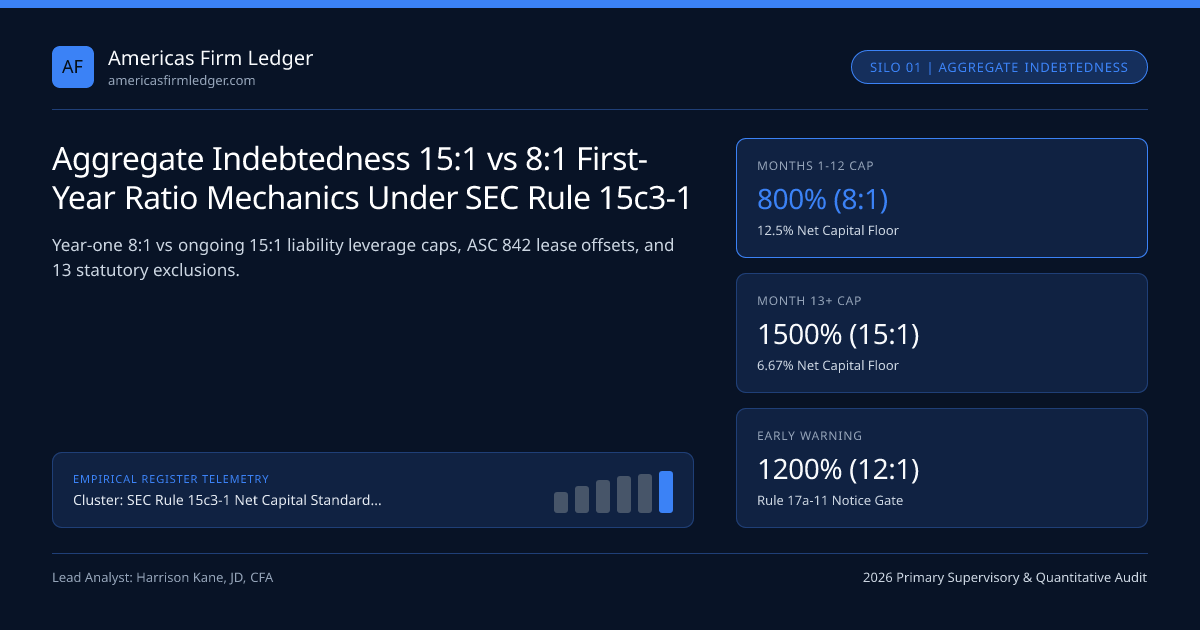
Under 17 CFR 240.15c3-1(a)(1)(i), a broker-dealer operating on the basic capital method cannot permit its Aggregate Indebtedness (AI) to exceed 800% (8:1) of Net Capital for the first 12 months after commencing securities business, loosening to 1,500% (15:1) starting on the first day of month 13. In practical FinOp accounting, a newly approved FINRA introducing firm holding $120,000 in accrued vendor bills, bonus accruals, and lease liabilities must carry at least $15,000 in liquid Net Capital during year one ($120,000 / 8), compared with $8,000 ($120,000 / 15) in subsequent years—always floored by its statutory $5,000, $50,000, or $100,000 activity minimum.
This foundational leverage cap sits at the core of our SEC Rule 15c3-1 Net Capital institutional guide and contrasts sharply with the clearing-oriented 2% Alternative Net Capital Standard.
Defining Aggregate Indebtedness Under Rule 15c3-1(c)(1)#
Rule 15c3-1(c)(1) defines Aggregate Indebtedness broadly as the total money liabilities of a broker-dealer arising in connection with any transaction whatsoever, regardless of whether the liability is recorded on a cash or accrual basis, unless explicitly excluded by one of thirteen statutory carve-outs in subparagraphs (c)(1)(i) through (xiii).
Compliance failures discovered during routine FINRA cycle examinations frequently stem from improper omission of accrued expenses or ASC 842 operating lease obligations:
- Included in AI: Accounts payable, accrued employee bonuses, unpaid legal and PCAOB audit retainers, current corporate income taxes payable, unsubordinated parent intercompany payables, and customer free credit balances (unless completely segregated in a Special Reserve Bank Account).
- ASC 842 Operating Lease Relief: Under SEC Division of Trading and Markets no-action relief, a broker-dealer may exclude an operating lease liability from AI only up to the amount of the corresponding Right-of-Use (ROU) asset recorded on the balance sheet; any excess lease liability (such as straight-line rent concessions or sublease impairments) must be added directly into AI.
- Excluded from AI: Indebtedness adequately collateralized by proprietary securities owned by the broker-dealer (such as street-side repo borrowings), fixed liabilities adequately secured by real estate sole-recourse mortgages, FINRA-approved Appendix D subordinated debt, and deferred tax liabilities tied directly to non-allowable assets or unrealized market appreciation.
When Does the 12-Month First-Year Clock Actually Start?#
A recurring trap for newly organized private placement portals, M&A boutiques, and digital-asset placement agents—operating in the same North American corporate ecosystem as ABT Capital Markets or BlockArrow Capital—is miscalculating the start date of the 12-month 8:1 window. SEC staff interpretations of SEC Rule 15c3-1 clarify that the 12-month clock does not begin on the date Delaware Secretary of State incorporation articles are filed, nor even on the date the SEC grants initial Form BD effectiveness if the firm remains dormant awaiting FINRA New Member Application (NMA) approval.
Instead, "commencing business as a broker or dealer" begins on the date the firm receives final FINRA Membership Agreement execution and opens its books to solicit customers, earn placement fees, or incur securities-related operating payables. Switching from 8:1 to 15:1 one month early on a quarterly FOCUS Part IIA filing triggers an immediate retrospective net capital deficiency if AI sat between 801% and 1,500%.
| Liability Line Item on Broker-Dealer Balance Sheet | GAAP Balance ($ USD) | Rule 15c3-1(c)(1) Citation | Included in Aggregate Indebtedness? | Net Capital Impact at 8:1 (Yr 1) | Net Capital Impact at 15:1 (Yr 2+) |
|---|---|---|---|---|---|
| Accrued Rep Commissions & Vendor Invoices | $480,000 | 15c3-1(c)(1) General Rule | Yes (100% Counted: $480,000) | $60,000 Required NC | $32,000 Required NC |
| Unsubordinated Parent Expense-Sharing Payable | $360,000 | FINRA Notice 03-63 | Yes (100% Counted: $360,000) | $45,000 Required NC | $24,000 Required NC |
| ASC 842 Lease Liability ($900k vs $820k ROU Asset) | $900,000 | SEC No-Action Relief | Excess Only ($80,000 Counted) | $10,000 Required NC | $5,333 Required NC |
| Street Repo Secured by Firm US Treasuries | $2,500,000 | 15c3-1(c)(1)(i) Exclusion | Excluded ($0 in AI) | $0 AI Charge (Haircut Only) | $0 AI Charge (Haircut Only) |
| FINRA-Approved Appendix D Subordinated Loan | $1,000,000 | 15c3-1(c)(1)(x) Exclusion | Excluded ($0 in AI; Added to Equity) | $0 AI Charge | $0 AI Charge |
Quantitative AI Ratio & Expense-Sharing Stress Model#
Parent-subsidiary expense-sharing agreements represent the number-one source of surprise AI spikes for non-carrying broker-dealers. Under FINRA Notice to Members 03-63, unless a parent company possesses independent financial resources to pay shared rent and payroll without relying on broker-dealer revenue—and explicitly waives recourse against the subsidiary—the broker-dealer must accrue its allocated share of unpaid parent expenses directly into Aggregate Indebtedness:
- AItoNetCapitalRatio = AI / Net_Capital
- RequiredMinimumNC (Year 1) = max(FixedDollarFloor, AI / 8)
- RequiredMinimumNC (Year 2+) = max(FixedDollarFloor, AI / 15)
- Worked Expense-Shock Scenario (Month 10 Introducing Broker-Dealer, $5,000 Floor):
- Liquid Cash & Allowable Clearing Deposit = $145,000
- Non-Allowable Prepaid Tech & Furniture = $35,000 (Deducted 100%)
- Tentative Net Capital = Net Capital = $145,000 (Zero security haircuts)
- Baseline Accrued Payables = $640,000
- + Year-End Investment Banking Bonus Accrual = $380,000
- + Excess Lease Liability Over ROU Asset = $40,000
- Total Aggregate Indebtedness (AI) = $1,060,000
- Actual AI-to-NC Ratio = $1,060,000 / $145,000 = 7.31:1 (731.0%) -> Compliant (< 800% Year-1 Cap)
- Required Minimum NC (Year 1, 8:1) = max($5,000, $1,060,000 / 8) = $132,500
- Excess Net Capital = $145,000 - $132,500 = $12,500
- Warning Check: 120% of Required NC = $159,000 -> TRIGGERED ($145,000 < $159,000 Rule 17a-11 Notice!)
Aggregate Indebtedness Supervisory Threshold Ladder#
Even though the 731% AI ratio stays below the 800% first-year ceiling, Net Capital ($145,000) falls below 120% of Required Minimum Net Capital ($159,000), triggering an immediate early-warning filing under SEC Rule 17a-11 early-warning rules.
Interplay with Debt-Equity Subordination Caps & Withdrawal Freezes#
Firms managing tight AI ratios cannot simply plug capital gaps with unlimited insider subordinated notes. Under Rule 15c3-1(d), if subordinated debt lacking equity-qualifying attributes exceeds 70% of a broker-dealer's total debt-equity total for more than 90 days, the firm violates net capital standards. Furthermore, under Rule 15c3-1(e)(2), no equity capital may be withdrawn by dividend, partner distribution, or unsecured affiliate loan if doing so would push Aggregate Indebtedness above 1,000% (10:1) of Net Capital. Compliance teams reviewing minimum dollar net capital tiers inside the SEC Rule 15c3-1 Topic Hub should maintain an internal 850% (8.5:1) FinOp soft ceiling to absorb unexpected month-end tax and bonus accruals without crossing the 10:1 withdrawal freeze or 12:1 early-warning gate.
Frequently asked questions
Does the 8:1 Aggregate Indebtedness limit start when Form BD is filed or when FINRA approves membership?
The 12-month 8:1 clock begins only when the firm actually commences business as a broker-dealer after receiving final FINRA Membership Agreement execution and opening operations—not upon Delaware incorporation or initial pending Form BD submission.
Are proprietary securities repo borrowings counted inside Aggregate Indebtedness?
No. Under 17 CFR 240.15c3-1(c)(1)(i), indebtedness adequately collateralized by securities carried in the proprietary account of the broker-dealer is excluded from Aggregate Indebtedness, though the underlying securities still incur statutory market haircuts.
How do ASC 842 office lease liabilities affect an introducing broker-dealer's AI ratio?
Pursuant to SEC Trading and Markets no-action guidance, a broker-dealer excludes operating lease liabilities from AI up to the carrying value of the matching Right-of-Use asset; however, straight-line rent abatements or impaired subleases exceeding the ROU asset count dollar-for-dollar in AI.
Can a broker-dealer switch back from the Alternative Standard to the Aggregate Indebtedness Standard?
No, not unilaterally. Under SEC Rule 15c3-1(a)(1)(ii), once a broker-dealer notifies its DEA that it has elected the 2% Alternative Net Capital Standard, it cannot revert to the Aggregate Indebtedness method without explicit written approval from the SEC.
Publication record
- Published
- November 14, 2026
- Updated
- November 14, 2026
- Author
- Harrison Kane, JD, CFA
- Review
- Review not recorded
- Automated fact check
- Passed in the stored pipeline record
- Source URLs
- 4 recorded
AI assistance recorded: anthropic/claude-opus-4.6. This field does not establish human review or source verification.
Academic & Institutional Attribution
Cite This Research & Embed Live Data Card
Standard academic & institutional research paper citation format.
Harrison Kane, JD, CFA. (2026, November 14). Aggregate Indebtedness 15:1 vs 8:1 First-Year Ratio Mechanics Under SEC Rule 15c3-1. Americas Firm Ledger. https://americasfirmledger.com/filings/sec-15c3-1-aggregate-indebtedness-15-to-1-first-year-ratioRegulatory Directory Cross-Reference
Referenced Institutions & Regulatory Registries
Top Regulated Institutions in This Coverage Slice
Related SEC Rule 15c3 1 Net Capital Haircuts & Institutional Briefings
Explore SEC Rule 15c3 1 Net Capital Haircuts Hub (20) →SEC Rule 15c3 1 Net Capital Haircuts
SEC Rule 15c3-1 Net Capital Standards, Haircuts & FOCUS Filings: Institutional GuideSEC Rule 15c3 1 Net Capital Haircuts
Alternative Net Capital Standard: $250,000 Floor vs 2% of Rule 15c3-3 Debit ItemsSEC Rule 15c3 1 Net Capital Haircuts
SEC Rule 15c3-1 Minimum Dollar Net Capital Tiers: $5k, $50k, $100k, $250k & $1M FloorsSEC Rule 15c3 1 Net Capital Haircuts
Non-Allowable Assets Under SEC Rule 15c3-1(c)(2)(iv): Prepaids, Fixed Assets & ReceivablesSEC Rule 15c3 1 Net Capital Haircuts
Equity Proprietary Position Haircuts (15% Long/Short & 25% Offset) Under SEC Rule 15c3-1SEC Rule 15c3 1 Net Capital Haircuts
U.S. Treasury & Government Agency Debt Haircut Maturity Buckets Under SEC Rule 15c3-1SEC Rule 15c3 1 Net Capital Haircuts
Municipal Securities & Investment-Grade Corporate Bond Haircuts Under SEC Rule 15c3-1SEC Rule 15c3 1 Net Capital Haircuts
Undue Concentration Add-On Haircuts Under SEC Rule 15c3-1(c)(2)(vi)(M): 10% TNC RulesSEC Rule 15c3 3 Customer Reserve Sipc
Daily vs Weekly SEC Rule 15c3-3 Reserve Computations: The $500M Total Credits RuleSEC Rule 15c3 3 Customer Reserve Sipc
Special Reserve Bank Accounts Under SEC Rule 15c3-3: No-Lien Letters & 15% Bank CapsSEC Rule 15c3 3 Customer Reserve Sipc
Qualified Securities in SEC Rule 15c3-3 Reserve Accounts: U.S. Treasury Rules & HaircutsSEC Rule 15c3 3 Customer Reserve Sipc
PAB Reserve Computations for Proprietary Accounts of Broker-Dealers Under SEC Rule 15c3-3
Americas Firm Ledger Data, Benchmarks & Contributor Records
CC BY 4.0 Open Data
Open Institutional Datasets (CSV / JSON) →
Download desk-compiled quantitative series & schemas.
2026 Reference Matrix
2026 Institutional Benchmarks & Thresholds →
Statutory capital, clearing, margin & rate conventions.
Editorial Records
Authors & Review Records →
View named contributors where those records are available.
Complete Index
Master Research & Dossier Archive →
Browse all published briefings by topic pillar & date.