
SEC Rule 15c3 1 Net Capital Haircuts
SEC Rule 15c3-1 Minimum Dollar Net Capital Tiers: $5k, $50k, $100k, $250k & $1M Floors
SEC Rule 15c3-1(a)(2) stratifies broker-dealers into fixed dollar net capital floors ranging from $5,000 for non-custodial placement agents up to $100,000 for proprietary dealers, $250,000 for carrying brokers, and $1,000,000 for multi-stock market makers.
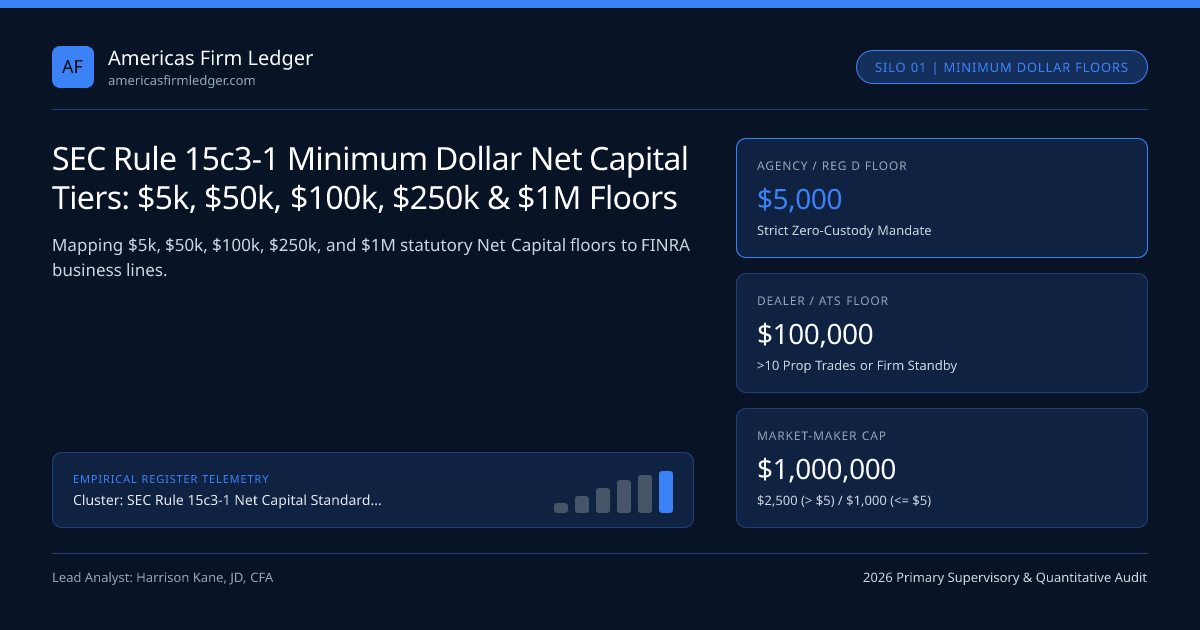
Under 17 CFR 240.15c3-1(a)(2) through (a)(9), every US broker-dealer faces an absolute fixed-dollar Net Capital floor dictated by the highest-risk business line authorized in its FINRA Membership Agreement—ranging from $5,000 for pure agency placement boutiques to $50,000 for omnibus introducing conduits, $100,000 for proprietary dealers and firm-commitment underwriters, $250,000 for customer-carrying clearing firms, and up to $1,000,000 for active equity market makers. Crucially, if a $5,000 introducing firm inadvertently accepts a customer's physical check made payable to the broker-dealer rather than to an escrow bank or clearing firm, its statutory minimum jumps overnight by 50x to $250,000, creating an instantaneous, reportable net capital violation.
This activity-tier taxonomy forms the operational backbone of our SEC Rule 15c3-1 Net Capital institutional guide and links directly to Aggregate Indebtedness 15:1 / 8:1 ratios and Form X-17A-5 FOCUS Part II/IIA reconciliations.
Granular Breakdown of Rule 15c3-1(a)(2) Activity Floors#
The SEC calibrates fixed dollar floors to operational custody exposure and principal market-risk velocity:
- $5,000 Floor — Rule 15c3-1(a)(2)(vi): Reserved for broker-dealers that do not receive, directly or indirectly, or hold customer funds or securities, do not carry customer accounts, and limit activities strictly to introducing accounts on a fully disclosed basis, private placements under SEC Regulation D where investor wires flow directly to a bank escrow agent, M&A advisory, or mutual fund wire-order agency applications.
- $25,000 Floor — Rule 15c3-1(a)(2)(v): Mutual fund / variable contract retailers that accept checks payable to an investment company underwriter and promptly transmit them by noon of the next business day, without engaging in general securities dealing.
- $50,000 Floor — Rule 15c3-1(a)(2)(iv): Introducing broker-dealers that receive but promptly transmit customer securities (e.g., physical stock certificates endorsed for transfer) or introduce accounts on an omnibus basis to another registered clearing broker-dealer without holding free credit balances.
- $100,000 Floor — Rule 15c3-1(a)(2)(iii): Broker-dealers that act as dealers (proprietary trading beyond 10 occasional investment transactions per calendar year), participate in firm-commitment underwritings (even as selling-group members assuming standby liability), or operate certain Alternative Trading Systems (ATSs).
- $250,000 Floor — Rule 15c3-1(a)(2)(i): Any broker-dealer that carries customer or broker-dealer accounts and receives or holds funds or securities—matching the base floor of the 2% Alternative Net Capital Standard.
Market-Maker Per-Security Scaling ($100,000 to $1,000,000) & Prime Brokerage ($1.5M)#
Broker-dealers making two-sided continuous markets in OTC or exchange-listed equities face a dynamic per-ticker formula under Rule 15c3-1(a)(4). Minimum Net Capital equals $2,500 for each security in which the firm makes a market with an average bid price above $5.00 per share, plus $1,000 for each security priced at $5.00 or less—floored at $100,000 and capped at $1,000,000 (unless the firm's AI or 2% debit ratio produces a higher figure).
Specialized institutional lines impose even steeper minimums under SEC no-action letters and parallel paragraphs:
- $1,500,000 Prime Brokerage Minimum: Under the landmark SEC Prime Brokerage No-Action Letter, an executing prime broker must maintain at least $1,500,000 in Net Capital (while an introducing executing broker clearing through a prime broker must maintain $1,000,000 if handling prime-brokerage settlement allocations).
- $20,000,000 OTC Derivatives Dealer: Broker-dealers registered under the specialized OTC Derivatives Dealer ("BD Lite") regime of Rule 15c3-1(a)(5) must hold $20,000,000 in Net Capital and $100,000,000 in Tentative Net Capital.
| Broker-Dealer Business Line / Charter Profile | Statutory / No-Action Authority | Fixed Dollar Floor | Rule 17a-11 120% Early-Warning Line | Inadvertent Escalation Trap | Registry / Benchmark Cohort |
|---|---|---|---|---|---|
| Reg D Placement / M&A Boutique | 17 CFR 240.15c3-1(a)(2)(vi) | $5,000 | $6,000 | Holding investor check payable to BD -> $250,000 | Atlas One / Private Portal Peer |
| Mutual Fund Wire-Order Conduit | 17 CFR 240.15c3-1(a)(2)(v) | $25,000 | $30,000 | Executing general equity agency orders -> $50k/$250k | FINRA Limited-Purpose BD |
| Proprietary Dealer / Firm Underwriter | 17 CFR 240.15c3-1(a)(2)(iii) | $100,000 | $120,000 | Exceeding 10 proprietary trades in treasury cash account | ABT Capital Markets Cohort |
| Self-Clearing / Carrying Custodian | 17 CFR 240.15c3-1(a)(2)(i) | $250,000 | $300,000 (or 5% Alt Debits) | Custody of customer cash/securities | Axos Invest Cohort |
| Multi-Ticker Equity Market Maker | 17 CFR 240.15c3-1(a)(4) | $100,000 to $1,000,000 | $120,000 to $1,200,000 | Quoting >400 tickers >$5 hits $1,000,000 ceiling | SEC Rule 15c3-1 |
| Executing / Clearing Prime Broker | SEC Prime Broker Letter | $1,500,000 | $1,800,000 | Handling institutional DVP/RVP prime give-ups | North American Standard |
Quantitative Market-Maker & Multi-Activity Floor Formula#
When a broker-dealer engages in multiple business lines (e.g., proprietary dealing, equity market making, and carrying accounts on Aggregate Indebtedness), its statutory requirement is the maximum across every applicable test:
- EffectiveMinimumNC = max(ActivityDollarFloor, MarketMakerFloor, Ratio_Requirement)
- EarlyWarning120Pct = 1.20 * max(ActivityDollarFloor, MarketMaker_Floor)
- Worked Wholesale OTC & Listed Market-Maker Audit:
- Quoted Equities > $5.00 per share (NOver5) = 290 securities -> 290 * $2,500 = $725,000
- Quoted OTC Equities <= $5.00 (NUnder5) = 195 securities -> 195 * $1,000 = $195,000
- Uncapped Per-Ticker Sum = $920,000
- MarketMakerFloor = min($1,000,000, max($100,000, $920,000)) = $920,000
- Aggregate Indebtedness = $8,400,000 -> AI Ratio Requirement ($8.4M / 15) = $560,000
- EffectiveMinimumNC = max($100,000, $920,000, $560,000) = $920,000
- Rule 17a-11 Early Warning (120% * $920,000) = $1,104,000
Statutory Dollar Floors vs 120% Early-Warning Buffers#
If the trading desk adds just 35 more stocks priced above $5.00 ($35 × $2,500 = $87,500), the uncapped sum hits $1,007,500 and caps cleanly at the $1,000,000 Rule 15c3-1(a)(4) ceiling, moving the 120% early-warning threshold to $1,200,000.
Avoiding the "Accidental $250k Carrying Firm" Trap#
FINRA disciplinary dockets routinely sanction $5,000 private-placement broker-dealers that violate Rule 15c2-4 during a contingency offering. To preserve the $5,000 floor on a "minimum-maximum" or "all-or-none" Regulation D offering, investor subscription funds must be wired directly to an unaffiliated bank acting as written escrow agent under Rule 15c2-4(b)—never to an attorney's IOLTA account, never to an affiliate LLC, and never to a bank account controlled by a broker-dealer officer. Similarly, investing corporate treasury cash in more than 10 proprietary equity trades in a single calendar year reclassifies a $5,000 placement firm into a $100,000 dealer under Rule 15c3-1(a)(2)(iii)(B) unless invested strictly in money-market funds or US Treasuries. Explore how balance-sheet receivables further erode excess capital in our guide to non-allowable asset deductions across the SEC Rule 15c3-1 Topic Hub.
Frequently asked questions
Why does a $5,000 private placement broker-dealer get hit with a $250,000 requirement if an attorney holds escrow?
SEC Rule 15c2-4 requires contingency offering funds to be escrowed at a statutory "bank" as defined in Exchange Act Section 3(a)(6). Using a law firm trust account or title agent violates Rule 15c2-4, causing the SEC to deem the broker-dealer in constructive custody of customer funds ($250,000 floor).
Does investing firm cash in a government money market fund trigger the $100,000 dealer capital floor?
No. Purchasing shares of registered Rule 2a-7 money market funds or holding bank certificates of deposit for corporate cash management does not count toward the 10-trade annual proprietary dealing threshold under Rule 15c3-1(a)(2)(iii).
How is the $1,000,000 market-maker net capital cap calculated each month?
Under Rule 15c3-1(a)(4), the FinOp counts the average number of securities in which the firm made a market during the preceding 30 days, applying $2,500 per issue quoted above $5 and $1,000 per issue at or below $5, up to a $1,000,000 per-security cap.
Can FINRA require a higher dollar floor in a Membership Agreement than Rule 15c3-1 specifies?
Yes, within statutory limits, and conversely a broker-dealer's FINRA Membership Agreement locks in its authorized floor: even if a $100,000 dealer temporarily holds zero inventory, it must maintain $100,000 until FINRA approves a Continuing Membership change.
Publication record
- Published
- November 14, 2026
- Updated
- November 14, 2026
- Author
- Harrison Kane, JD, CFA
- Review
- Review not recorded
- Automated fact check
- Passed in the stored pipeline record
- Source URLs
- 4 recorded
AI assistance recorded: anthropic/claude-opus-4.6. This field does not establish human review or source verification.
Academic & Institutional Attribution
Cite This Research & Embed Live Data Card
Standard academic & institutional research paper citation format.
Harrison Kane, JD, CFA. (2026, November 14). SEC Rule 15c3-1 Minimum Dollar Net Capital Tiers: $5k, $50k, $100k, $250k & $1M Floors. Americas Firm Ledger. https://americasfirmledger.com/filings/sec-15c3-1-minimum-dollar-capital-tiers-5k-50k-100k-250kRegulatory Directory Cross-Reference
Referenced Institutions & Regulatory Registries
Top Regulated Institutions in This Coverage Slice
Related SEC Rule 15c3 1 Net Capital Haircuts & Institutional Briefings
Explore SEC Rule 15c3 1 Net Capital Haircuts Hub (20) →SEC Rule 15c3 1 Net Capital Haircuts
SEC Rule 15c3-1 Net Capital Standards, Haircuts & FOCUS Filings: Institutional GuideSEC Rule 15c3 1 Net Capital Haircuts
Non-Allowable Assets Under SEC Rule 15c3-1(c)(2)(iv): Prepaids, Fixed Assets & ReceivablesSEC Rule 15c3 1 Net Capital Haircuts
Equity Proprietary Position Haircuts (15% Long/Short & 25% Offset) Under SEC Rule 15c3-1SEC Rule 15c3 1 Net Capital Haircuts
U.S. Treasury & Government Agency Debt Haircut Maturity Buckets Under SEC Rule 15c3-1SEC Rule 15c3 1 Net Capital Haircuts
Municipal Securities & Investment-Grade Corporate Bond Haircuts Under SEC Rule 15c3-1SEC Rule 15c3 1 Net Capital Haircuts
Undue Concentration Add-On Haircuts Under SEC Rule 15c3-1(c)(2)(vi)(M): 10% TNC RulesSEC Rule 15c3 1 Net Capital Haircuts
Non-Marketable Securities, Restricted Rule 144 Stock & 100% Blockage Under SEC Rule 15c3-1SEC Rule 15c3 1 Net Capital Haircuts
SEC Rule 15c3-1a Appendix A Listed Options Theoretical Pricing Haircuts & OCC TIMSSEC Rule 15c3 3 Customer Reserve Sipc
Qualified Securities in SEC Rule 15c3-3 Reserve Accounts: U.S. Treasury Rules & HaircutsSEC Rule 15c3 3 Customer Reserve Sipc
PAB Reserve Computations for Proprietary Accounts of Broker-Dealers Under SEC Rule 15c3-3SEC Rule 15c3 3 Customer Reserve Sipc
Physical Possession or Control Under SEC Rule 15c3-3(b): Fully Paid & 140% Margin RulesSEC Rule 15c3 3 Customer Reserve Sipc
Good Control Locations Under SEC Rule 15c3-3(c): DTC Free Box & Foreign Custodians
Americas Firm Ledger Data, Benchmarks & Contributor Records
CC BY 4.0 Open Data
Open Institutional Datasets (CSV / JSON) →
Download desk-compiled quantitative series & schemas.
2026 Reference Matrix
2026 Institutional Benchmarks & Thresholds →
Statutory capital, clearing, margin & rate conventions.
Editorial Records
Authors & Review Records →
View named contributors where those records are available.
Complete Index
Master Research & Dossier Archive →
Browse all published briefings by topic pillar & date.