
SEC Rule 15c3 1 Net Capital Haircuts
Non-Allowable Assets Under SEC Rule 15c3-1(c)(2)(iv): Prepaids, Fixed Assets & Receivables
SEC Rule 15c3-1(c)(2)(iv) requires broker-dealers to deduct 100% of assets not readily convertible into cash—including prepaid Bloomberg/SaaS contracts, fixed equipment, unsecured affiliate loans, and aged advisory or 12b-1 receivables—when computing Tentative Net Capital.
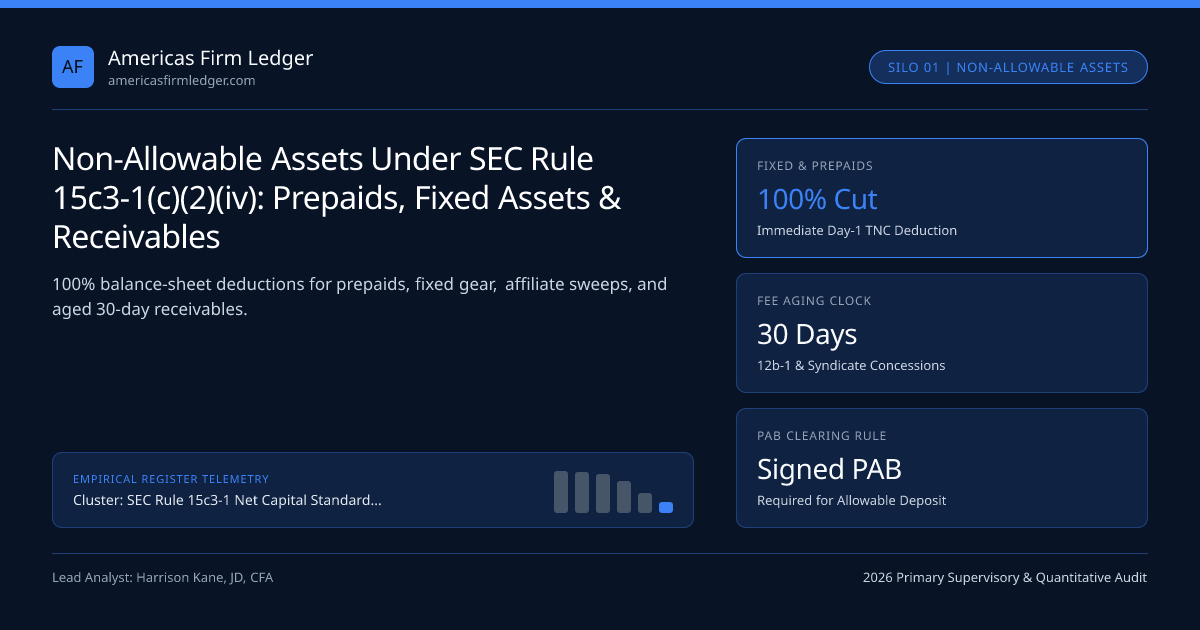
Under 17 CFR 240.15c3-1(c)(2)(iv), computing Tentative Net Capital requires deducting 100% of every balance-sheet asset that cannot be converted immediately into unencumbered cash during a forced liquidation—spanning real estate, servers, leasehold improvements, goodwill, exchange seats, prepaid vendor contracts, unsecured affiliate advances, and investment banking or mutual fund receivables aged past strict statutory cutoffs. Across FINRA financial examination sweeps and PCAOB broker-dealer audits, misclassifying an illiquid receivable or restricted clearing deposit as an "allowable asset" remains the most frequent cause of retroactive FOCUS Report restatements.
This balance-sheet purification step bridges GAAP equity and Tentative Net Capital inside our SEC Rule 15c3-1 Net Capital institutional guide, sitting directly between minimum dollar capital tiers and equity proprietary inventory haircuts.
The Core Convertibility Test & Clearing Deposit PAIB Agreements#
For cash or a receivable to count as allowable under SEC Rule 15c3-1, the broker-dealer must enjoy unrestricted legal right to withdraw or collect it immediately without counterparty setoff:
- Bank Cash vs Certificate of Deposit Traps: Demand deposits at US commercial banks supervised by the FDIC or OCC are allowable up to bank-capital concentration limits, whereas a bank Certificate of Deposit pledged as collateral for an office letter of credit or carrying a non-waivable withdrawal freeze is 100% non-allowable.
- Introducing Broker Clearing Deposits (PAB Agreement Mandate): Every fully disclosed introducing broker posts an error/clearing deposit ($25,000 to $500,000+) at its carrying clearing firm. That deposit is allowable only if the introducing and carrying firms execute a FINRA-compliant Proprietary Accounts of Broker-Dealers (PAB) Agreement confirming that the deposit is held inside the clearing firm's PAB Reserve computation and cannot be seized for non-brokerage parent debts. Missing a signed PAB addendum turns the entire clearing deposit non-allowable!
- Prepaids, Intangibles & Tax Refunds: Annual upfront Bloomberg, cloud infrastructure, D&O insurance, and FINRA CRD renewal fees are 100% non-allowable the moment cash leaves the bank account. Federal and state income tax receivables are likewise 100% non-allowable (except strictly limited offsets against deferred tax liabilities tied to non-allowable assets).
Receivable Aging Clocks & The "Rep Commission Pass-Through" Exception#
Rule 15c3-1(c)(2)(iv) applies unforgiving aging clocks to broker-to-broker and issuer receivables:
- Mutual Fund Concessions & 12b-1 Trails: Commissions or 12b-1 fees receivable from a registered investment company or its principal underwriter are allowable for 30 calendar days from the date they become payable; on day 31, they turn 100% non-allowable.
- Investment Banking, M&A Retainers & Private Placement Fees: Unsecured M&A success fees, corporate retainer invoices, and Regulation D placement fees receivable from non-broker-dealer corporate issuers are immediately 100% non-allowable on Day 1—with one narrow offset recognized under FINRA SEA Rule 15c3-1(c)(2)(iv)(C)/09: an aged or unsecured fee/commission receivable may be treated as allowable solely to the extent of a directly corresponding commission payable to a registered representative booked in Aggregate Indebtedness, provided a written agreement states the rep is paid only if and when the firm actually collects the cash from the client!
- Registered Investment Adviser (RIA) Wrap Fees: Dual-registrant firms managing advisory accounts alongside SEC IARD registrants like Bitwise (801-122073) cannot count uncollected quarterly advisory fees unless the broker-dealer possesses contractual authority to debit the fee directly from liquid customer cash/securities held at an omnibus/carrying custodian within 30 days.
| Balance-Sheet Asset Category | GAAP Carrying Value | Rule 15c3-1(c)(2)(iv) Rule | Allowable Amount | Non-Allowable Deduction | Common Audit Failure Mode |
|---|---|---|---|---|---|
| Unencumbered Cash at FDIC Bank | $2,400,000 | Allowable Cash | $2,400,000 | $0 | Pledged CD for office lease letter of credit |
| Clearing Deposit at Carrying BD | $250,000 | Rule 15c3-1(c)(2)(iv)(E) | $250,000 (With PAB) | $0 ($250k if no PAB!) | Unsigned or outdated PAB Reserve letter |
| Prepaid SaaS, Insurance & CRD Fees | $185,000 | 100% Non-Allowable | $0 | $185,000 | Prepaying 12-month vendor bill on Dec 28 |
| Unsecured Parent / Affiliate Advance | $420,000 | Rule 15c3-1(c)(2)(iv)(B) | $0 | $420,000 | Intercompany tax/cash sweep receivable |
| 12b-1 Mutual Fund Trails (Day 22 vs Day 41) | $140,000 ($95k <=30d) | 30-Day Aging Cutoff | $95,000 | $45,000 | Failing to age receivable sub-ledger by fund |
| M&A Success Fee ($500k w/ $350k Contingent Rep Split) | $500,000 | SEA 15c3-1(c)(2)(iv)/09 | $350,000 (Offset Only) | $150,000 | Missing written "pay-when-paid" rep contract |
Worked Tentative Net Capital Reconciliation Formula#
Below is a month-end FinOp reconciliation illustrating how an exuberant year-end SaaS prepayment and an intercompany cash sweep turn solid GAAP equity into an early-warning capital squeeze:
- TentativeNetCapital (TNC) = AllowableAssets - TotalUnsubordinatedGAAPLiabilities + ExcessROULease_Adjustment
- Worked Boutique Investment Bank & Introducing BD Audit:
- Total GAAP Assets = $3,685,000
- Total GAAP Liabilities (All Unsubordinated) = $1,210,000 (Includes $350k Contingent Rep Payable)
- GAAP Stockholders' Equity = $2,475,000
- Non-Allowable Asset Deductions:
- Leasehold Improvements & Servers (Net) = ($310,000)
- Goodwill from Boutique Acquisition = ($650,000)
- Prepaid Annual Market Data & Insurance = ($185,000)
- Unsecured Receivable From Holding Parent = ($420,000)
- Aged >30-Day 12b-1 Trails = ($45,000)
- Net M&A Fee ($500k Fee - $350k Contingent)= ($150,000)
- Total Non-Allowable Deductions = ($1,760,000)
- Tentative Net Capital = $2,475,000 - $1,760,000 = $715,000
- Less 2% Haircut on $1.5M Govt Money Market Fund = ($30,000)
- Net Capital (NC) = $685,000
Non-Allowable Deduction Rates Across Balance Sheet Lines#
Notice how $2,475,000 of GAAP equity shrinks by 71.1% down to $715,000 in Tentative Net Capital before a single dollar of securities market risk is even measured!
Operational Treasury Controls for FinOps#
To prevent inadvertent month-end capital drops, seasoned FinOps house all multi-year vendor software contracts, office leases, fixed hardware purchases, and corporate M&A billing inside an unregulated parent holding company—allocating monthly recurring costs cleanly under a FINRA Notice 03-63 expense-sharing agreement—and strictly prohibit automated corporate treasury sweeps from pulling broker-dealer cash into parent concentration accounts. Next, examine how marketable securities surviving the allowability filter face percentage deductions in our deep dive on equity proprietary position haircuts within the SEC Rule 15c3-1 Topic Hub.
Frequently asked questions
Why does prepaying an annual software or insurance invoice reduce a broker-dealer's Net Capital?
The moment cash leaves the broker-dealer's bank account, an allowable liquid asset (cash) is converted into a prepaid expense asset, which receives a 100% non-allowable deduction under Rule 15c3-1(c)(2)(iv) because vendors do not refund prepaid contracts on demand in liquidation.
Can a broker-dealer treat an intercompany loan to its parent holding company as an allowable asset?
No, unless the loan is 100% collateralized by liquid, readily marketable securities placed in the physical possession and control of the broker-dealer (taking into account applicable Rule 15c3-1 market haircuts on that collateral). Unsecured affiliate receivables are 100% non-allowable.
How does the FINRA Rule 4360 fidelity bond deductible affect Net Capital?
Under FINRA Rule 4360 and SEA Rule 15c3-1 interpretations, any fidelity bond insurance deductible exceeding the greater of $5,000 or 10% of the broker-dealer's minimum required Net Capital must be deducted directly from Net Capital as an operational charge.
Are ASC 842 Right-of-Use (ROU) office lease assets treated as non-allowable?
Under SEC Trading and Markets no-action relief, a broker-dealer does not deduct the ROU operating lease asset as non-allowable to the extent it is offset dollar-for-dollar by the corresponding operating lease liability on the balance sheet.
Publication record
- Published
- November 14, 2026
- Updated
- November 14, 2026
- Author
- Harrison Kane, JD, CFA
- Review
- Review not recorded
- Automated fact check
- Passed in the stored pipeline record
- Source URLs
- 4 recorded
AI assistance recorded: anthropic/claude-opus-4.6. This field does not establish human review or source verification.
Academic & Institutional Attribution
Cite This Research & Embed Live Data Card
Standard academic & institutional research paper citation format.
Harrison Kane, JD, CFA. (2026, November 14). Non-Allowable Assets Under SEC Rule 15c3-1(c)(2)(iv): Prepaids, Fixed Assets & Receivables. Americas Firm Ledger. https://americasfirmledger.com/filings/sec-15c3-1-non-allowable-assets-prepaids-unsecured-receivablesRegulatory Directory Cross-Reference
Referenced Institutions & Regulatory Registries
Mentioned Regulated Institutions
Referenced Supervisory Authorities
Related SEC Rule 15c3 1 Net Capital Haircuts & Institutional Briefings
Explore SEC Rule 15c3 1 Net Capital Haircuts Hub (20) →SEC Rule 15c3 1 Net Capital Haircuts
SEC Rule 15c3-1 Net Capital Standards, Haircuts & FOCUS Filings: Institutional GuideSEC Rule 15c3 1 Net Capital Haircuts
Equity Proprietary Position Haircuts (15% Long/Short & 25% Offset) Under SEC Rule 15c3-1SEC Rule 15c3 1 Net Capital Haircuts
U.S. Treasury & Government Agency Debt Haircut Maturity Buckets Under SEC Rule 15c3-1SEC Rule 15c3 1 Net Capital Haircuts
Municipal Securities & Investment-Grade Corporate Bond Haircuts Under SEC Rule 15c3-1SEC Rule 15c3 1 Net Capital Haircuts
Undue Concentration Add-On Haircuts Under SEC Rule 15c3-1(c)(2)(vi)(M): 10% TNC RulesSEC Rule 15c3 1 Net Capital Haircuts
Non-Marketable Securities, Restricted Rule 144 Stock & 100% Blockage Under SEC Rule 15c3-1SEC Rule 15c3 1 Net Capital Haircuts
SEC Rule 15c3-1a Appendix A Listed Options Theoretical Pricing Haircuts & OCC TIMSSEC Rule 15c3 1 Net Capital Haircuts
ANC Broker-Dealers Under SEC Rule 15c3-1e: $5 Billion Tentative Net Capital & VaR ModelsSEC Rule 15c3 3 Customer Reserve Sipc
PAB Reserve Computations for Proprietary Accounts of Broker-Dealers Under SEC Rule 15c3-3SEC Rule 15c3 3 Customer Reserve Sipc
Physical Possession or Control Under SEC Rule 15c3-3(b): Fully Paid & 140% Margin RulesSEC Rule 15c3 3 Customer Reserve Sipc
Good Control Locations Under SEC Rule 15c3-3(c): DTC Free Box & Foreign CustodiansSEC Rule 15c3 3 Customer Reserve Sipc
Possession or Control Deficits Under SEC Rule 15c3-3(d): T+1 Turnaround & Buy-In Clocks
Americas Firm Ledger Data, Benchmarks & Contributor Records
CC BY 4.0 Open Data
Open Institutional Datasets (CSV / JSON) →
Download desk-compiled quantitative series & schemas.
2026 Reference Matrix
2026 Institutional Benchmarks & Thresholds →
Statutory capital, clearing, margin & rate conventions.
Editorial Records
Authors & Review Records →
View named contributors where those records are available.
Complete Index
Master Research & Dossier Archive →
Browse all published briefings by topic pillar & date.