
SEC Rule 15c3 1 Net Capital Haircuts
Alternative Net Capital Standard: $250,000 Floor vs 2% of Rule 15c3-3 Debit Items
Clearing and carrying broker-dealers electing SEC Rule 15c3-1(a)(1)(ii) replace Aggregate Indebtedness ratios with a minimum Net Capital requirement equal to the greater of $250,000 or 2% of Rule 15c3-3 Exhibit A Aggregate Debit Items, paired with a mandatory 3% reserve debit reduction.
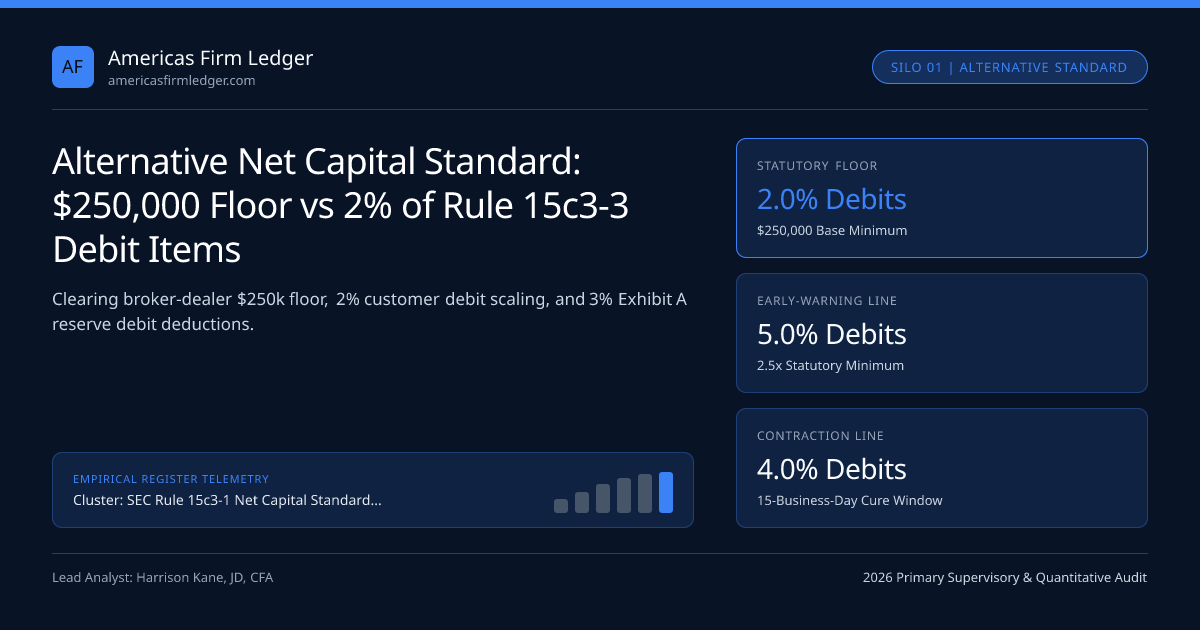
Under 17 CFR 240.15c3-1(a)(1)(ii), a broker-dealer that carries customer accounts may elect the Alternative Net Capital Standard, replacing the 15-to-1 Aggregate Indebtedness test with a minimum Net Capital requirement equal to the greater of $250,000 or 2% of Aggregate Debit Items computed under the SEC Rule 15c3-3 Customer Protection Exhibit A Reserve Formula. Once elected via written notice to FINRA, the election is irrevocable without formal SEC approval and imposes an immediate quid pro quo inside the customer reserve calculation: instead of taking a 1% deduction against aggregate customer debits on Exhibit A, an Alternative Standard firm must take a 3% debit item reduction, increasing cash locked inside its Special Reserve Bank Account.
This dual capital-and-reserve coupling anchors our SEC Rule 15c3-1 Net Capital institutional guide and explains why every major Wall Street self-clearing broker-dealer abandons the Aggregate Indebtedness 15:1 method as soon as margin lending and stock-borrow operations scale.
Why Clearing Firms Elect the 2% Customer Debit Standard#
Under the basic Aggregate Indebtedness method, unsubordinated operating liabilities, street-side stock-borrowed payables not matched against proprietary inventory, and certain clearing house settlement balances inflate AI and consume $6.67$ cents of Net Capital per dollar. By contrast, under the Alternative Standard, non-customer operating liabilities carry zero direct ratio charge; capital adequacy scales strictly alongside customer-related receivables—principally margin loan debit balances governed by FINRA Rule 4210, securities borrowed to cover customer short sales, and customer fails-to-deliver.
Whenever customer margin borrowing crosses $12,500,000 ($12,500,000 × 2% = $250,000), the 2% variable formula overtakes the $250,000 fixed dollar floor (minimum dollar net capital tiers). Digital-first clearing platforms and wealth custodians—comparable in North American retail clearing profile to Axos Invest or cross-border execution desks like Velocity Trade—model both the 2% statutory floor and the 5% early-warning boundary whenever customer margin books expand during equity rallies.
The 3% Exhibit A Debit Penalty & Liquidity Trade-Off#
Electing Rule 15c3-1(a)(1)(ii) alters the firm's weekly or daily Rule 15c3-3 Special Reserve computation under paragraph (a)(1)(ii)(A). A basic AI carrying broker reduces total customer debit items by 1% before subtracting debits from customer credits. An Alternative Standard broker must reduce aggregate debit items by 3%—effectively forcing the broker-dealer to fund an extra 2% of total customer debits in unencumbered cash or qualified US Treasury securities inside its Special Reserve Bank Account.
| Customer Aggregate Debit Volume | Required NC (2% Floor, Min $250k) | Rule 17a-11 Early Warning (5% Debits) | Rule 15c3-1(e) Equity Withdrawal Gate (5%) | Extra 2% Reserve Cash Lockup (3% vs 1% Haircut) | Combined Capital + Extra Reserve Funding |
|---|---|---|---|---|---|
| $8,000,000 (Small Carrying BD) | $250,000 ($250k Floor Binds) | $400,000 (Max 120% Floor or 5%) | $400,000 | $160,000 Extra Reserve Deposit | $410,000 Statutory Minimum |
| $50,000,000 (Regional Clearing) | $1,000,000 | $2,500,000 | $2,500,000 | $1,000,000 Extra Reserve Deposit | $2,000,000 Statutory Minimum |
| $500,000,000 (Mid-Tier Prime) | $10,000,000 | $25,000,000 | $25,000,000 | $10,000,000 Extra Reserve Deposit | $20,000,000 Statutory Minimum |
| $4,200,000,000 (National Clearing) | $84,000,000 | $210,000,000 | $210,000,000 | $84,000,000 Extra Reserve Deposit | $168,000,000 Statutory Minimum |
Worked Quantitative Comparison: AI Method vs Alternative Standard#
Consider a mid-sized clearing broker-dealer carrying $600 million in customer margin receivables, $180 million in securities borrowed for customer short deliveries, and $1,450 million in countable street/operating payables that would otherwise enter Aggregate Indebtedness:
- AltMinimumRequiredNC = max($250,000, 0.02 * GrossCustomer_Debits)
- AltEarlyWarningFloor = max($300,000, 0.05 * GrossCustomer_Debits)
- BasicAIMinimumNC = max($250,000, CountableAI / 15)
- Numerical Break-Even Audit:
- Customer Margin Loans (Net of 1% Allowance) = $600,000,000
- + Securities Borrowed for Customer Shorts = $180,000,000
- + Customer Fails-to-Deliver (< 30 Days) = $20,000,000
- = Gross Aggregate Debit Items = $800,000,000
- 1. Under Basic AI Method (15:1):
- Countable AI = $1,450,000,000 -> Minimum Required NC = $1,450M / 15 = $96,666,667
- Rule 15c3-3 Exhibit A 1% Debit Cut = $8,000,000
- 2. Under Alternative Standard (2% Debits):
- Minimum Required NC = 0.02 * $800,000,000 = $16,000,000 (Saves $80.67M in regulatory minimum!)
- Rule 17a-11 Early-Warning Threshold (5%) = 0.05 * $800,000,000 = $40,000,000
- Rule 15c3-3 Exhibit A 3% Debit Cut = $24,000,000 ($16.0M higher Reserve Bank lockup)
Alternative Standard Supervisory Percentage Gates#
Even after funding the extra $16.0 million in customer reserve deposits and maintaining $48.0 million in actual Net Capital (comfortably above the $40.0 million 5% early-warning threshold), the broker-dealer unlocks nearly $48.67 million in balance-sheet efficiency compared with the 15:1 AI regime.
The Steep 2%-to-5% Early-Warning Cliff#
Unlike the AI method—where early warning sits at 120% of the dollar floor (only 1.2x minimum capital)—the Alternative Standard places its early-warning trigger at 5% of Aggregate Debit Items, which is 2.5 times the 2% statutory minimum! Under FINRA Rule 4120(a)(1)(C) and Rule 15c3-1(e)(2)(vi), dropping below 5% of Aggregate Debit Items simultaneously triggers:
- Immediate 24-hour SEC/FINRA notice under Rule 17a-11(b)(2);
- Complete prohibition on equity capital withdrawals, parent dividends, and subordinated debt prepayments; and
- Prohibition on expanding margin lending, proprietary inventory, or branch count.
Worse still, if Net Capital falls below 4% of Aggregate Debit Items for more than 15 consecutive business days, FINRA Rule 4120(c) empowers FINRA to order immediate business contraction—forcing the clearing firm to liquidate proprietary desks or transfer introduced margin books to rival carrying brokers. Review our companion analysis of FOCUS Part II vs Part IIA reconciliation inside the SEC Rule 15c3-1 Topic Hub to trace how Line 3870 (2% Debit Items) feeds monthly regulatory reporting.
Frequently asked questions
Can a non-carrying introducing broker-dealer elect the $250,000 Alternative Net Capital Standard?
Generally, the Alternative Standard is designed for carrying/clearing firms subject to Rule 15c3-3, though certain non-carrying broker-dealers (such as OTC derivatives dealers or firms maintaining $250,000+ to avoid high AI charges on unsubordinated operating payables) can elect it if they meet all 15c3-1(a)(1)(ii) conditions.
Why is the early-warning level 5% of Aggregate Debit Items when the minimum requirement is only 2%?
Because customer margin loans and stock borrows can contract or default rapidly during market crashes, regulators designed a wide buffer zone between 5% and 2% so FINRA can freeze dividends at 5% and mandate orderly balance-sheet contraction at 4% long before customer assets face insolvency risk.
Are concentrated single-customer margin loans included in Aggregate Debit Items for the 2% calculation?
No, if excluded under Rule 15c3-3 Exhibit A Note E! Margin debits concentrated in a single customer or concentrated collateral exceeding Exhibit A thresholds are disallowed as reserve debits, lowering Aggregate Debit Items while simultaneously increasing required cash in the Special Reserve Bank Account.
Where is the 2% Alternative Net Capital requirement reported on FINRA eFOCUS?
Carrying firms report the 2% computation on Form X-17A-5 FOCUS Report Part II under Computation of Net Capital (Alternative Standard), cross-referencing gross Aggregate Debit Items from the Computation for Determination of Customer Reserve Requirements.
Publication record
- Published
- November 14, 2026
- Updated
- November 14, 2026
- Author
- Harrison Kane, JD, CFA
- Review
- Review not recorded
- Automated fact check
- Passed in the stored pipeline record
- Source URLs
- 4 recorded
AI assistance recorded: anthropic/claude-opus-4.6. This field does not establish human review or source verification.
Academic & Institutional Attribution
Cite This Research & Embed Live Data Card
Standard academic & institutional research paper citation format.
Harrison Kane, JD, CFA. (2026, November 14). Alternative Net Capital Standard: $250,000 Floor vs 2% of Rule 15c3-3 Debit Items. Americas Firm Ledger. https://americasfirmledger.com/filings/sec-15c3-1-alternative-net-capital-2-percent-debit-itemsRegulatory Directory Cross-Reference
Referenced Institutions & Regulatory Registries
Mentioned Regulated Institutions
Related SEC Rule 15c3 1 Net Capital Haircuts & Institutional Briefings
Explore SEC Rule 15c3 1 Net Capital Haircuts Hub (20) →SEC Rule 15c3 1 Net Capital Haircuts
SEC Rule 15c3-1 Net Capital Standards, Haircuts & FOCUS Filings: Institutional GuideSEC Rule 15c3 1 Net Capital Haircuts
SEC Rule 15c3-1 Minimum Dollar Net Capital Tiers: $5k, $50k, $100k, $250k & $1M FloorsSEC Rule 15c3 1 Net Capital Haircuts
Non-Allowable Assets Under SEC Rule 15c3-1(c)(2)(iv): Prepaids, Fixed Assets & ReceivablesSEC Rule 15c3 1 Net Capital Haircuts
Equity Proprietary Position Haircuts (15% Long/Short & 25% Offset) Under SEC Rule 15c3-1SEC Rule 15c3 1 Net Capital Haircuts
U.S. Treasury & Government Agency Debt Haircut Maturity Buckets Under SEC Rule 15c3-1SEC Rule 15c3 1 Net Capital Haircuts
Municipal Securities & Investment-Grade Corporate Bond Haircuts Under SEC Rule 15c3-1SEC Rule 15c3 1 Net Capital Haircuts
Undue Concentration Add-On Haircuts Under SEC Rule 15c3-1(c)(2)(vi)(M): 10% TNC RulesSEC Rule 15c3 1 Net Capital Haircuts
Non-Marketable Securities, Restricted Rule 144 Stock & 100% Blockage Under SEC Rule 15c3-1SEC Rule 15c3 3 Customer Reserve Sipc
Special Reserve Bank Accounts Under SEC Rule 15c3-3: No-Lien Letters & 15% Bank CapsSEC Rule 15c3 3 Customer Reserve Sipc
Qualified Securities in SEC Rule 15c3-3 Reserve Accounts: U.S. Treasury Rules & HaircutsSEC Rule 15c3 3 Customer Reserve Sipc
PAB Reserve Computations for Proprietary Accounts of Broker-Dealers Under SEC Rule 15c3-3SEC Rule 15c3 3 Customer Reserve Sipc
Physical Possession or Control Under SEC Rule 15c3-3(b): Fully Paid & 140% Margin Rules
Americas Firm Ledger Data, Benchmarks & Contributor Records
CC BY 4.0 Open Data
Open Institutional Datasets (CSV / JSON) →
Download desk-compiled quantitative series & schemas.
2026 Reference Matrix
2026 Institutional Benchmarks & Thresholds →
Statutory capital, clearing, margin & rate conventions.
Editorial Records
Authors & Review Records →
View named contributors where those records are available.
Complete Index
Master Research & Dossier Archive →
Browse all published briefings by topic pillar & date.