
SEC Rule 15c3 1 Net Capital Haircuts
Undue Concentration Add-On Haircuts Under SEC Rule 15c3-1(c)(2)(vi)(M): 10% TNC Rules
SEC Rule 15c3-1(c)(2)(vi)(M) imposes an additional 50% haircut surcharge—raising listed equity haircuts from 15% to 22.5% or 30% under specialist scales—on any single-issuer position whose market value exceeds 10% of Tentative Net Capital.
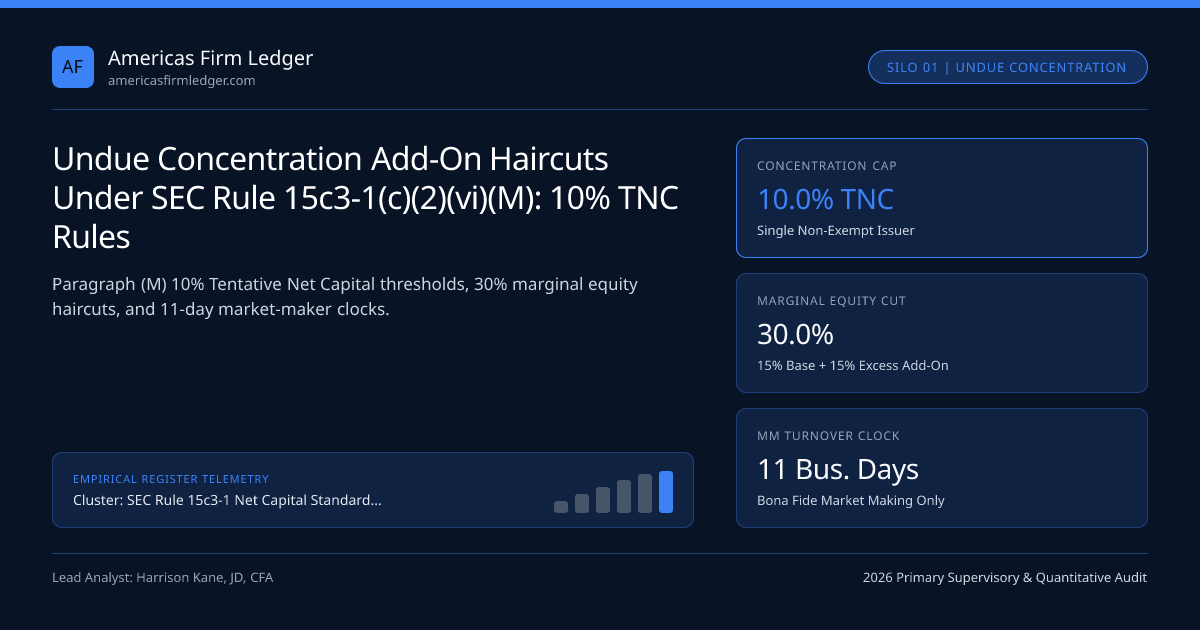
Under 17 CFR 240.15c3-1(c)(2)(vi)(M), whenever a broker-dealer holds a proprietary position in the securities of a single non-exempt issuer whose market value exceeds 10% of Tentative Net Capital (TNC) (after deducting the base haircut under Paragraph M(1), or raw market value > greater of $10,000 or 10% TNC depending on security class), the excess position suffers a steep Undue Concentration add-on haircut. For Paragraph (J) equities, Paragraph (M)(4) doubles the penalty to an extra 15% haircut on the concentrated excess (pushing the marginal haircut rate to 30.0%!), whereas for minimal-credit-risk corporate and preferred securities under Paragraphs (F), (G), and (H), Paragraph (M)(1) adds 50% of the base haircut rate (e.g., lifting an 8% corporate bond haircut to 12.0% on the excess).
This concentration penalty safeguards broker-dealer solvency against single-name gap risk (such as an overnight biotech FDA rejection or corporate fraud halt) inside our SEC Rule 15c3-1 Net Capital institutional guide, compounding equity proprietary haircuts and municipal/corporate bond charges.
Exact Mechanics: Paragraph (M)(1) Debt vs Paragraph (M)(4) Equity Thresholds#
FinOps preparing FOCUS schedules for FINRA must carefully distinguish the two mathematical formulas embedded inside Paragraph (M):
- Paragraph (M)(1) — Debt & Preferred Securities (Paras E, F, G, H): Aggregate all non-exempt debt and preferred CUSIPs of a single corporate issuer (after subtracting the normal base haircut!). If that post-haircut value exceeds 10% of Tentative Net Capital, apply an extra haircut equal to 50% of the normal percentage haircut on the excess amount.
- Paragraph (M)(4) — All Other Securities / Listed Equities (Para J): For any single class or series of an issuer's equity securities with a market value exceeding the greater of $10,000 or 10% of Tentative Net Capital (and also exceeding 500 shares), apply an additional 15% haircut on the market value above the threshold—bringing the marginal deduction on concentrated stock from 15% to 30%!
Crucially, Tentative Net Capital in the 10% denominator is computed before any securities haircuts—meaning non-allowable asset spikes (non-allowable asset rules) shrink TNC, lower the 10% concentration ceiling, and trigger cascading concentration charges across the entire trading book!
The 11-Business-Day Market-Maker & Underwriting Exemptions#
Without temporary inventory relief, wholesale market makers and syndicate underwriters could never absorb institutional block trades or unsold IPO allotments. Paragraph (M) provides three vital time-bounded exemptions:
- 11-Business-Day Bona Fide Market-Making Exemption: Positions acquired in the ordinary course of bona fide market making (or specialist/DMM stabilization) are exempt from undue concentration for 11 business days—provided the position does not exceed moderate volume turnover norms and the dealer actively quotes two-sided markets to liquidate the block. Holding a stagnant speculative position under a "market-making" account code past day 11 triggers immediate FINRA enforcement!
- Underwriting Syndicate Allotment: Unsold allotments from a firm-commitment underwriting are governed first by open contractual commitment rules (underwriting syndicate haircuts) and enter inventory concentration aging upon settlement if retained past 11 business days.
- 20-Business-Day Municipal Rule — Paragraph (M)(2): Municipal securities receive a longer 20-business-day grace window and a higher $500,000 dollar threshold (greater of $500,000 or 10% of TNC).
- Complete Sovereign & Money-Fund Carve-Out: U.S. Treasuries, GSE agency obligations, and registered investment company shares (such as Rule 2a-7 money market funds under SEC staff relief) are exempt from undue concentration.
| Position Held > 11 Business Days (Firm TNC = $20,000,000) | Position Market Value | 10% TNC Threshold ($2,000,000) | Base Haircut ($) | Undue Concentration Excess ($) | Concentration Add-On Charge ($) | Total Combined Haircut ($) |
|---|---|---|---|---|---|---|
| US Treasury 10Y Notes | $15,000,000 | Exempt (Para A) | $675,000 (4.5%) | $0 (Exempt) | $0 | $675,000 (4.50%) |
| Diversified Listed Stock A | $1,800,000 | Below $2,000,000 | $270,000 (15.0%) | $0 | $0 | $270,000 (15.00%) |
| Concentrated Listed Stock B | $7,000,000 | Exceeds $2,000,000 | $1,050,000 (15.0%) | $5,000,000 | $750,000 (+15% on $5M) | $1,800,000 (25.71%) |
| IG 10Y Corporate Bond (7.5% Rate) | $6,000,000 | $5.55M Post-Base > $2M | $450,000 (7.5%) | $3,550,000 | $133,125 (+3.75% on $3.55M) | $583,125 (9.72%) |
| Municipal GO Bond (Held 24 Days, 6%) | $5,000,000 | Exceeds $2,000,000 (>20d) | $300,000 (6.0%) | $3,000,000 | $150,000 (+50%/Spec Scale) | $450,000 (9.00%) |
Worked Quantitative Stress Test: TNC Drop Triggering Cascading Concentration#
Watch how a $4.0 million parent loan non-allowable deduction shrinks TNC and triggers an unexpected undue concentration penalty on an unchanged equity block at a mid-market dealer comparable to North American trading firms in our registrants roll:
- EquityUndueConcentrationAddOn = 0.15 * max(0, SingleIssuerMV - TNCThreshold_Equity) [if Held > 11 Bus. Days]
- TotalSingleStockHaircut = (0.15 * SingleIssuerMV) + EquityUndueConcentrationAddOn
- Worked Cascade Stress Scenario:
- Single-Name Equity Block Held 14 Business Days = $5,500,000 (110,000 shares @ $50)
- Scenario A (Before Parent Loan — TNC = $60,000,000):
- 10% TNC Threshold = 0.10 * $60,000,000 = $6,000,000
- Since $5.50M < $6.00M -> Undue Concentration Add-On = $0
- Total Haircut = 15% * $5,500,000 = $825,000
- Scenario B (Firm Wires $25,000,000 Unsecured Advance to Parent — TNC Drops to $35,000,000):
- New 10% TNC Threshold = 0.10 * $35,000,000 = $3,500,000
- Concentrated Excess = $5,500,000 - $3,500,000 = $2,000,000
- Undue Conc. Add-On = 0.15 * $2,000,000 = $300,000
- New Total Haircut = $825,000 + $300,000 = $1,125,000 (+36.4% Haircut Jump!)
Base vs Undue-Concentrated Marginal Haircut Rates#
FINRA Enforcement Against "11-Day Parking" & ETF Concentration#
FINRA Market Regulation algorithms flag any broker-dealer that sells a concentrated block to a friendly street counterparty on Business Day 10 and repurchases the identical block on Business Day 12 ("parking" to reset the 11-business-day undue concentration clock)—treating parked positions as sham transactions under FINRA Rule 2010 and SEC Rule 15c3-1. Also note that while Rule 2a-7 money market funds enjoy concentration relief, single-sector ETFs or leveraged ETPs held past 11 business days are subject to the 10% TNC undue concentration test unless covered by specific broad-based index basket relief. Next, see what happens when inventory lacks a ready market altogether in our guide to non-marketable securities & 100% blockage deductions inside the SEC Rule 15c3-1 Topic Hub.
Frequently asked questions
Are U.S. Treasury bonds or agency MBS subject to the 10% Tentative Net Capital undue concentration charge?
No. Paragraph (M)(1) explicitly exempts securities covered by Paragraph (A)—meaning U.S. Government obligations and qualifying federal agency securities can exceed 10% or even 100% of Tentative Net Capital with zero undue concentration surcharge.
Do common stock and corporate bonds of the same company get combined for undue concentration?
Paragraph (M)(1) aggregates debt and preferred issues of the same issuer, while Paragraph (M)(4) tests each class or series of equity securities; however, FINRA examiners scrutinize cross-capital-structure exposure and require issuer-level aggregation across affiliated obligors where parent guarantees apply.
Does holding a large cash balance in a single Rule 2a-7 money market fund trigger undue concentration?
Under longstanding SEC Trading and Markets staff interpretations, shares of open-end registered investment companies—specifically diversified Rule 2a-7 government and prime money market funds—are not hit with single-issuer undue concentration charges.
Can a non-market-maker proprietary trading desk use the 11-business-day concentration exemption?
No! For non-market-making investment or proprietary trading accounts, undue concentration applies immediately on Trade Date (Day 1). Only bona fide market-making positions actively quoted to the street qualify for the 11-business-day turnover window.
Publication record
- Published
- November 14, 2026
- Updated
- November 15, 2026
- Author
- Harrison Kane, JD, CFA
- Review
- Review not recorded
- Automated fact check
- Passed in the stored pipeline record
- Source URLs
- 4 recorded
AI assistance recorded: anthropic/claude-opus-4.6. This field does not establish human review or source verification.
Academic & Institutional Attribution
Cite This Research & Embed Live Data Card
Standard academic & institutional research paper citation format.
Harrison Kane, JD, CFA. (2026, November 15). Undue Concentration Add-On Haircuts Under SEC Rule 15c3-1(c)(2)(vi)(M): 10% TNC Rules. Americas Firm Ledger. https://americasfirmledger.com/filings/sec-15c3-1-undue-concentration-add-on-haircuts-10-percentRegulatory Directory Cross-Reference
Referenced Institutions & Regulatory Registries
Top Regulated Institutions in This Coverage Slice
Related SEC Rule 15c3 1 Net Capital Haircuts & Institutional Briefings
Explore SEC Rule 15c3 1 Net Capital Haircuts Hub (20) →SEC Rule 15c3 1 Net Capital Haircuts
SEC Rule 15c3-1 Net Capital Standards, Haircuts & FOCUS Filings: Institutional GuideSEC Rule 15c3 1 Net Capital Haircuts
Non-Marketable Securities, Restricted Rule 144 Stock & 100% Blockage Under SEC Rule 15c3-1SEC Rule 15c3 1 Net Capital Haircuts
SEC Rule 15c3-1a Appendix A Listed Options Theoretical Pricing Haircuts & OCC TIMSSEC Rule 15c3 1 Net Capital Haircuts
ANC Broker-Dealers Under SEC Rule 15c3-1e: $5 Billion Tentative Net Capital & VaR ModelsSEC Rule 15c3 1 Net Capital Haircuts
Appendix D Subordinated Loan Agreements & Revolving Subordinations Under FINRA Rule 4110SEC Rule 15c3 1 Net Capital Haircuts
Open Contractual Commitments & Firm-Commitment Underwriting Haircuts Under SEC Rule 15c3-1SEC Rule 15c3 1 Net Capital Haircuts
Repo & Reverse-Repo Net Capital Deficits and SEC FICC Treasury Clearing OffsetsSEC Rule 15c3 1 Net Capital Haircuts
SEC Rule 17a-11 Early Warning & Capital Deficiency Notices: 120%, 12:1 & 5% TriggersSEC Rule 15c3 3 Customer Reserve Sipc
T+1 Settlement Compression: Aged Fail-to-Receive Credits, Fail-to-Deliver Debits & HaircutsSEC Rule 15c3 3 Customer Reserve Sipc
SEC Rule 15c3-3(b)(3) Fully Paid Securities Lending: FINRA Collateral & SIPC RulesSEC Rule 15c3 3 Customer Reserve Sipc
SEC Rule 15c3-3(j) Free Credit Balances & FDIC Bank Sweep Disclosures for Broker-DealersSEC Rule 15c3 3 Customer Reserve Sipc
SEC Rule 15c3-3(k) Exemptions Explained: (k)(1), (k)(2)(i), (k)(2)(ii) & Footnote 74
Americas Firm Ledger Data, Benchmarks & Contributor Records
CC BY 4.0 Open Data
Open Institutional Datasets (CSV / JSON) →
Download desk-compiled quantitative series & schemas.
2026 Reference Matrix
2026 Institutional Benchmarks & Thresholds →
Statutory capital, clearing, margin & rate conventions.
Editorial Records
Authors & Review Records →
View named contributors where those records are available.
Complete Index
Master Research & Dossier Archive →
Browse all published briefings by topic pillar & date.