
SEC Rule 15c3 1 Net Capital Haircuts
Non-Marketable Securities, Restricted Rule 144 Stock & 100% Blockage Under SEC Rule 15c3-1
SEC Rule 15c3-1(c)(2)(vii) imposes a 100% Net Capital deduction on any proprietary security lacking a ready market—including unregistered Reg D shares, underwriter warrants, legend-restricted Rule 144 stock, and microcap blocks exceeding four-week trading volume.
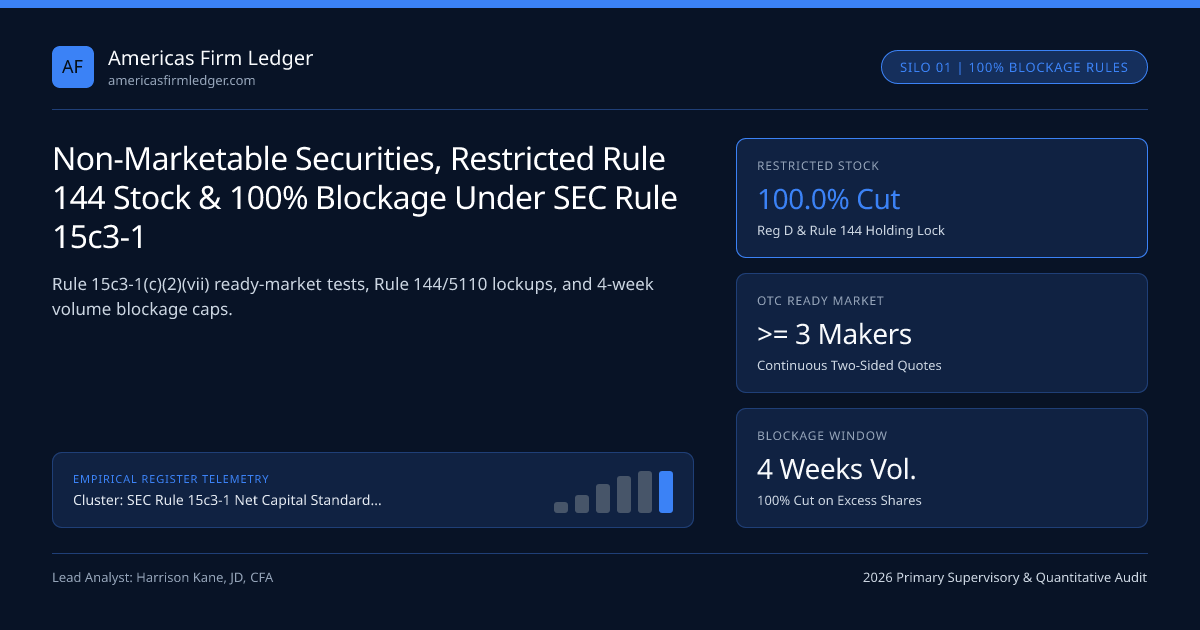
Under 17 CFR 240.15c3-1(c)(2)(vii), any proprietary security held by a broker-dealer for which there is no ready market—or which cannot be publicly offered or sold because of statutory, regulatory, or contractual restrictions—suffers an immediate 100% Net Capital deduction. Even when a stock trades on NASDAQ or OTCQX with three or more market makers, FINRA's Marketplace Blockage Rule applies a 100% deduction to the portion of a broker-dealer's position that exceeds the aggregate trading volume of the preceding four calendar weeks, preventing thinly traded microcap inventory from artificially propping up regulatory capital.
This marketability gate fortifies our SEC Rule 15c3-1 Net Capital institutional guide, extending 10% TNC undue concentration surcharges and linking directly to private-market exemptions under SEC Regulation D.
Defining a "Ready Market" Under Rule 15c3-1(c)(11)#
A security escapes Paragraph (c)(2)(vii)'s 100% deduction only if the broker-dealer proves a ready market under one of two prongs in Rule 15c3-1(c)(11):
- Direct Marketability — Paragraph (c)(11)(i): The security trades on a registered US national securities exchange (NYSE, NASDAQ, Cboe), a recognized foreign stock exchange (FTSE 100 / major sovereign exchanges meeting SEC criteria), or an interdealer quotation system with bona fide continuous two-sided bid and ask quotes from at least three independent market makers capable of settling normal institutional size within T+1.
- Constructive Collateral Marketability — Paragraph (c)(11)(ii): Even if unquoted on an exchange, securities pledged as collateral for an overnight/demand bank loan at a US commercial bank supervised by the OCC, Federal Reserve, or FDIC are deemed to have a ready market strictly up to the dollar amount actually borrowed (or committed under an unconditional bank line) where the bank accepts the securities as sole collateral!
Restricted Stock, FINRA Rule 5110 Warrants & Private Tokenized Securities#
Investment banks, venture placement agents, and alternative asset platforms—operating alongside private-market portals like Atlas One or venture registrants like Blockchain Capital—frequently accept equity warrants or restricted shares as placement compensation. Every FinOp must apply these bright-line deductions:
- FINRA Rule 5110 Underwriter Compensation Warrants: Under FINRA Rule 5110(e)(1), securities acquired as underwriting compensation are locked up from sale, transfer, or hedging for 180 days following effectiveness of the SEC EDGAR S-1 registration statement. Throughout that 180-day lockup, the shares/warrants carry a 100% non-marketable haircut!
- Rule 144 Restricted & Affiliate Control Shares: Unregistered shares acquired in a Regulation D Rule 506(b)/506(c) offering carry a 100% deduction during the 6-month (reporting issuer) or 12-month (non-reporting issuer) Rule 144 holding period. Even after legend removal becomes legally available, shares subject to Rule 144(e) volume dribble-out limits (1% of outstanding shares or 4-week average weekly volume) are marketable only up to the immediately saleable volume slice.
- Rule 144A Institutional Corporate Debt Exception: Although Rule 144A bonds are technically restricted to Qualified Institutional Buyers (QIBs), SEC staff interpretations permit Paragraph (F) or (J) ready-market treatment if the issue is investment-grade (or liquidly traded on FINRA TRACE-144A) with continuous two-sided institutional dealer liquidity.
- Unlisted Private Digital Securities / ATS-Only Tokens: Security tokens traded solely on a low-volume Alternative Trading System without three independent continuous dealer quotes or exchange listing receive a 100% deduction on the broker-dealer's balance sheet.
| Proprietary Security Type | Fair Value on GAAP Balance Sheet | Governing 15c3-1 Citation | Ready Market Recognized? | Net Capital Deduction (%) | Allowable Post-Haircut Value |
|---|---|---|---|---|---|
| Reg D Rule 506(c) Pre-IPO Preferred | $2,000,000 | 15c3-1(c)(2)(vii) | No (Statutory Resale Lock) | 100.0% ($2,000,000) | $0 |
| FINRA Rule 5110 IPO Warrants (Day 90) | $850,000 | 15c3-1(c)(2)(vii) + FINRA 5110 | No (180-Day Lockup) | 100.0% ($850,000) | $0 |
| Liquid 144A IG Corporate Note (TRACE Active) | $5,000,000 | SEA 15c3-1(c)(11)/01 | Yes (QIB Dealer Market) | 7.0% ($350,000) | $4,650,000 |
| OTC Equity w/ 2 Independent Market Makers | $600,000 | 15c3-1(c)(2)(vi)(K)(i) | Limited Market | 40.0% ($240,000) | $360,000 |
| Thin Microcap (500k Shares; 4-Wk Vol = 180k) | $2,500,000 (@ $5/sh) | SEA 15c3-1(c)(2)(vii) Blockage | 180k Sh Yes / 320k Sh No | $135k + $1.60M (69.4% Eff.) | $765,000 |
Worked Quantitative Model: Marketplace Blockage + Undue Concentration#
FINRA's Marketplace Blockage interpretation (SEA Rule 15c3-1(c)(2)(vii)/01) catches small-cap investment banks off guard when they accumulate inventory in an illiquid NASDAQ Capital Market or OTCQX ticker. Let us run the exact combined Blockage + Base Haircut + Undue Concentration math:
- BlockedShares = max(0, PositionShares - Marketable_Shares)
- Blockage100PctCut = BlockedShares * Market_Price
- MarketableSliceMV = MarketableShares * MarketPrice
- MarketableHaircut = (0.15 * MarketableSliceMV) + (0.15 * max(0, MarketableSlice_MV - max($10,000, 0.10 * TNC)))
- Worked Small-Cap Dealer Blockage Audit (Firm TNC = $4,000,000):
- Proprietary Holding: 500,000 unrestricted shares of Ticker XYZ @ $5.00 = $2,500,000 GAAP Value
- Preceding 4-Week Consolidated Tape Volume (Excluding Firm's Own Crosses) = 180,000 shares
- Step 1 (Blockage Cut):
- Marketable Slice = 180,000 shares * $5.00 = $900,000
- Blocked Slice = 320,000 shares * $5.00 = $1,600,000 -> 100% Deduction = $1,600,000
- Step 2 (Base 15% Equity Haircut on $900,000 Marketable Slice):
- Base Haircut = 0.15 * $900,000 = $135,000
- Step 3 (Undue Concentration on $900,000 vs 10% TNC = $400,000, Held > 11 Bus. Days):
- Excess Marketable = $900,000 - $400,000 = $500,000
- 15% Add-On = 0.15 * $500,000 = $75,000
- Total Net Capital Deduction = $1,600,000 + $135,000 + $75,000 = $1,810,000 (72.4% Effective Haircut!)
- Allowable Net Capital Value = $2,500,000 - $1,810,000 = $690,000
Marketability & Liquidity Haircut Cliff#
ASC 820 Fair Value vs Regulatory Net Capital Reality#
Corporate controllers transitioning from private equity funds to registered broker-dealers frequently assume that an independent Big-Four ASC 820 Level 3 valuation report allows private shares to support Net Capital at a 30% or 50% discount. Under SEC and FINRA rules, ASC 820 fair value increases GAAP equity, only to be 100% reversed out on the Net Capital schedule—and worse, if the broker-dealer booked a deferred tax liability on an unrealized Level 3 write-up without matching it cleanly under Rule 15c3-1(c)(2)(i)(C), sloppy tax accounting can actually reduce Net Capital! Next, explore how listed options desks replace flat percentage cuts with shock matrices in our guide to Appendix A theoretical option pricing haircuts across the SEC Rule 15c3-1 Topic Hub.
Frequently asked questions
Can a broker-dealer count FINRA Rule 5110 underwriter warrants toward Net Capital if the underlying stock trades on NASDAQ?
No, not during the mandatory 180-day FINRA Rule 5110(e)(1) lockup period following registration effectiveness, because contractual/regulatory resale prohibitions render the warrants non-marketable (100% deduction) under Rule 15c3-1(c)(2)(vii).
How are Rule 144A corporate bonds treated if they are restricted solely to QIBs?
Under SEC Trading and Markets interpretations, unregistered Rule 144A corporate debt securities with minimal credit risk (or active institutional two-sided dealer quotes on TRACE) qualify as having a ready market and take standard Paragraph (F) or (J) haircuts rather than 100%.
Does a broker-dealer's own trading volume count toward the 4-week Marketplace Blockage volume test?
No. When testing whether a concentrated microcap block can be absorbed by the street within four calendar weeks, FINRA excludes the broker-dealer's own proprietary trading volume so a dealer cannot manufacture illusory liquidity.
How does the bank-loan ready-market prong in Rule 15c3-1(c)(11)(ii) work?
If a supervised US bank lends cash to the broker-dealer secured solely by otherwise unquoted securities (without parent guarantees), the securities are deemed marketable up to the actual loan proceeds, neutralizing the 100% deduction up to the borrowed amount.
Publication record
- Published
- November 14, 2026
- Updated
- November 14, 2026
- Author
- Harrison Kane, JD, CFA
- Review
- Review not recorded
- Automated fact check
- Passed in the stored pipeline record
- Source URLs
- 4 recorded
AI assistance recorded: anthropic/claude-opus-4.6. This field does not establish human review or source verification.
Academic & Institutional Attribution
Cite This Research & Embed Live Data Card
Standard academic & institutional research paper citation format.
Harrison Kane, JD, CFA. (2026, November 14). Non-Marketable Securities, Restricted Rule 144 Stock & 100% Blockage Under SEC Rule 15c3-1. Americas Firm Ledger. https://americasfirmledger.com/filings/sec-15c3-1-non-marketable-securities-100-percent-blockageRegulatory Directory Cross-Reference
Referenced Institutions & Regulatory Registries
Top Regulated Institutions in This Coverage Slice
Related SEC Rule 15c3 1 Net Capital Haircuts & Institutional Briefings
Explore SEC Rule 15c3 1 Net Capital Haircuts Hub (20) →SEC Rule 15c3 1 Net Capital Haircuts
SEC Rule 15c3-1 Net Capital Standards, Haircuts & FOCUS Filings: Institutional GuideSEC Rule 15c3 1 Net Capital Haircuts
SEC Rule 15c3-1a Appendix A Listed Options Theoretical Pricing Haircuts & OCC TIMSSEC Rule 15c3 1 Net Capital Haircuts
ANC Broker-Dealers Under SEC Rule 15c3-1e: $5 Billion Tentative Net Capital & VaR ModelsSEC Rule 15c3 1 Net Capital Haircuts
Appendix D Subordinated Loan Agreements & Revolving Subordinations Under FINRA Rule 4110SEC Rule 15c3 1 Net Capital Haircuts
Open Contractual Commitments & Firm-Commitment Underwriting Haircuts Under SEC Rule 15c3-1SEC Rule 15c3 1 Net Capital Haircuts
Repo & Reverse-Repo Net Capital Deficits and SEC FICC Treasury Clearing OffsetsSEC Rule 15c3 1 Net Capital Haircuts
SEC Rule 17a-11 Early Warning & Capital Deficiency Notices: 120%, 12:1 & 5% TriggersSEC Rule 15c3 1 Net Capital Haircuts
Equity Capital Withdrawal Restrictions & FINRA Rule 4110/4120 Expansion ControlsSEC Rule 15c3 3 Customer Reserve Sipc
SEC Rule 15c3-3(b)(3) Fully Paid Securities Lending: FINRA Collateral & SIPC RulesSEC Rule 15c3 3 Customer Reserve Sipc
SEC Rule 15c3-3(j) Free Credit Balances & FDIC Bank Sweep Disclosures for Broker-DealersSEC Rule 15c3 3 Customer Reserve Sipc
SEC Rule 15c3-3(k) Exemptions Explained: (k)(1), (k)(2)(i), (k)(2)(ii) & Footnote 74SEC Rule 15c3 3 Customer Reserve Sipc
SEC Rule 17a-5 Annual Broker-Dealer Audits: PCAOB AT-1 Compliance vs AT-2 Exemption Reports
Americas Firm Ledger Data, Benchmarks & Contributor Records
CC BY 4.0 Open Data
Open Institutional Datasets (CSV / JSON) →
Download desk-compiled quantitative series & schemas.
2026 Reference Matrix
2026 Institutional Benchmarks & Thresholds →
Statutory capital, clearing, margin & rate conventions.
Editorial Records
Authors & Review Records →
View named contributors where those records are available.
Complete Index
Master Research & Dossier Archive →
Browse all published briefings by topic pillar & date.