
SEC Rule 15c3 1 Net Capital Haircuts
Municipal Securities & Investment-Grade Corporate Bond Haircuts Under SEC Rule 15c3-1
SEC Rule 15c3-1 assigns maturity-tiered haircuts of 1% to 7% for municipal bonds under Paragraph (B) and 2% to 9% for minimal-credit-risk corporate debt under Paragraph (F), while sub-investment-grade high-yield bonds suffer 15% to 100% deductions.
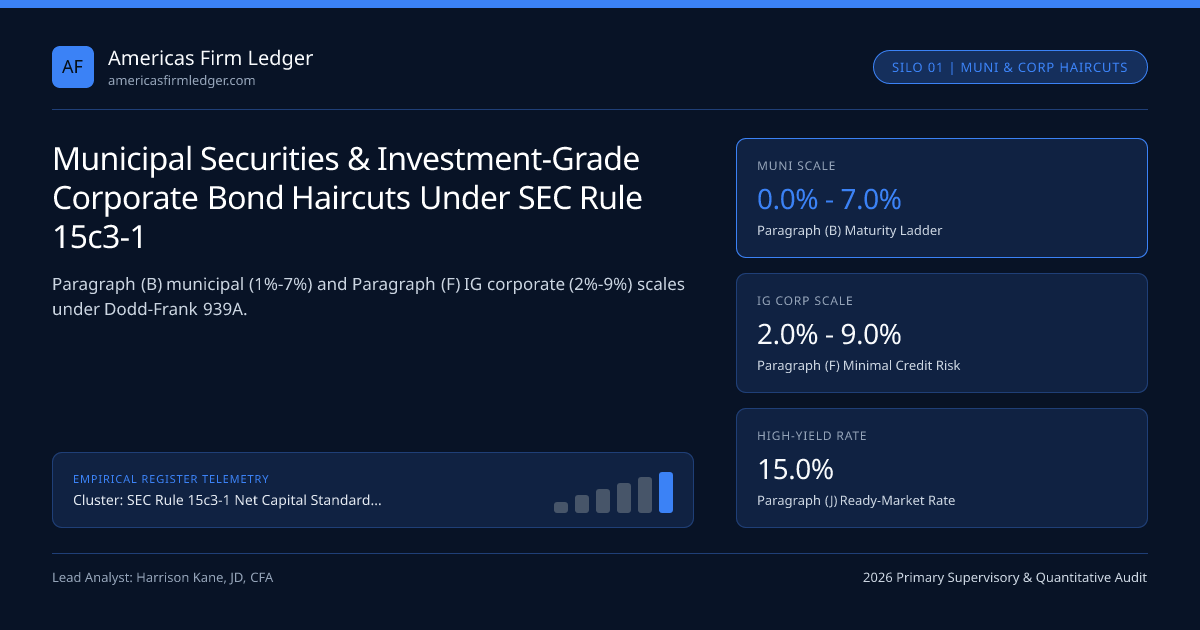
Under 17 CFR 240.15c3-1(c)(2)(vi)(B) and (F), registered broker-dealers carrying proprietary municipal and nonconvertible corporate debt apply two distinct credit-and-maturity ladders: qualifying municipal obligations take 0% to 7.0% haircuts across eight maturity tiers, while commercial paper takes 0% to 0.5% and investment-grade corporate bonds exhibiting "only a minimal amount of credit risk" take 2.0% to 9.0% across five maturity brackets. Following the SEC's Dodd-Frank Section 939A rulemaking removing mandatory NRSRO credit-rating reliance, a broker-dealer cannot mechanically point to Moody's or S&P letters alone—it must maintain documented internal creditworthiness policies verified during FINRA and PCAOB AS 2701 examinations, or else its corporate bond inventory defaults to the punitive 15% Paragraph (J) all-other-securities haircut!
This credit-sensitive fixed-income framework extends our SEC Rule 15c3-1 Net Capital institutional guide, sitting between US Treasury & agency maturity buckets and 10% TNC undue concentration surcharges.
Dodd-Frank Section 939A "Minimal Credit Risk" Governance#
Under amended Rule 15c3-1(c)(2)(vi)(E) (commercial paper) and Paragraph (F) (nonconvertible corporate debt), a broker-dealer may apply the favorable 2%–9% corporate debt table only if the security has a ready market and the firm determines—through written policies and procedures—that the issuer possesses only a minimal amount of credit risk.
Per SEC Release No. 34-71194, compliant broker-dealer credit files weigh up to eight objective factors (which may still include external NRSRO ratings as one input among others):
- Credit spreads relative to comparable-maturity U.S. Treasuries and sector OAS medians;
- Yield-to-worst and secondary TRACE trade frequency/bid-ask dispersion;
- Leverage, interest-coverage ratios, and upcoming maturity walls from SEC EDGAR Corporate Reporting 10-K/10-Q filings; and
- Structural subordination or covenant erosion.
If FINRA examiners determine that a bond trading at +650 bps over Treasuries was left in the 7% minimal-credit-risk bucket merely because a stale BBB- rating had not yet been downgraded, FINRA reclassifies the bond to 15% (or 40%–100% if TRACE liquidity is thin), retroactively slashing Net Capital.
Side-by-Side Municipal (Paragraph B) vs Corporate (Paragraph F) Scales#
Unlike U.S. Treasuries, both municipal bonds (above exempt thresholds) and corporate bonds ARE subject to undue concentration add-ons if a single issuer exceeds 10% of Tentative Net Capital. Furthermore, municipal securities scheduled to mature in under 1 year ("short-term municipal notes" under Paragraph (B)(1)) follow dedicated sub-year tiers, while serial and long-term municipal bonds follow Paragraph (B)(2):
| Remaining Time to Maturity | Municipal Bonds: Para (B)(1)/(2) Haircut | IG Corporate Debt: Para (F)(1) Haircut | Commercial Paper: Para (E) Haircut | High-Yield / Non-Minimal Risk (Ready Market) | Unquoted / Defaulted / Non-Marketable |
|---|---|---|---|---|---|
| Less than 30 days | 0.0% (Muni Note) / 1.0% (Bond) | 2.0% (< 1 Year Bucket) | 0.0% (< 30 Days) | 15.0% (Paragraph J) | 100.0% Deduction |
| 30 days to < 9 months | 0.5% - 1.0% (Muni Note) | 2.0% (< 1 Year Bucket) | 0.125% to 0.50% | 15.0% (Paragraph J) | 100.0% Deduction |
| 1 year to < 2 years | 2.0% | 3.0% (1 to < 2 Years) | N/A (> 270 Days = Note) | 15.0% (Paragraph J) | 100.0% Deduction |
| 2 years to < 5 years | 3.0% (2-3.5y) / 4.0% (3.5-5y) | 5.0% (2 to < 3y) / 6.0% (3 to < 5y) | N/A | 15.0% (Paragraph J) | 100.0% Deduction |
| 5 years to < 15 years | 5.0% (5-7y) / 5.5% (7-10y) / 6.0% (10-15y) | 7.0% (5 to < 10y) / 7.5% (10 to < 15y) | N/A | 15.0% (Paragraph J) | 100.0% Deduction |
| 15 years to 25+ years | 6.5% (15-20y) / 7.0% (20+ yrs) | 8.0% (15 to < 25y) / 9.0% (25+ yrs) | N/A | 15.0% (Paragraph J) | 100.0% Deduction |
Convertible Corporate Bonds (Paragraph G) & Hedging Offsets#
Convertible corporate debt under Rule 15c3-1(c)(2)(vi)(G) occupies a hybrid regime:
- If a minimal-credit-risk convertible bond trades at or above 100% of par (face value), it behaves primarily like an equity derivative and incurs the 15% equity haircut (unless hedged dollar-for-dollar by shorting the underlying common shares into which it is immediately convertible, reducing the charge to conversion spread/friction costs).
- If that same minimal-credit-risk convertible bond trades below 100% of par ("busted convertible"), it behaves like straight fixed income and qualifies for the 2%–9% Paragraph (F) corporate bond schedule!
Similarly, under Paragraph (F)(2), institutional corporate bond dealers hedging long investment-grade corporate bonds with short U.S. Treasury notes (or short IG corporate bonds in the same or adjacent maturity categories) reduce the hedged corporate pair haircut dramatically—retaining 50% (or lower spread factors) of the corporate rate rather than paying unhedged charges on both the corporate bond and the Treasury hedge.
- IGCorpvsTreasuryHedgedCut (Same Maturity Bucket, >= $25k) = 0.50 * ParaFRatek * HedgedMV + ParaFRatek * Unhedged_MV
- Worked Corporate Credit Desk Calculation:
- 1. $40,000,000 Long 8-Year IG Corporate Notes (Minimal Credit Risk, 5-10Y Bucket: 7.0% Rate)
- Hedged with $30,000,000 Short 8-Year US Treasury Notes (Same 5-10Y Maturity Subcategory):
- Hedged $30M Credit Spread Pair (Half of 7.0% Rate = 3.5%): $30,000,000 * 3.5% = $1,050,000
- Unhedged $10M IG Corporate Residual (Full 7.0% Rate): $10,000,000 * 7.0% = $700,000
- Subtotal IG Corporate Desk Haircut = $1,750,000 (vs $4.0M Gross Unnetted!)
- 2. $15,000,000 Long 6-Year High-Yield BB- Bond (Active TRACE Quotes, Fails Minimal-Risk Test):
- Reclassified to Paragraph (J) 15% Rate: $15,000,000 * 15.0% = $2,250,000
- 3. $20,000,000 Long 12-Year General Obligation Municipal Bonds (Para B, 10-15Y: 6.0% Rate):
- Muni Haircut: $20,000,000 * 6.0% = $1,200,000
- Total Fixed-Income Haircut = $1,750,000 + $2,250,000 + $1,200,000 = $5,200,000
10-Year Benchmark Bond Haircuts Across Credit Tiers#
Non-Marketable Conduit Municipals & Distressed Debt Traps#
Broker-dealers underwriting small-issue industrial development revenue bonds, charter-school municipal dirt bonds, or private Rule 144A high-yield tranches must verify secondary marketability every business day. Under MSRB/FINRA interpretations of SEC Rule 15c3-1, a municipal bond that defaults on interest or lacks independent secondary dealer bids loses Paragraph (B) eligibility and takes a 100% non-marketable deduction unless FINRA approves a specific partial marketability valuation. Next, inspect how oversized single-issuer bond or stock holdings trigger penalty surcharges in our guide to undue concentration 10% TNC add-on haircuts within the SEC Rule 15c3-1 Topic Hub.
Frequently asked questions
Can a broker-dealer still look at S&P, Moody's, or Fitch ratings when applying Paragraph (F) corporate haircuts?
Yes. SEC Release 34-71194 permits broker-dealers to incorporate external NRSRO credit ratings as one factor inside written creditworthiness procedures, provided the firm also monitors objective market indicators like OAS credit spreads and issuer financials and downgrades stale-rated fallen angels.
How are convertible corporate bonds haircut when trading below par value?
Under Rule 15c3-1(c)(2)(vi)(G), a minimal-credit-risk convertible debt security selling below 100% of principal ("busted convertible") takes the lower 2% to 9% Paragraph (F) corporate debt haircut, whereas convertibles trading at or above par take the 15% equity haircut unless hedged.
What haircut applies to Tier-1 commercial paper held in corporate treasury?
Minimal-credit-risk commercial paper maturing in less than 9 months with a ready market qualifies under Paragraph (E) for haircuts ranging from 0% (<30 days) to 0.25% (91-180 days) and 0.50% (181-270 days).
Are municipal bonds exempt from undue concentration charges like U.S. Treasuries?
Not unconditionally. Municipal securities face customized concentration thresholds under Rule 15c3-1(c)(2)(vi)(M)(2)—generally triggering additional haircuts when single-issuer positions held over 20 business days exceed the greater of $500,000 or 10% of Tentative Net Capital.
Publication record
- Published
- November 14, 2026
- Updated
- November 14, 2026
- Author
- Harrison Kane, JD, CFA
- Review
- Review not recorded
- Automated fact check
- Passed in the stored pipeline record
- Source URLs
- 4 recorded
AI assistance recorded: anthropic/claude-opus-4.6. This field does not establish human review or source verification.
Academic & Institutional Attribution
Cite This Research & Embed Live Data Card
Standard academic & institutional research paper citation format.
Harrison Kane, JD, CFA. (2026, November 14). Municipal Securities & Investment-Grade Corporate Bond Haircuts Under SEC Rule 15c3-1. Americas Firm Ledger. https://americasfirmledger.com/filings/sec-15c3-1-municipal-investment-grade-corporate-bond-haircutsRegulatory Directory Cross-Reference
Referenced Institutions & Regulatory Registries
Top Regulated Institutions in This Coverage Slice
Related SEC Rule 15c3 1 Net Capital Haircuts & Institutional Briefings
Explore SEC Rule 15c3 1 Net Capital Haircuts Hub (20) →SEC Rule 15c3 1 Net Capital Haircuts
SEC Rule 15c3-1 Net Capital Standards, Haircuts & FOCUS Filings: Institutional GuideSEC Rule 15c3 1 Net Capital Haircuts
Undue Concentration Add-On Haircuts Under SEC Rule 15c3-1(c)(2)(vi)(M): 10% TNC RulesSEC Rule 15c3 1 Net Capital Haircuts
Non-Marketable Securities, Restricted Rule 144 Stock & 100% Blockage Under SEC Rule 15c3-1SEC Rule 15c3 1 Net Capital Haircuts
SEC Rule 15c3-1a Appendix A Listed Options Theoretical Pricing Haircuts & OCC TIMSSEC Rule 15c3 1 Net Capital Haircuts
ANC Broker-Dealers Under SEC Rule 15c3-1e: $5 Billion Tentative Net Capital & VaR ModelsSEC Rule 15c3 1 Net Capital Haircuts
Appendix D Subordinated Loan Agreements & Revolving Subordinations Under FINRA Rule 4110SEC Rule 15c3 1 Net Capital Haircuts
Open Contractual Commitments & Firm-Commitment Underwriting Haircuts Under SEC Rule 15c3-1SEC Rule 15c3 1 Net Capital Haircuts
Repo & Reverse-Repo Net Capital Deficits and SEC FICC Treasury Clearing OffsetsSEC Rule 15c3 3 Customer Reserve Sipc
Possession or Control Deficits Under SEC Rule 15c3-3(d): T+1 Turnaround & Buy-In ClocksSEC Rule 15c3 3 Customer Reserve Sipc
T+1 Settlement Compression: Aged Fail-to-Receive Credits, Fail-to-Deliver Debits & HaircutsSEC Rule 15c3 3 Customer Reserve Sipc
SEC Rule 15c3-3(b)(3) Fully Paid Securities Lending: FINRA Collateral & SIPC RulesSEC Rule 15c3 3 Customer Reserve Sipc
SEC Rule 15c3-3(j) Free Credit Balances & FDIC Bank Sweep Disclosures for Broker-Dealers
Americas Firm Ledger Data, Benchmarks & Contributor Records
CC BY 4.0 Open Data
Open Institutional Datasets (CSV / JSON) →
Download desk-compiled quantitative series & schemas.
2026 Reference Matrix
2026 Institutional Benchmarks & Thresholds →
Statutory capital, clearing, margin & rate conventions.
Editorial Records
Authors & Review Records →
View named contributors where those records are available.
Complete Index
Master Research & Dossier Archive →
Browse all published briefings by topic pillar & date.