
SEC Rule 15c3 3 Customer Reserve Sipc
SEC Rule 15c3-3 Customer Protection, Reserve Formula & SIPC Limits: Institutional Guide
SEC Rule 15c3-3 compels carrying broker-dealers to segregate net customer cash inside Special Reserve Bank Accounts, maintain physical possession or control of fully paid and excess margin securities, and preserve SIPA customer property ahead of SIPC $500,000 protection.
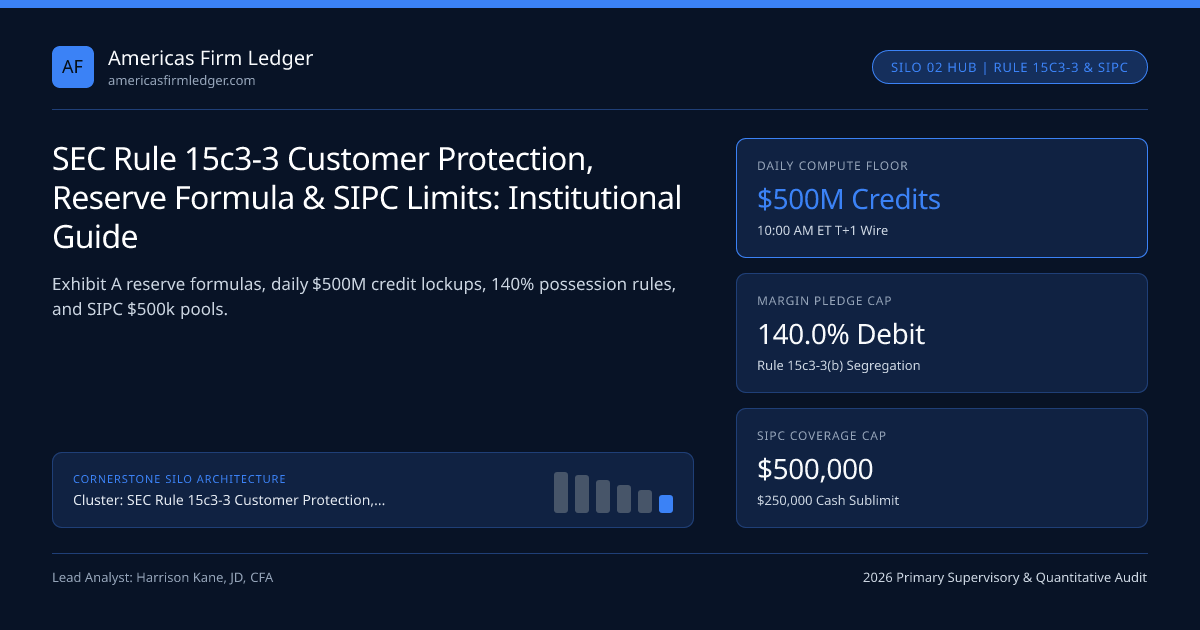
Enacted alongside the Securities Investor Protection Act of 1970, 17 CFR 240.15c3-3—the SEC Rule 15c3-3 Customer Protection Standard—forbids registered U.S. carrying broker-dealers from using customer cash or fully paid securities to finance proprietary trading desks or firm overhead. Supervised jointly by the U.S. Securities and Exchange Commission, FINRA, and the Securities Investor Protection Corporation, Rule 15c3-3 enforces a two-pillar custodial firewall: (1) prompt physical Possession or Control over 100% of fully paid and excess margin securities, and (2) an insulated Special Reserve Bank Account for the Exclusive Benefit of Customers holding cash and U.S. Treasury obligations equal to net customer credit balances over allowable customer debit items.
Across the SEC Rule 15c3-3 & SIPC Protection Topic Hub, institutional operations principals, prime-brokerage treasurers, and fiduciary due-diligence teams evaluate reserve deposit clocks, T+1 settlement deficits, PAB inter-broker accounts, and SIPA trustee waterfall mechanics.
Two-Pillar Architecture: Reserve Cash Lockups & Custodial Control#
If a self-clearing broker-dealer fails, SIPC should ideally find 100% of customer securities sitting unencumbered at DTC and 100% of net customer cash locked inside bankruptcy-remote bank accounts—leaving SIPC's statutory $500,000 per separate capacity ($250,000 cash sublimit) fund solely to plug operational timing gaps or fraud (SIPC $500k/$250k separate capacity rules).
Rule 15c3-3 operationalizes that goal through synchronized front-to-back treasury controls:
- Exhibit A Customer & PAB Reserve Computations: Every carrying firm compares Customer Credit Items (free credit cash, stock loaned for customers, customer fails-to-receive) against Customer Debit Items (margin loans net of 1% or 3% haircuts, stock borrowed for customer shorts, customer fails-to-deliver) (Exhibit A credit vs debit line audit), while maintaining a separate reserve account for Proprietary Accounts of Broker-Dealers (PAB) (PAB reserve computations).
- Shift from Weekly to Daily Computations ($500M Threshold): Under the SEC's landmark Rule 15c3-3(e)(3) amendments, carrying broker-dealers with average total credits of $500 million or more must compute Customer and PAB reserves every business day and wire required deposits by 10:00 AM ET on T+1 (daily $500M credit reserve mandate).
- Possession or Control & Good Control Locations: Every business day, carrying brokers segregate all fully paid securities and margin securities exceeding 140% of a customer's adjusted debit balance (fully paid & 140% excess margin rules) inside SEC-recognized good control locations such as DTC free boxes (good control locations), curing turnaround deficits under strict mandatory buy-in clocks (Rule 15c3-3(d) deficit cure clocks).
Regulatory Comparison Across North American Custodial Regimes#
Institutional allocators auditing clearing counterparties—comparing U.S. clearing wealth platforms like Axos Invest and SEC IARD managers like Bitwise (801-122073) against FDIC sweep banks or non-custodial MSB conduits like Airtm—must track exact statutory boundaries across reserve, sweep, and insolvency regimes:
| Custodial Regime / Account Structure | Governing Statute / Rule | Reserve / Custody Cadence | Bank / Qualified Asset Concentration | Statutory Insolvency Coverage | Registry / Verification Path |
|---|---|---|---|---|---|
| Carrying BD (Large >= $500M Credits) | 17 CFR 240.15c3-3(e)(3) | Daily Computation (10 AM T+1 Wire) | Cash <15% of Bank Equity; US Treasuries | SIPA Pool + SIPC $500k ($250k Cash) | SEC / FINRA |
| Carrying BD (Under $500M Credits) | 17 CFR 240.15c3-3(e)(3) | Weekly (Fri Close -> Tue 10 AM Wire) | Written No-Lien Bank Letter (15c3-3(f)) | SIPA Pool + SIPC $500k ($250k Cash) | SIPC |
| PAB Inter-Broker Account | 17 CFR 240.15c3-3(e)(1) | Separate PAB Reserve Bank Account | Distinct from Retail Customer Reserve | Non-Customer unless PAB/SIPA Eligible | SEC Rule 15c3-1 |
| Rule 15c3-3(j) FDIC Bank Sweep | 17 CFR 240.15c3-3(j)(2)(ii) | Swept off BD Exhibit A into Program Banks | Multi-Bank Network ($250k per Bank) | FDIC $250,000 per Bank | FDIC Sweep Rules |
| Introducing BD ((k)(2)(ii) Exempt) | 17 CFR 240.15c3-3(k)(2)(ii) | Prompt Noon Next-Day Transmission | Zero Customer Custody Permitted | Covered Through Carrying Clearing BD | PCAOB AT-2 |
| Special Purpose Crypto BD (SPBD) | SEC 2020 SPBD Statement | Exclusive Digital Asset Securities Control | Prohibited From Carrying Non-Securities | SIPA Uncertainty Disclosed Upfront | SPBD Custody Analysis |
Quantitative Reserve Lockup & 140% Rehypothecation Formula#
Two formulas govern daily prime-brokerage and retail clearing liquidity—the Exhibit A Reserve Formula and the Rule 15c3-3(b) 140% Hypothecation Ceiling (working alongside SEC Rules 8c-1 and 15c2-1):
- RequiredCustomerReserve = max(0, TotalExhibitACustomerCredits - AllowableAggregateDebits)
- PledgeableCustomerMarginStock = min(TotalMarginAccountMV, 1.40 * CustomerAdjustedDebit_Balance)
- ExcessMarginSecurities (Must Segregate!) = max(0, TotalMarginAccountMV - 1.40 * CustomerAdjustedDebitBalance)
- Worked Daily Clearing Broker Audit (Alternative Net Capital Firm):
- Total Customer Credit Items (Free Credits, Shorts, Fails-to-Receive) = $2,400,000,000
- Gross Customer Debit Items (Margin Loans, Stock Borrows, FICC Margin)= $1,900,000,000
- Less Single-Customer Concentrated Margin Exclusion (Note E) = ($50,000,000)
- Net Pre-Haircut Debits = $1,850,000,000
- Less Mandatory 3% Alternative Standard Debit Reduction = ($55,500,000)
- Allowable Aggregate Debit Items = $1,794,500,000
- Required Special Reserve Bank Balance = $2,400,000,000 - $1,794,500,000 = $605,500,000
- Current Reserve Balance ($540,000,000) -> Mandatory 10:00 AM ET Deposit = $65,500,000!
Customer Custody & Liquidation Protection Thresholds#
Navigating Specialized Custodial Rules & Annual PCAOB Attestations#
Modern brokerage business models require surgical compliance across six specialized Rule 15c3-3 sub-regimes analyzed throughout this cluster:
- Reserve Bank No-Lien Letters & 15% Bank Equity Caps: Excluding affiliated banks for cash deposits and capping cash at any single unaffiliated bank below 15% of the bank's equity capital (no-lien letters & bank caps and qualified Treasury reserve securities).
- T+1 Settlement Compression: Managing aged fails-to-receive and fails-to-deliver in compressed T+1 equity settlement cycles (T+1 settlement fail rules).
- Fully Paid Securities Lending (FPSL): Delivering written borrower disclosures and daily mark-to-market independent bank collateral under Rule 15c3-3(b)(3) (fully paid securities lending).
- Introducing Exemptions & Clearing Agreements: Operating cleanly under (k)(1), (k)(2)(i), or (k)(2)(ii) exemptions (Rule 15c3-3(k) exemptions), audited via PCAOB AT-1/AT-2 compliance & exemption reports, and allocating responsibilities under FINRA Rule 4311 carrying agreements.
- SIPA Trustee Waterfall & Excess Lloyd's Bonds: Understanding pro-rata customer property recovery (SIPA liquidation waterfall) versus commercial Excess SIPC aggregate surety limits. Cross-check active license records anytime via our institutional verification portal and prudential benchmarks.
Frequently asked questions
Does SEC Rule 15c3-3 require every customer's cash to sit in an individual segregated bank account?
No. Rule 15c3-3(e) uses an omnibus formula (Exhibit A): customer cash credits across the firm can fund other customers' regulated margin loans, and the net excess of total customer credits over allowable customer debits is locked in an omnibus Special Reserve Bank Account.
What happens if a broker-dealer misses its 10:00 AM ET Special Reserve Bank Account deposit deadline?
Under 17 CFR 240.15c3-3(i), failing to make a required reserve bank deposit on time requires immediate same-day electronic notice to both the SEC and FINRA, triggering high-priority regulatory examination and enforcement.
Does SIPC protect against market losses if stocks or crypto ETFs crash in value?
Never. SIPC protects only against the custodial loss of missing securities and cash following the financial failure and SIPA liquidation of a SIPC-member broker-dealer—restoring the exact number of shares held on the filing date regardless of price changes.
Are cash balances swept into an FDIC-insured bank sweep program still locked in the Rule 15c3-3 Reserve Account?
Once customer free credits are swept under written customer consent pursuant to Rule 15c3-3(j)(2)(ii) into unaffiliated program banks, those balances leave the broker-dealer's Exhibit A reserve computation and become FDIC-insured bank deposits (up to $250,000 per bank).
Publication record
- Published
- November 14, 2026
- Updated
- November 14, 2026
- Author
- Harrison Kane, JD, CFA
- Review
- Review not recorded
- Automated fact check
- Passed in the stored pipeline record
- Source URLs
- 4 recorded
AI assistance recorded: anthropic/claude-opus-4.6. This field does not establish human review or source verification.
Academic & Institutional Attribution
Cite This Research & Embed Live Data Card
Standard academic & institutional research paper citation format.
Harrison Kane, JD, CFA. (2026, November 14). SEC Rule 15c3-3 Customer Protection, Reserve Formula & SIPC Limits: Institutional Guide. Americas Firm Ledger. https://americasfirmledger.com/filings/sec-rule-15c3-3-customer-reserve-formula-sipc-limits-guideRelated SEC Rule 15c3 3 Customer Reserve Sipc & Institutional Briefings
Explore SEC Rule 15c3 3 Customer Reserve Sipc Hub (20) →SEC Rule 15c3 3 Customer Reserve Sipc
SEC Rule 15c3-3a Exhibit A Customer Reserve Formula: Credit vs Debit Line AuditSEC Rule 15c3 3 Customer Reserve Sipc
Daily vs Weekly SEC Rule 15c3-3 Reserve Computations: The $500M Total Credits RuleSEC Rule 15c3 3 Customer Reserve Sipc
Special Reserve Bank Accounts Under SEC Rule 15c3-3: No-Lien Letters & 15% Bank CapsSEC Rule 15c3 3 Customer Reserve Sipc
Qualified Securities in SEC Rule 15c3-3 Reserve Accounts: U.S. Treasury Rules & HaircutsSEC Rule 15c3 3 Customer Reserve Sipc
PAB Reserve Computations for Proprietary Accounts of Broker-Dealers Under SEC Rule 15c3-3SEC Rule 15c3 3 Customer Reserve Sipc
Physical Possession or Control Under SEC Rule 15c3-3(b): Fully Paid & 140% Margin RulesSEC Rule 15c3 3 Customer Reserve Sipc
Good Control Locations Under SEC Rule 15c3-3(c): DTC Free Box & Foreign CustodiansSEC Rule 15c3 3 Customer Reserve Sipc
Possession or Control Deficits Under SEC Rule 15c3-3(d): T+1 Turnaround & Buy-In ClocksFinra Brokercheck Form Bd Crs Filings
Form BD, Form CRS, FINRA BrokerCheck & CAT Supervision: Institutional Filing GuideCFTC Nfa Fcm Segregated Residual Interest
CFTC & NFA FCM Customer Segregation, Residual Interest & RFED Capital: Institutional GuideCiro Csa Canadian Investment Dealers
Canadian CIRO (IIROC) Dealer Rules, Form 1 RAC & CIPF Regulatory Filings GuideSEC Rule 15c3 1 Net Capital Haircuts
Aggregate Indebtedness 15:1 vs 8:1 First-Year Ratio Mechanics Under SEC Rule 15c3-1
Americas Firm Ledger Data, Benchmarks & Contributor Records
CC BY 4.0 Open Data
Open Institutional Datasets (CSV / JSON) →
Download desk-compiled quantitative series & schemas.
2026 Reference Matrix
2026 Institutional Benchmarks & Thresholds →
Statutory capital, clearing, margin & rate conventions.
Editorial Records
Authors & Review Records →
View named contributors where those records are available.
Complete Index
Master Research & Dossier Archive →
Browse all published briefings by topic pillar & date.